

A retired device isn’t out of an agency’s control simply because it has left the premises. Data may remain on it, and without clear custody records, its final outcome can be difficult to demonstrate. This IT asset disposition government sector guide treats disposal as an evidence-led process, not a one-off collection.
Government teams need to protect sensitive information, maintain operational continuity and meet procurement and sustainability priorities. The challenge is to plan and trace each step, from identifying assets for retirement to recording their final outcomes.
This guide explains how to build a controlled, auditable ITAD process for Australian government operations. It covers collection planning, custody records, data sanitisation and destruction, and how to direct viable equipment towards reuse or remarketing before recycling non-viable items. It also explains how to align disposal planning with agency requirements, reduce avoidable e-waste and recover value where appropriate. Clear controls and documented outcomes bring security, accountability and responsible resource use into the same process.
Key Takeaways
- Plan IT asset disposition government sector as a controlled lifecycle process, with security, service continuity and accountability built in.
- Use a clear workflow from asset scoping and release approval through collection, processing, reconciliation and reporting.
- Assess ITAD partner evidence against your agency’s procurement documents, including custody controls, data handling and environmental outcomes.
- Set roles, collection schedules, exception processes and reporting expectations before mobilisation to support consistent governance.
- Prioritise secure data sanitisation, reuse or remarketing where appropriate, and responsible recycling for assets that have reached end of life.
Why government IT asset disposition needs more than a disposal booking
Government agencies must retire technology without exposing sensitive information, interrupting essential services or losing track of public assets. A collection booking covers the movement of equipment, but doesn’t establish who approved its release, whether data was sanitised or destroyed, or what happened to each asset afterwards.
IT asset disposition government sector planning belongs within the asset lifecycle, alongside procurement, deployment, maintenance and refresh decisions. Before equipment is released, define the reason for retirement and the intended pathway for each asset. Depending on its condition and suitability, it may be recovered for reuse or remarketing, or sent for responsible recycling. Records should connect the agency’s approval to the final outcome.
Evidence-led government ITAD links each authorised asset release to its documented custody, data treatment and final disposition. This is a practical description, not a legal definition. Common control objectives include protecting information, maintaining asset accountability and documenting outcomes. Specific procedures, approvals and assurance evidence depend on the agency’s policies, contracts and jurisdiction. Commonwealth, state and territory agencies shouldn’t assume one process or checklist applies universally.
Which government teams need to work together?
Retirement decisions cross functional boundaries. Procurement can clarify contract conditions and disposal arrangements. ICT operations can identify equipment, dependencies and a safe decommissioning point. Information security can advise on data handling, records teams can guide record management and retention, and sustainability teams can inform reuse and recycling objectives.
Clear ownership helps close gaps between these responsibilities. A device might be marked as surplus before its operational dependencies are removed, or collected before its release approval is recorded. Assign an accountable decision-maker to authorise retirement and set conditions. Then identify who will coordinate collection, maintain processing records and reconcile outcomes. Supporting teams contribute to the decision, but shouldn’t be assumed to hold the authority to make it.
What makes public-sector asset retirement distinctive?
Agencies may hold information requiring careful handling across laptops, servers, storage media and other ICT equipment. Devices may also be distributed across offices, facilities and operational teams, making a reliable asset view harder to maintain. Decisions about public resources may need to withstand internal review or audit.
Maintain visibility from approved collection through to the final outcome. If a device is reused or remarketed, keep a record connecting that outcome to the released asset. If it isn’t suitable for further use, record its recycling or other disposition. This makes missing information easier to identify and exceptions easier to resolve while the relevant details are accessible.
Assurance expectations and approval pathways vary between agencies and jurisdictions. Build the process around relevant internal policy, contract terms and applicable guidance, rather than treating a provider’s standard paperwork as universal proof of compliance. The aim is a traceable handover that gives decision-makers confidence and leaves a coherent record for every retired asset.
How a government ITAD workflow protects assets from collection to outcome
A repeatable workflow gives staff clear checkpoints without assuming every agency needs the same forms or approvals. In the IT asset disposition government sector, custody records connect the agency’s release decision to asset processing and its final outcome. The record format can vary, provided it supports the agency’s controls and reporting needs.
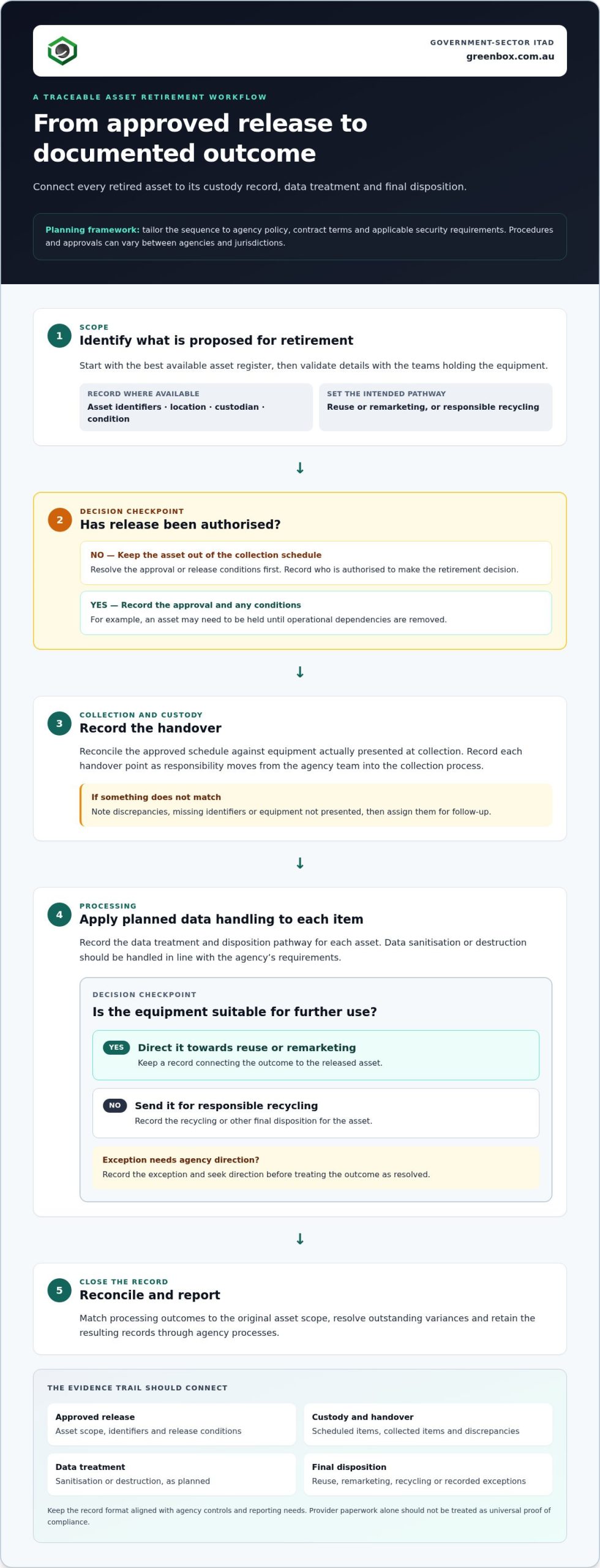
Use this sequence as a planning framework, then tailor it to internal policy, contract terms and applicable security requirements:
- Scope assets. Identify equipment proposed for retirement and gather available asset identifiers, locations, custodians and relevant condition details.
- Authorise release. Record who approved each asset for release and any conditions, such as holding it until operational dependencies are removed.
- Collect and record handover. Reconcile items against the approved schedule at collection. Note discrepancies, missing identifiers or equipment not presented, and assign them for follow-up.
- Process and determine outcomes. Apply the planned data handling and disposition pathway to each item, recording exceptions that need agency direction.
- Reconcile and report. Match processing outcomes to the original asset scope, resolve outstanding variances and retain the resulting records through agency processes.
Build an accurate asset scope and release record
Start with the best available asset register, then validate it with the teams holding the equipment. Capture serial numbers or other available identifiers, along with location, custodian and release status. These details help distinguish similar devices and make mismatches easier to investigate.
Record each handover point, including when responsibility moves from an agency team to the collection process. Reconcile the scheduled list against the equipment actually collected. If a listed laptop isn’t present, or an unlisted storage device is found, log the exception rather than silently changing the scope. A consistent record shows staff what needs to be resolved before the job is closed.
Match data handling and disposition to each asset
Not every item needs the same outcome. Equipment suitable for continued use may be recovered for reuse or remarketing; equipment that isn’t suitable may go to e-waste recycling. Data sanitisation or physical destruction decisions depend on the media type, its condition and the agency’s requirements. Record the selected method and result against the relevant asset, using a certified data sanitisation process within a documented ITAD workflow.
NIST SP 800-88 Rev. 2, published in September 2025, provides technical sanitisation guidance, but it isn’t automatically an agency’s governing requirement. Agencies should determine how it applies alongside their own controls and relevant Australian Government guidance. A method suitable for one storage device may not suit another. Greenbox’s IT asset recovery services can support a controlled handover from recovery to processing as part of an agency’s ITAD planning.
How to assess an ITAD partner for government procurement
Procurement decisions are stronger when agencies compare evidence against the work they need, rather than broad claims or a checklist assumed to apply everywhere. For IT asset disposition government sector procurement, define evaluation criteria using the agency’s procurement documents, security settings, contract conditions and reporting expectations.
A comparison matrix can make the assessment more consistent. Ask each prospective partner to show how its documented approach addresses relevant requirements, then record evidence, gaps and clarifications for evaluation.
- Security: Are data sanitisation or destruction procedures documented, and do they address the media types and handling requirements in scope?
- Custody: How are collection, handovers, asset identification and exceptions recorded? Can records be reconciled against the agency’s authorised release list?
- Processing: Can the partner explain how assets are assessed and directed to reuse, remarketing, recycling or destruction, as appropriate?
- Environmental outcomes: What information is provided about reuse, remarketing, recycling and residual disposal? Is the reporting useful for the agency’s sustainability objectives?
- Reporting: Do asset-level records and outcome reports provide the evidence the agency needs for reconciliation, assurance and internal records?
Apply the same evaluation method across submissions. Distinguish a documented procedure from a general statement of capability, and assess whether the evidence covers the services and facilities relevant to the proposed work. A certificate or management-system credential may support an assessment, but its scope matters. Facility certification isn’t the same as government approval, agency endorsement or proof that every service and outcome meets an agency’s requirements.
Which security and traceability evidence matters?
Look for evidence connecting each stage: collection records, custody handovers, data sanitisation or destruction records, exception handling and final asset outcomes. Check whether the proposed reporting can link actions to individual assets where required. An unexplained gap between a collection list and an outcome report can create avoidable reconciliation work, so assess how discrepancies are recorded and resolved.
Be precise about assurance. A credential may apply to a facility, system or defined activity rather than every part of a service. Assess its stated scope against the work being procured. Certification alone doesn’t replace reviewing relevant procedures and sample reporting.
How should agencies compare environmental and value outcomes?
Compare how clearly each submission separates assets directed to reuse or remarketing from those sent for recycling or residual disposal. Where value recovery is relevant, consider whether reporting links the outcome to the asset and explains how reconciliation is handled. Sustainable IT asset recovery can support resource stewardship and asset accountability, but agencies should assess the evidence against their own objectives.
Greenbox provides IT asset recovery, remarketing and e-waste recycling services. These outcome pathways can be considered together when assessing a coordinated approach, including through Greenbox’s IT asset recovery services.
How to plan implementation, governance and reporting across an agency
Before mobilisation, turn the agreed ITAD approach into a working plan that fits agency operations. Set the scope, decision-making roles, collection schedule, exception pathway and reporting expectations in advance. This gives participating teams a shared reference and helps prevent an asset refresh from becoming a series of disconnected handovers.
For IT asset disposition government sector programmes, align the operational plan with existing agency records and approvals. Use established asset registers and release workflows where they meet the task’s needs, and define how ITAD records will be attached, referenced or retained. Staff can then follow existing governance processes while keeping track of what happened to retired equipment.
Set scope, roles and service checkpoints
Group assets in a way that supports safe, efficient scheduling. Useful factors include location, device category, information sensitivity and readiness for release from operational use. Separate items awaiting a user handover or system change from equipment approved for collection.
Assign owners for inventory approval, site access, staff communications, collection coordination and decisions about exceptions. These roles may sit across different teams, but each checkpoint needs a clear handover and an identified decision-maker. Plan collection timing around refresh activity and operational constraints, and tell affected staff what to prepare and when. Clear instructions reduce uncertainty and help avoid disruption.
Before the first collection, document the authorised asset scope, how changes are approved, and how incomplete or unexpected items will be handled. Agreeing these details early helps teams respond consistently when an asset is missing, a release is delayed or equipment doesn’t match the schedule.
Report outcomes for assurance and continuous improvement
Agree on reporting categories before work begins so returned information can be reconciled with agency records. Useful categories may include:
- Assets received compared with the approved scope, including unresolved discrepancies.
- Data sanitisation or destruction outcomes recorded against relevant assets.
- Disposition pathways, such as reuse, remarketing or recycling, where applicable.
- Exceptions, actions taken and any items still awaiting resolution.
Reports can support internal review and audit readiness by bringing activity and outcomes into a coherent record. They don’t guarantee compliance; agencies need to assess the evidence within their own governance and assurance processes. Choose measures that reflect agency priorities, such as the proportion of assets reconciled to an approved scope or the completeness of outcome records. Avoid universal benchmarks that don’t reflect the programme’s purpose or context.
After each programme stage, review recurring discrepancies, delays and unclear handovers with the relevant teams. Use the findings to refine instructions, responsibilities or collection planning for the next stage. This creates a practical feedback loop for responsible business e-waste management, while keeping security, operational requirements and environmental outcomes connected.
Greenbox’s asset recovery and processing services can form part of a coordinated ITAD programme.
How Greenbox supports secure and sustainable government-sector ITAD
Greenbox is an Australian IT asset lifecycle management provider offering IT asset recovery, data sanitisation and destruction, asset remarketing and e-waste recycling. For agencies planning IT asset disposition government sector programmes, these services connect the practical stages of retirement, from collection and secure processing to an appropriate asset outcome.
This coordinated approach supports agencies’ security, accountability and sustainability priorities without treating collection as the end of the process. The right pathway depends on the asset, its condition, data requirements and agency direction.
Connect secure recovery with responsible asset outcomes
Greenbox’s IT asset recovery and data sanitisation services support the secure handling of equipment as it leaves operational use. Assets can then be assessed for reuse or remarketing where appropriate. Suitable equipment can retain value, while records can distinguish assets with further use potential from those requiring another outcome.
Equipment that isn’t suitable for reuse can be directed to e-waste recycling. This brings secure processing and environmental responsibility into the same lifecycle, rather than treating recycling as the default for every retired device. Greenbox operates R2-certified facilities. This credential isn’t government approval or agency endorsement, and agencies should consider its scope alongside their own procurement and assurance requirements.
Greenbox is a carbon-neutral organisation. This doesn’t mean a particular agency programme will achieve a specific environmental result. Agencies can set their own reporting needs and assess how service records support them.
Move from requirements to a practical ITAD programme
A clear starting brief makes implementation more manageable. Set out the asset scope, participating stakeholders, security and assurance needs, collection requirements and reporting priorities. For a multi-site programme, note how assets will be grouped and how local handovers and exceptions will fit the agency’s approval processes. Greenbox’s national operations and service range support organisations coordinating ITAD across multiple locations.
Use the agency’s procurement and governance framework to define responsibilities, decision points and expected evidence before mobilisation. This gives operational teams and the ITAD partner a shared basis for planning, while keeping approvals and requirements with agency decision-makers. Shape the programme around the assets and outcomes in scope rather than relying on assumed universal settings.
If your agency is planning a secure, traceable ITAD programme, discuss your government-sector ITAD requirements with Greenbox. A conversation can help define the practical scope, service stages and reporting priorities for your programme.
Make your next asset transition a controlled one
Your next refresh is an opportunity to establish a repeatable approach rather than solve end-of-life handling from scratch each time. Set a clear starting scope, agree what evidence decision-makers need, and use lessons from the first stage to improve later roll-outs. This brings security, accountability and resource stewardship into routine asset planning.
An effective IT asset disposition government sector programme reflects agency context rather than relying on a generic template. Internal policies, operational dependencies and assurance priorities can differ, so leave room for those differences while keeping responsibilities and intended outcomes visible. The aim isn’t complexity for its own sake. It’s a process that can be reviewed, adapted and sustained as assets and needs change.
Greenbox can help your agency plan an ITAD programme around its requirements and operational context. Discuss a secure, sustainable ITAD programme with Greenbox to take a considered next step towards a more manageable asset transition.
Frequently Asked Questions
Is IT asset disposition mandatory for Australian government agencies?
There isn’t one universal ITAD process that applies identically to every Australian government agency. Requirements depend on the agency’s jurisdiction, asset ownership, policies, contracts and the information held on devices. For organisations subject to the Privacy Act 1988, Australian Privacy Principle 11.2 concerns taking reasonable steps to destroy or de-identify personal information when it’s no longer needed, subject to applicable exceptions. Agencies should map IT asset disposition government sector procedures to their own obligations and approvals.
What is the difference between IT asset disposition and e-waste recycling?
IT asset disposition covers the managed end-of-life pathway for technology, while e-waste recycling focuses on recovering materials from equipment no longer suitable for use. An ITAD process may include data handling, asset assessment and value recovery before recycling is considered. For example, a working laptop may be suitable for remarketing after required data treatment, while damaged equipment may be directed to recycling.
Can government agencies remarket retired IT equipment?
Yes, agencies may be able to remarket retired equipment when this aligns with asset disposal approvals, procurement arrangements and other applicable requirements. The decision should account for the asset’s condition, information security needs and any contract terms affecting ownership or disposal. Equipment with potential resale value still needs an approved release and appropriate data treatment before it can be prepared for a new user.
Does R2 certification mean an ITAD provider is government-approved?
No. R2 certification relates to responsible electronics recycling practices within the scope of the certified operation. It doesn’t by itself indicate government approval, agency endorsement or suitability for every government contract. Agencies should consider the certification’s stated scope alongside procurement criteria, security requirements and evidence relevant to the services being assessed. Keep certification claims distinct from claims about government authorisation.
What happens to assets that cannot be reused or remarketed?
Assets that aren’t suitable for further use can be directed to e-waste recycling, with data-bearing media handled according to the agency’s requirements. Depending on the item and its condition, the processing route may differ from that used for a reusable device. Outcome records can distinguish equipment processed for material recovery from items remarketed or otherwise dispositioned, supporting clearer asset reconciliation.
How can an agency reduce disruption during a large IT asset retirement?
Coordinate retirement with operational teams before collection begins. Identify devices still needed for service delivery, agree which staff must transfer or return equipment, and schedule collections around planned refresh activity. Give staff clear instructions and a way to flag equipment that isn’t ready. A staged rollout lets teams resolve issues in an initial group and apply those lessons to later groups.
Can ITAD cover both data-bearing devices and other retired technology?
Yes. An ITAD programme can include data-bearing equipment, such as laptops, servers and storage devices, as well as other retired IT hardware. The handling pathway should reflect each item’s function, condition and whether it stores information. A storage device needs an appropriate data treatment decision, while a non-data-bearing accessory may follow a different assessment and recycling route. Keep both categories visible in the asset scope.