

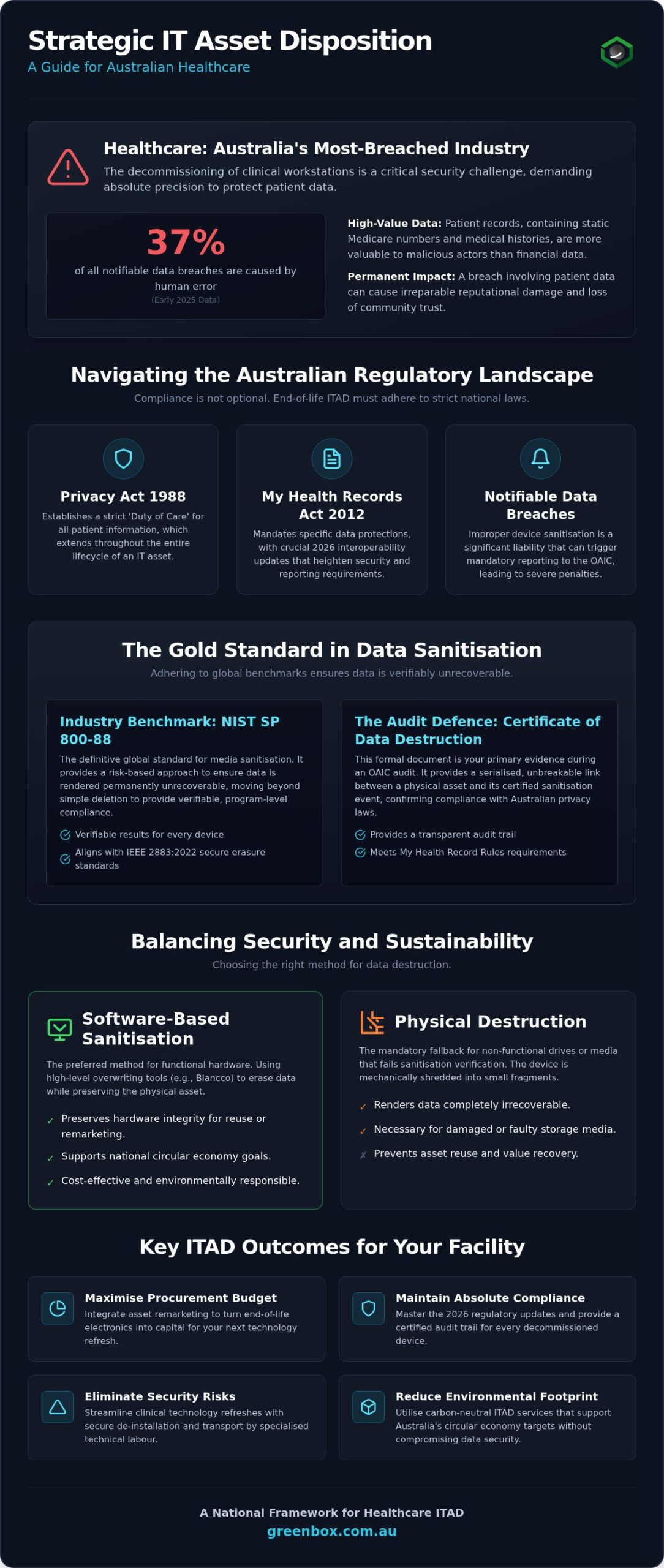
Did you know the healthcare sector remains the most-breached industry in Australia, with human error causing 37% of all notifiable data breaches in early 2025? For hospital administrators and IT managers, the complexity of decommissioning clinical workstations has never been higher. You likely feel the immense pressure of balancing patient care with the strict requirements for ITAD for healthcare Australia, especially as the 2026 updates to the My Health Record Rules and TGA reporting mandates come into full effect.
We understand that managing end-of-life medical technology is a high-stakes transition that demands absolute precision. This guide provides a strategic roadmap to help you navigate these regulatory hurdles while ensuring total compliance with Australian privacy laws and environmental standards. You’ll discover how a structured, documented disposal process eliminates security risks, provides certified data destruction, and recovers maximum value for your next technology refresh. We will preview the shift toward a circular economy and the technical standards required to meet the latest NIST sanitisation benchmarks.
Key Takeaways
- Master the 2026 regulatory updates for the My Health Records Act and TGA reporting to ensure your facility maintains absolute compliance with Australian privacy standards.
- Implement high-standard ITAD for healthcare Australia by adopting NIST 800-88 sanitisation protocols that provide a certified audit trail for every decommissioned device.
- Streamline clinical technology refreshes using specialised technical labour to handle the secure de-installation and transport of sensitive medical hardware.
- Maximise your procurement budget by integrating asset remarketing into your lifecycle management, turning end-of-life electronics into capital for your next refresh.
- Reduce your environmental footprint through carbon-neutral ITAD services that support national circular economy targets without compromising data security.
Understanding Healthcare ITAD in the Australian Regulatory Landscape
Healthcare ITAD is the secure, ethical, and documented retirement of medical IT assets. In the Australian context, this process moves beyond simple disposal. It represents a critical security protocol designed to protect the integrity of the healthcare system. Effective ITAD for healthcare Australia ensures that every tablet, server, and clinical workstation is handled with the same level of care as a physical patient file.
Under the Privacy Act 1988, healthcare providers hold a strict “Duty of Care” regarding patient information. This legal obligation doesn’t end when a device reaches its end-of-life. The My Health Records Act 2012, including its latest 2026 interoperability updates, mandates specific protections for data that interacts with the national e-health system. Failure to sanitise these devices properly isn’t just a technical oversight; it’s a significant legal liability that can trigger mandatory reporting under the Notifiable Data Breaches scheme.
Healthcare remains Australia’s most targeted sector for data breaches. Records often contain Medicare numbers and medical histories that remain static for a lifetime, making them far more valuable to malicious actors than replaceable financial data. This high-value profile necessitates a specialised approach to asset retirement that standard corporate disposal services can’t provide.
The High Stakes of Patient Data Sanitisation
Clinical data requires a higher tier of protection than standard corporate files because the information is deeply personal and permanent. If a decommissioned laptop from a radiology clinic is found with intact patient scans, the reputational damage is irreparable. For Australian medical providers, the fallout of a hardware-linked breach often results in lost community trust and severe OAIC penalties. Healthcare ITAD is the intersection of clinical compliance and data security.
Alignment with the National Digital Health Strategy
The National Digital Health Strategy 2023-2028 envisions a “digitally enabled” and “data-driven” health system. Achieving this requires a secure lifecycle for every piece of hardware involved. Secure retirement ensures that the shift toward “person-centred” care includes protecting patient privacy long after a device is replaced. By managing assets responsibly, providers also address their role in the global electronic waste landscape, ensuring that the drive for digital innovation doesn’t come at an unacceptable environmental cost. This integrated approach allows hospital networks to maintain a modern fleet while meeting their sustainability and security obligations simultaneously.
Certified Data Sanitisation Standards for Medical Devices
Modern medical devices are sophisticated data repositories. From MRI machines to patient monitors, these assets store sensitive information that requires more than a simple factory reset. The industry benchmark for this process is NIST SP 800-88 Revision 2, released in September 2025. This standard moves beyond basic deletion, focusing on program-level compliance and verifiable results. For practitioners of ITAD for healthcare Australia, adhering to these guidelines, alongside the IEEE 2883:2022 standard for secure erasure, ensures that every bit of data is rendered unrecoverable.
Every sanitisation event must culminate in a formal Certificate of Data Destruction. This document serves as your primary defence during an audit by the Office of the Australian Information Commissioner (OAIC). It confirms that the device was processed using approved methods. It also provides a serialised audit trail that links the physical asset to the destruction event, providing the transparency required by the 2026 updates to the My Health Record Rules.
Software-Based Sanitisation vs. Physical Destruction
Software-based sanitisation, using high-level overwriting tools like Blancco, is often the superior choice for medical hardware. Unlike mechanical shredding, which renders the device useless, software erasure preserves the hardware’s integrity while ensuring data is unrecoverable. This supports the national circular economy framework by allowing devices to be reused or remarketed. Physical destruction remains the mandatory fallback only when a drive is non-functional or fails the verification pass. It’s a pragmatic approach that balances security with sustainability.
R2v3 Certification: The Gold Standard for Healthcare
Selecting an R2v3-certified partner provides Australian healthcare providers with peace of mind regarding downstream accountability. This certification requires rigorous tracking of every component. It ensures that even the smallest circuit board is handled ethically and securely. It bridges the gap between technical excellence and environmental stewardship. If you are looking to secure your next fleet refresh, choosing a partner with certified data sanitisation and destruction capabilities ensures your facility meets both privacy and sustainability targets. This level of oversight is essential for diagnostic equipment where data-bearing components are often embedded deep within complex machinery. You can’t afford to leave the final stage of an asset’s life to chance.
Managing the Logistics of Clinical Technology Refreshes
Effective ITAD for healthcare Australia requires a logistics framework that matches the intensity of a clinical environment. Unlike standard corporate offices, hospitals operate 24/7, meaning a technology refresh cannot compromise patient care or staff workflows. A structured, four-step logistics process removes the operational burden from hospital IT teams while maintaining a rigorous chain of custody.
- Step 1: Secure On-site Collection. Every asset is scanned and recorded at the point of collection. This initial documentation creates a definitive link between the physical device and your internal asset register.
- Step 2: Specialist Technical Labour. Professional technicians manage the de-installation of clinical workstations and complex diagnostic hardware. This ensures that sensitive medical equipment is handled with precision and care.
- Step 3: Secure Transport. Assets are moved in GPS-tracked vehicles to a national processing centre. This provides real-time visibility and ensures that data-bearing devices are never left unmonitored during transit.
- Step 4: Auditing and Reporting. Upon arrival, assets undergo a final audit. Detailed reporting provides hospital administration with the necessary evidence for financial reconciliation and compliance audits.
By following this methodical progression, healthcare providers ensure that no device is lost or unaccounted for during a large-scale deployment. This level of transparency is essential for meeting the strict reporting obligations of the Australian health sector.
Minimising Disruption in Clinical Environments
Decommissioning hardware in active wards requires strategic timing. Scheduling “after-hours” services ensures that technicians can work without impacting patient rounds or emergency procedures. Integrating Pre-Configuration and Imaging services also accelerates the transition. By preparing new hardware off-site, you can swap out old units for new ones in a single, seamless motion. This approach reduces downtime and allows clinical staff to remain focused on care delivery rather than troubleshooting new setups.
Remote Workforce and Telehealth Asset Recovery
The rise of hybrid work and telehealth has expanded the physical footprint of healthcare data. Securing devices from home-based staff presents unique challenges, particularly regarding “Bring Your Own Device” (BYOD) policies. It’s critical to ensure telehealth tablets and laptops are wiped using software-based sanitisation before they leave the clinician’s home. This proactive step prevents sensitive patient data from entering the public transport network, effectively mitigating the risk of a breach during the return journey.
Sustainable ITAD: Remarketing and the Circular Economy
Sustainable ITAD for healthcare Australia is no longer a peripheral concern; it’s a core business metric. With e-waste in Australia growing three times faster than general municipal waste, hospital networks must adopt a circular economy approach to meet the national target of an 80% resource recovery rate by 2035. Strategic remarketing transforms retired hardware from a liability into a financial asset, providing a clear alternative to the costs associated with simple recycling.
The financial difference between basic e-waste recycling and a strategic resale programme is substantial. While recycling focuses on the recovery of raw materials, remarketing targets the reuse of functional components and devices. This approach aligns with the National Circular Economy Framework released in December 2024, which emphasises doubling Australia’s circularity by 2035. By prioritising reuse, healthcare facilities achieve “Zero Landfill” goals while recovering significant capital from their retired fleet.
Maximising Asset Resale Value Securely
In 2026, high-spec clinical tablets, mobile workstations, and server infrastructure continue to hold the highest resale value. The process involves refurbishing this hardware for a second life in less critical sectors, such as education or general business, once data sanitisation is verified. This extension of the asset lifecycle reduces the environmental burden of manufacturing new electronics. Remarketing funds the next generation of patient care technology, allowing facilities to reinvest recovered capital into critical medical upgrades without straining procurement budgets.
Carbon Neutrality in the Healthcare Supply Chain
Healthcare providers increasingly prioritise carbon-neutral partners to satisfy their Environmental, Social, and Governance (ESG) obligations. Choosing a sustainable ITAD provider directly reduces a facility’s “Scope 3” emissions, which represent the indirect carbon footprint within the supply chain. Calculating these offsets allows hospital administrators to report tangible progress toward sustainability targets. This alignment ensures that technical success and responsible practice are inseparable. If you are ready to optimise your lifecycle strategy, explore our asset remarketing services to see how your retired tech can support both your budget and the planet.
A National Framework for Healthcare ITAD with Greenbox
Managing ITAD for healthcare Australia across disparate facilities requires a unified strategy. Large-scale hospital networks and state-wide health districts often struggle with inconsistent disposal protocols that vary by location. Greenbox provides a single national framework that ensures every facility, regardless of its position across the country, adheres to the same rigorous data security and environmental standards. This consistency eliminates the administrative “postcode lottery” of compliance, providing head-office administration with a consolidated, transparent view of their entire asset lifecycle.
Our end-to-end approach covers the entire journey of a clinical device. It begins with secure deployment and ends with documented recovery. By centralising these services through a single national partner, healthcare organisations reduce the complexity of managing multiple local vendors. This streamlined model ensures 100% data security and environmental compliance at every national facility, backed by R2-certified processing and a deep commitment to carbon-neutral operations. We provide the steady hand needed to manage these high-stakes transitions with absolute precision.
End-to-End Lifecycle Management
Greenbox manages the operational burden of complex medical rollouts. Our specialist technical labour solutions handle the heavy lifting of de-installation and pre-configuration, ensuring that clinical staff can maintain their focus on patient outcomes. We provide the technical expertise required to navigate the intricacies of diagnostic hardware and integrated clinical workstations. If your organisation currently relies on fragmented local providers, it’s time to request a national audit of your current ITAD protocols. This assessment identifies gaps in your chain of custody and ensures your sanitisation methods align with the latest 2026 compliance benchmarks.
Securing the Future of Australian Digital Health
As a trusted partner for the Australian government and healthcare sectors, Greenbox understands the high-stakes nature of digital health transitions. We provide the peace of mind that comes from working with a seasoned professional who is both highly credentialed and committed to modern ethical standards. Our R2-certified facilities and carbon-neutral status ensure that your technology refreshes support national sustainability targets without compromising patient privacy. By choosing a partner with a disciplined, strategic approach, you secure the future of your facility’s digital infrastructure. Organise a secure ITAD consultation for your healthcare facility with Greenbox today to discuss a tailored solution for your network.
Secure Your Clinical Future with Compliant Asset Recovery
Transitioning to a secure, documented lifecycle for medical technology is a critical requirement under the latest 2026 Australian health privacy laws. By integrating NIST-certified sanitisation with strategic asset recovery, your facility protects patient trust while removing the operational burden of complex fleet refreshes. This integrated approach to ITAD for healthcare Australia ensures that every decommissioned device supports your sustainability targets through carbon-neutral processing and the circular economy.
Greenbox provides the specialised expertise of technical labour for clinical environments, supported by R2-certified national facilities. This disciplined strategy allows you to focus on care delivery, knowing that your data security and environmental obligations are handled with absolute precision. You can confidently navigate the transition from old hardware to new deployments while meeting every regulatory benchmark. Secure your healthcare data and maximise asset value with Greenbox Australia. Taking these proactive steps today guarantees a more resilient, compliant, and sustainable health system for all Australians tomorrow.
Frequently Asked Questions
What is ITAD in the context of Australian healthcare?
ITAD for healthcare Australia refers to the secure and ethical retirement of medical technology assets. It involves a structured process of recovering, sanitising, and disposing of hardware like clinical workstations and diagnostic equipment. This methodology ensures that patient data remains protected while meeting the environmental standards set by the national circular economy framework. It moves beyond simple disposal by providing a documented audit trail for every decommissioned device.
How does the Privacy Act 1988 affect medical hardware disposal?
The Privacy Act 1988 mandates that healthcare providers take reasonable steps to protect personal information from misuse or unauthorised access. This “Duty of Care” extends to the final disposal of hardware. If a device isn’t properly sanitised, it can lead to a mandatory reportable breach under the Notifiable Data Breaches scheme. Compliance requires a verified process that renders data unrecoverable before the asset leaves your control.
Is software data wiping as secure as physical hard drive shredding?
Software-based sanitisation following NIST 800-88 guidelines is often more secure than physical shredding. It involves overwriting data and performing a verification pass to ensure no information remains. This method preserves the hardware’s integrity, allowing for asset remarketing and supporting sustainability goals. Physical destruction is typically reserved for drives that are non-functional or fail the sanitisation process. It’s a pragmatic choice between reuse and total destruction.
What certifications should I look for in a healthcare ITAD provider?
You should prioritise providers with R2v3 certification and carbon-neutral status. R2v3 is the global standard for responsible recycling, ensuring that every component is tracked and handled ethically. Carbon-neutral certification supports your facility’s ESG targets by offsetting the environmental impact of disposal. These credentials provide the peace of mind that your ITAD for healthcare Australia is handled by a seasoned professional committed to high modern standards.
Can we recover any financial value from our old medical IT equipment?
Asset remarketing allows you to recover significant financial value from functional medical IT equipment. Devices such as clinical tablets, high-spec laptops, and server infrastructure often retain value in secondary markets. By refurbishing and reselling these assets, you can generate capital to fund your next technology refresh. This approach transforms a disposal cost into a revenue-generating opportunity while supporting a sustainable circular economy.
How do we manage ITAD for remote or telehealth employees?
Managing assets for remote or telehealth staff requires a secure recovery protocol. We recommend software-based wiping at the point of origin before the device is transported. This prevents sensitive patient data from being exposed if a device is lost during transit. Secure logistics with GPS tracking ensure that every tablet or laptop reaches a processing centre safely for final auditing and reporting for hospital administration.
What documentation is required for a healthcare ITAD audit in Australia?
A healthcare ITAD audit requires a serialised Certificate of Data Destruction and a comprehensive chain-of-custody report. These documents provide a definitive link between the physical asset and the destruction event. They serve as primary evidence for the OAIC to prove compliance with the My Health Records Act 2012. Maintaining these records ensures your organisation can demonstrate a rigorous, transparent approach to data security during clinical technology refreshes.
Does Greenbox provide national coverage for large hospital groups?
Greenbox provides comprehensive national coverage across every Australian state and territory. This allows large-scale hospital networks to maintain a single, consistent security standard for their entire digital infrastructure. By using a national partner, you eliminate the risks associated with managing multiple local vendors. We manage the entire lifecycle from initial deployment to secure recovery, ensuring a seamless and documented transition for your entire fleet.