

Did you know that fewer than 35 out of every 100 IT devices coming off corporate leases in Australia are currently refurbished for a second life? Managing this transition requires a robust IT asset disposition checklist Australia to avoid the pitfalls of a fragmented disposal process. You’re likely facing the dual pressure of stringent Australian Privacy Act requirements and the need to meet ambitious ESG targets. It’s a high-stakes environment where a single undocumented hard drive could lead to a data breach or a significant fine from the National EPA.
We recognise that your priority is a secure, predictable outcome for every retired asset. This guide provides a comprehensive roadmap for 2026, covering everything from NIST 800-88 Rev. 2 data sanitisation to maximising your return on investment through strategic remarketing. You’ll learn how to transform a complex logistical burden into a streamlined, compliance-focused asset recovery program that protects your data, your reputation, and the planet.
Key Takeaways
- Align your disposal processes with the latest Australian Privacy Act amendments and National EPA regulations to mitigate the risk of multi-million dollar penalties.
- Develop a robust internal audit process that identifies all data-bearing assets, preventing the common “store room trap” where unmonitored legacy hardware creates security vulnerabilities.
- Utilise a definitive IT asset disposition checklist Australia to manage high-stakes transitions, ensuring every device is accounted for through an end-to-end audit trail.
- Master the application of NIST 800-88 Rev. 2 standards to determine when software-based sanitisation or physical destruction is required for your specific hardware mix.
- Optimise your technology refresh by integrating asset remarketing into your strategy, allowing your organisation to recover value while meeting strict carbon-neutral targets.
Why Your Organisation Needs a Formal ITAD Strategy in 2026
IT Asset Disposition (ITAD) is no longer a peripheral operational task; it’s a core risk management framework. In 2026, simply handing over retired hardware to a generic recycler is an unacceptable gamble for any enterprise. A comprehensive ITAD strategy manages the entire lifecycle of corporate technology, ensuring every data-bearing device is tracked from the moment it leaves the desk to its final destruction or remarketing. By utilising a structured IT asset disposition checklist Australia, organisations can move beyond haphazard disposal and adopt a disciplined approach to asset recovery that protects both their data and their bottom line.
The Australian regulatory environment has tightened significantly. With the National EPA now enforcing federal recycling laws as of July 1, 2026, and the ongoing oversight of the Office of the Australian Information Commissioner (OAIC), the margin for error is non-existent. Under the Notifiable Data Breaches (NDB) scheme, hardware loss isn’t just an operational hiccup. It’s a reportable event. If a laptop containing sensitive client data isn’t sanitised to NIST 800-88 Rev. 2 standards, your organisation faces multi-million dollar penalties and lasting reputational damage.
We’ve seen a decisive shift from simple waste management toward a circular economy model. Australian enterprises are now expected to contribute to solving the global e-waste problem by prioritising refurbishment over shredding. This transition involves more than just being “green”; it’s about extracting residual value from hardware while ensuring materials are recovered responsibly. Standard recycling often fails to provide the granular reporting required to prove these outcomes.
The Legal Cost of Improper Disposal
The OAIC treats hardware loss with the same severity as a sophisticated cyberattack. If a chain of custody is broken, your organisation loses its primary legal defence during an investigation. Professional ITAD ensures a documented, tamper-proof audit trail for every serial number, providing the transparency required for legal compliance. Without this visibility, you’re unable to prove that data was destroyed according to Australian standards, leaving the business vulnerable to litigation.
ESG and Sustainability Targets
Sustainable ITAD is now a core business metric rather than an afterthought. Most Australian enterprises have committed to zero-to-landfill targets for 2026, making R2-certified facilities a non-negotiable requirement for disposal partners. These certifications provide the verified data needed for environmental reporting and meeting carbon-neutral goals. By integrating carbon-neutral ITAD services, you ensure that your technology refresh doesn’t expand your organisation’s ecological footprint, supporting your standing as a sustainability leader.
Phase 1: Internal Audit and Asset Inventory
The first stage of any successful technology refresh begins long before a logistics vehicle arrives at your loading dock. Establishing a rigorous internal audit is the most critical step in your IT asset disposition checklist Australia. This phase involves identifying every data-bearing device across your network, including laptops, servers, mobile handsets, and even high-end networking gear like switches and routers. You can’t protect what you haven’t accounted for.
Many Australian organisations fall into the “Store Room” trap, where decommissioned hardware is left to accumulate in unsecured cupboards or basements. This practice creates significant security vulnerabilities. Legacy devices often lack the latest encryption, and the longer they sit idle, the higher the risk of “internal leakage” or theft. Additionally, hardware value depreciates rapidly. A device that’s repairable and highly remarketable today may only be fit for scrap in six months. To maximise your return, you should categorise your assets into three distinct streams:
- Redundant: Older tech with no resale value, destined for certified e-waste recycling.
- Repairable: Business-grade hardware that can be refurbished for a second life.
- Scrap: Damaged or obsolete components that must be harvested for materials.
By categorising your assets early, you can establish a baseline for value recovery through professional IT asset recovery services.
Creating a Bulletproof Inventory
Precision is the only way to ensure a full audit trail. Your inventory must record serial numbers, asset tags, and specific hardware configurations to verify that what was decommissioned is exactly what is eventually destroyed or sold. Asset visibility is the foundation of secure disposal. It’s also vital to distinguish between leased and owned equipment. Returning a leased device that’s been accidentally shredded can result in heavy contractual penalties and complicated financial reconciliations.
Secure On-site Storage Protocols
Once you’ve identified the assets, they must be physically secured while awaiting collection. Leaving end-of-life hardware in public-access areas or unsecured hallways is a high-risk strategy. We recommend “caging” or locking down these devices in a restricted-access zone. This prevents unauthorised personnel from tampering with drives or removing components. A formal risk assessment of your storage area should be a mandatory part of your IT asset disposition checklist Australia. If your storage isn’t secure, your entire data protection strategy is compromised before the disposal process even begins.
Phase 2: Data Sanitisation and Destruction Standards
Data security represents the most critical pivot point in your IT asset disposition checklist Australia. In 2026, the benchmark for this process is NIST 800-88 Rev. 2, a standard that has evolved from simple device-level wiping to a comprehensive, enterprise-wide sanitisation programme. Relying on a basic “factory reset” is a significant risk. These consumer-grade methods often fail to address data stored in unallocated space or hidden partitions, leaving sensitive corporate information vulnerable to recovery. Professional sanitisation ensures that data is not just deleted, but rendered completely irretrievable.
Every successful sanitisation event must culminate in the issuance of a formal Certificate of Destruction. This document serves as your primary evidence during a compliance audit, linking specific serial numbers to verified destruction methods. It’s the “receipt” that proves your organisation has met its duty of care under the Australian Privacy Act. Without this documentation, you have no way to demonstrate to regulators that your retired hardware didn’t become the source of a data breach. It provides the peace of mind that your “safe pair of hands” partner has completed the task to the highest standard.
Software-Based Sanitisation (Wiping)
Software-based sanitisation is the preferred method for functional, business-grade hardware. By securely overwriting every sector of a drive, we maintain the physical integrity of the device, allowing it to be refurbished and remarketed. This approach directly supports your ESG targets by extending the technology’s lifecycle and reducing the demand for new raw materials. It turns a potential waste stream into a valuable asset. For this to be effective, your provider must use software that verifies the success of the wipe for every individual drive.
Physical Destruction (Shredding)
Physical destruction is mandatory for drives that are non-functional or those containing high-security government data. Shredding involves reducing the hardware to small, unreadable fragments, ensuring that no data can ever be recovered. You must decide between on-site shredding, which offers maximum visibility at your facility, and off-site shredding at a secure, R2-certified facility. Both methods require meticulous e-waste management to ensure the resulting materials are recycled according to AS 5377:2022 standards, keeping hazardous components out of Australian landfills.
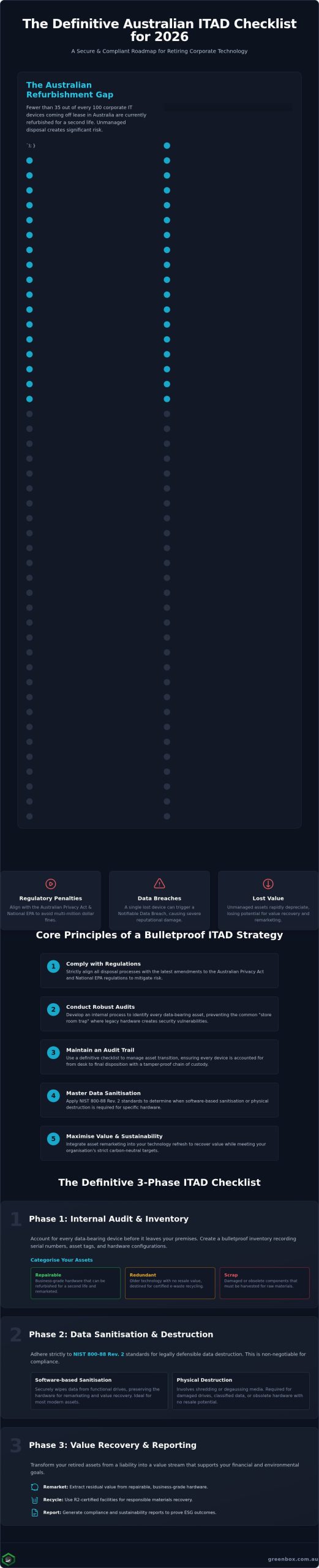
The Definitive Australian ITAD Checklist for 2026
Executing a technology refresh requires precision at every touchpoint. This IT asset disposition checklist Australia ensures your organisation maintains control from the loading dock to the final audit report. It’s a structured framework designed to eliminate the gaps where data breaches or environmental non-compliance often occur. By following these steps, you move from a reactive disposal process to a proactive asset recovery strategy.
- Pre-Collection: Finalise your inventory records and ensure all assets are staged in a restricted area. Double-check that all power cables and peripherals are included if they are part of the remarketing agreement.
- Logistics: Confirm the provider utilises GPS-tracked vehicles and staff who have undergone rigorous police clearances. Demand a “blind” scan at the point of collection to match the provider’s count with your own records.
- Processing: Verify that sanitisation uses NIST 800-88 Rev. 2 compliant software or certified physical shredding. This work should only occur in R2-certified facilities that meet AS 5377:2022 standards.
- Reporting: Collect your Certificates of Destruction and detailed environmental impact statements immediately. These documents must be serial-number specific to provide a full audit trail.
- Financials: Reconcile remarketing returns against your original inventory. Settle your carbon-neutral certification for the project to ensure all emissions from the logistics and processing phases are fully offset.
Vetting Your ITAD Provider
Choosing the right partner is a strategic decision that directly impacts your risk profile. You must verify that your provider holds R2 (Responsible Recycling) and ISO 27001 certifications. These aren’t just badges; they’re your guarantee of ethical and secure processing. In 2026, you should also confirm their carbon-neutral status to ensure their operations align with your own corporate sustainability targets. A provider with deep experience in the Australian government and enterprise sectors will understand the specific nuances of local data laws. You can partner with Greenbox to manage these complexities through a single, secure, and carbon-neutral framework.
Post-Disposition Reporting
The process doesn’t end when the hardware leaves your site. You should integrate the resulting ITAD reports directly into your annual sustainability statement. This data provides concrete evidence of your contribution to the circular economy. Maintaining a permanent digital record of every disposal event is also essential for future OAIC audits. Finally, use the data from your asset remarketing to inform future hardware procurement budgets. Knowing the residual value of your fleet helps you make more informed decisions during the next technology refresh cycle. It turns a historical cost centre into a strategic data point for your financial planning.
Maximising Value: Remarketing and Deployment with Greenbox
Modern ITAD is a circular process that bridges the gap between your retiring fleet and your next technology investment. By integrating asset remarketing into your IT asset disposition checklist Australia, you transform a logistical cost centre into a strategic revenue stream. We manage this entire transition, ensuring that while your legacy hardware is being securely decommissioned, your new fleet is being prepared for deployment. This end-to-end approach removes the operational friction often associated with large-scale technology refreshes.
Our carbon-neutral ITAD services ensure that your technology refresh achieves a net-zero impact on your environmental reporting. We offset the emissions generated during recovery and processing, allowing your organisation to meet its ESG targets without compromising on security or efficiency. This integrated logic ensures that technical success and responsible practice are inseparable components of your corporate strategy.
The Financial Benefits of Remarketing
Business-grade hardware often retains significant residual value even after several years of service. We utilise a transparent, commission-based model to resell refurbished assets on global markets, directly offsetting the costs of your disposal programme. Every device destined for remarketing undergoes rigorous data sanitisation to ensure it’s 100% clear of corporate information before it enters its second life. This provides the dual benefit of maximising your return on investment while supporting the circular economy through high-standard refurbishment.
Seamless Deployment and Configuration
Reducing downtime is essential during a corporate rollout. We synchronise the recovery of old assets with the pre-configuration and imaging of your new hardware. Our technical teams handle the complex labour involved in large-scale rollouts, ensuring that your new devices arrive on-site ready for immediate use. This synchronisation prevents the “Store Room trap” mentioned earlier by ensuring old gear is removed the moment new gear is deployed. Organise your secure technology refresh with Greenbox today to secure your data and maximise the value of your retired assets.
Securing Your Organisation’s Digital Future
The landscape of technology disposal in Australia has shifted toward a model where data security and environmental stewardship are inseparable. Implementing a formal IT asset disposition checklist Australia isn’t just about clearing out old stock. It’s about protecting your organisation from the legal and financial fallout of a data breach. By prioritising NIST-compliant sanitisation and R2-certified recycling, you ensure every retired device is handled with the precision required by the 2026 regulatory environment.
A well-executed ITAD strategy also unlocks significant residual value. Transitioning from a waste-focused mindset to a circular economy approach allows you to recover capital through remarketing while meeting your net-zero targets. As a carbon-neutral organisation trusted by Australian government departments, Greenbox provides the national end-to-end logistics needed for a seamless transition. Download our Enterprise ITAD Framework or book a consultation to begin your secure technology refresh. You’ve built a reputation for excellence; let us help you maintain it through every stage of your hardware’s lifecycle.
Frequently Asked Questions
What is the difference between e-waste recycling and ITAD?
E-waste recycling is the final stage of breaking down hardware into raw materials for recovery. IT Asset Disposition (ITAD) is a broader lifecycle management framework that prioritises data security and value recovery. While a recycler focuses on the physical destruction of components, an ITAD partner manages the secure recovery, data sanitisation, and remarketing of assets. This approach ensures your organisation recovers residual value while maintaining a rigorous audit trail.
Is a Certificate of Destruction legally required in Australia?
The Australian Privacy Act requires organisations to take reasonable steps to destroy or de-identify personal information that is no longer needed. While the law doesn’t explicitly name the document, a Certificate of Destruction is your primary evidence of compliance during an OAIC audit. It proves that you’ve met your duty of care under the Notifiable Data Breaches (NDB) scheme, protecting the business from significant financial penalties.
How does NIST 800-88 compare to traditional data wiping?
NIST 800-88 Rev. 2 is a sophisticated global standard that ensures data is rendered irretrievable across all drive sectors, including hidden partitions. Traditional wiping often only targets the file system, which can leave sensitive information vulnerable to recovery tools. Incorporating NIST standards into your IT asset disposition checklist Australia ensures your sanitisation process meets the highest security requirements for both corporate and government sectors.
Can we remarket leased IT equipment?
Leased equipment typically remains the property of the lessor and must be returned at the end of the term. You cannot remarket these assets for profit, but you should still utilise professional ITAD services to sanitise the devices before they leave your site. This protects your data during the return process. We often coordinate the sanitisation of leased gear alongside the deployment of new hardware to ensure a seamless transition.
What are the risks of using a non-R2 certified recycler?
Non-R2 certified providers lack independent verification for their data security and environmental protocols. This increases the risk of “internal leakage” where data-bearing drives are mishandled or stolen. Additionally, uncertified recyclers may export hazardous waste to developing nations rather than processing it responsibly. R2 certification ensures that every facility follows strict, audited standards for downstream material tracking and verified data destruction, protecting your corporate reputation.
How does Greenbox ensure data security during transport?
We maintain a secure chain of custody by using GPS-tracked vehicles and logistics staff who have passed rigorous national police clearances. Every asset is scanned at the point of collection to match your internal inventory. This methodical process ensures that no hardware is left unattended or handled by unvetted third parties. By controlling the entire logistics network, we eliminate the gaps where assets often go missing during transit.
What happens to the hardware that cannot be refurbished?
Hardware that is obsolete or physically damaged is moved into our certified e-waste recycling stream. We harvest any functional components for spare parts and shred the remaining materials to recover raw commodities like copper, gold, and aluminium. We follow AS 5377:2022 standards to ensure zero components reach landfill. This process supports the circular economy by returning raw materials to the manufacturing sector for use in new products.
How do ITAD services help with our ESG reporting?
Professional ITAD provides the granular, verified data required for your annual sustainability statements. We issue detailed environmental impact reports that quantify the weight of materials diverted from landfill and the carbon emissions offset through refurbishment. By using our carbon-neutral ITAD services, you can demonstrate a net-zero impact for your technology refresh. This data turns a technical disposal task into a measurable metric for your organisation’s ethical and sustainable performance.