

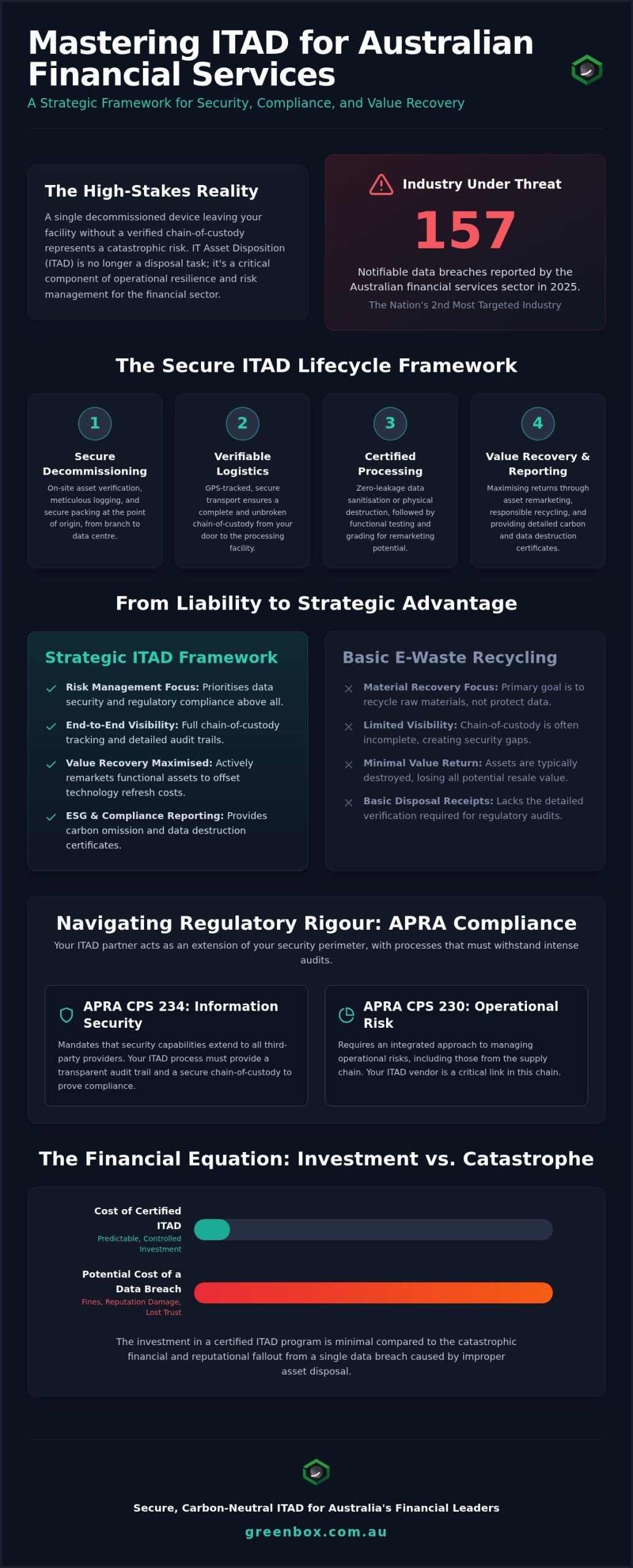
In 2025, the Australian financial services sector reported 157 notifiable data breaches, cementing its position as the nation’s second most targeted industry. You understand that a single decommissioned laptop or server leaving your facility without a verified chain-of-custody represents a catastrophic risk to both your reputation and your regulatory standing. It’s no longer just about disposal; it’s about managing a high-stakes operational vulnerability that demands absolute precision and transparency.
This guide provides the roadmap to master ITAD for financial services Australia by implementing a rigorous, secure lifecycle framework. You’ll learn how to align your decommissioning processes with the latest APRA CPS 230 and CPS 234 standards while hitting ambitious ESG targets through carbon-neutral practices. We’ll examine how to achieve zero-leakage data sanitisation and full chain-of-custody documentation, ensuring every asset is accounted for. By the end, you’ll see how to transform end-of-life hardware into a strategic advantage, using asset remarketing to recover value and offset the costs of your 2026 technology refresh.
Key Takeaways
- Understand how the transition to APRA CPS 230 integrates IT asset disposal into your broader operational risk framework, ensuring continuous compliance for third-party hardware management.
- Master a rigorous lifecycle framework for ITAD for financial services Australia that guarantees zero-leakage data sanitisation and a verifiable chain-of-custody for every device.
- Learn to leverage asset remarketing commissions to maximise returns on functional equipment, effectively offsetting the capital expenditure of your next technology refresh.
- Align your disposal processes with corporate ESG targets by utilising carbon-neutral services that provide transparent reporting and carbon omission certificates.
- Streamline deployment cycles through integrated pre-configuration and imaging services, ensuring new assets are secure and operational the moment they reach your staff.
The Strategic Role of ITAD in Australian Financial Services
IT Asset Disposition (ITAD) has transitioned from a back-office logistics task to a front-line strategic priority. In 2026, the accelerated pace of financial technology cycles means hardware is refreshed more frequently to accommodate AI-driven processing and enhanced security protocols. Implementing a robust framework for ITAD for financial services Australia is no longer optional; it’s a core component of operational resilience. This structured approach reconciles rapid deployment with the absolute necessity of data security.
The Australian financial sector faces unique pressures regarding data sovereignty. With strict local regulations governing where and how sensitive information is handled, the end-of-life phase of any device is a potential point of failure. A comprehensive ITAD framework addresses this by ensuring hardware never leaves a controlled environment until it is fully sanitised. This shift from simple e-waste disposal to a risk management framework allows firms to support the circular economy while protecting their institutional reputations.
Beyond E-waste: The ITAD Strategic Framework
Professional ITAD for financial services Australia moves beyond the global e-waste problem by integrating security into the first step of the decommissioning process. While basic recycling focuses on material recovery, a strategic framework prioritises the following:
- End-to-end visibility: Tracking assets from the moment they are decommissioned at a branch or office until they reach a certified facility.
- Global best practice: Implementing sanitisation standards that exceed local requirements to ensure data is irrecoverable.
- CIO alignment: Ensuring the hardware lifecycle supports the broader security roadmap and digital transformation goals.
This level of oversight provides the transparency required for modern audit trails. It transforms a potential liability into a predictable, managed process that supports national technology rollouts without compromising security.
The Financial Impact of Improper Asset Disposal
The cost of a data breach in the financial sector now dwarfs the investment required for certified sanitisation. Entrusting end-of-life assets to uncertified vendors creates a vulnerability that can lead to catastrophic regulatory fines and a permanent loss of customer confidence. There is also a significant operational burden in attempting to manage decommissioning internally. Outsourcing to a specialist removes this weight from internal IT teams, allowing them to focus on core banking innovations while a partner manages the complex logistics of national rollouts. ITAD represents a comprehensive risk-mitigation strategy designed to safeguard the data integrity and brand equity of Australian fintechs throughout the hardware decommissioning process.
Regulatory Rigour: APRA Compliance and Data Sanitisation
Financial institutions in Australia operate under some of the world’s most stringent data protection mandates. Compliance isn’t a “set and forget” task; it requires active oversight of the entire hardware lifecycle. When implementing ITAD for financial services Australia, the focus must shift from simple logistics to a verified security operation. This ensures that every data-bearing device is handled according to the specific demands of APRA and the Consumer Data Right (CDR).
Meeting APRA CPS 234 Standards
Under APRA CPS 234, regulated entities must maintain information security capabilities commensurate with the threats they face. This obligation extends to third-party providers. When you outsource your asset disposal, your partner acts as an extension of your own security perimeter. They must provide a transparent audit trail and a secure chain-of-custody from the moment a drive leaves your server room until the final bit is erased. R2-certified facilities play a critical role here, providing independent verification that both security and environmental standards are met at every stage.
The introduction of APRA CPS 230 in July 2025 further intensified these requirements. It mandates a more integrated approach to managing operational risks, including those originating from the supply chain. You must ensure your provider’s processes are robust enough to withstand rigorous internal and external audits.
Software-Based Sanitisation vs. Shredding
Choosing between software wiping and physical destruction depends on the asset’s functional state and your recovery goals. NIST 800-88 Rev. 2, published in late 2025, remains the benchmark for media sanitisation. Software-based wiping is often the preferred choice for functional laptops and servers. It allows for asset remarketing, which supports the circular economy and aligns with the National Television and Computer Recycling Scheme by extending the hardware’s useful life.
However, damaged storage media or high-security drives require industrial shredding. Modern SSDs and NVMe drives store data differently than traditional HDDs, which means they require specific protocols to ensure no data remnants remain. Whether you choose wiping or shredding, every retired asset must be backed by a “Certificate of Destruction” or a “Data Sanitisation Certificate.” This document serves as your primary evidence for auditors, proving you’ve met your regulatory duties. If you’re looking to strengthen your compliance posture, you can explore our secure data sanitisation services to ensure your end-of-life hardware is handled with total precision.
Maximising Value: Remarketing vs. Recycling
Effective hardware decommissioning shouldn’t be viewed solely as a cost centre. For those managing ITAD for financial services Australia, there’s a significant opportunity to transform retired assets into a tangible revenue stream. By prioritising remarketing over immediate recycling, institutions can capture the residual value of their technology, often offsetting the capital expenditure required for new infrastructure. This pragmatic approach balances high-level security with fiscal responsibility.
The Economics of Asset Recovery
Resale values for servers, laptops, and mobile devices depend on processor generation, physical condition, and current market demand. Professional refurbishment plays a vital role here; it increases the “second-life” potential of IT hardware by ensuring devices meet the quality standards required for secondary markets. A commission-based remarketing model provides a transparent way for financial firms to share in the success of these sales, turning what was once e-waste into a financial asset. Remarketing functional IT equipment allows organisations to recover significant portions of their initial investment while maintaining a secure, audited chain-of-custody.
However, not all equipment is suitable for resale. Obsolete or non-functional assets must be managed through responsible e-waste recycling. This ensures that precious metals and hazardous materials are handled in accordance with Australian environmental regulations, preventing them from entering landfill. A balanced ITAD strategy identifies which assets are destined for the global secondary market and which must be broken down for material recovery.
Environmental Metrics as a Business Value
Modern ESG reporting requires clear, data-driven evidence of sustainability commitments. Integrating carbon omission certificates into these reports provides a sophisticated way for the Australian financial sector to demonstrate its environmental impact. When you choose ITAD for financial services Australia that includes a remarketing component, you’re directly contributing to Scope 3 emissions reductions. Extending the lifecycle of a device is far more energy-efficient than manufacturing a new one or even recycling the raw materials.
Partnering with carbon-neutral ITAD providers ensures that the entire disposition process aligns with your firm’s net-zero targets. These specialists offer the visibility needed to track the environmental footprint of every retired asset, providing the documentation required for annual disclosures. This integration of technical success and responsible practice ensures that your technology refresh is as sustainable as it’s secure.
Implementing a Secure Technology Refresh Protocol
A technology refresh in the Australian financial sector is a complex orchestration of logistics and security. It requires a “clean-desk” transition where the installation of new assets and the removal of legacy hardware occur simultaneously. This integrated approach ensures operational continuity while maintaining a rigid security posture throughout the transition. By treating deployment and decommissioning as a single, unified workflow, you eliminate the security gaps that often occur when old devices are left in storage rooms awaiting collection.
Phase 1: Configuration and Deployment
Off-site imaging and staging are essential for reducing downtime during national rollouts. When you prepare devices in a controlled, R2-certified facility, you ensure that hardware arrives at its destination fully operational and secured with your specific corporate image. This is particularly vital for remote and hybrid teams, where assets must be shipped directly to residential addresses or satellite offices across Australia.
Managing the technical labour required for these large-scale corporate rollouts often strains internal resources. A specialist partner provides the necessary on-site technicians to handle the physical swap, ensuring every workstation is ready for immediate use. This “service-then-solution” model means your internal IT teams don’t have to worry about the manual burden of unboxing, cabling, and basic setup. Instead, they can focus on high-level systems integration while the physical deployment is handled with precision.
Phase 2: Secure Decommissioning
Once the new hardware is deployed, the focus shifts to the legacy fleet. You must decide between on-site and off-site data sanitisation based on your institution’s specific risk profile. On-site services provide immediate peace of mind by destroying data before the hardware leaves your premises, while off-site processing offers the highest level of efficiency for bulk volumes. Both methods are foundational to effective ITAD for financial services Australia, provided they follow NIST 800-88 Rev. 2 guidelines.
Inventory reconciliation is the most critical step in this phase. Every serial number must be matched against your internal records to ensure no device is unaccounted for during the transition. Securely transporting sensitive hardware requires vetted logistics chains that prevent unauthorised access during transit. The process concludes with final reporting and the issuance of compliance documentation, providing the audit trail required for APRA compliance. This structured lifecycle removes the operational burden from your department and ensures total visibility. To streamline your next rollout, you can organise a secure technology refresh that covers everything from initial imaging to final asset recovery.
Greenbox: Australia’s Partner for Secure, Carbon-Neutral ITAD
Greenbox stands as a disciplined strategist in the Australian ITAD sector, specifically tailored to the rigorous demands of the financial and government industries. As an Australian-owned, carbon-neutral organisation, we provide the end-to-end visibility required to manage complex transitions with absolute confidence. Our R2-certified facilities ensure that every stage of the hardware lifecycle, from initial configuration to final asset recovery, adheres to global best-practice standards. This steady, experienced hand allows your institution to navigate the complexities of ITAD for financial services Australia without compromising on security or environmental integrity.
National Reach, Local Expertise
National reach is combined with local expertise to support financial institutions with secure logistics across all states. Our highly credentialed staff understand the high-stakes nature of handling sensitive financial assets and the absolute importance of maintaining a secure chain-of-custody. We manage the entire process with meticulous planning, ensuring that every device is tracked and every data point is protected from the moment it leaves your facility.
A partnership-focused approach removes the heavy operational burdens from your internal IT and security teams. Instead of managing the fragmented logistics of a national technology refresh, you gain a single point of accountability. This streamlined execution ensures that your decommissioning projects are completed on time and in full compliance with your internal risk frameworks. We act as a transparent partner, providing the visibility and reporting necessary to satisfy both internal stakeholders and external regulators.
A Vision for Sustainable Finance
Environmental stewardship is now a core business metric for the Australian financial sector. Greenbox helps your organisation lead in this space by integrating sustainability into your ITAD strategy. Our carbon-neutral status ensures that your technology disposal processes align with corporate net-zero targets. We bridge the gap between technical excellence and ecological responsibility, treating sustainability as a fundamental requirement rather than an afterthought.
Through detailed “Carbon Omission” reporting, we provide the transparency you need for your annual ESG reviews. These certificates quantify the carbon savings achieved through asset remarketing and responsible recycling, providing verifiable data for your sustainability disclosures. Technical success and responsible practice are inseparable in our framework, ensuring that your commitment to the planet is as robust as your commitment to data security. To secure your data and hit your ESG targets with Australia’s most rigorous ITAD framework, you can partner with Greenbox for your next technology refresh and experience the peace of mind that comes from professional lifecycle management.
Securing Your Financial Hardware Lifecycle
The transition from legacy hardware to next-generation infrastructure is a critical moment for any financial institution. Integrating a secure lifecycle framework ensures continuous compliance with APRA CPS 230 and CPS 234. By prioritising verified data sanitisation and strategic remarketing, your organisation can turn operational risk into a financial and environmental advantage. This approach reconciles the need for rapid digital transformation with the absolute necessity of institutional security.
Professional ITAD for financial services Australia provides the transparency required to meet modern ESG targets while protecting sensitive reputations. Greenbox offers the steady, experienced hand needed for these complex transitions. As a carbon-neutral organisation with R2-certified facilities, we’re already trusted by the Australian Government and leading enterprises to manage high-stakes technology refreshes with total precision.
It’s time to remove the operational burden of decommissioning from your internal teams. You can secure your financial IT assets with Greenbox’s certified ITAD services and ensure your next rollout is both sustainable and secure. We look forward to supporting your commitment to technical excellence and environmental stewardship.
Frequently Asked Questions
Does ITAD for financial services require specific APRA certification?
APRA doesn’t issue specific certifications to ITAD providers directly. Instead, regulated entities must ensure their third-party partners comply with standards like CPS 234 and CPS 230. Choosing a partner with R2-certified facilities provides the independent verification needed to satisfy these regulatory requirements. This ensures that ITAD for financial services Australia meets the same security rigour as your internal systems, providing the necessary audit trails for your compliance officers.
What is the difference between NIST 800-88 and simple data wiping?
NIST 800-88 Rev. 2 is a globally recognised media sanitisation standard that offers a far more rigorous framework than simple data wiping. While basic wiping might leave data fragments on modern storage media, NIST guidelines specify precise methods for Clearing, Purging, or Destroying data. This ensures that sensitive financial information is rendered completely irrecoverable. Following these protocols is essential for meeting the high security baseline required by Australian regulatory bodies.
How does IT asset remarketing improve our company’s ESG score?
IT asset remarketing directly supports your ESG goals by extending the useful life of technology and reducing the demand for new manufacturing. This practice contributes to a circular economy, which is a key metric in modern sustainability reporting. By refurbishing and reselling functional hardware, you divert e-waste from landfills and lower your firm’s environmental footprint. Greenbox provides carbon omission certificates to help you quantify these positive impacts in your annual ESG reviews.
Can Greenbox manage a national technology rollout across all Australian states?
Greenbox maintains a comprehensive national footprint, allowing us to manage large-scale technology rollouts across all Australian states and territories. Our secure logistics network and technical labour teams are equipped to handle complex deployments and recoveries in both metropolitan and remote locations. This national coverage ensures a consistent service standard for your entire organisation. It removes the operational burden of managing multiple local vendors for your national technology refresh projects.
What documentation is provided to prove data has been securely destroyed?
You’ll receive a formal Certificate of Destruction or a Data Sanitisation Certificate for every asset processed through our facilities. These documents provide a verifiable audit trail by listing specific serial numbers, the date of processing, and the sanitisation method used. This level of documentation is critical for demonstrating compliance with APRA CPS 234. It ensures your risk management team has the evidence required for both internal audits and external regulatory inspections.
Is physical shredding always more secure than software-based sanitisation?
Physical shredding isn’t always superior to software-based sanitisation; the right choice depends on the media type and your recovery goals. Software-based wiping, when performed to NIST 800-88 Rev. 2 standards, renders data irrecoverable while allowing the hardware to be remarketed. Shredding is typically reserved for damaged storage media or assets that have reached the end of their functional life. Both methods provide total security when executed within a certified framework.
How does carbon-neutral ITAD help with our Scope 3 emissions targets?
Carbon-neutral ITAD services help lower your Scope 3 emissions by ensuring the entire disposition process has a net-zero impact. By choosing a partner that offsets the carbon footprint of logistics and processing, you reduce the emissions associated with your supply chain. Additionally, remarketing functional assets avoids the significant carbon cost of manufacturing new devices. This integrated approach ensures that your ITAD for financial services Australia aligns perfectly with your broader corporate net-zero targets.
What types of financial IT assets can be remarketed for value recovery?
A wide variety of corporate technology can be remarketed for value recovery, including laptops, desktop PCs, servers, and networking equipment. Mobile devices and high-end monitors also hold significant residual value in secondary markets. As long as the hardware is functional and can be securely sanitised, it represents a potential revenue stream. Our experts assess each asset to determine whether refurbishment or recycling is the most financially and environmentally responsible path for your institution.