

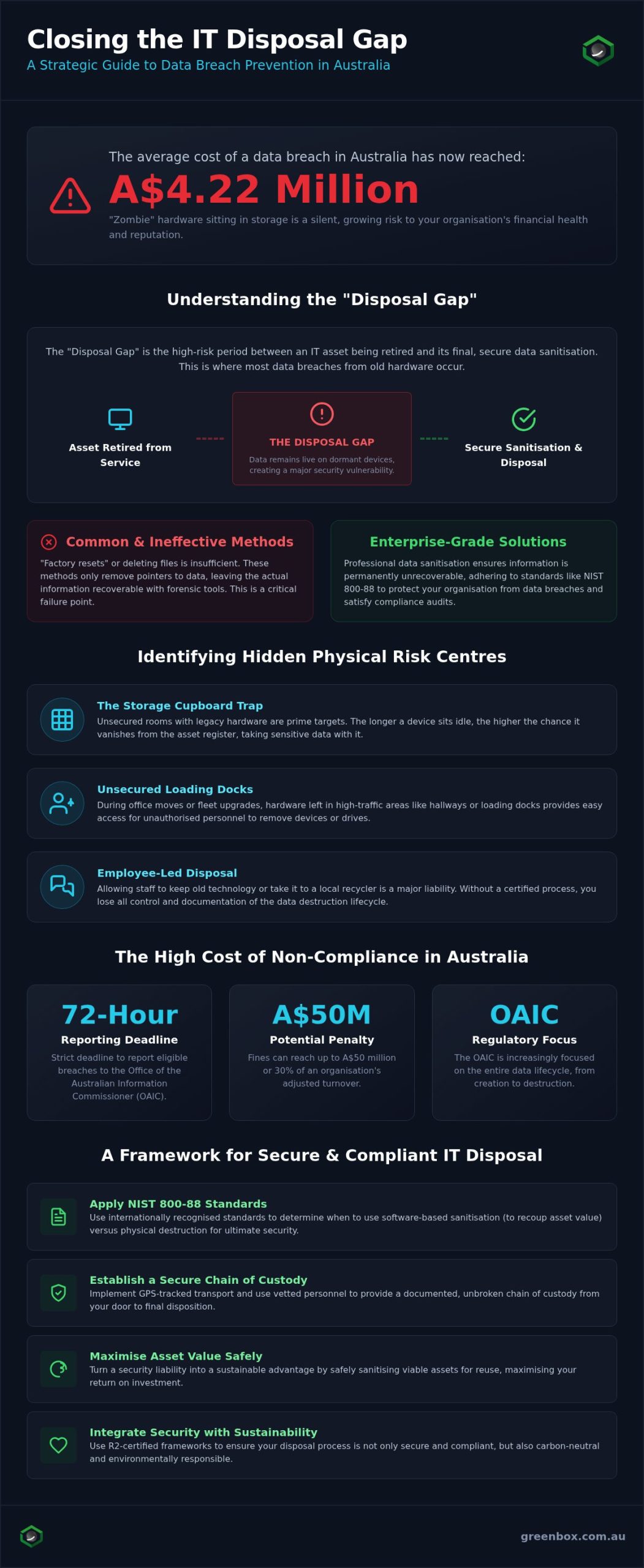
With the average cost of a data breach in Australia now reaching A$4.22 million, can your organisation afford to let “zombie” hardware sit idle in an unsecured storage room? It’s a common anxiety for IT leaders. You recognise that while your front-end security is robust, the legacy devices piling up in national offices represent a silent, growing risk. This vulnerability, often called the “disposal gap,” is where corporate reputations are most at risk under the 2026 privacy law reforms and the looming 72-hour notification deadlines.
We understand the challenge of maintaining consistent data breach prevention IT disposal processes across a distributed workforce. This guide provides a strategic framework to close that gap through certified IT asset management and rigorous data destruction. You’ll learn how to secure a documented chain of custody that satisfies the strictest OAIC audits. We also examine how to maximise the remaining value of your assets through carbon-neutral sanitisation; this turns a significant security liability into a disciplined, sustainable business advantage that protects both your bottom line and the planet.
Key Takeaways
- Understand why standard “factory resets” leave your organisation vulnerable to the “disposal gap” and how to bridge it with enterprise-grade security protocols.
- Identify the specific legal risks under the Australian Privacy Act and learn how to align your data breach prevention IT disposal strategy with the latest OAIC requirements.
- Learn to apply NIST 800-88 standards to determine when to use software-based sanitisation versus physical destruction to recoup asset value safely.
- Establish a secure chain of custody that includes GPS-tracked transport and vetted personnel to provide documented proof for mandatory compliance audits.
- Discover how R2-certified frameworks integrate technical excellence with carbon-neutral practices to ensure your disposal is both secure and environmentally responsible.
Understanding the “Disposal Gap” in Corporate Data Security
Most Australian organisations invest heavily in firewalls, encryption, and endpoint protection. However, a significant vulnerability often remains unaddressed: the period between an asset being retired from service and its final sanitisation. This interval is known as the “disposal gap.” It represents a high-risk window where sensitive corporate information sits on dormant hardware, often outside the active monitoring of IT security teams. Effective data breach prevention IT disposal requires closing this window through immediate, documented action.
The disposal gap is the critical failure point in an otherwise robust cybersecurity posture.
Relying on “factory resets” or “deleting” files is insufficient for enterprise-grade security. These methods typically only remove the pointers to the data rather than the data itself. For a truly secure transition, organisations must adhere to rigorous Data Sanitisation Standards that ensure information is unrecoverable even by sophisticated actors. Without professional intervention, “zombie” hardware in your storage rooms remains a live threat to your reputation.
The Technical Reality of Data Residuals
Data persistence varies significantly between hardware types. Traditional Hard Disk Drives (HDDs) store data magnetically, while modern Solid State Drives (SSDs) use complex flash memory controllers. These controllers often move data around to manage wear, meaning fragments of sensitive files can remain in “over-provisioned” areas of the drive that standard software cannot reach. Malicious third parties frequently use forensic recovery tools to reconstruct these fragments from discarded devices. Simply having physical possession of a laptop in a locked office doesn’t equate to data security; if the drive hasn’t been professionally sanitised, the risk remains live.
Identifying Hidden Risk Centres
The most common breach vectors aren’t always digital. They’re physical “risk centres” within your own facilities that often go overlooked during busy operational periods.
- The Storage Cupboard Trap: Unsecured rooms filled with legacy hardware are prime targets for internal theft or accidental loss. The longer a device sits idle, the higher the likelihood it’ll vanish from the asset register.
- Unsecured Loading Docks: During office moves or fleet upgrades, hardware is often left in high-traffic areas like hallways or loading docks. This provides easy access for unauthorised personnel to remove drives.
- Employee-Led Disposal: Allowing staff to keep old tech or take it to a local “recycling” centre is a major liability. Without a certified process, you’ve lost control of the data lifecycle.
A disciplined data breach prevention IT disposal strategy ensures that every device is tracked and processed the moment it leaves the user’s desk, removing the opportunity for these hidden risks to materialise.
The True Cost of Improper Hardware Decommissioning in Australia
The financial consequences of a security failure during hardware retirement are no longer just theoretical risks. In Australia, the average cost of a data breach has climbed to A$4.22 million according to 2026 industry reports. This figure includes more than just immediate technical fixes; it encompasses legal fees, regulatory fines, and the complex process of notifying affected parties. Under the Privacy Amendment (Personal Data Protection) Bill 2026, organisations now face a strict 72-hour deadline to report eligible breaches to the Office of the Australian Information Commissioner (OAIC). Failing to implement a rigorous data breach prevention IT disposal strategy can trigger penalties of up to A$50 million or 30% of an organisation’s adjusted turnover.
Regulatory Compliance and the OAIC
The OAIC is increasingly focused on the entire lifecycle of personal information. Legal obligations under the Privacy Act require that once data is no longer needed, it must be destroyed or de-identified. A “lost” laptop or a drive sold on the secondary market without professional sanitisation is considered a reportable event if it contains sensitive Personally Identifiable Information (PII). Following guidelines for the Proper Disposal of Electronic Devices is a baseline requirement, but Australian regulators expect documented proof of destruction. If your organisation cannot produce a certificate of sanitisation for a retired asset, you are effectively self-reporting a compliance failure during an audit.
Beyond Fines: Operational and Reputational Impact
The “reputation tax” often exceeds the initial fine. When a breach becomes public, the loss of client trust can be catastrophic, particularly for those in the financial, government, or education sectors. Future tender opportunities may be restricted if your security protocols are deemed insufficient. Internally, a breach causes a massive resource drain. Your IT and legal teams will spend months on forensic investigations and remediation instead of high-value projects. In 2026, data security is a core component of ESG and corporate governance.
Investing in certified IT asset disposal services is a pragmatic insurance policy against these escalating costs. When you consider that the average cost per compromised record in Australia is A$167, the price of professional data breach prevention IT disposal is a fraction of the potential liability. Managing these risks through a steady, experienced partner ensures that your transition remains secure and your corporate reputation remains intact.
Beyond Physical Destruction: Modern Data Sanitisation Standards
Effective data breach prevention IT disposal requires more than just a sledgehammer. While physical shredding is definitive, it often contradicts corporate sustainability goals by creating unnecessary e-waste. Modern enterprises now favour a more nuanced approach that prioritises data security while preserving the functional life of the hardware. This shift is guided by rigorous technical frameworks that ensure information is unrecoverable, even when the device is transitioned to a second user.
The foundation of any professional disposal programme is the NIST Guidelines for Media Sanitization (SP 800-88 Rev. 2). This standard defines the protocols necessary to ensure data is purged from all storage areas. Upon completion, a certified partner provides a Certificate of Destruction (CoD). This document serves as a vital audit trail, linking each specific serial number to a verified sanitisation event, which is essential for satisfying Australian regulatory requirements.
The NIST 800-88 Framework
The NIST standard categorises sanitisation into three distinct levels: Clear, Purge, and Destroy. While “Clear” uses basic software techniques to prevent simple recovery, “Purge” is the preferred enterprise standard for data-bearing devices. Purging involves more robust methods, such as cryptographic erasure or block-level overwriting, which make data recovery infeasible even using advanced laboratory techniques. Professional sanitisation ensures that 100% of sectors, including hidden or remapped areas of an SSD, are completely addressed. This level of precision is something standard “wipe” tools simply can’t guarantee. For organisations that require physical destruction as the final step, understanding the full scope of data bearing device destruction protocols is essential to maintaining a serialised chain of custody from collection through to verified disposal.
Remarketing: Turning Security into Value
One of the most significant advantages of software-based sanitisation is that it supports the circular economy. By securely overwriting the data rather than shredding the drive, you preserve the hardware for resale. This allows organisations to engage in asset remarketing, recouping a portion of their initial investment. Recovering value from retired assets doesn’t have to mean compromising your security posture. When managed by a steady, experienced hand, the transition from active use to the secondary market is seamless and secure. It enables your business to balance total security with corporate sustainability goals, ensuring that technical success and responsible practice remain inseparable. Choosing a data breach prevention IT disposal strategy that includes remarketing turns what was once a cost centre into a source of recovered capital.
Establishing a Secure Chain of Custody for End-of-Life Assets
Data security doesn’t end when a laptop is closed for the final time. It requires a disciplined, unbroken trail of accountability from the moment an asset leaves a desk until its data is verified as destroyed. This process, known as the chain of custody, is the backbone of effective data breach prevention IT disposal. Without it, your organisation loses visibility, and the “disposal gap” becomes a physical reality during transit. Maintaining a rigorous record of who handled the device, where it was stored, and when it was processed is essential for mitigating risk.
A secure IT disposal logistics plan should follow this 5-step checklist:
- Pre-collection Audit: Log every serial number and asset tag before the hardware leaves your secure facility.
- Secure Containment: Place all data-bearing devices in lockable, tamper-evident bins at the point of decommissioning.
- Vetted Transport: Utilise specialised vehicles and personnel who have undergone comprehensive security background checks.
- GPS Tracking: Monitor the transit of assets in real-time to ensure point-to-point security without unauthorised stops.
- Arrival Verification: Conduct a secondary scan upon arrival at the processing centre to reconcile the load against the initial manifest.
Secure Logistics and Transport
Generic couriers are designed for speed and volume, not for the high-stakes requirements of data-bearing assets. These services often involve multiple depots and hand-overs, which significantly increases the risk of loss or theft. Professional ITAD logistics rely on sealed containers and dedicated transport routes. Point-to-point tracking ensures that your devices never “fall off the radar” during their journey. This level of control provides the reassurance that your sensitive information remains protected from the moment it leaves your sight. Enterprises managing mixed hardware fleets should review a comprehensive enterprise security checklist for data bearing device destruction to ensure every asset class is accounted for before it reaches the loading dock.
Inventory Validation and Auditing
The final stage of the chain of custody involves meticulous reconciliation. Every collected asset is scanned and checked against your master asset register. Discrepancies, such as a missing serial number or an unexpected device in the batch, are flagged immediately for investigation. This rigorous auditing bridges the gap between IT operations and compliance departments. It provides the documented proof required for internal and external audits, ensuring that your data breach prevention IT disposal strategy is both transparent and defensible. To ensure your next fleet upgrade is managed with this level of precision, explore our end-to-end chain of custody tracking services.
Integrating Security with Sustainability: The Greenbox ITAD Framework
Managing technology refreshes for large scale organisations requires a partner capable of operating at a national level while maintaining hyper-local security standards. Greenbox provides an end-to-end lifecycle management framework that treats data breach prevention IT disposal as an integrated business process rather than a final act of destruction. By consolidating disposal with a single partner, organisations eliminate the inconsistencies often found when managing multiple local vendors. This ensures a uniform security posture across all offices, regardless of their location. It provides a steady, experienced hand to manage the high-stakes transitions that define modern IT operations.
Central to this framework is our R2 certification. This global standard ensures that every facility adheres to the highest benchmarks for both data sanitisation and environmental responsibility. It provides the technical rigour necessary to navigate the 2026 regulatory environment, offering a disciplined approach that satisfies both IT security and sustainability officers. Our carbon-neutral ITAD services allow your business to meet ambitious ESG targets without compromising on data breach prevention IT disposal. We bridge the gap between technical excellence and ecological stewardship, ensuring that your security successes contribute directly to your corporate responsibility goals.
National Scale, Localised Security Standards
A national technology refresh often involves complex logistics across multiple sites. Greenbox delivers consistent security protocols across all Australian operations, providing clients with total visibility through a transparent reporting portal. This approach allows your compliance department to verify the status of any asset at any time, providing the documented proof required for OAIC audits. It removes the operational burden of managing fragmented disposal processes. Your team can focus on core objectives while we handle the secure transition of your legacy hardware with precision and integrity.
The Future of Ethical IT Disposal
The traditional linear “buy-use-dispose” model is being replaced by a secure circular IT economy. This evolution maximises asset life through secure remarketing and refurbishment, turning potential e-waste into functional technology for a second user. Greenbox provides documented environmental impact reporting alongside your data destruction certificates. This dual-layered reporting ensures you have a complete record of both your security compliance and your carbon footprint reduction. Transitioning to a circular model allows you to recoup asset value safely, which can be reinvested into future technology cycles.
Our commitment to transparency and visibility means you’re never left guessing about the fate of your data or your hardware. To ensure your hardware retirement is handled with this level of professional rigour, you can organise a secure audit of your end-of-life IT assets with Greenbox today. We provide the peace of mind that comes from knowing every detail has been considered and every risk mitigated.
Securing Your Legacy through Disciplined Asset Management
Navigating the complexities of hardware retirement in 2026 requires a shift from passive disposal to active lifecycle management. By closing the “disposal gap” and enforcing a rigorous, documented chain of custody, your organisation can effectively mitigate the risk of a multimillion-dollar breach. Adopting a framework that prioritises data breach prevention IT disposal ensures that your retired assets don’t become a liability for your reputation or your balance sheet.
Greenbox provides the steady, experienced hand needed for these complex national transitions. Our R2-certified facilities ensure the highest global standards for data security, while our carbon-neutral operations directly support your corporate ESG objectives. With comprehensive national coverage, we deliver consistent security protocols across all your Australian offices, removing the operational burden from your internal teams. It’s time to transform your end-of-life IT process into a source of recovered value and verified compliance.
Secure your enterprise data with Greenbox certified ITAD services and gain the peace of mind that comes from a breach-proof disposal framework. We’re ready to help you lead the way in ethical, secure technology management.
Frequently Asked Questions
What is the difference between data sanitisation and data destruction?
Data sanitisation is the process of making data unrecoverable while keeping the hardware functional for reuse. In contrast, data destruction involves physical damage to the media through shredding or degaussing. Sanitisation is often the preferred choice for the circular economy as it enables asset remarketing. Both methods are critical components of a disciplined data breach prevention IT disposal strategy designed to eliminate residual security risks.
How does the Australian Privacy Act affect IT equipment disposal?
The Act mandates that organisations must take active steps to destroy personal information that is no longer required. With the 2026 reforms ending the small business exemption, an additional 2.5 million Australian entities now fall under these strict disposal requirements. Failing to secure data during hardware retirement can trigger significant penalties under the NDB scheme, making certified data breach prevention IT disposal a mandatory component of corporate compliance.
Is physical shredding of hard drives safer than software wiping?
Not necessarily; software wiping to NIST 800-88 standards is equally secure and significantly more sustainable. While shredding is a definitive physical act, professional software sanitisation ensures every data sector is overwritten, making recovery impossible even in a laboratory setting. Sanitisation allows the hardware to be refurbished and resold, whereas shredding turns valuable corporate assets into e-waste that requires energy-intensive recycling to recover raw materials.
What should be included in a Certificate of Destruction?
A valid Certificate of Destruction (CoD) must include specific details to satisfy a potential OAIC audit. It should list the unique serial number of each device, the date of processing, and the specific method of sanitisation used. This document serves as your primary audit trail, providing legal proof that your data security obligations were met with professional rigour. It is the final link in a secure chain of custody.
How can we prevent data breaches during a large-scale office relocation?
Secure relocation requires a documented chain of custody and vetted logistics. You should audit all assets before they leave the building and use lockable, tamper-evident containers for transport. Generic couriers pose a high risk; instead, use specialised ITAD partners who provide GPS tracking and point-to-point security. This prevents “zombie” hardware from being misplaced or stolen during the high-traffic transition between your old and new facilities.
What are the risks of using a standard e-waste recycler for corporate IT?
Standard recyclers often focus on material recovery rather than data security. They may not provide a certified chain of custody or use enterprise-grade sanitisation software. This creates a significant “disposal gap” where your sensitive data remains on drives while they sit in unsecured scrap piles. Corporate IT disposal requires a partner that prioritises data sanitisation as a security process before any physical recycling of the materials occurs.
How does R2 certification protect my business from liability?
R2 certification is a global standard that ensures a provider follows the highest benchmarks for data security and environmental ethics. It requires third-party auditors to verify that a provider handles all data-bearing assets with the highest technical precision. For your business, this reduces the risk of downstream liability and environmental non-compliance. It ensures that your decommissioned hardware is processed according to global best practices, protecting your legal standing.
Can mobile devices and tablets be securely sanitised for resale?
Yes, modern mobile devices can be securely sanitised using software-based factory resets combined with cryptographic erasure. Professional ITAD providers use specialised tools that verify the erasure of all user data, including cloud-linked accounts and encrypted partitions. Once verified, these devices can enter an asset remarketing stream. This recovers value for your organisation while ensuring no residual data remains on the device for the next user.