

If your decommissioned hardware leaves the loading dock without a serialised chain of custody, the industrial shredder at the other end is essentially irrelevant. For Australian enterprises, the physical destruction of hardware is only the final step in a much more complex security narrative. You’ve likely felt that familiar anxiety when a pallet of mixed assets containing everything from NVMe SSDs to legacy smartphones disappears into a courier’s van. It’s a high-stakes moment where “lost in transit” isn’t just an operational hiccup; it’s a potential breach that could attract significant penalties. Effective data bearing device destruction requires a disciplined strategy that accounts for every serial number from the server rack to the furnace.
This guide provides the rigorous protocols you need to master these requirements while maintaining an auditable trail for every asset. We understand the difficulty of tracking diverse hardware while trying to meet stringent environmental and security reporting requirements. We’ll provide a repeatable framework for secure decommissioning that aligns with R2-certified practices. You’ll learn how to achieve certified proof of destruction for every asset, ensuring your technical success and ecological stewardship are handled with a smooth, integrated logic.
Key Takeaways
- Understand the evolving landscape of storage hardware, from legacy HDDs to high-density NVMe storage, and why each requires a specific sanitisation approach.
- Learn to apply NIST SP 800-88 standards to your decommissioning workflow, distinguishing between clear, purge, and destroy protocols for maximum regulatory compliance.
- Implement a rigorous enterprise checklist for data bearing device destruction that ensures a serialised chain of custody from the initial audit to the final facility.
- Balance security with sustainability by identifying which assets are suitable for certified remarketing versus those destined for carbon-neutral recycling.
- Secure your organisation against data breaches and financial penalties with R2-certified proof of destruction and comprehensive reporting that meets Australian standards.
The Scope of Data Bearing Devices in the Modern Enterprise
A Data Bearing Device (DBD) includes any hardware component that maintains persistent storage of digital information. In the past, this definition was largely confined to the magnetic platters of hard disk drives (HDDs). Today, the landscape has shifted toward high-density solid-state drives (SSDs) and Non-Volatile Memory Express (NVMe) modules. These modern devices offer superior performance but present unique challenges for data bearing device destruction. Because flash-based storage manages data differently than magnetic media, traditional wiping methods often leave behind recoverable fragments.
The modern office is full of “silent” DBDs that often escape the standard IT audit. Multi-function printers, networking switches, and even sophisticated IoT sensors frequently store sensitive configuration data or cached documents. Under the Australian Privacy Principles (APP 11.2), organisations must take reasonable steps to destroy or de-identify personal information that is no longer needed. Failing to account for these hidden storage points creates a significant vulnerability during hardware decommissioning or relocation.
Common Enterprise DBDs to Audit
A comprehensive audit is the foundation of secure disposal. It’s vital to look beyond the server room and consider every asset capable of data retention. Effective inventory management identifies these assets before they leave your secure perimeter.
- User Endpoints: Laptops, desktops, smartphones, and tablet devices.
- Data Centre Infrastructure: Server drives, SAN arrays, and high-speed NVDIMM modules.
- Removable Media: USB drives, SD cards, and legacy backup tapes.
The Risk of Improper Disposal
The consequences of a security lapse extend far beyond a technical failure. Since the introduction of the Notifiable Data Breaches (NDB) scheme in Australia, the financial penalties for failing to secure personal data have increased substantially. A single “lost” device during an office move can trigger a mandatory reporting event, leading to public scrutiny and severe reputational damage. It’s an operational burden no business wants to carry.
Simple file deletion or formatting is never a sufficient safeguard. Data remanence refers to the residual representation of data that remains even after attempts have been made to erase it. Professional data bearing device destruction ensures that this residual data is physically or cryptographically obliterated. Without a certified process, your discarded hardware remains a target for “dumpster diving” and industrial espionage, where even damaged drives can be harvested for intellectual property.
Decommissioning Standards: NIST 800-88 and Beyond
The NIST SP 800-88 standard serves as the primary framework for Australian enterprises managing end-of-life hardware. It provides a logical methodology for identifying the correct sanitisation path based on media type and data confidentiality. Understanding the best practices for eliminating data involves categorising assets into three distinct levels: Clear, Purge, and Destroy. This classification ensures that your data bearing device destruction strategy is both cost-effective and secure.
R2 certification complements these standards by adding a layer of operational accountability. It ensures that every facility handling your assets adheres to strict environmental and security protocols. For organisations seeking a certified approach to asset recovery, these standards provide a clear roadmap for mitigating risk. It’s a structured way to move from uncertainty to verified completion.
Clear vs. Purge: When Software is Sufficient
“Clear” is the baseline level of sanitisation. It applies logical techniques to overwrite storage locations, preventing simple data recovery tools from accessing information. While it’s effective for lower-risk assets, it doesn’t always protect against sophisticated laboratory-grade recovery efforts. It’s typically used for devices that will remain within the same organisation.
“Purge” represents a more rigorous standard. It uses hardware-level commands, such as cryptographic erase or block erase, to render data recovery infeasible even with advanced forensic equipment. The primary benefit of Purging is that it preserves the physical integrity of the hardware. This allows for asset remarketing, which recovers financial value and supports carbon-neutral business goals by extending the device’s lifecycle rather than sending it to the scrap heap.
The “Destroy” Mandate: When Physical Shredding is Essential
Physical destruction remains the final recourse for damaged hardware or assets containing ultra-high-security information. If a device can’t be reliably Purged due to physical failure or if its classification demands total obliteration, it must be destroyed. This ensures that no data fragments remain accessible under any circumstances.
Industrial shredding is the most common method, but the technique must match the media. Traditional degaussing, which uses powerful magnets to disrupt magnetic storage, is completely ineffective for modern SSDs and NVMe modules. For flash-based storage, data bearing device destruction must achieve a specific particle size, typically 10mm or smaller. This level of precision is necessary because data is stored on tiny NAND chips. Physical obliteration prevents any possibility of chip-level data harvesting, providing the airtight audit trail required for modern compliance.
Selecting the Right Destruction Method for Your Assets
Choosing between physical shredding and software-based erasure is a strategic decision that impacts your balance sheet and your carbon footprint. For Australian organisations, particularly those in the financial sector governed by APRA CPS 234, the primary requirement is a legally defensible audit trail. If a device still possesses significant market value, physical data bearing device destruction might represent a needless loss of capital. Conversely, shredding is the only logical path for assets that are physically damaged or have reached the end of their functional life. A pragmatic approach balances the need for absolute security with the financial recovery available through asset remarketing.
The environmental cost of decommissioning is a core business metric. Shredding converts complex electronics into raw material streams, which is energy-intensive. Refurbishing and remarketing assets through certified sanitisation supports a circular economy, significantly reducing the carbon footprint associated with your IT lifecycle. This alignment of technical success and responsible practice ensures your organisation meets both security and sustainability benchmarks simultaneously.
Software-Based Sanitisation
Modern erasure platforms, such as Blancco, provide a high-standard alternative to physical destruction. These tools overwrite every sector of a drive, including hidden areas like the HPA or DCO. While traditional overwriting methods often fail on SSDs due to wear-levelling algorithms, professional-grade software uses firmware-level commands to ensure total data erasure. This process generates a tamper-proof Certificate of Sanitisation for every serialised asset. It provides the granular visibility required for internal audits and regulatory compliance while preserving the hardware for its next user.
Physical Destruction Protocols
Physical data bearing device destruction is essential when a device cannot be electronically accessed or when data sensitivity levels are extreme. On-site shredding offers the highest level of perceived security, as the assets never leave your premises in a readable state. However, off-site destruction in an R2-certified facility often provides a more controlled environment for high-volume batches. For government and high-security sectors, witnessed destruction is a standard requirement. In these cases, a representative observes the process to verify that every item on the manifest is obliterated. A valid Certificate of Destruction must include:
- The exact date and time of the destruction event.
- The serial number and asset tag of every individual device.
- The specific method of destruction used (e.g., 10mm shredding).
- The signature of the authorised technician performing the task.
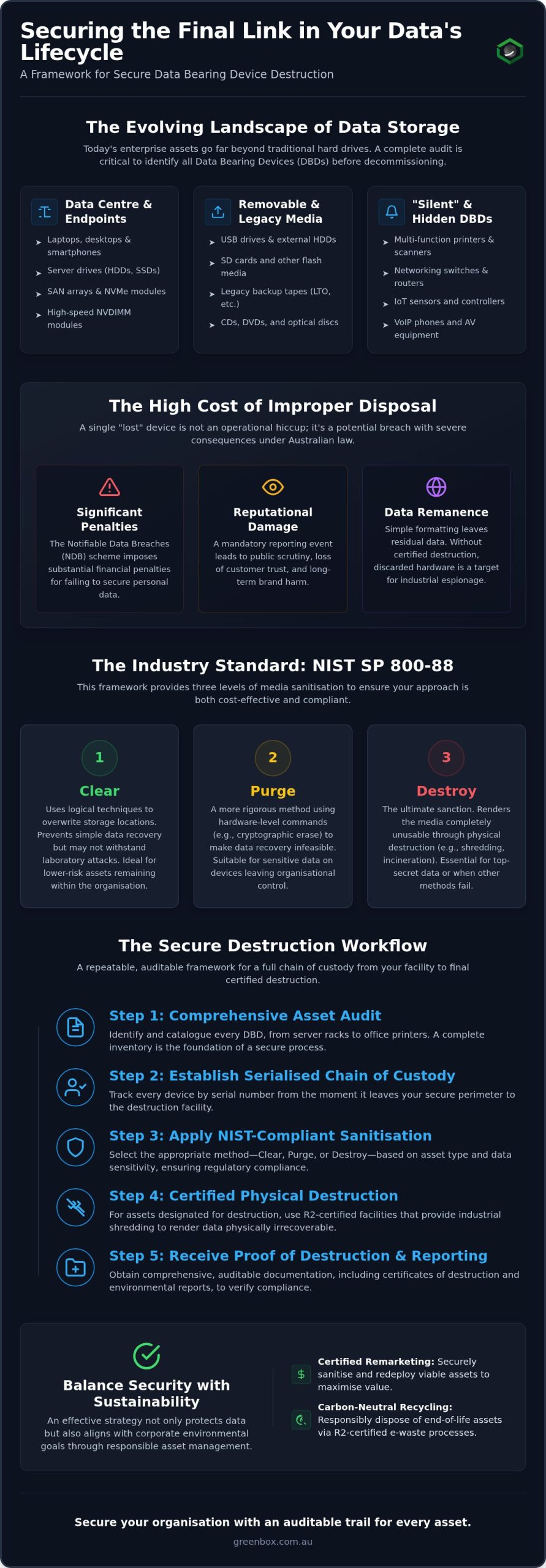
The Secure Destruction Checklist: Ensuring a Full Chain of Custody
The most significant vulnerability in data bearing device destruction isn’t the technical erasure itself; it’s the physical movement of assets between your facility and the destruction centre. Without a rigorous chain of custody, a device can be misplaced or stolen long before it reaches the shredder. A disciplined checklist ensures that your security posture remains airtight from the moment a technician unplugs a server until the final certificate is issued. This methodical approach replaces operational anxiety with verified data.
A comprehensive decommissioning process follows five distinct phases:
- Phase 1: Pre-Collection Audit. Every asset is scanned and tagged at the point of origin. Recording serial numbers before the items leave your rack creates a definitive manifest for the entire project.
- Phase 2: Secure Packaging. Assets are loaded into locked, tamper-evident stillages. GPS-tracked vehicles provide real-time visibility, ensuring the load remains secure during transit.
- Phase 3: Sanitisation and Processing. Upon arrival at the facility, every serial number is re-verified against the collection manifest to ensure no items were lost in transit.
- Phase 4: Reporting and Certification. You receive a full audit pack containing individual certificates for every DBD processed, providing a legally defensible record.
- Phase 5: Sustainable Disposal. Non-functional components enter R2-certified recycling streams. Detailed carbon reporting is provided to support your organisation’s ESG metrics.
Logistics and Transport Security
Transporting sensitive hardware requires more than a standard courier service. Security-vetted personnel manage every collection, ensuring that assets are never left unattended or exposed to unauthorised access. We use locked transit containers and direct transport protocols to minimise stops between your site and our facility. This controlled movement eliminates the “black box” period where data is most at risk. For enterprises requiring the highest level of assurance, book a secure logistics consultation to customise your transport requirements.
The Audit Trail: Essential Documentation
Documentation is the only proof that your organisation has met its regulatory obligations under the Australian Privacy Principles. A serial-number-level report is essential for every single DBD, including those found in peripheral devices like printers or networking gear. This destruction report must match your initial collection manifest exactly. Integrating these reports into your enterprise asset management system allows for seamless internal audits and provides a defensible record for regulators. It’s a structured way to ensure that technical success and responsible practice are handled with a smooth, integrated logic.
Partnering with Greenbox for Certified National Data Destruction
Greenbox provides a sophisticated ITAD framework that removes the operational burden of hardware disposal while protecting your organisation’s financial health. Our end-to-end service model integrates security, sustainability, and value recovery into a single, managed workflow. With R2-certified facilities and a national logistics capability across Australia, we manage complex transitions for organisations that cannot afford a lapse in visibility. Every asset we handle is tracked through the Greenbox Portal, giving your team real-time visibility into the sanitisation status of your inventory from any location.
Environmental responsibility is a core metric of our operation, not an afterthought. As a carbon-neutral organisation, we align your IT disposal with your broader ESG goals. We don’t just process e-waste; we actively reduce the environmental impact of your technology lifecycle by prioritising secure remarketing after software-based sanitisation. This approach ensures that your technical success and ecological stewardship are inseparable, providing peace of mind for stakeholders and regulators alike.
Why Australian Enterprises Trust Greenbox
We’ve spent decades serving government departments and highly regulated financial sectors where the standards for data bearing device destruction are most stringent. Our team understands that a one-size-fits-all approach doesn’t work for modern enterprises. We provide bespoke solutions ranging from bulk server decommissioning in high-security data centres to national mobile device refreshes for remote workforces. By choosing a partner committed to the circular economy, you recover maximum value from your assets while ensuring every byte of data is irretrievably destroyed.
Next Steps for Your Decommissioning Project
Initiating a secure collection and audit is a straightforward process designed to integrate seamlessly with your existing IT operations. We begin by defining the scope of your inventory and identifying the specific security protocols required for your device types. Whether you require on-site shredding or certified software erasure, we provide the documentation needed for an airtight audit trail. This structured progression ensures that no detail is overlooked and every risk is mitigated before the hardware leaves your site.
You can request a tailored quote for data bearing device destruction that accounts for your national footprint and specific security classification. Our specialists will help you build a repeatable framework for hardware decommissioning that protects your reputation and the planet’s future. It’s a partnership-focused approach that delivers professional, secure, and deeply pragmatic results.
Contact Greenbox to secure your corporate data today.
Securing Your Enterprise Future with Disciplined Decommissioning
Effective data bearing device destruction is a logistical discipline that protects your organisation’s reputation and financial health. By mastering the transition from local audits to certified sanitisation, you ensure no asset leaves a gap in your security perimeter. Whether you’re navigating the complexities of high-density SSDs or legacy server arrays, the objective remains a serialised, airtight audit trail that satisfies internal stakeholders and national regulators. This methodical approach replaces operational anxiety with verified, defensible data.
Choosing a partner with R2-certified facilities and carbon-neutral status allows you to achieve these security benchmarks without compromising your sustainability goals. Our national Australian coverage provides the steady, experienced hand needed to manage large-scale transitions with precision and transparency. You can move forward with confidence, knowing that every serial number is accounted for and every risk is mitigated through a proven framework. Secure your enterprise data with Greenbox certified destruction services and transform your hardware decommissioning into a strategic, responsible practice that benefits both your business and the planet.
Frequently Asked Questions
What is considered a data bearing device in a corporate environment?
A data bearing device includes any hardware component capable of persistent digital storage. This extends beyond obvious items like laptops and server drives to include “silent” storage points. Multi-function printers, networking switches, and IoT sensors often cache sensitive information during their operational life. Identifying these hidden assets is a critical first step in an enterprise audit to prevent unauthorised data recovery after the hardware leaves your secure office environment.
Is a factory reset sufficient for secure data destruction?
A factory reset is rarely sufficient for enterprise security. This process usually only deletes logical pointers to the data, leaving the actual information intact on the storage media. Forensic recovery tools can easily bypass these logical barriers to harvest sensitive intellectual property. For true security, you must employ professional data bearing device destruction or certified software erasure that overwrites every sector of the drive to ensure data is irretrievable.
What is the difference between data sanitisation and data destruction?
Data sanitisation and data destruction are distinct methods within the ITAD framework. Sanitisation uses software to wipe data while keeping the hardware functional for remarketing. Destruction involves physical processes like industrial shredding that render the device completely unusable. Choosing between them depends on the asset’s residual value and your specific security classification. Both methods should result in a serialised certificate to maintain an airtight audit trail for your organisation.
How does NIST 800-88 apply to Australian businesses?
NIST SP 800-88 is the primary framework used by Australian organisations to meet their obligations under the Australian Privacy Principles (APP 11.2). While it is a US-developed standard, it provides the most rigorous methodology for media sanitisation globally. Adhering to these guidelines helps Australian enterprises demonstrate they’ve taken “reasonable steps” to protect personal information, which is a mandatory requirement under the Notifiable Data Breaches (NDB) scheme.
Can I get a certificate of destruction for every individual hard drive?
Yes, you can and should receive a certificate for every individual asset. Professional providers scan the unique serial number of every drive to ensure it matches your initial collection manifest. This serial-number-level reporting is essential for maintaining a full chain of custody. These individual certificates are then compiled into a comprehensive audit pack, providing the legally defensible proof required for internal compliance reviews or external regulatory inspections.
What happens to the physical materials after a device is shredded?
After a device undergoes physical data bearing device destruction, the resulting particles are sorted into distinct material streams. These include ferrous and non-ferrous metals, plastics, and glass. These materials are then sent to specialised R2-certified downstream partners who process them back into raw commodities. This rigorous recycling process ensures that even the smallest fragments are handled responsibly, preventing hazardous e-waste from entering landfills and supporting global circular economy initiatives.
Does Greenbox provide on-site data destruction services?
Greenbox provides on-site destruction services for organisations that require the highest level of security assurance. Our technicians bring specialised equipment to your location, allowing you to witness the physical obliteration of assets before they ever leave your secure perimeter. This service is particularly valuable for government and financial sectors where internal policy mandates that data must never exit the building in a readable state, ensuring absolute control over the entire process.
How does secure data destruction support my ESG and sustainability targets?
Secure destruction supports ESG targets by ensuring that end-of-life IT assets are managed through carbon-neutral and R2-certified channels. By prioritising software-based sanitisation, you enable asset remarketing, which extends the device’s lifecycle and reduces the need for new manufacturing. When hardware must be shredded, our sustainable recycling protocols ensure maximum material recovery. We provide detailed reporting that integrates directly into your environmental and social governance metrics, documenting your commitment to responsible practice.