

A device isn’t secure simply because someone has wiped it. Healthcare data security on end-of-life assets depends on the full chain of custody: knowing which equipment may hold patient or personal information, controlling it through each handover, and documenting sanitisation or destruction and final disposition. If your team is unsure what remains on retired laptops, servers, storage media or connected equipment, that uncertainty is a governance concern.
Healthcare organisations understand that sensitive records require careful protection. The harder question is how to prove that protection continues after equipment leaves service, particularly when a disposal provider is involved. A defensible process needs more than a wipe-or-shred decision; it needs clear accountability and evidence at every stage.
This practical Australian guide explains how to identify data-bearing assets, match sanitisation or destruction to the media, assess provider controls and build an auditable retirement process. It also shows how asset recovery, remarketing or e-waste recycling can follow appropriate data controls, helping your organisation recover suitable equipment responsibly without compromising information security.
Key Takeaways
- Map retired and redeployed equipment that could retain patient, identity, billing or workforce information before it leaves your control.
- Build healthcare data security on end-of-life assets around a documented sequence, with controls matched to each device, media type and intended outcome.
- Compare sanitisation, physical destruction and reuse by checking suitability, verification evidence and what happens to each asset next.
- Assess providers on custody records, subcontractor visibility, exception handling and how asset outcomes are reconciled.
- Once data controls are complete, consider whether suitable assets can be recovered or remarketed, with recycling for equipment that cannot be reused.
Why healthcare data security matters when retiring end-of-life assets
End-of-life assets are devices retired from service or redeployed elsewhere that may still store organisational information. A computer removed from a nurses’ station, a server replaced during an upgrade or a mobile device reassigned to another team can each require different checks before its next use or disposition.
Health information is only part of the picture. Devices may also contain identity details, billing records, staff information, saved credentials or operational data. The risk depends on the asset and how it was used. Not every retired device contains recoverable information, and retirement alone does not prove that a breach has occurred. It does create a control point where the organisation needs to establish what is present and what should happen next. The technical concept of data remanence helps explain why deleting files may not, by itself, resolve questions about information remaining on storage media.
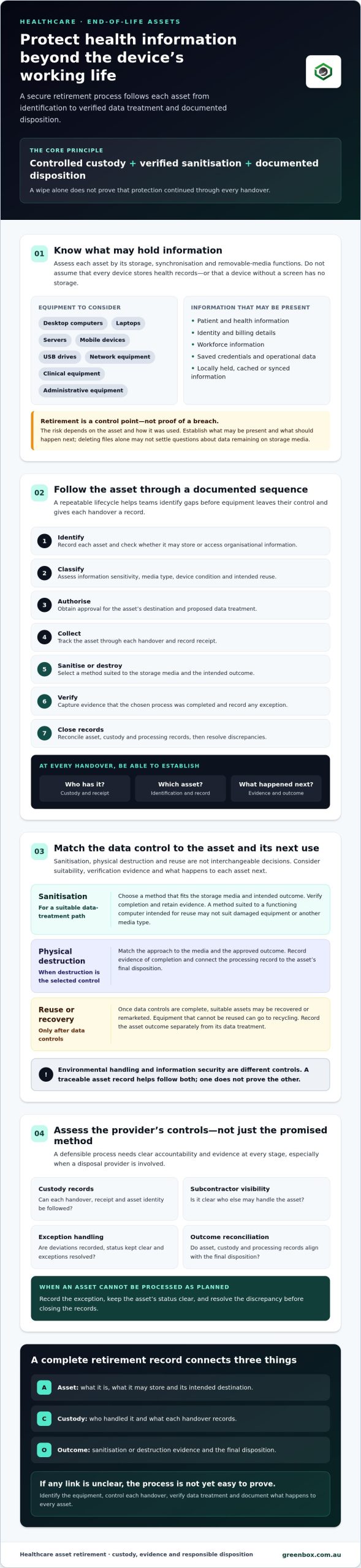
Secure end-of-life asset handling is controlled custody, verified sanitisation and documented disposition. This provides a clear standard for healthcare data security on end-of-life assets, while recognising that controls should reflect the device, its use and its intended outcome.
Which healthcare devices may retain sensitive information?
Potential data-bearing assets include desktop and laptop computers, servers, mobile devices, removable media such as USB drives, and network equipment. Clinical devices and administrative equipment both warrant consideration, but their information functions differ: one may support a clinical workflow, while another may handle staff, finance or general business records. Don’t assume either that every device stores health records or that a device without a screen has no storage.
Check each asset’s storage, synchronisation and removable-media functions. Consider whether information may be held locally, cached from another system, synced to the device or saved to attached media. Confirming these functions helps teams identify what needs assessment without treating every item as identical.
Why retirement creates a distinct security control point
Retirement can involve several hand-offs: a device moves from a user to an internal holding area, then to collection and processing. Each transfer creates a custody question: who has the asset, how is it identified, and what evidence records its next step? Temporary storage can also separate equipment from the context needed to classify it correctly.
An incomplete inventory may leave a device outside the planned process, even if the rest of a retirement batch is accounted for. Information security and environmental handling are different controls, but they connect at disposition: data must be addressed before an asset is prepared for reuse, remarketing or recycling. A traceable asset record helps teams follow both outcomes without assuming that one proves the other.
How to protect health information across the end-of-life asset lifecycle
A repeatable process makes healthcare data security on end-of-life assets easier to manage and audit. It also gives teams a consistent way to identify gaps before equipment leaves their control. Use this sequence as a practical framework, then align it with your organisation’s policies and legal advice:
- Identify: Record each asset and check whether it may store or access organisational information.
- Classify: Assess information sensitivity, media type, device condition and intended reuse.
- Authorise: Obtain approval for the asset’s destination and the proposed data treatment.
- Collect: Track the asset through each hand-off and record receipt.
- Sanitise or destroy: Select a method suited to the storage media and the intended outcome.
- Verify: Capture evidence that the chosen process was completed, and record any exception.
- Close records: Reconcile asset, custody and processing records, then resolve discrepancies.
These controls should work together, not as isolated checks. A method appropriate for a functioning computer intended for reuse may not suit damaged equipment or a different media type. If an asset can’t be processed as planned, record the exception, keep its status visible and agree the next action before closing its record.
Build an inventory and authorise each asset disposition
Before collection, list asset identifiers, accountable owners, intended destinations and disposition approvals. Identify devices that may hold health or personal information, rather than relying on broad equipment categories alone. At collection, reconcile what was received against the approved inventory. Investigate missing, additional or mismatched items; don’t treat an unexplained discrepancy as a completed hand-off.
Maintain custody and verify the sanitisation outcome
Keep a custody log that records hand-offs, transport controls, receipt and processing outcomes. Link evidence to the relevant asset identifiers so the organisation can trace what happened to each item. Verification shows that the selected process was completed and recorded; it isn’t a blanket guarantee that every risk has been eliminated. For further background, consult guidance on certified data sanitisation in Australia and assess whether the method suits each device and media type.
The OAIC’s guidance on reasonable steps to destroy or de-identify personal information is a useful reference when shaping organisational controls. Australian privacy and health-record requirements can vary by context, so have relevant legal references reviewed by a qualified adviser. This section offers practical guidance, not legal advice.
For organisations assessing recovery and data sanitisation together, Greenbox’s IT asset lifecycle services can be considered against the same inventory, custody and evidence criteria.
Sanitisation, destruction or reuse: compare the right control for each asset
Choosing a disposition method means weighing the storage media, its condition, the information it may hold and whether the equipment is intended for reuse. Software-based sanitisation may support reuse when the media and process allow a suitable outcome to be verified. Physical destruction may be considered where sanitisation isn’t suitable or can’t be verified. Reuse is a downstream option, not a substitute for completing and evidencing the required data controls first.
The appropriate disposition method depends on the media, information sensitivity and verified outcome. This decision-led approach supports healthcare data security on end-of-life assets without assuming one method fits every device or information classification.
| Option | Media and condition | Evidence and downstream use | Environmental consideration |
|---|---|---|---|
| Software-based sanitisation | May suit supported media and functioning devices where the selected process is compatible. | Record the method, asset identity and verification outcome. Reuse may be considered once data controls are complete. | Can preserve equipment for potential reuse, subject to its condition and suitability. |
| Physical destruction | May be considered for damaged, unsupported or otherwise unsuitable data-bearing media, following a documented decision. | Retain evidence that links the destruction outcome to the relevant asset or media record. The device may require separate handling. | Destroys the media, which may limit reuse; assess whether other components can be handled responsibly. |
| Controlled reuse | Applies to equipment assessed as suitable for another use after appropriate data treatment. | Document the sanitisation method and verification before transfer, along with the intended destination. | Extends the useful life of suitable equipment; it doesn’t remove the need to address data first. |
The OAIC’s guide to reasonable steps to destroy or de-identify personal information is a useful reference when developing organisational controls. Confirm applicable requirements with a qualified adviser and assess any method against the specific media and circumstances.
When sanitisation may support continued use
Sanitisation can be a potential route to continued use when the media supports the selected process and the outcome can be verified. The receiving organisation should retain the asset identity, method and verification evidence, so records connect the process to the actual device or media. For a closer comparison of software-based sanitisation and physical destruction, assess how each approach suits the asset’s condition and intended destination.
When physical destruction may be considered
If media is damaged, unsupported or unsuitable for a verifiable sanitisation process, document why destruction was selected and how it will be evidenced. Destroying data-bearing media doesn’t necessarily mean disposing of the entire device. Where components are separated, keep records that link the destroyed media to its asset, and determine how the remaining equipment will be handled.
How healthcare organisations can assess an end-of-life asset security provider
For healthcare data security on end-of-life assets, assess the provider’s documented process, not just its service description. Procurement teams should establish what work is included, how custody is tracked, which activities involve partners and what evidence is supplied when processing is complete. These details help determine whether the provider’s controls can support your organisation’s governance and audit needs.
- Scope: Confirm which assets and media types the provider can process, and how methods are matched to device condition and intended disposition.
- Custody: Ask how assets are identified, secured and recorded during collection, transport, receipt and processing.
- Subcontractors: Clarify which activities are performed directly and which involve other parties. Ask how those hand-offs are documented.
- Sanitisation evidence: Request examples of the records provided, including asset identifiers, method, outcome and any verification details.
- Exceptions: Establish how missing assets, mismatched identifiers, failed processing or other exceptions are reported, escalated and resolved.
- Reconciliation: Ask how the final asset list is matched against collection records, processing outcomes and certificates or other disposition evidence.
Questions to ask about process, evidence and exceptions
Ask the provider to walk through a typical asset from collection to final disposition. What records capture each hand-off, receipt and processing outcome? Can they share a sample report with sensitive details removed? Clarify who receives exception notices, how discrepancies are investigated and what evidence confirms resolution. These answers reveal whether records can be traced from the approved inventory through to the reported outcome.
Assess assurance without relying on broad claims
Request current certification evidence and review its status, scope and relevance to the specific facility and activities involved. A certificate can inform due diligence, but it doesn’t prove that every control applies to your assets or guarantee legal compliance or eliminate risk. Check whether reporting provides the asset-level detail your internal audit and governance teams need.
Greenbox states that its facilities are R2-certified and provides data sanitisation and destruction, asset recovery, remarketing and e-waste recycling. Assess these claims against the same criteria: ask which evidence and facility scopes are relevant to your requirements, and how data outcomes connect to final disposition.
Discuss your end-of-life asset requirements with Greenbox and review how its process and supporting evidence align with your organisation’s needs.
A secure and responsible next step for healthcare end-of-life assets
A controlled retirement programme turns healthcare data security on end-of-life assets into a repeatable operational process. Start by scoping equipment and assigning accountable stakeholders across information security, privacy, IT, procurement and facilities. Then agree the controls and evidence required before collection begins.
- Scope assets: Define which devices are included and who is accountable for them.
- Agree controls: Set disposition approvals, sanitisation or destruction requirements, timelines and escalation contacts.
- Document custody: Record asset hand-offs and plan secure temporary storage if collection can’t happen immediately.
- Review evidence: Check processing records and any certificates against your requirements.
- Reconcile outcomes: Confirm every asset has a documented final disposition and investigate discrepancies.
Prepare a controlled retirement programme
Coordinate the teams responsible for information protection, operational continuity and asset movement. Set approval points and evidence expectations in advance, and plan how equipment will be stored securely while awaiting collection. If devices support essential services, coordinate retirement with the relevant operational teams so that asset handling doesn’t disrupt continuity.
Agree how assets may proceed after data controls are complete. Suitable equipment may be considered for recovery or remarketing, while items that aren’t suitable for reuse may be directed to e-waste recycling. The data outcome should be established and recorded before reuse or recycling decisions are finalised. A related sustainable IT asset recovery case study can offer another perspective on connecting responsible recovery with lifecycle planning.
Close the record and review the outcome
At completion, reconcile every asset against its approved destination and the evidence received. Record sanitisation or destruction outcomes, recovery or remarketing decisions, recycling outcomes and any exceptions. Retain these records under your organisation’s approved retention and governance processes, and have applicable health-record and privacy requirements checked by a qualified adviser.
Review discrepancies and lessons with the teams involved before the next technology refresh or decommissioning cycle. A missing identifier or unclear hand-off is easier to address when the process is still fresh. Greenbox provides data sanitisation and destruction, IT asset recovery, asset remarketing and e-waste recycling, which organisations can assess against their own security and evidence criteria.
Talk with Greenbox about secure asset recovery.
Put a traceable retirement process into practice
Strong healthcare data security on end-of-life assets comes from decisions that can be followed and evidenced, from asset approval through to final disposition. Match sanitisation or destruction to the media and its intended outcome, then reconcile each asset against its records. A clear process gives your organisation a sound basis for responsible reuse or recycling after data controls are complete.
When assessing support, look beyond broad assurances. Greenbox provides national IT asset recovery, data sanitisation and destruction services, and describes itself as a carbon-neutral organisation. It also states that its facilities are R2-certified. Confirm the current certificate scope and review relevant service evidence against your organisation’s requirements; these claims aren’t healthcare-specific endorsements or guarantees.
Discuss secure end-of-life asset recovery with Greenbox and assess how its services and evidence may fit your retirement process. With clear ownership and documented outcomes, your team can move forward with greater confidence and a responsible plan for equipment at end of life.
Frequently Asked Questions
What does healthcare data security on end-of-life assets involve?
It involves controlling information and equipment from retirement approval through to sanitisation or destruction and final disposition. Start by identifying devices that may store or access organisational information, then assign an appropriate method and record each asset’s progress. For example, a laptop intended for reuse needs a documented data treatment and outcome before transfer. The process should also capture custody hand-offs and explain how exceptions are resolved.
Do healthcare organisations need to destroy every retired hard drive?
No. Physical destruction isn’t automatically required for every retired hard drive. A suitable sanitisation process may be considered if the media supports it and the outcome can be verified. The decision should reflect the information’s sensitivity, the drive’s condition and its intended use. If sanitisation isn’t suitable or verifiable, document the reason for considering destruction and retain evidence linking the outcome to the relevant asset or media.
Can retired healthcare devices be reused after data sanitisation?
Yes, a device may be reused if its condition and media support an appropriate sanitisation process, and the organisation verifies and records the outcome before transfer. Keep the asset identity, method and evidence connected in the retirement record, and document the intended destination. Sanitisation doesn’t establish that a device is technically suitable for another user, so assess its condition separately and follow your organisation’s approval process.
What records should an end-of-life asset provider supply?
Agree the required evidence before work begins. Useful records may include asset identifiers, collection and receipt details, processing method and outcome, sanitisation or destruction evidence, final disposition and any exceptions. Ask how certificates or reports are matched to individual assets, and request sample reporting fields. The records should let your organisation reconcile the approved inventory with items received and outcomes reported, rather than relying on an unlinked batch summary.
How can healthcare organisations maintain chain of custody for retired devices?
Maintain an asset-level record from internal release through collection, receipt, processing and final disposition. Record who is responsible at each hand-off, the asset identifier and any discrepancy that needs follow-up. Before collection, compare the approved inventory with the assets presented; after processing, reconcile it against provider records. If an item is missing or identifiers don’t match, keep it open for investigation rather than marking its retirement complete.
Does Australian privacy law apply when healthcare assets are disposed of?
Privacy obligations can remain relevant during asset retirement if equipment contains personal information. The Privacy Act 1988 generally applies to Australian health service providers, and My Health Record and state or territory requirements may also be relevant, depending on the organisation and information involved. The applicable rules can be complex. Treat this as general information, not legal advice, and ask a qualified adviser to review your organisation’s circumstances and current obligations.
How should a healthcare organisation compare asset disposal providers?
Compare providers against the work your organisation needs and the evidence it must retain. Ask which assets and media they process, how custody is recorded, whether subcontractors are involved, how exceptions are escalated and how outcomes are reconciled to asset records. Review current certification evidence for its scope and relevance, rather than treating a certificate as proof of every control. Check that reporting supports your internal governance and audit processes.