

Resale value is often shaped before retired IT assets leave your premises. To maximise IT asset resale value, assess equipment while it is still relevant, record its condition accurately and prepare it for a secure, transparent route to market.
It is reasonable to be cautious. You may not know which devices are ready for resale, how their condition affects assessment or whether security steps will slow recovery. Secure handling and value recovery can work together. Timely assessment, accurate asset records and documented data sanitisation help support both.
This guide explains how to identify assets with realistic resale potential, assess their condition and prepare them for remarketing. It also covers why timing matters, what information to gather before collection and how to maintain visibility through processing and final disposition. A clear, well-documented approach helps you make informed decisions about reuse, resale or responsible recycling without relying on assumed values or compromising data security.
Key Takeaways
- To maximise IT asset resale value, assess assets while they are still relevant and base expectations on condition, configuration and completeness.
- Build a clear inventory with identifying details and known faults to support a more informed assessment.
- Choose the right outcome for each asset: redeployment, remarketing, recycling or another appropriate route.
- Make secure data sanitisation a prerequisite to remarketing, and retain records showing how each asset was handled.
- Before engaging an ITAD partner, clarify assessment criteria, data controls, reporting and how final asset outcomes will be communicated.
How to maximise IT asset resale value starts before collection
Resale value is the evidence-based recovery from eligible assets after assessment. It is not a guaranteed amount or an assumed return. The outcome depends on the equipment, its condition and configuration, whether key components are present, and demand for that type of hardware when it is assessed. For example, a desktop with its power supply and working components may have different potential from an incomplete unit of the same age.
Preparation starts before collection. Clear asset information supports a more reliable assessment and helps determine an appropriate route. Consider the wider IT asset management lifecycle: resale is one possible outcome in the responsible management of equipment, not the only measure of success. Commercial recovery must sit alongside data protection and appropriate end-of-life handling.
Which retired IT assets may retain resale potential?
Laptops, desktops, servers and networking hardware may be suitable for assessment, but the category alone does not establish suitability or guarantee acceptance. Check observable condition: does the device power on, are any ports or components damaged, and are accessories or parts missing? Working equipment may warrant a resale assessment. Repairable items need closer evaluation, while damaged, incomplete or non-functional equipment may be better suited to another route.
Age matters, but it is not a verdict. Configuration, completeness, condition and market demand also shape resale potential, so avoid ruling assets in or out on age alone.
What does maximising IT asset resale value involve?
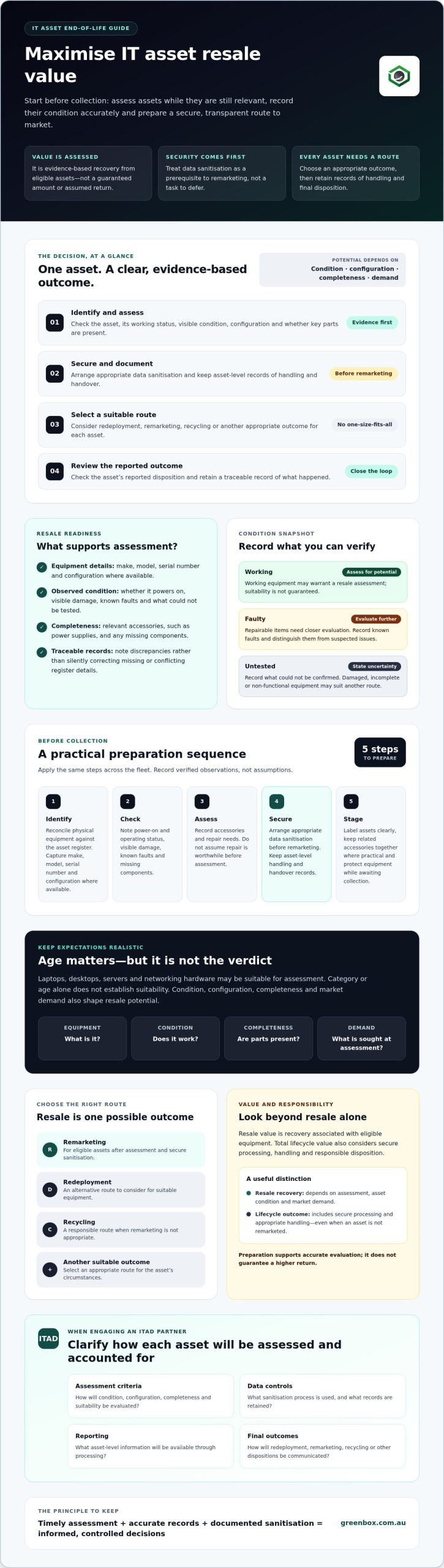
To maximise IT asset resale value, follow a controlled sequence: identify each asset, assess its condition, secure its data, document its details, select an appropriate route and review the outcome. This gives your team a clearer basis for decisions and keeps value recovery connected to security and responsible handling.
- Identify: Record available asset details and distinguish equipment from accessories.
- Assess: Note working status, visible damage, missing parts and known faults.
- Secure and document: Arrange appropriate data sanitisation and retain asset-level records.
- Route and review: Consider remarketing, redeployment, recycling or another suitable outcome, then check the reported disposition.
Resale value is the recovery associated with eligible equipment. Total lifecycle value also considers secure processing, handling and responsible disposition. An asset that is not suitable for remarketing still needs a controlled outcome. Treat sanitisation as a prerequisite to resale, not a task to defer until after transfer.
Assess and prepare IT assets to improve resale readiness
A consistent pre-collection assessment gives your organisation a clearer picture of its assets and reduces avoidable uncertainty during processing. It will not guarantee a higher return. Preparation supports accurate evaluation, while resale outcomes still depend on the equipment and market conditions.
Apply the same steps across the fleet, and record what you can verify rather than treating assumptions as facts:
- 1. Identify each asset. Reconcile the physical equipment against your asset register. Record make, model, serial number and configuration where available, and flag missing or conflicting records for follow-up.
- 2. Check function and condition. Note whether a device powers on and operates, any visible damage, known faults and missing components. Record what was tested and what could not be confirmed.
- 3. Assess completeness and repair needs. Record relevant accessories, such as power supplies, and distinguish observed faults from suspected issues. Do not assume repair is worthwhile before an appropriate assessment.
- 4. Secure and document. Arrange data sanitisation through an appropriate process before remarketing, and keep asset-level records of handling and handover.
- 5. Stage for controlled transfer. Label assets clearly, keep related accessories together where practical and protect equipment from damage while it awaits collection.
Create a reliable inventory and condition record
Agree on simple condition categories your team can apply consistently, such as working, faulty or untested, and define what each category means. Capture damage, missing parts and known repair requirements before equipment leaves your site. If a register lists a device that cannot be located, or a serial number does not match, record the discrepancy rather than silently correcting it. This creates a traceable starting point for assessment.
Preserve resale readiness during handling
Keep custody controlled from staging through to handover. Do not make unapproved repairs, remove components or change configurations without considering security and assessment requirements. Clear identification and careful handling help maintain the connection between each device and its record. If equipment is not suitable for remarketing, retain its identification and handling records as it moves to the agreed end-of-life route.
For more detail on how refurbishment and remarketing can support value recovery, read this guide to refurbished IT asset resale. Organisations considering specialist support can also review Greenbox IT asset recovery to explore coordinated secure handling and potential remarketing.
Choose the right route: remarketing, redeployment or recycling
A technology refresh does not have to send every device down the same path. One laptop may suit internal redeployment, another may be worth assessing for remarketing, while damaged or obsolete equipment may need recycling or another responsible end-of-life outcome. Decide asset by asset, weighing utility, condition, security needs and organisational requirements.
Use this framework to guide the decision. These are assessment signals, not guarantees of acceptance or value.
| Route | Suitable signals | Considerations and evidence |
|---|---|---|
| Redeployment | Equipment appears functional and there is an internal need. | Check compatibility, support requirements, security controls and remaining useful life. Record the intended user or business purpose and any checks required before reuse. |
| Remarketing | Equipment may be functional or repairable, reasonably complete and suitable for secure processing. | Ask for assessment against condition, configuration, completeness and market suitability. Confirm data sanitisation, reporting and any agreed handling or processing fees. |
| Recycling | Equipment is at end of life, unsuitable for reuse or has no practical recovery pathway. | Confirm the responsible recycling outcome and retain records showing the asset’s final disposition. |
| Other disposal | No suitable reuse or recycling route is identified. | Clarify why this route is appropriate, how the asset will be handled and what evidence of final disposition will be provided. |
When should an organisation consider remarketing?
Consider remarketing when assessment shows plausible market suitability, not simply because equipment belongs to a commonly resold category. Functionality, physical condition, completeness and configuration all inform the decision. Data security readiness matters too: sanitisation should be planned before an asset is offered for resale. The NIST Guidelines for Media Sanitization provide reference guidance on sanitising data-bearing media. Organisations should confirm that their chosen approach fits their own security requirements.
Ask an ITAD provider to assess eligible assets and explain the basis for its recommendation. To maximise IT asset resale value, distinguish potential gross proceeds from net recovery. Net recovery accounts for agreed handling, processing and other applicable fees. Request a transparent breakdown rather than treating an estimated resale figure as the final return.
When is redeployment or recycling more appropriate?
Redeployment may make sense when a device meets an internal need, remains compatible with required systems and can be supported for its expected use. Recycling is more appropriate for equipment that is unsuitable for reuse or has reached end of life. Different assets in the same refresh may need different routes. For broader lifecycle context, see this guide to sustainable IT asset recovery.
Protect data and maintain evidence while recovering asset value
Data sanitisation must happen before a data-bearing device is remarketed or redeployed, not after transfer. Build this control into the asset pathway from the outset so a commercial assessment never takes priority over protecting information. The appropriate approach depends on the media type, data sensitivity and your organisation’s security requirements. Physical destruction may be appropriate in some cases, but it is not automatically required for every device.
“Secure sanitisation and resale preparation work best as one controlled process: protect the data first, then document the asset’s readiness for its next use.”
Coordinate secure data sanitisation with asset assessment
NIST SP 800-88 Rev. 2, published in September 2025, describes Clear, Purge and Destroy as media sanitisation methods and recommends considering IEEE 2883 for sanitisation techniques. Use the guidance as a reference, then select a method that fits your approved security policy and the specific storage media. HDDs, SSDs and mobile devices may require different techniques, so do not assume one process suits every asset.
Coordinate assessment and sanitisation without confusing their purposes: condition and configuration inform resale suitability, while sanitisation addresses data risk. Ask a provider to explain how it identifies media, selects the method and records the outcome. For more detail, consult this certified data sanitisation guide.
Keep a clear record from collection to final outcome
Asset-level records make it easier to trace equipment through handover, processing and final disposition. Agree in advance what evidence you need and how it will map back to your inventory. A certificate or processing report is useful only when its scope and identifiers are clear. Do not assume all providers use the same format or include the same details.
- Asset identity: Record available identifiers, such as the serial number and asset-register reference.
- Custody transfers: Log when and to whom assets are handed over, according to your agreed process.
- Sanitisation outcome: Confirm what method was applied, to which asset or media, and what evidence is supplied.
- Final disposition: Record whether each item was remarketed, redeployed, recycled or handled through another agreed route.
Complete records support internal review, audit preparation and stakeholder confidence. They can also help identify gaps, such as an asset with no matched processing outcome. Before engagement, confirm exactly which reports are available, what identifiers they contain and which processing stages they cover. This keeps the evidence useful without assuming a particular document or outcome.
To coordinate data sanitisation with asset recovery and remarketing, explore Greenbox’s IT asset recovery services.
Build a repeatable IT asset resale process with an ITAD partner
A defined process makes each refresh easier to manage and gives your organisation a consistent basis for decisions. It also helps align commercial goals with security, accountability and responsible handling. Set out the work before equipment moves:
- Define the scope: Set out the asset groups, volumes and intended outcomes, including equipment that may be redeployed, remarketed or recycled.
- Prepare the inventory: Share available asset details and flag missing records, known faults or special handling requirements.
- Agree controls: Confirm data sanitisation expectations, custody arrangements, assessment criteria and the records you need.
- Arrange collection: Document responsibilities, collection arrangements and how assets will be identified at handover.
- Assess and review: Compare assessed condition and proposed routes with the agreed scope, then review each asset’s final outcome.
What to agree with an ITAD partner before collection
Put the working arrangements in writing. Confirm which asset categories the partner will accept for assessment, how collection will be arranged and who is responsible at each stage. Ask how resale eligibility is determined, what factors affect the assessment and how any associated service fees are established. Clarify what happens when an asset is not suitable for remarketing.
Agree how asset-level assessment, sanitisation and final disposition will be recorded. Ask what reporting is available, which identifiers it includes and how you can match outcomes back to your inventory. Do not assume a particular certificate or report is standard. Confirm its format and scope before collection.
A specialist partner can coordinate IT asset recovery, data sanitisation and asset remarketing as connected parts of the process. Greenbox provides these services for Australian businesses, with remarketing as a possible outcome for eligible hardware, not a guaranteed return. Discuss secure IT asset recovery with Greenbox to explore whether its services suit your requirements.
Review outcomes and improve the next refresh cycle
Once processing is complete, reconcile the collected inventory against assessed, remarketed, redeployed and recycled outcomes. Follow up on unmatched items or records that do not clearly explain an asset’s final disposition. This review helps you check whether the agreed controls and reporting provided the visibility your organisation needs.
Look for recurring issues, including incomplete asset records, missing accessories, avoidable damage or equipment that was difficult to assess. Apply those lessons to procurement, asset tracking and refresh planning. Better records and earlier preparation can help maximise IT asset resale value, while transparent processing supports secure, responsible recovery even when resale is not the right route.
Make your next asset refresh count
Resale outcomes are shaped before equipment leaves your organisation. Identify and assess assets early, keep inventory and condition records accurate, and choose the right route for each item. Remarketing may recover value from eligible equipment, while redeployment or responsible recycling may be a better fit for others. Secure data sanitisation and clear processing evidence should remain part of every decision.
This measured approach can help you maximise IT asset resale value without treating returns as guaranteed or putting information security second. It also creates a repeatable process your team can review and improve with each refresh.
Greenbox has supported Australian businesses with IT asset recovery and remarketing services since 2000. It operates R2-certified facilities.
To discuss a secure, documented approach for your retired equipment, contact Greenbox about IT asset recovery. With the right preparation and a transparent process, your organisation can make informed, responsible decisions about each asset’s next step.
Frequently Asked Questions
How can a business maximise IT asset resale value?
Start with a reliable inventory and a consistent condition assessment. Record each asset’s make, model, serial number, configuration and known faults where available, then consider whether it may suit redeployment or remarketing. Arrange appropriate data sanitisation before resale and retain records of the outcome. A provider’s assessment can help establish realistic options, but recovery depends on factors such as condition, completeness and market demand.
Which IT assets are most suitable for resale?
Suitability depends on the individual asset, not just its category or age. Working laptops, desktops, servers and networking equipment may be considered, subject to condition, configuration, completeness, demand and data-security requirements. Record observable faults and missing components so they can be considered during assessment. Before preparing a batch, ask the provider which categories it accepts for assessment and how it determines whether each item is suitable for remarketing.
Does data sanitisation reduce the resale value of IT assets?
Data sanitisation should be treated as a necessary control for responsible remarketing, not an optional trade-off against recovery. The appropriate method depends on the device, storage media, data and your organisation’s requirements. Do not assume sanitisation damages hardware or that every device must be physically destroyed. Ask how the method is selected and what evidence will be provided, then retain records linking each asset to its sanitisation outcome.
Should a business refurbish IT assets before resale?
Not automatically. First document the asset’s condition and identify any faults, missing parts or possible refurbishment needs. Then ask the provider to assess suitability and clarify whether proposed work is appropriate before authorising it. Consider the expected route alongside the work and handling involved, rather than assuming repairs will improve recovery. Agree in advance who can approve refurbishment and how any associated service fees will be handled.
How should a business compare remarketing with recycling?
Assess each asset individually, considering its condition, remaining utility, security requirements and potential next use. Eligible equipment may suit remarketing, while items that cannot reasonably be reused may need recycling or another appropriate end-of-life route. Compare the full process, including documentation and agreed service fees, rather than focusing only on possible resale proceeds. Different items in the same refresh batch can warrant different outcomes.
What records should accompany IT assets during resale?
Maintain an inventory with available identifiers, such as make, model and serial number, alongside condition notes and known faults. Track collection and custody transfers, sanitisation outcomes, assessment decisions and final disposition. Ask the provider what reports or certificates it supplies, which asset identifiers they include and what processing stages they cover. Consistent records help your team reconcile equipment and review how each item was handled throughout the process.
When should an organisation start preparing assets for resale?
Start during refresh planning, before equipment is decommissioned or collected. Early preparation gives your team time to reconcile records, identify possible routes, plan secure sanitisation and agree who is responsible for handling. It can also help prevent avoidable damage or the loss of accessories while assets are staged. Set the timeline around your asset volume, operational requirements and collection plan, and confirm assessment criteria with the provider in advance.