

What if the greatest IT asset disposition risk isn’t the final disposal step, but the hand-offs that happen before it? A device can leave organisational control with sensitive data still on it, while incomplete custody records make its journey difficult to verify. Effective IT asset disposition risk management starts well before an asset reaches its final destination.
It’s understandable to focus on secure data destruction and responsible recycling. But when security, environmental and financial risks sit with different teams, gaps can emerge between collection, transport, sanitisation, recovery and final disposition. Recording evidence at each hand-off helps close those gaps and demonstrate accountability.
This guide explains how to identify and control ITAD risks across the asset lifecycle, and which records can support internal assurance, audits and incident response. It also covers how secure recovery, asset remarketing and responsible recycling can work together to protect information, recover value and support more sustainable outcomes.
Key Takeaways
- Build IT asset disposition risk management into retirement planning, with clear ownership across IT, information security, procurement, risk and sustainability.
- Map each stage, from inventory and authorisation to processing and final disposition, and assign a control and accountable role to every step.
- Test whether documented controls match actual practice by reviewing exceptions, asset reconciliations and escalation paths.
- Use a repeatable process to set expectations, retain evidence and improve controls as risks or operations change.
- Greenbox brings secure recovery, data sanitisation, remarketing and recycling together to support traceable outcomes, reuse and responsible resource recovery.
Why IT asset disposition risk management starts before equipment is retired
IT asset disposition risk management is the process of identifying, controlling and evidencing risks from the decision to retire an asset through to its verified final outcome. It goes beyond arranging collection or choosing whether equipment should be resold or recycled. It defines who owns each decision, which safeguards apply and what records will show that the asset was handled as intended.
Start when an organisation selects equipment for retirement, not when collection is arranged. Confirm which assets are in scope, whether any still support business services, what information they may hold and whether they have reuse or resale value. Leaving these questions until collection can create gaps in ownership, planning and evidence.
Decommissioning brings several considerations together. A retired laptop may still store business or personal information, while a server or network device could support a service or contain components with recoverable value. The right outcome depends on the asset and the controls it requires.
Which business risks can an ITAD process create?
Risk can arise when a device is misplaced, processed incorrectly or sent down an unsuitable disposition path. Each exposure needs a control and an accountable owner.
- Data exposure: Information left on a device could be accessed without authorisation, creating privacy, security and reputational concerns.
- Service disruption: Equipment marked for retirement could still support a business process. Removing it before checking dependencies may interrupt work or complicate recovery.
- Lost asset value: Devices suitable for reuse or remarketing may instead be discarded, reducing potential financial recovery and opportunities to extend their useful life.
- Environmental harm: Poor sorting or an unsuitable disposal route may prevent materials from being recovered responsibly and create avoidable environmental impacts.
These risks are connected. If a device cannot be matched to an inventory record, it is harder to track, assess for data sanitisation and direct to an appropriate reuse or recycling outcome.
Why does an end-to-end view matter?
An asset can pass through several stages and hands: internal approval, collection, transport, processing and final disposition. Each transition can introduce a different risk. A collection record, for example, has limited value if it cannot later be reconciled with the asset’s sanitisation and disposition outcomes.
Data sanitisation is one important control within that lifecycle. Choose a method that reflects the asset, its information and the organisation’s requirements, then retain evidence of the decision and its execution. The enterprise guide to certified data sanitisation provides a practical foundation for embedding relevant controls from retirement planning through to verified disposition.
Map ITAD risks and controls across every asset hand-off
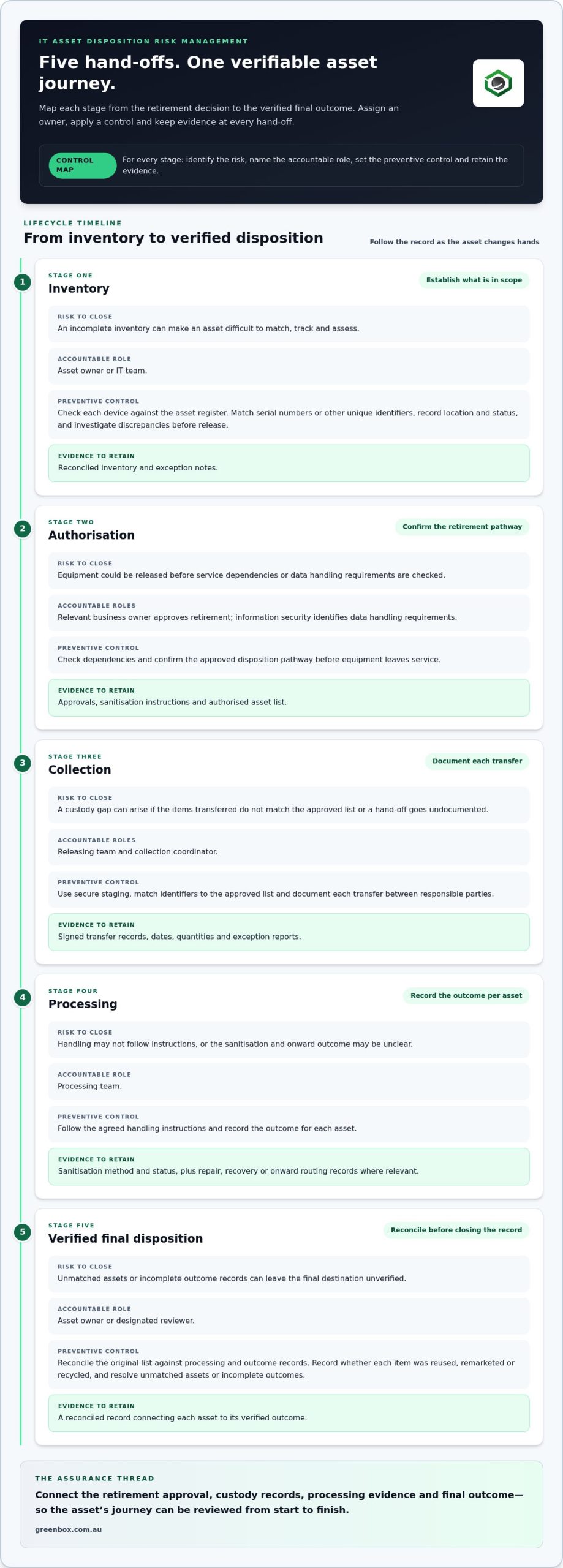
A practical control map follows each asset from the retirement decision to its final outcome. For every stage, record four things: the risk, the accountable role, the preventive control and the evidence to retain. This turns IT asset disposition risk management into a sequence teams can review, rather than a general expectation to “handle equipment securely”.
The roles below are examples. Assign named owners that match your organisation’s structure and approval pathways.
- Inventory: The asset owner or IT team checks each device against the asset register. Match serial numbers or other unique identifiers, record location and status, and investigate discrepancies before release. Retain the reconciled inventory and exception notes.
- Authorisation: The relevant business owner approves retirement, while information security identifies data handling requirements. Check dependencies and confirm the approved disposition pathway before equipment leaves service. Retain approvals, sanitisation instructions and the authorised asset list.
- Collection: The releasing team and collection coordinator confirm the items being transferred. Use secure staging, match identifiers to the approved list and document each transfer between responsible parties. Keep signed transfer records, dates, quantities and exception reports.
- Processing: The processing team follows the agreed handling instructions and records the outcome for each asset. Retain results showing the sanitisation method and status, alongside records of repair, recovery or onward routing where relevant.
- Verified final disposition: The asset owner or designated reviewer reconciles the original list against processing and outcome records. Record whether each item was reused, remarketed or recycled, and resolve unmatched assets or incomplete outcomes before closing the record.
Where can custody and operational controls fail?
Visibility can break down when an inventory is incomplete, release approval is unclear, ownership changes between teams or a transfer goes undocumented. Maintain control by comparing each asset identifier with the approved list at release and receipt, then investigating any mismatch. Chain-of-custody records show who held an asset and when. They do not, by themselves, prove that its data was sanitised or destroyed.
Traceable custody records connect asset identifiers, transfer dates, responsible parties and reconciled quantities. They help teams establish who controlled each device at every hand-off and investigate discrepancies using a clear audit trail.
How should data and environmental outcomes be evidenced?
Keep evidence of data outcomes separate from custody documentation. Record the sanitisation method, asset identifier, result and any exception or follow-up required. For downstream outcomes, retain records showing whether an asset entered reuse, remarketing or recycling. Collection alone does not prove that processing is complete. The sustainable IT asset recovery approach shows how recovery and environmental outcomes can be considered together, while recognising that assets can follow different pathways.
Greenbox brings secure recovery, data sanitisation, remarketing and e-waste recycling together to support managed asset disposition. Explore Greenbox’s IT asset recovery services as part of a lifecycle approach that connects controlled hand-offs with documented outcomes.
Assess ITAD risk controls without relying on assumptions
A policy describes the intended process; it doesn’t prove that each retirement followed it. Assess ITAD controls by comparing written requirements with completed transactions. Check that records identify the assets handled, show approvals and transfers, document outcomes and account for exceptions. If an asset is missing from a reconciliation, for example, the review should show who investigated the discrepancy and how it was resolved.
Use your organisation’s established risk methodology to assess likelihood, impact and priority. Avoid introducing an arbitrary ITAD score. Apply existing criteria consistently, record assumptions and escalate gaps through the usual governance channels.
What evidence shows that a control is operating?
Start with current procedures and named responsibilities, then sample completed transactions. Check that approvals, transfer records and outcome documents are present and consistent. Reconcile the collected asset list with processing results, and trace exceptions through to closure. A certificate or other certification can inform assurance, but it doesn’t replace transaction-level evidence that the required steps were completed for each asset.
How should Australian privacy and compliance exposure be reviewed?
Ask your legal, privacy and risk teams to identify which obligations apply to your organisation, the information involved and the planned disposition. The Privacy Act 1988 and relevant Office of the Australian Information Commissioner (OAIC) guidance may inform controls where applicable. Neither is a blanket answer for every organisation or asset. Record the requirements considered, the decisions made and who reviewed them.
Then test the policy against operational evidence. Can reviewers follow an asset from approval to its recorded outcome? Are missing identifiers, failed processing steps or incomplete records escalated? A sound assessment identifies the gap, assigns an owner and tracks remediation. A documented procedure alone does not show that it is working.
Build a repeatable ITAD risk management process
A repeatable process makes IT asset disposition risk management part of normal governance, rather than a set of checks assembled for each retirement project. Start with clear policy and ownership, then define a route for each decision, exception and final outcome.
- Set the policy and scope. Define which assets and disposition activities the process covers, the required approvals, record-keeping expectations and how data and environmental outcomes will be considered.
- Assign decision owners. Name who can approve retirement, confirm information security requirements, release equipment and accept completion evidence. Set a delegate or escalation route for when an owner is unavailable.
- Prepare each retirement. Reconcile proposed assets against the register, check for operational dependencies and record the approved handling pathway before collection or transfer.
- Control hand-offs and outcomes. Require identifiable transfer records, processing evidence and disposition documentation. Match records back to the approved asset list before closing the activity.
- Manage exceptions. Define how teams respond to missing assets, failed sanitisation, mismatched identifiers and incomplete outcome records. Pause closure, assign an investigation owner, record decisions and escalate unresolved concerns through security or risk channels.
- Review and improve. Examine reconciliations, exceptions, incidents and process changes. Update procedures and staff guidance when evidence shows that a control needs strengthening.
Organisations with limited internal ITAD resources can start with a controlled register, a named process owner, a short approval checklist and a single exception log. Build on records and governance forums already in use, then expand controls where the organisation’s established risk methodology indicates greater exposure. Even a proportionate process needs clear accountability and evidence.
Which roles and decisions should the process define?
How can organisations monitor and improve ITAD controls?
Review whether asset reconciliations close cleanly, exceptions have owners, sanitisation outcomes are recorded and disposition records are complete. Look for recurring causes, not just individual errors. An incident, revised internal process or change in organisational requirements can prompt updated controls and staff guidance. The secure ITAD framework for financial services provides relevant context for sector-specific lifecycle considerations.
Greenbox connects secure recovery, data sanitisation, remarketing and recycling within IT asset lifecycle management. Explore Greenbox’s ITAD services as part of a controlled disposition process with documented outcomes.
How Greenbox supports a controlled ITAD disposition
Effective ITAD connects secure handling with clear decisions about each asset’s next use. Greenbox brings secure asset recovery, data sanitisation, asset remarketing and e-waste recycling together within an IT asset lifecycle service. This lets organisations plan for information security, asset value and responsible material recovery as related parts of disposition, rather than disconnected tasks.
This coordination supports IT asset disposition risk management by helping organisations define requirements and maintain visibility as equipment moves through the process. The right outcome depends on the asset’s condition, data requirements and suitability for reuse. Not every device follows the same path.
How can one ITAD workflow connect security and recovery?
A controlled workflow links collection and handling with the appropriate data sanitisation or destruction step, then directs each asset to its recorded downstream outcome. Connecting these activities helps organisations understand what happened to equipment and identify where follow-up is needed.
- Secure recovery: Assets enter a managed disposition process with attention to handling and accountability.
- Data sanitisation and destruction: Data handling is treated as a core control, with the required approach guided by organisational requirements.
- Remarketing: Eligible assets may be prepared for value recovery and further use, depending on their condition and suitability.
- Recycling: Equipment that isn’t suitable for reuse can be directed to responsible e-waste recycling.
Records of handling and outcomes give internal teams a clearer view of the disposition pathway and support assurance activities. Greenbox operates R2-certified facilities and describes itself as a carbon-neutral organisation. These points form part of its operational and environmental context; they don’t mean every asset follows the same processing route or has the same outcome.
What should the next step look like?
Before planning a programme, bring the relevant internal owners together to establish:
- Asset scope: Which equipment is included, and how will it be identified?
- Risk priorities: Which data handling, custody, recovery and environmental considerations shape the process?
- Reporting needs: Which records will help the organisation reconcile assets and understand final outcomes?
These decisions create a practical starting point for aligning an ITAD programme with existing governance. Greenbox has supported IT asset lifecycle management since 2000, bringing secure recovery, data sanitisation, remarketing and recycling to the process. A defined scope and reporting expectations help connect that work to your organisation’s assurance needs.
To discuss a risk-managed ITAD programme shaped around your requirements, speak with Greenbox about IT asset disposition.
Make your next retirement a stronger starting point
The next asset retirement can be an opportunity to test how well your governance works in practice. Choose a defined group of devices, agree who owns each decision and set the evidence needed to close the process. Review what the records reveal, address gaps and use those lessons to refine the approach before applying it more broadly.
This practical first step turns IT asset disposition risk management into an ongoing capability, not a policy that sits on the shelf. It also gives teams a shared basis for discussing security, accountability and responsible recovery.
Greenbox can help shape a risk-managed ITAD programme around your asset scope, priorities and reporting needs. Discuss an ITAD programme with Greenbox to take the next step towards a more controlled disposition process. With clear ownership and a considered plan, your organisation can move forward with greater confidence.
Frequently Asked Questions
What is IT asset disposition risk management?
IT asset disposition risk management is the governance of risks that arise as an organisation retires and processes technology assets. It helps teams make consistent decisions about devices, data and final outcomes, rather than treating each item as an isolated disposal task. For example, a retirement plan can identify whether laptops, docking stations and storage media need different handling, approvals or records before they leave the business.
What are the main risks of IT asset disposition?
The main risks include unauthorised access to information, loss of equipment, disruption to services, missed asset value and poor environmental outcomes. Risk can also hide in overlooked items: a small storage device or printer may hold information even when the main computer has been accounted for. Review not only obvious hardware, but also accessories, removable media and equipment held in storage or assigned to departing staff.
How can an organisation maintain chain of custody during ITAD?
Maintain chain of custody by linking each transfer to an identifiable asset or clearly defined batch, with a record of who released and received it and when. For a mixed collection, a manifest can distinguish individual serial-numbered equipment from items recorded by quantity. If the receiving count differs from the release record, flag the discrepancy, preserve the records and follow the organisation’s escalation process rather than silently adjusting the inventory.
Does ITAD risk management include data sanitisation?
Yes. It includes deciding how data on each asset will be handled and confirming that the chosen sanitisation or destruction outcome is recorded. A laptop with an operational drive may require a different treatment decision from damaged media that cannot be processed as planned. If a sanitisation attempt fails or its result is unclear, keep the asset on the exception pathway until an authorised decision resolves the data risk.
How should a business assess an ITAD process?
Assess the process by tracing a sample of completed asset retirements from approval through to their recorded outcomes. Compare the register, transfer documentation and processing records, then check whether exceptions were assigned, escalated and resolved. A walkthrough with staff who perform the work can reveal informal steps or hand-offs that a written procedure misses. Apply the organisation’s existing risk criteria to prioritise control gaps.
What records should an organisation retain for IT asset disposition?
Retain records that let an authorised reviewer reconstruct what happened to an asset. These may include its identifier and condition, retirement approval, handling instructions, transfer details, sanitisation result, final disposition and reconciliation sign-off. Keep relevant versions or dates for records that can change, such as instructions or exception decisions. Organise evidence so teams can retrieve it for assurance or incident review, and follow the organisation’s retention and access-control practices.
How does ITAD risk management support sustainability?
ITAD risk management supports sustainability by making the reason for each asset’s outcome visible and reviewable. Equipment suitable for continued use may be considered for recovery or remarketing, while unsuitable assets can be directed to recycling. Recording the chosen pathway helps organisations distinguish reuse from material recovery and identify equipment that wasn’t accounted for as intended. This gives sustainability teams more meaningful disposition information for internal reporting and future planning.