

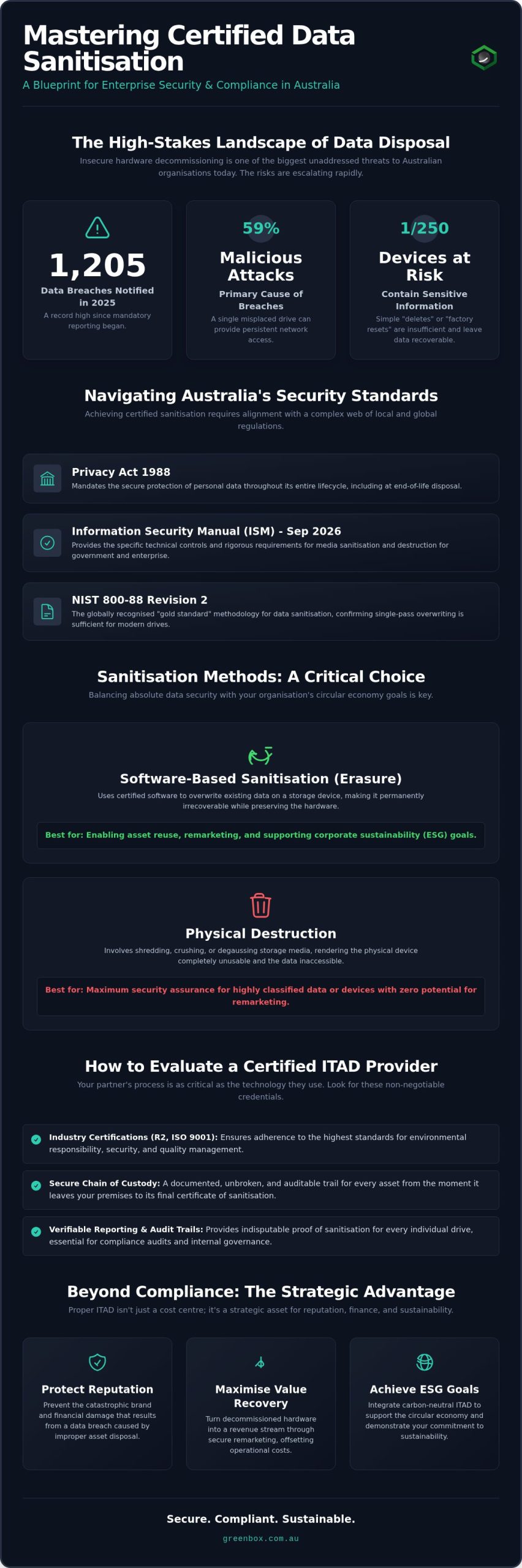
With Australian organisations notifying a record 1,205 data breaches in 2025, the stakes for hardware decommissioning have never been higher. For enterprise leaders, the risk of a single misplaced hard drive triggering a Notifiable Data Breach is a constant operational pressure. Managing the logistics of a distributed national fleet while adhering to the September 2026 ISM updates and the Privacy Act is a complex, high-stakes responsibility. You shouldn’t have to compromise between rigorous security and your corporate sustainability targets.
This guide provides the definitive blueprint for mastering certified data sanitisation Australia. We’ll help you move beyond the fear of non-compliance by establishing a secure, audit-ready chain of custody that meets the latest NIST 800-88 Revision 2 standards. We’ll examine the intricacies of national logistics and risk mitigation during asset recovery. We also preview how integrating carbon-neutral ITAD services can turn your redundant hardware into a strategic asset through remarketing and value recovery. By the end of this guide, you’ll have a clear framework to protect your reputation, your data, and the planet with confidence.
Key Takeaways
- Understand your legal obligations under the Privacy Act 1988 to ensure that all data-bearing devices undergo a permanent and irreversible sanitisation process.
- Align your IT asset disposal protocols with the September 2026 ISM updates and NIST 800-88 standards to achieve rigorous certified data sanitisation Australia wide.
- Evaluate the security efficacy of software-based erasure versus physical destruction to balance data protection with your organisation’s circular economy goals.
- Identify the critical certifications, such as R2 and ISO 9001, required to maintain a secure and transparent chain of custody for distributed fleets.
- Discover how integrating carbon-neutral ITAD services can offset operational costs through asset remarketing while supporting your broader ESG commitments.
The Growing Risk of Insecure Data Disposal in Australia
Certified data sanitisation Australia is a fundamental requirement for modern risk management. It’s defined as the deliberate, permanent, and irreversible process of removing data from a storage device so that it cannot be reconstructed. This standard is vastly different from a simple “delete” command or a “factory reset”. Those common methods usually leave the underlying data intact on the disk, making it accessible to anyone with basic recovery software. For an enterprise, relying on such surface-level actions is a gamble that invites regulatory scrutiny and technical failure.
The Privacy Act 1988 places a clear burden on Australian organisations to secure personal data throughout its entire lifecycle. When a device reaches the end of its functional life, the legal obligation to protect that data doesn’t vanish. Failure to implement professional sanitisation can lead to significant penalties and a loss of consumer trust. Research from PwC highlights the scale of this issue, reporting that 1 in 250 disposed devices still contain sensitive information. This statistic represents a massive, unaddressed “back door” for data theft that often goes unnoticed until a breach is reported.
Cyber Security Threats and the Cost of a Breach
Hardware disposal is frequently the weakest link in a corporate security strategy. While teams focus on firewalls and encryption, decommissioned laptops and servers often sit in unsecured storage or are sold with their storage media intact. The OAIC reported 1,205 data breaches in 2025, the highest total since mandatory reporting began. Malicious or criminal attacks were responsible for 59% of these incidents. A single misplaced drive containing network credentials or PII can grant an attacker persistent access to your internal systems. The reputational damage from such a breach often outweighs the immediate financial penalties, as clients lose confidence in your ability to manage their private information.
Regulatory Compliance: Beyond the Essential Eight
Australian organisations are increasingly looking to the latest September 2026 Information Security Manual (ISM) and the PSPF Release 2026 for guidance. While the Essential Eight provides a baseline, the Security of Critical Infrastructure Act 2018 has raised the bar for disposal protocols across the country. Private sector leaders are now adopting government-level standards to ensure their audit trails are beyond reproach. Utilising various Data sanitization methods, such as cryptographic erasure or physical destruction, allows businesses to meet these rigorous requirements. This shift toward high-standard disposal reflects a broader trend of integrating security with operational efficiency.
Navigating Australian Security Standards: ISM, PSPF, and NIST 800-88
Achieving certified data sanitisation Australia requires a deep understanding of the overlapping regulatory landscape. For government agencies and their private sector partners, the Protective Security Policy Framework (PSPF) Release 2026 serves as the primary mandate. It dictates how entities must manage security risks, including the disposal of sensitive hardware. Central to this is the Australian Information Security Manual (ISM), which provides the technical controls for media destruction and sanitisation. These aren’t just suggestions; they’re rigorous requirements designed to ensure that data remains protected throughout its entire lifecycle.
While the ISM provides the local framework, the NIST 800-88 Revision 2 guidelines offer a globally recognised methodology for executing these tasks. Revision 2, published in late 2025, simplified the process by confirming that multi-pass overwriting is largely unnecessary for modern drives. For software-based solutions, ISO/IEC 15408 (Common Criteria) remains the gold standard. It ensures that the tools used to perform sanitisation have been independently verified to do exactly what they claim. This level of certification is essential for enterprise procurement leads who need to justify their security spend to the board.
The ISM Alignment: What Enterprises Need to Know
The ACSC’s view on software-based overwriting has evolved significantly with storage technology. Today, the focus is on verifiable reporting and a transparent audit trail. Every asset must be accounted for from the moment it leaves your rack until the final certificate is issued. We ensure our processes remain aligned with the latest September 2026 ISM revisions, giving you the confidence that your decommissioning projects meet the highest national security standards. A robust audit trail isn’t just about ticking a box; it’s about providing a “Certificate of Destruction” that serves as a legal shield in the event of an audit or inquiry.
NIST 800-88: The Global Standard in an Australian Context
Choosing the right sanitisation level depends on your data’s sensitivity and the device type. ‘Clear’ involves logical techniques to sanitise data in all user-addressable storage locations, suitable for lower-sensitivity assets. ‘Purge’ uses physical or logical techniques to render target data recovery infeasible, even with advanced laboratory tools. Finally, ‘Destroy’ involves physical destruction where the media can no longer be used for storage. Selecting the correct path is vital for balancing security with value recovery. If you’re unsure which standard applies to your fleet, our specialists can help you design a compliant disposal strategy that fits your risk profile and operational needs.
Software-Based Sanitisation vs. Physical Destruction
Deciding between physical shredding and software-based erasure is a pivotal moment in any decommissioning project. While shredding offers a visceral sense of security, it’s a destructive process that effectively ends the asset’s lifecycle. Software-based erasure, when executed to the highest standards, provides the same level of security without the environmental toll. For enterprise leaders, certified data sanitisation Australia wide means selecting the method that best balances risk mitigation with corporate responsibility. It’s about moving away from “shred-everything” policies toward a more intelligent, data-driven framework.
Physical destruction remains the necessary choice for damaged or obsolete media that cannot be accessed via software. If a hard drive has a mechanical failure or an SSD controller is unresponsive, shredding is the only way to guarantee the data is irrecoverable. However, for the majority of functional enterprise fleets, software sanitisation is the superior option. It allows for a verifiable, bit-by-bit overwrite of the entire drive, including hidden sectors, ensuring that no trace of sensitive information remains before the hardware enters its next phase.
The Circular Economy Advantage
Australia’s e-waste problem is accelerating, with 588,000 tonnes generated in 2023 alone. Software-based sanitisation is a powerful tool for reversing this trend. By choosing to sanitise and reuse hardware, your organisation supports a circular economy that keeps materials in use for longer. This approach aligns perfectly with the Protective Security Policy Framework (PSPF), which emphasises the responsible management of government and enterprise assets. Our carbon-neutral approach ensures that the entire sanitisation lifecycle contributes to your broader ESG targets, turning a potential liability into a sustainability win.
Maximising Value Recovery through Remarketing
The financial argument for software-based erasure is just as compelling as the environmental one. A shredded laptop is reduced to a few dollars of scrap value, whereas a refurbished unit can be remarketed to recover significant capital. These remarketing commissions often offset the entire cost of the ITAD service, transforming a traditional cost centre into a source of value. We handle the complexities of the secondary market, ensuring that all corporate identifiers are removed and the hardware is presented in its best possible light. This disciplined approach protects your brand while delivering a tangible return on your technology investment.
How to Evaluate a Certified Data Sanitisation Provider
Selecting a partner for certified data sanitisation Australia is a critical exercise in risk management. It’s not merely a service procurement; it’s a verifiable transfer of liability. When your organisation decommissions hardware, the responsibility for the data remains yours until a certificate of destruction is issued. To mitigate this risk, you must look beyond marketing claims and verify a provider’s operational credentials. High-security sectors like government and finance require a partner that maintains ISO 9001 for quality, ISO 14001 for environmental management, and ISO 45001 for occupational health and safety. These certifications ensure that the provider’s internal processes are subject to rigorous, independent scrutiny.
Transparency is the hallmark of a professional ITAD partner. You should demand real-time visibility into the asset lifecycle, from the moment a device is collected until its final disposition. A provider that cannot offer a clear, digital audit trail creates a “black hole” in your security posture. The quality of the final reporting is equally vital. A robust Sanitisation Report must include specific serial numbers, the method of erasure used, and a timestamp of completion. This documentation serves as your primary evidence during a regulatory audit or a Privacy Act inquiry.
The Importance of R2 Certification
R2 (Responsible Recycling) is the global standard for the electronics disposal industry. It provides a comprehensive framework for both data security and environmental compliance. Uncertified “recyclers” often lack the infrastructure to protect your data during transit or the ethical oversight to prevent illegal e-waste dumping. R2-certified facilities are required to follow strict protocols for data sanitisation and material recovery. The rigour of third-party audits ensures that every asset is handled with precision. Choosing an R2-certified provider protects your organisation from the legal and reputational fallout of improper disposal.
Logistics and Chain of Custody Security
Managing a distributed fleet across Australian sites requires a sophisticated logistics network. You need a provider that can maintain a consistent, secure process regardless of the location. This includes the use of GPS-tracked, secure vehicles and staff who have undergone thorough background checks. The choice between on-site and off-site sanitisation depends on your specific risk profile. On-site services provide immediate peace of mind by erasing data before the hardware ever leaves your premises. Off-site services, conducted at a secure facility, often allow for higher throughput and more efficient value recovery. To ensure your next decommissioning project meets these rigorous criteria, you can request a detailed audit of our sanitisation protocols and logistics capabilities.
Integrating Security and Sustainability with Greenbox ITAD
Greenbox stands as the premier Australian partner for organisations requiring absolute certainty in their technology transitions. We provide a comprehensive, end-to-end service that spans from initial pre-configuration to certified data sanitisation Australia wide. By managing the entire lifecycle, we eliminate the fragmentation that often leads to security gaps during hardware decommissioning. Our carbon-neutral organisation status ensures that your data protection measures don’t come at an environmental cost, aligning technical excellence with ecological stewardship. This integrated model provides a steady, experienced hand for complex transitions, allowing your leadership team to focus on core business objectives.
A Partnership-Focused Approach to ITAD
Internal IT teams are often overextended, particularly during large-scale fleet refreshes. We remove this operational burden by acting as a disciplined strategist for your hardware decommissioning. Our team customises sanitisation protocols to meet specific industry mandates, whether you’re governed by the ISM or the Privacy Act. Through the Greenbox visibility portal, you gain a single source of truth for your entire fleet. This platform provides real-time tracking and instant access to your audit-ready certificates, ensuring that certified data sanitisation Australia is managed through a transparent, controlled process. Every asset is tracked with precision, providing the peace of mind that comes from a fully documented chain of custody.
Next Steps: Securing Your Next Technology Refresh
Transitioning to a new technology standard requires meticulous planning and execution. For national hardware rollouts, we often recommend a pilot project to refine logistics and verify the chain of custody before a full-scale deployment. This measured approach allows you to identify potential risks and optimise value recovery through our remarketing channels. You can initiate a secure recovery and sanitisation audit to establish a baseline for your current decommissioning practices. This audit provides a clear view of your risk profile and identifies opportunities for carbon-neutral ITAD services to support your ESG goals. To begin your transition with a partner who values integrity as much as innovation, you can contact Greenbox to organise a secure data sanitisation consultation.
Securing Your Enterprise Future through Disciplined ITAD
Managing the transition of end-of-life IT assets is no longer just a technical task; it’s a strategic imperative. By aligning your protocols with the latest ISM and NIST standards, you protect your organisation from the rising tide of data breaches while ensuring absolute transparency. Professional certified data sanitisation Australia wide guarantees that your audit trails are robust and your compliance with the Privacy Act remains beyond reproach. It’s about building a foundation of trust that extends from your internal teams to your most valued clients.
A sophisticated ITAD strategy also transforms potential e-waste into a source of tangible value. Leveraging remarketing opportunities and carbon-neutral processes allows you to meet aggressive ESG targets without sacrificing operational security. As a carbon-neutral provider with R2-certified facilities and national Australian operations, we provide the steady, experienced hand required for complex hardware transitions. We help you remove the operational burden of decommissioning so you can focus on driving innovation. You don’t have to manage these risks alone.
Partner with Greenbox for Certified Data Sanitisation and secure your next technology refresh with confidence.
Frequently Asked Questions
What is a Certificate of Destruction and why is it necessary?
A Certificate of Destruction is a formal document that confirms your storage media has been professionally sanitised. It’s necessary for maintaining an audit-ready chain of custody and serves as critical evidence for compliance with the Privacy Act. This report includes specific serial numbers and the sanitisation method used. Without it, your organisation cannot prove it has met its legal obligations to protect sensitive data during hardware disposal.
Does physical shredding guarantee 100% data destruction?
Not necessarily for high-density media like SSDs. If the shred size is larger than the memory chip, data can remain. Professional certified data sanitisation Australia requires methods matched to the media type, such as specific shred sizes or software erasure, to ensure total removal. This ensures that even the smallest storage components are rendered unreadable. It’s a critical distinction for enterprises moving away from legacy magnetic storage to modern flash-based systems.
How does NIST 800-88 differ from Australian ISM standards?
NIST 800-88 is a global methodology focusing on ‘Clear’, ‘Purge’, and ‘Destroy’ techniques. The Australian Information Security Manual (ISM) provides specific controls and mandates for Australian government agencies and contractors. While they often align, the ISM is the local regulatory authority for national security compliance. Following both ensures your decommissioning process meets international best practices while satisfying local legislative requirements for data protection.
Can mobile devices like tablets and smartphones be securely sanitised?
Yes, through specialised software that targets internal flash storage and firmware. These devices require different protocols than traditional magnetic hard drives. Professional ITAD providers use factory-level commands and cryptographical erasure to ensure that all personal identifiers and corporate credentials are permanently removed before the hardware is remarketed. This process is essential for maintaining security when transitioning distributed fleets of mobile assets.
What happens to the hardware after the data has been sanitised?
Assets are typically refurbished for remarketing or dismantled for R2-certified recycling. Remarketing allows organisations to recover capital and offset the cost of their technology refresh. If the hardware is obsolete or damaged, it undergoes e-waste recycling where raw materials are recovered. This prevents toxic components from reaching Australian landfills and supports a circular economy by keeping valuable materials in the production cycle for longer.
Is it better to perform data sanitisation on-site or at a secure facility?
The choice depends on your organisation’s specific risk tolerance and logistics. On-site sanitisation eliminates the risk of data loss during transit by erasing drives before they leave your premises. Off-site processing at a secure facility often allows for more efficient, large-scale processing and faster asset remarketing for distributed national fleets. Both methods should provide a transparent, audit-ready chain of custody to ensure full compliance.
How does certified data sanitisation impact our corporate ESG reporting?
Professional certified data sanitisation Australia wide provides verifiable data for your sustainability metrics by documenting the diversion of e-waste from landfill. Choosing a carbon-neutral ITAD provider allows you to report on Scope 3 emission reductions through asset reuse. This disciplined approach demonstrates a commitment to both information security and environmental stewardship. It transforms a routine technical task into a core component of your broader corporate social responsibility strategy.
What are the risks of using a non-certified e-waste recycler?
Uncertified providers often lack a secure chain of custody, which increases the likelihood of a data breach. They may also engage in illegal e-waste dumping, creating significant legal and reputational liabilities for your business. Without R2 or ISO certifications, there is no independent verification that your sensitive data has been permanently and irreversibly destroyed. This lack of oversight can lead to catastrophic failures in your data protection protocols.