

What if the safest next step for a retired business device isn’t recycling, but a carefully managed route to its most responsible next use? Corporate IT asset recovery can protect data and preserve value, but only when each asset remains traceable from collection through final disposition.
It’s reasonable to be concerned about what happens after equipment leaves your site. Data, asset records and potential resale value can all be put at risk when processing lacks clear controls. At the same time, not every device is suitable for reuse or remarketing. Responsible recovery means assessing each item and documenting why it follows a particular route.
This guide explains how to build a traceable recovery process that supports secure data handling, appropriate value recovery and environmental responsibility. You’ll learn how collection, data sanitisation, remarketing and recycling fit together, and how to make recovery part of ordinary asset governance. Greenbox provides managed IT asset recovery for Australian businesses, alongside data sanitisation, asset remarketing and e-waste recycling. Greenbox is a carbon-neutral organisation with R2-certified facilities.
Key Takeaways
- Corporate IT asset recovery is more than collection: plan for secure data handling, clear asset outcomes and complete records.
- Map each stage from asset scope and collection through assessment, sanitisation and final disposition, with accountable hand-offs.
- Match devices to reuse, remarketing or recycling based on condition, security and suitability rather than assuming one outcome fits all.
- Use staged processing to coordinate asset recovery with business owners, security requirements and reporting needs during a technology refresh.
- Greenbox’s Australian operations, carbon-neutral status and R2-certified facilities support a managed approach to recovery.
What corporate IT asset recovery means for business technology
Corporate IT asset recovery is the controlled collection, assessment and disposition of retired business technology. It gives an organisation a managed way to decide what should happen to each item, rather than treating every device as unwanted equipment. Depending on its condition, data status and suitability, an asset may be redeployed, prepared for remarketing, recycled or sent for other end-of-life processing.
Asset recovery is the managed process of assessing, protecting and directing retired equipment to its most appropriate next use or end-of-life outcome, not simply sending it to recycling. The broader concept of Asset recovery can include reuse, redeployment and divestment. For business technology, those outcomes need to sit alongside secure data treatment and records showing how each asset was handled.
Collection is only the start. Without assessment, an organisation may not know whether a device is suitable for another user, has remarketing potential or should instead be recycled. Without appropriate data handling and a recorded disposition, it can also be difficult to establish what happened after equipment left the business. Bringing these steps into one programme connects security, potential financial recovery and environmental responsibility without assuming they always point to the same outcome.
Which business assets can enter a recovery programme?
Common items include laptops, desktop computers, monitors, servers, networking equipment, printers, mobile devices and associated peripherals. Their route depends on the individual asset, not just its category. Age, working condition, completeness and whether the item stores data can all affect assessment and processing. A usable device may be assessed differently from damaged equipment or a component with no suitable reuse pathway.
Planning also needs to reflect where and how equipment is used. Dispersed offices, education environments and government operations may have different asset owners, storage arrangements and collection coordination needs. Grouping items by type, organisational location or refresh project can help define the scope. Keep each item’s identity and data-bearing status visible throughout the process.
What outcomes should a recovery programme deliver?
A well-managed programme maintains control through each hand-off and records a clear disposition for every asset. The outcome should reflect both the equipment and the organisation’s security requirements, rather than a blanket preference for reuse or recycling.
- Controlled hand-off: Retired equipment moves through an accountable collection and processing pathway.
- Appropriate data treatment: Data-bearing assets receive handling suited to their status before any reuse or remarketing decision.
- Recorded disposition: Records show whether an asset was directed towards reuse, remarketing, recycling or another end-of-life process.
Reuse or remarketing may support value recovery when an asset’s condition and security status make that route appropriate. Recycling provides a separate pathway for equipment unsuitable for those outcomes. Assessing each option helps embed sustainability in asset governance while keeping data protection and the condition of each item central to the decision.
How corporate IT asset recovery moves from collection to final disposition
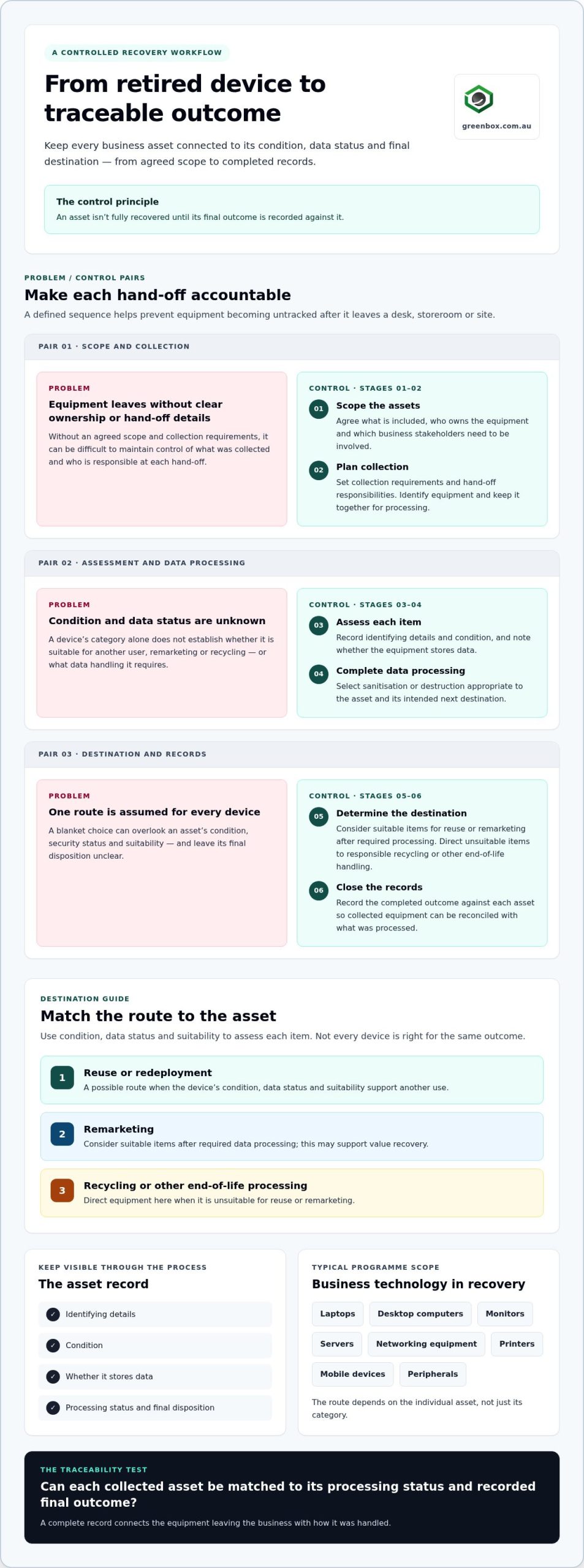
A controlled workflow keeps each device connected to its condition, data status and intended outcome. Corporate IT asset recovery should make every hand-off visible, so equipment doesn’t become untracked once it leaves a desk, storeroom or site. IBM also describes recovery as part of IT asset lifecycle management, linking IBM’s perspective on IT asset recovery with cost, security and data destruction considerations.
Use a defined sequence, with a responsible owner and recorded status at each stage:
- Scope the assets. Agree what is included, who owns the equipment and which business stakeholders need to be involved.
- Plan collection. Set collection requirements and hand-off responsibilities, including how equipment will be identified and kept together for processing.
- Assess each item. Record identifying details and condition, and note whether the equipment stores data.
- Complete data processing. Select appropriate sanitisation or destruction based on the asset and its intended next destination.
- Determine the destination. Consider suitable items for potential reuse or remarketing after required processing. Direct unsuitable items to responsible recycling or other end-of-life handling.
- Close the records. Record the completed outcome against each asset so the organisation can reconcile what was collected with what was processed.
An asset isn’t fully recovered until its final outcome is recorded against it. That record closes the gap between equipment leaving a business and the organisation knowing how it was handled. It also keeps asset information useful for internal review and reporting.
How should collection and assessment be controlled?
Begin with an agreed asset scope, named business stakeholders and collection requirements. During assessment, capture details that distinguish each item, alongside its condition and data-bearing status. Keep data-bearing equipment under controlled handling until its data process is complete. This gives each hand-off a clear purpose and helps prevent devices moving towards reuse, remarketing or recycling before the relevant checks are done.
How does an asset reach its appropriate next destination?
Data sanitisation or destruction should match the device and its planned outcome. A device being considered for another user or remarketing needs the appropriate data process before it moves along that route. Greenbox’s enterprise guide to certified data sanitisation explores how sanitisation fits into secure asset handling. Where condition or suitability rules out further use, responsible recycling or other end-of-life processing provides a distinct destination.
Don’t make these decisions on resale potential alone. Security requirements, asset condition and the suitability of a next use all shape the route. Greenbox’s managed IT asset recovery service brings collection, data processing, remarketing and recycling into a coordinated pathway, with each asset’s disposition kept in view.
How to balance reuse, remarketing and recycling in asset recovery
Choosing an outcome for retired technology means weighing condition, security, operational suitability and environmental responsibility together. Reuse may extend an asset’s service life, while remarketing may offer a route to recover value. Recycling is a separate, necessary pathway for equipment unsuitable for another use. A consistent assessment helps avoid treating one option as the default for every item.
Use this comparison as a starting point. The final route depends on the assessment of each asset.
| Outcome | Suitability | Data status | Intended outcome |
|---|---|---|---|
| Reuse | Functional and suitable for the organisation’s intended use. | Required data processing is completed before redeployment. | Keep the asset in use within an appropriate setting. |
| Remarketing | Condition and functionality may support a subsequent user or market. | Data is sanitised or destroyed as appropriate before onward movement. | Assess whether value can be recovered through remarketing. |
| Recycling | Unsuitable for further use, or another route isn’t appropriate. | Data-bearing components receive appropriate treatment. | Direct materials into responsible end-of-life processing. |
When might reuse or remarketing be appropriate?
Consider whether the equipment functions reliably, is in suitable condition and can meet the requirements of its proposed next use. An item that remains useful within the business may be considered for reuse. Equipment assessed as suitable for another user may be considered for remarketing. In both cases, data processing must align with the intended destination. Any resale value is an assessed possibility, not a guaranteed return.
When should equipment move to recycling or disposal?
Damage, poor function or other assessment findings may make an asset unsuitable for reuse or remarketing. That doesn’t make its final handling less important. A clear recycling pathway supports responsible processing when no further-use option is suitable. The EPA guidelines for electronics recycling offer general information about donation and recycling considerations, while Australian businesses should apply the relevant local context.
For corporate IT asset recovery, a sound decision balances potential value against security, condition and the asset’s realistic next use. Don’t send equipment to remarketing solely because it might have resale potential, or choose reuse if the asset isn’t appropriate for that purpose. Record the reason for the chosen route so financial and environmental objectives remain visible alongside the decision.
Recycling is not a fallback to overlook. It is an intentional destination for assets unsuitable for another use, and should be managed as part of the same programme. Greenbox’s business e-waste recycling guide provides further detail on responsible recycling and end-of-life processing.
How to plan a controlled corporate IT asset recovery programme
A well-planned corporate IT asset recovery programme starts before equipment is collected. Define what’s included, who is accountable and what information will be needed to reconcile each asset’s outcome. This groundwork helps IT, security, procurement, finance and operational teams work to the same process, while keeping collection aligned with business needs and technology refresh plans.
Set the programme scope around practical details such as asset types, ownership, data-bearing status and where equipment is held. Then agree on:
- Owners and contacts: Identify the business teams responsible for approving scope, coordinating collection and resolving exceptions.
- Handling controls: Establish the security requirements for equipment from hand-off through data processing.
- Collection coordination: Align collection arrangements with business operations and refresh activities.
- Records and reporting: Decide which asset details, processing statuses and final outcomes must be reconciled.
- Exception handling: Set a process for incomplete records, ownership queries and equipment unsuitable for reuse.
What should teams agree before recovery begins?
Confirm the asset population and ownership checks with the teams responsible for the equipment. Agree who will manage collection coordination, security requirements and decisions about exceptions. Timing matters: a staged collection can help avoid disrupting business operations during a refresh. If records are incomplete or an item doesn’t match the agreed scope, define how it will be held and resolved rather than allowing it to move through the process without a clear status.
For a large refresh, consider processing assets in defined batches, such as by business unit, site or equipment group. Give each batch an agreed scope and reconciliation point. This can make it easier to identify missing items, manage operational dependencies and review progress without waiting for the entire programme to finish. Keep the method proportionate to the project, and maintain a clear link between each asset and its batch.
Which outcomes should programme reporting make visible?
Reporting should let teams follow assets through assessment and data processing to their recorded final disposition. Keep reuse, remarketing and recycling distinct. A single combined total can obscure whether equipment was redeployed, assessed for potential value recovery or directed to end-of-life processing. Agree the reporting fields in advance so stakeholders receive information that supports operational review and governance.
- Asset reconciliation: Compare the agreed scope with assets processed and identify unresolved differences.
- Processing status: Show assessment and data handling progress, including outstanding exceptions.
- Disposition: Record the outcome for each asset using separate categories for reuse, remarketing and recycling.
- Financial and environmental indicators: Include proceeds or sustainability measures only where reliable supporting records exist.
For remarketed assets, agree how proceeds will be reported and matched to the relevant records. Treat financial and environmental indicators as evidence-based measures, not assumptions. A structured programme can bring secure processing, potential value recovery and responsible recycling into ordinary asset governance. Plan your business IT asset recovery with Greenbox’s managed service, aligned with your refresh and reporting requirements.
How Greenbox supports secure and sustainable corporate IT asset recovery
Greenbox provides managed corporate IT asset recovery for Australian organisations, bringing collection and processing, data sanitisation, potential remarketing and responsible recycling together. This helps businesses consider data security and environmental responsibility as connected parts of an asset recovery programme, while assessing each item for an appropriate outcome. Reuse or remarketing may suit some assets, but the route depends on their condition and suitability.
Greenbox serves enterprise, education and government customers nationally across Australia. These organisations can have different operating requirements, from coordinating equipment across multiple business units to planning recovery around an education or government environment. Greenbox’s managed service brings those requirements into a structured programme alongside secure processing and an appropriate end-of-life pathway.
What makes Greenbox’s approach relevant to Australian organisations?
Greenbox has operated since 2000 and provides IT asset lifecycle services. It is a carbon-neutral organisation and operates R2-certified facilities. These are relevant credentials for businesses seeking to integrate environmental responsibility into asset governance while keeping secure data handling in view. They describe Greenbox’s operating context, not a guaranteed result for every recovery project.
For an organisation, the practical value lies in aligning priorities before assets move: which equipment is in scope, what data treatment is required and what records will help teams understand final outcomes. Greenbox’s recovery service connects these considerations with potential remarketing and e-waste recycling. Each asset is directed according to its assessment rather than assuming every device is suitable for another user.
What is the next step for a recovery programme?
Start by setting out the asset scope, business priorities and desired reporting. Note which teams own the equipment, any operational requirements that affect collection, and the information needed to reconcile processing and final disposition. If potential remarketing is an objective, include how relevant proceeds should be associated with asset records. Clear priorities help shape a programme around the organisation’s needs.
Greenbox supports businesses across recovery, data sanitisation, asset remarketing and e-waste recycling. These services provide a managed route from collection through processing to the appropriate next destination, with each outcome considered in light of security, condition and sustainability objectives. The programme can be tailored to the assets and operational requirements involved, without presuming a single route will suit every item.
For Australian organisations planning a technology refresh or reviewing their asset lifecycle approach, start with your asset scope, priorities and reporting requirements. Discuss your IT asset recovery programme with Greenbox.
Make your next refresh a more controlled one
A technology refresh is an opportunity to strengthen how your organisation governs assets beyond their active use. Use the next planning cycle to clarify who owns recovery decisions, what information teams need and how lessons from completed dispositions will shape future processes. That continuity can make corporate IT asset recovery a more deliberate part of lifecycle planning, rather than a task considered only when equipment is ready to leave.
Start with a practical conversation about your asset scope, operational priorities and reporting needs. Greenbox can shape a recovery programme around those requirements, connecting secure processing with appropriate reuse, remarketing or recycling pathways.
Plan your corporate IT asset recovery with Greenbox and take the next step towards a clearer, more considered approach to retired technology.
Frequently Asked Questions
Can corporate IT asset recovery include equipment from more than one office?
Yes. A corporate IT asset recovery programme can include equipment from multiple business locations, with collection and processing coordinated around operational needs. Greenbox serves organisations nationally across Australia. Before a programme begins, establish which assets belong in each batch, nominate a responsible contact for each office and use consistent records. For example, a central team can reconcile local asset lists against the equipment received, helping identify discrepancies early.
Is IT asset recovery suitable for leased or third-party-owned equipment?
It can be considered, but establish ownership and responsibilities before transferring or processing equipment. Identify whether an asset is owned by the organisation, leased or supplied by another party, then obtain the appropriate internal authorisation for its next step. For example, a laptop returned during a staff transition may be subject to different arrangements from a company-owned device. Keep assets with unresolved ownership separate until the relevant parties clarify their status.
What happens when a retired device is damaged or no longer works?
A damaged or non-functioning device still needs controlled assessment and appropriate data handling. Its condition may rule out reuse or remarketing, but it still needs a recorded outcome. For example, a laptop that won’t start may require a different assessment from a working unit before its data-bearing components are processed. Equipment unsuitable for further use can be directed towards responsible recycling or disposal as appropriate.
Can an organisation recover assets in stages during a technology refresh?
Yes. Staged recovery can align collection with deployment schedules, staff transitions and operational priorities. Define each batch clearly, such as by team or refresh phase, and use consistent processing records so the organisation can see what has been handled and what remains. This can help avoid confusion when outgoing equipment overlaps with new deployments. Greenbox’s lifecycle services support businesses coordinating recovery alongside wider technology changes.
How should a business handle equipment with unclear ownership records?
Pause the transfer of any asset whose ownership or authorisation is unclear. Separate it from confirmed items, record the discrepancy and refer it to the relevant internal business owner or team for resolution. For instance, a device missing from the asset register shouldn’t be grouped with approved company-owned equipment until its status is established; where missing enterprise hardware or unaccounted devices warrant a formal inquiry, corporate intelligence firms such as International Investigative Group can assist organisations in tracing assets and securing chain of custody. Resolve the issue through the organisation’s governance process before adding the asset to an agreed recovery pathway.
Does corporate IT asset recovery guarantee a resale return?
No. Remarketing may create a potential return, but it isn’t guaranteed. An asset’s condition, functionality and market demand at the time of assessment can all affect its suitability and value. A business should treat resale as one possible outcome, separate from data-security and environmental requirements. For example, equipment that functions but has limited demand may follow a different route from a device that’s in good working order and suitable for another user.
How can a business use recovery records in sustainability reporting?
Recovery records can help show whether assets were reused, remarketed or recycled, provided outcomes are recorded consistently and supported by evidence. Keep these categories distinct, and avoid reporting environmental benefits that the available records can’t substantiate. Greenbox’s carbon-neutral organisational status and R2-certified facilities describe Greenbox, not the outcomes of a particular client’s asset programme. Client-specific reporting should rely on that programme’s documented processing and disposition information.