

Retired technology isn’t automatically waste. IT asset disposition (ITAD) is the managed process of assessing end-of-life equipment, securely handling its data and directing usable assets towards reuse or resale, while sending unsuitable equipment for responsible recycling. Achieving circular economy goals with ITAD means treating retirement as part of an asset’s lifecycle, not simply the point when it leaves a desk or data centre. The goal is to make deliberate decisions about equipment and its remaining usefulness.
For Australian organisations, replacing equipment is only one part of the technology lifecycle. Extending the useful life of suitable devices can reduce demand for new hardware, while recycling recovers materials from equipment that can no longer be used. Planning also brings security, procurement and sustainability considerations into one process, so asset retirement is less likely to become an isolated administrative task.
This article explains how ITAD works, how reuse and recycling support circular economy objectives, and why value recovery belongs in retirement planning. You’ll also learn how secure data handling, clear records and certified processing can help organisations manage retired assets confidently and assess the outcomes of their decisions over time.
Key Takeaways
- Assess whether retired devices can be refurbished or redeployed before sending them for recycling to help avoid emissions from manufacturing replacements.
- Include resale and reuse in retirement planning to recover asset value and retain a clear record of each device’s outcome.
- Use secure data handling and traceable processing records to support responsible IT asset retirement and sustainability reporting.
- Understand how Australian e-waste policy and product stewardship priorities shape the way organisations manage end-of-life electronics.
Emissions avoided through IT asset reuse and recycling
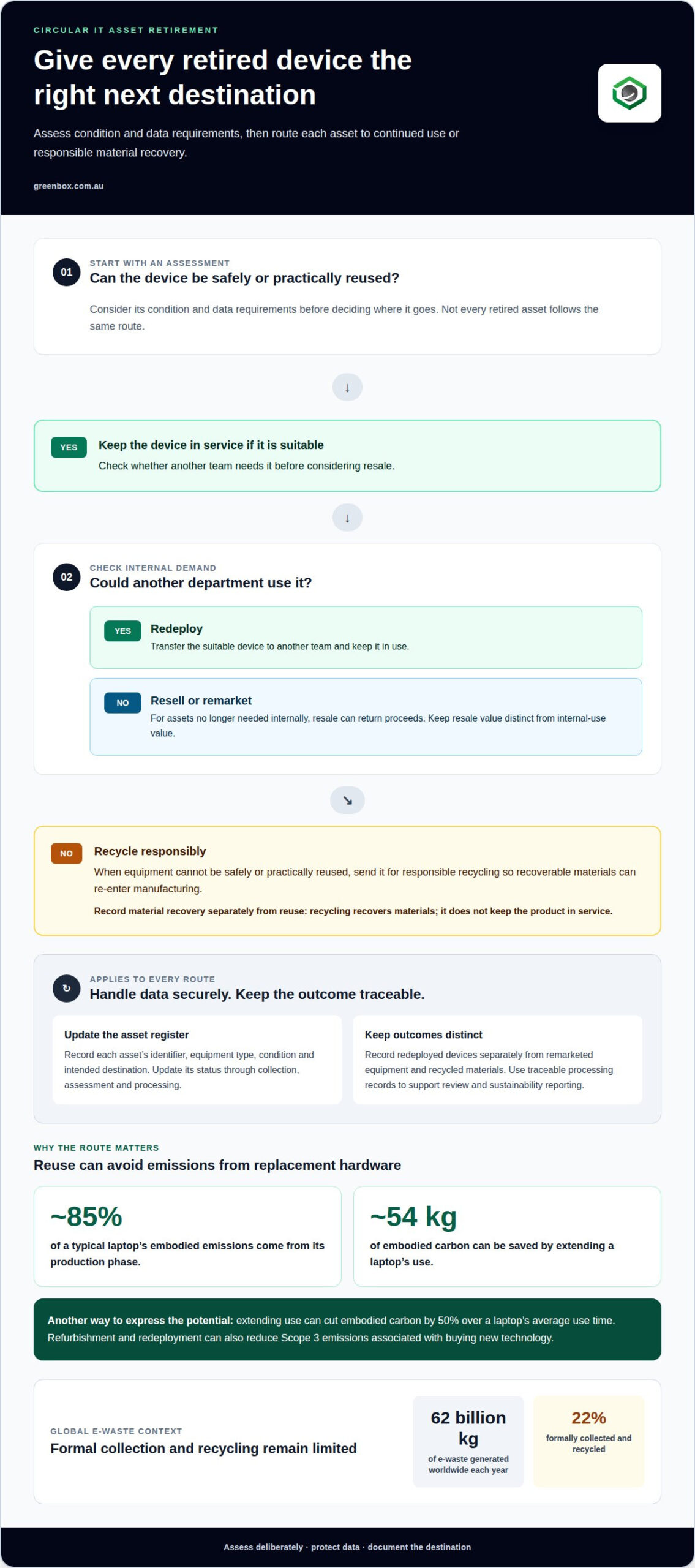
Reuse generally retains more of an IT asset’s value than recycling because the device stays in service. Recycling is essential when equipment cannot be safely or practically reused.
A typical laptop’s production phase accounts for around 85% of its embodied emissions. Extending its use can save approximately 54 kilograms of embodied carbon, or cut embodied carbon by 50% over its average use time. Refurbishment and redeployment can also reduce Scope 3 emissions associated with buying new technology. Australia’s circular economy could abate up to 23% of national greenhouse gas emissions by 2050 if circularity doubles by 2035.
Responsible recycling and material recovery
Responsible recycling separates end-of-life equipment so recoverable materials can re-enter manufacturing rather than become waste. An asset that cannot be reused may still contain materials worth recovering. Assess equipment condition and data requirements before directing unsuitable devices to recycling. Record material recovery separately from reuse: reuse keeps a product in service, while recycling recovers materials from it.
E-waste generation and formal recycling
E-waste is discarded electrical and electronic equipment, including computers and televisions. Worldwide, 62 billion kilograms are generated each year, while only 22% is formally collected and recycled. Formal processing provides a documented route for end-of-life equipment.
The Productivity Commission identified product stewardship for small electronics, including devices with embedded lithium-ion batteries, as a priority. For the National Television and Computer Recycling Scheme, identify the equipment category and record its final destination. Don’t assume every retired IT asset follows the same route.
Measuring ITAD circularity and e-waste diversion
ITAD circularity measures what happens to retired assets, including whether they are reused, resold or recycled. Separate outcome records show which devices stayed in use and which entered material recovery.
Track asset counts and weights by outcome, then compare them with the total retired during the same reporting period. Record redeployed devices separately from remarketed equipment and recycled materials. These measures help teams report e-waste diversion and identify where refurbishment could keep more equipment productive. They also support sustainability reporting and decisions about future replacement cycles.
Asset value recovery and business benefits
Retired technology can retain business value beyond its first deployment. Recovery planning helps organisations account for that value before approving a replacement cycle. For example, when planning a hardware refresh, identify whether surplus devices could meet another department’s needs. This connects procurement with internal demand and makes asset retirement part of technology investment planning, rather than an isolated disposal task.
Different outcomes create value in different ways. Redeployment makes existing equipment available to another team, while resale can return proceeds from assets no longer needed. Recycling is appropriate for equipment unsuitable for further use. Keeping these outcomes distinct gives finance teams a clearer view of value realised through continued use, resale or material recovery, and helps avoid treating every retired device as an immediate loss.
Timing also shapes the business case. If replacement is scheduled before internal demand for existing equipment is understood, suitable devices may leave service unnecessarily. Coordinating refresh plans with department needs gives teams time to consider transfers before retirement. For resale, accurate asset descriptions and completed data handling help prepare devices for their next stage, while keeping resale value distinct from internal-use value.
The national economic context reinforces the opportunity: doubling Australia’s circularity could add A$26 billion to gross domestic product each year by 2035. At an organisational level, including end-of-use planning in technology investment reviews helps teams consider remaining utility alongside replacement needs. It can also inform future purchasing decisions, such as selecting equipment suited to broader internal use.
Review whether retirement decisions align with the organisation’s procurement and budget assumptions. If equipment is regularly replaced while another team still needs comparable technology, the timing of future purchases may warrant reconsideration. A structured asset recovery approach can connect business priorities with appropriate next-use decisions and help make the value of retired technology visible.
Certified ITAD providers and implementation practices
A structured ITAD process links each retired asset to its final outcome. Organisations need to know which devices were reused, resold or recycled, and how their data was handled. Audit trails, certificates of destruction and chain-of-custody reporting can document these steps, creating evidence for internal review, sustainability reporting and operational records.
Start with an asset register that records identifiers, equipment type, condition and intended destination. As equipment moves through collection, assessment and processing, update its status in the register. For example, a laptop marked for reuse should not appear in recycling totals. Matching records to outcomes helps teams identify gaps and explain how each asset was managed.
- Asset register: Match each device to an identifier and recorded outcome.
- Chain of custody: Record transfers between collection and processing stages.
- Destruction evidence: Retain certificates for devices whose data is destroyed.
Certification can help assess a provider’s processes, but organisations still need clear reporting on their own assets. Confirm that documentation covers the activities relevant to the project, such as data destruction, reuse or recycling. A certificate of destruction, for example, documents data handling for a device that cannot be redeployed with its data intact.
Implementation works best when IT, security, procurement and sustainability teams agree on asset categories and reporting needs before collection. Define how equipment will be identified, how data-sensitive devices will be handled, and which records each team needs. This supports consistent handovers across offices and departments and helps sustainability teams distinguish reuse from recycling in circularity reports.
Use the resulting records to review process performance over time. Compare assets collected with their recorded outcomes, then investigate unmatched items or incomplete documentation. A documented chain of custody and clear outcome records provide a practical foundation for accountable ITAD and credible reporting.
What Australian laws and regulations apply to e-waste disposal and ITAD?
Australian ITAD planning needs to distinguish legislation, product stewardship priorities and voluntary circular economy targets. The Recycling and Waste Reduction Act 2020 has limited power to set product design standards. That distinction matters: a national waste framework does not automatically mean every electronic device follows the same disposal route.
The Productivity Commission identified product stewardship for small electronics, including devices with embedded lithium-ion batteries, as a priority. Product stewardship focuses on responsibility across a product’s lifecycle, including what happens when it becomes waste. When retiring laptops, phones or battery-containing equipment, organisations can apply this principle through clear asset records and a defined end-of-life pathway.
The National Television and Computer Recycling Scheme covers eligible televisions and computers, not every category of business technology. Identify the equipment type before deciding whether the scheme is relevant. Other devices need an appropriate route based on their materials, condition and data requirements. Keep these decisions distinct from data sanitisation, which addresses information stored on devices.
Australia’s circular economy goals provide broader policy context, but should not be presented as disposal laws. The national targets include reducing the per capita material footprint by 10% and lifting material productivity by 30%. Australia also aims to safely recover 80% of its resources, according to the Australian Government Department of Climate Change, Energy, the Environment and Water. These goals reinforce the value of tracking whether retired assets are reused, resold or recycled.
For practical governance, map each equipment category to its intended destination and retain records of the decision. Separate reusable devices from items sent for recycling, and document the final outcome for sustainability reporting. This helps teams avoid treating scheme eligibility, data protection and resource recovery as interchangeable obligations. Organisations planning an end-of-life electronics pathway can explore responsible e-waste recycling as part of their ITAD process.
Greenbox: Data Sanitisation and Destruction
Greenbox provides Data Sanitisation and Destruction for organisations retiring devices that may contain business information. This service supports a controlled transition from active use to reuse, remarketing or recycling, with data handling considered alongside each asset’s next destination.
When equipment remains suitable for further use, Greenbox’s IT Asset Recovery and Asset Remarketing services help organisations manage its value beyond its original deployment. Pre-Configuration and Imaging can also prepare equipment for a new environment. Together, these services connect secure retirement with practical asset lifecycle decisions.
Greenbox can support your organisation when you’re planning a hardware refresh, retiring a group of devices or reviewing how data security and reuse fit into your ITAD process. Contact Greenbox to discuss your IT asset requirements.
Make your next technology transition count
A hardware refresh is an opportunity to build asset decisions into procurement planning instead of treating retirement as an afterthought. Set clear criteria for which devices can return to service, which need secure data treatment and what records your teams require. This gives IT, security and sustainability teams a shared basis for decisions before equipment leaves the workplace.
Achieving circular economy goals with ITAD depends on making these choices part of everyday asset management. Greenbox supports organisations with Data Sanitisation and Destruction, IT Asset Recovery, and Pre-Configuration and Imaging, connecting secure retirement with future technology deployment.
Bring your asset lifecycle priorities and operational requirements together in the planning process. Contact Greenbox about ITAD to discuss how its services could fit your organisation’s next transition. A considered plan can help turn retiring equipment into a more deliberate step towards responsible technology management.
Frequently Asked Questions
What Is IT Asset Disposition (ITAD)?
IT asset disposition (ITAD) is the organised management of business technology at retirement. It covers deciding what happens to each device, from redeployment or resale to recycling, while addressing the data stored on equipment. For example, an organisation replacing staff laptops can assess each device individually instead of treating the whole batch as waste. That distinction helps align security, operational and environmental decisions.
How does IT asset disposition (ITAD) support circular economy goals?
ITAD supports circular economy goals by keeping usable technology in service and returning materials from end-of-life equipment to recovery pathways. Achieving circular economy goals with ITAD means making asset outcomes part of routine technology planning. An organisation, for example, can direct suitable devices to another team, then send equipment that cannot be reused for recycling. Recording each outcome helps teams understand how retirement decisions support their sustainability objectives.
What ITAD practices enable reuse, refurbishment, and recycling of electronics?
Useful practices include maintaining an asset inventory, assessing device condition, securely handling data and sorting equipment by its next use. A laptop in good working condition may be refurbished for redeployment; a faulty device may need assessment before resale or recycling. Keep records that distinguish redeployed, remarketed and recycled assets. This makes outcomes easier to track and prevents the same device from being counted in multiple categories.
What percentage of electronic waste is recycled in Australia, and how much is generated?
Australia’s National Television and Computer Recycling Scheme covers eligible televisions and computers, not every category of electronic waste. The available headline figures are global: 62 billion kilograms of e-waste are generated worldwide each year, and 22% is formally collected and recycled. Those figures describe global e-waste, not Australia’s generation or recycling rate. For Australian reporting, distinguish scheme-covered equipment from other electronic assets.
How do certified ITAD providers compare on data security, reuse, and environmental outcomes?
Compare providers by the evidence they supply for each part of the process, rather than treating one certification as proof of every outcome. Look for records connecting devices to data sanitisation or destruction, reuse or resale decisions, and recycling destinations. A destruction certificate, for example, documents data handling, while asset outcome reporting shows whether equipment stayed in use or entered recycling.