

To choose an ITAD vendor in Australia, prioritise documented chain of custody, secure data sanitisation and responsible reuse or recycling. Assess whether its processes align with standards such as AS/NZS 5377 for end-of-life equipment, ISO 27001 for information security and ISO 14001 for environmental management.
IT asset disposition, or ITAD, is the final stage of the IT asset management lifecycle. It covers how retired devices are handled, including data sanitisation, recovery, remarketing and recycling. Choosing an ITAD vendor in Australia therefore affects both information security and environmental outcomes.
The right vendor depends on your equipment, data risks and sustainability goals. Assess the vendor’s standards and safeguards, how it tracks devices and handles data, and whether its recovery and recycling services match your requirements.
Key Takeaways
- Match certifications to the risks you need to manage, including information security, environmental practices and e-waste processing.
- Assess each retired asset for secure reuse, remarketing or recycling before deciding on disposal.
- Look for clear evidence of responsible processing and reporting that supports your sustainability goals.
- Compare vendors on custody tracking, data sanitisation methods and the scope of their support, not just the headline offer.
ITAD certifications and standards
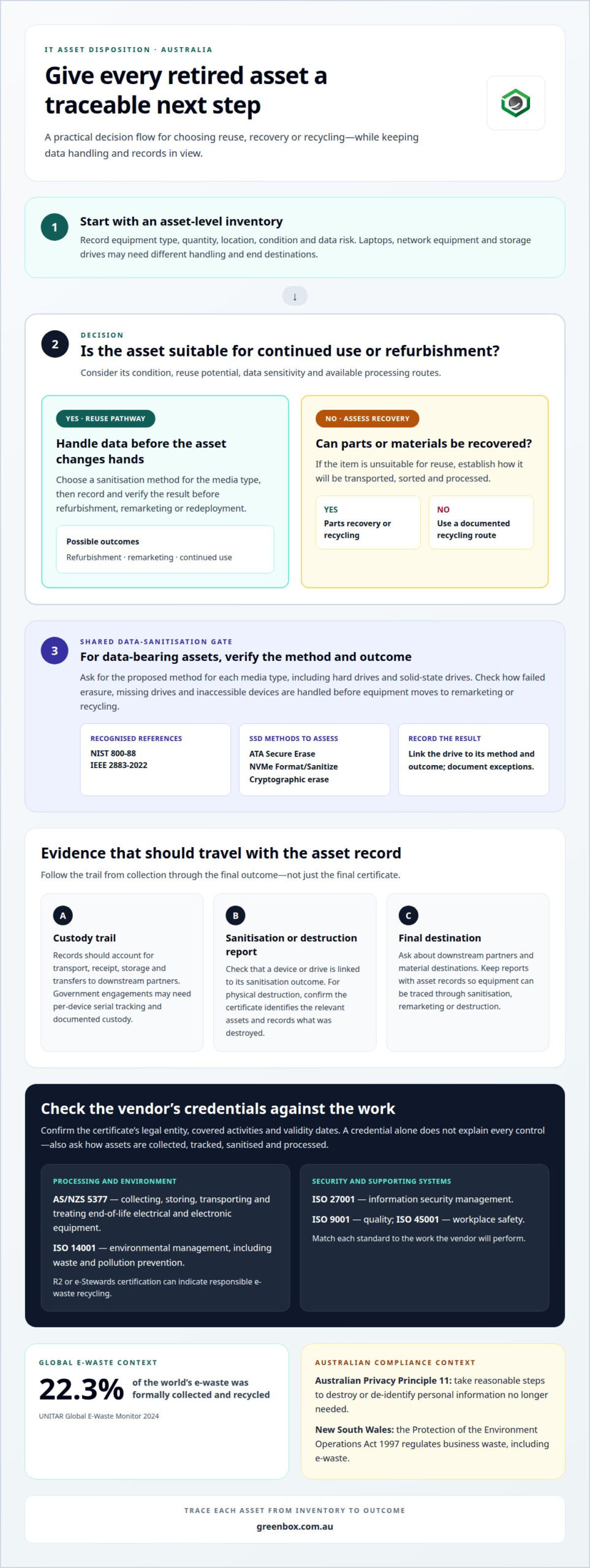
Assess standards alongside the controls used to handle equipment. Match each standard to the work it covers, then examine how assets, drives and records move through collection, data sanitisation, remarketing or destruction.
Check Australian ITAD certifications and standards
Match each credential to the work being performed. AS/NZS 5377 covers collecting, storing, transporting and treating end-of-life electrical and electronic equipment. ISO 27001 relates to information security management, while ISO 14001 addresses environmental management, including waste and pollution prevention. ISO 9001 and ISO 45001 can also inform your assessment of quality and workplace safety.
Then compare the certificate’s legal entity, covered activities and validity dates with the proposed work. R2 or e-Stewards certification can indicate responsible e-waste recycling. A credential alone doesn’t explain every control, so ask how the vendor collects, tracks, sanitises and processes your assets.
Check data wiping and verification
Ask for the proposed sanitisation method for each media type, including hard drives and solid-state drives. NIST 800-88 is a recognised reference for media sanitisation, while IEEE 2883-2022 addresses sanitisation methods and verification. For SSDs, ask whether methods such as ATA Secure Erase, NVMe Format/Sanitize or cryptographic erase suit the device and process.
Check how results are recorded, not just which method is named. A useful erasure report identifies the drive, method and result, linking the outcome to a specific asset. Clarify how failed erasure, missing drives and inaccessible devices are handled. Document these exceptions before equipment moves to remarketing or recycling.
Review erasure and destruction certificates
Request a redacted sample report that reflects your project scope. Check whether each record links a device or drive to its sanitisation outcome. For physical destruction, confirm that the certificate identifies the relevant assets and records what was destroyed. This gives your organisation evidence for its disposal register and internal governance records.
Review the custody trail as well as the final certificate. Records should account for transport, receipt, storage and any transfers to downstream partners. Government engagements may need per-device serial tracking and documented custody. Keep the reports with your asset records, so you can trace equipment from collection through sanitisation, remarketing or destruction.
What is IT Asset Disposition (ITAD)?
ITAD is the final stage of the IT asset management lifecycle. It determines how retired equipment is handled, from assessment and transport to reuse, remarketing or recycling.
- Define what’s leaving service. List equipment types, quantities and locations before arranging collection. Laptops, network equipment and storage drives may need different handling and end destinations. Treat asset disposition as a managed process, not simply a removal job. An inventory helps match each item to its condition, data risk and potential for continued use.
- Assess reuse before recycling. Sort working equipment from damaged or obsolete items, then consider refurbishment and remarketing for assets with useful life remaining. Reuse can retain more of an asset’s value than immediate recycling. Before any device changes hands, ensure sensitive data is handled securely. Separate equipment suitable for reuse from items needing parts recovery or recycling.
- Plan the recycling stream. For equipment unsuitable for reuse, establish how it will be transported, sorted and processed. Ask for transparency about downstream partners and the destination of materials, especially when recycling involves multiple facilities. The UNITAR Global E-Waste Monitor 2024 reported that 22.3% of the world’s e-waste was formally collected and recycled. Documenting the route helps show how retired assets enter a responsible recycling stream.
- Set the outcome for each asset. Use condition, reuse potential, data sensitivity and available processing routes to decide between refurbishment, remarketing and recycling. Avoid treating disposal as the default for equipment that could be redeployed or recovered. A clear asset-level record connects the initial inventory to its final outcome. For equipment suited to recovery rather than scrapping, IT asset recovery can support a reuse-focused disposition pathway.
How do ITAD solutions support sustainability goals?
Australian Privacy Principle 11 requires organisations to take reasonable steps to destroy or de-identify personal information they no longer need. In New South Wales, the Protection of the Environment Operations Act 1997 regulates business waste, including e-waste.
Review e-waste compliance and sustainability
Map the vendor’s handling process against the locations where your retired devices are collected and processed. In New South Wales, include the Protection of the Environment Operations Act 1997 in your assessment of business waste management. Ask how the vendor documents material streams and downstream processing. Clear records help connect environmental practices with organisational reporting and protect your reputation through accountable disposal.
Assess e-waste handling and reduction
Prioritise refurbishment and reuse for suitable devices rather than sending them directly to recycling. Confirm how equipment is assessed and how sensitive data is handled before reuse or remarketing. For items that cannot be recovered, check the recycling route and how downstream handling is documented. Physical destruction, including shredding, may suit assets that require it, but should follow a considered assessment.
- Set sustainability outcomes. Record the intended outcome for each asset: continued use, refurbishment, remarketing or recycling. This helps distinguish waste avoided through reuse from material sent for processing. Australia’s e-waste generation is projected to reach 657,000 tonnes in 2030, according to the Department of Climate Change, Energy, the Environment and Water. Use this context to set practical reduction priorities and track outcomes over time.
- Make reporting useful. Choose measures that connect disposal activity with your sustainability goals, such as quantities reused, remarketed or recycled. Keep records of asset destinations and processing streams, then use them to assess progress on waste reduction. For Australian operations, account for relevant state requirements as well as broader environmental objectives throughout collection, transport and final treatment.
ITAD vendor selection criteria
Set a shared scope before comparing proposals. Compare included services, collection coverage, stated timeframes and reporting with your operational needs.
Set vendor selection criteria
Define your requirements before evaluating proposals. List hardware types, locations, data sensitivity, reporting needs and environmental priorities. A practical approach to how to choose an ITAD vendor in Australia starts with these project requirements, not a generic checklist. Apply the same criteria to each proposal, giving sensitive data handling appropriate weight. This makes differences in scope, controls and deliverables easier to assess.
Compare services, coverage and turnaround times
Compare the work included, collection coverage and stated turnaround commitments against your project schedule. Australian vendors may differ in the services they provide and the locations or equipment they cover. Check whether reporting and downstream handling are included. For a fair comparison, clarify what starts the turnaround period and which project stages it covers, rather than relying on headline timing alone.
Assess risks of choosing a vendor
Identify where a data breach, missing device or processing delay could affect your organisation. Map responsibility for assets during collection, transport and storage, including subcontracted stages. APRA-regulated banks, insurers and superannuation entities must meet CPS 234 information security requirements, including requirements relevant to decommissioning and destroying information assets. Record how each proposal addresses your data, operational and environmental risks.
Check references, insurance and subcontractors
Use references from projects with comparable equipment, locations and data sensitivity. Ask what the work covered and how handovers and reporting were managed. Review insurance documents for the activities involved, and identify each subcontractor’s role in collection, storage or processing. As you decide how to choose an ITAD vendor in Australia, document these responsibilities alongside your evaluation. For sustainability priorities, explore carbon-neutral ITAD services.
Greenbox: Data Sanitisation and Destruction
Greenbox supports organisations retiring data-bearing equipment with Data Sanitisation and Destruction to military-grade security standards. This service is relevant when devices need secure treatment before recovery, remarketing or another end-of-life outcome. Clear asset records and disposal requirements help shape a process that fits your operational and sustainability priorities.
Where equipment may still hold value, Greenbox’s IT Asset Recovery and Asset Remarketing services can support reuse rather than immediate disposal. Pre-Configuration and Imaging helps prepare hardware for deployment when equipment is being redeployed as part of a lifecycle plan. Together, these services connect secure data handling with practical asset outcomes.
For support with retired IT assets, contact Greenbox to discuss your organisation’s requirements.
Plan the next stage of your IT transition
Treat the vendor decision as the start of a transition plan, not the finish line. Assign an internal owner, agree how site teams will prepare equipment, and set a communication path for staff affected by collection or redeployment. Include the people approving asset release and receiving redeployed hardware so responsibilities stay clear between teams. This gives stakeholders a shared point of coordination as technology moves out of service.
Knowing how to choose an ITAD vendor in Australia means selecting support that fits your operational plan. Greenbox provides Data Sanitisation and Destruction to military-grade security standards for retired devices, IT Asset Recovery for assets with further potential, and Pre-Configuration and Imaging for hardware being prepared for deployment. Aligning the work with internal milestones helps keep the transition organised.
When you’re ready to discuss your requirements and desired outcomes, contact Greenbox to discuss ITAD. A clear starting brief can help your team move forward with purpose and confidence.
Frequently Asked Questions
Is certification enough to choose a provider?
No. Certification can indicate that a management system or facility meets a defined standard, but it does not show how every job will be handled. Compare the proposed workflow with your equipment and internal controls. Confirm that the project’s asset records, exception handling and final reports fit your audit requirements, rather than relying on a certificate as the sole selection test.
Should an ITAD provider supply sample reports?
Yes. A redacted sample lets you assess whether reporting is usable before work begins. Compare it with your disposal register and identify the fields your teams need to reconcile each device. Consider unusual cases too, such as a missing serial number or an inaccessible drive. A clear sample helps reveal whether reports support your review process.
What are the essential steps for a legal and ethical ITAD programme?
Start with an approved inventory and assign responsibility for releasing each asset. Under Australian Privacy Principle 11, organisations must take reasonable steps to destroy or de-identify personal information they no longer need. For NSW public offices, the State Records Act 1998 requires records to be destroyed only when authorised, securely, irreversibly and with documentation. Keep the approval and outcome records together.
What is an ITAD company?
An ITAD company manages the transition of an organisation’s retired technology out of service. Its role can include assessing equipment, coordinating data treatment, arranging recovery or remarketing, and directing unsuitable items into recycling. This differs from a simple collection service: the organisation needs a defined outcome for each asset, with records that connect its condition and handling to its final destination.
Why is a Certificate of Destruction necessary for IT equipment disposal?
A Certificate of Destruction records that specified equipment or media underwent physical destruction. It can support internal governance and provide evidence for disposal records, particularly when an audit asks what happened to a particular asset. It serves a different purpose from an erasure report, which records the sanitisation method and result. Match the certificate’s asset details to your own inventory.
Why is choosing the right ITAD provider important?
The provider’s process affects what happens to information and equipment after retirement. A poorly controlled handover can leave gaps in accountability, while an unsuitable disposal route may overlook assets that could be recovered or reused. Functional hardware and data-bearing drives, for example, need different decisions. Choose a process that aligns with your organisation’s security, operational and environmental priorities.