

A sustainability claim is only as strong as the controls behind it. The most useful questions to ask a potential ITAD partner cover data protection, asset tracking, reuse and environmental reporting. Ask for clear explanations of security processes, evidence of asset handling and a practical account of how issues are resolved.
Sustainability and security should work together, not compete. This guide helps you assess a partner’s environmental approach, asset tracking, data sanitisation and destruction, reputation, and response when expectations differ. Use the questions to compare answers and determine whether a potential partner can provide the visibility and accountability your organisation needs.
Key Takeaways
- Ask how the partner prioritises reuse and recycling alongside secure data handling, so sustainability is part of the process rather than a standalone claim.
- Find out how individual assets are tracked from collection through inspection and testing, including who handles them at each stage.
- Explore the partner’s data sanitisation and destruction methods, facility security controls and evidence provided when data handling is complete.
- Discuss how disagreements are resolved and how recovery, remarketing or other services can fit your organisation’s asset lifecycle.
1. Handling disagreement and unmet expectations
A disagreement over a delayed collection or an asset count can reveal how a partner manages pressure. Treat the response as evidence of how the working relationship may unfold, not as a minor sales conversation. A partner who dismisses your concern instead of addressing it is showing a warning sign.
Use a realistic example to explore the partner’s approach. Describe a collection where several devices are missing from the agreed inventory. Ask who investigates, how they communicate progress and how they document the outcome. Look for a clear sequence of actions, defined responsibilities and a record both parties can review.
Discuss unmet expectations before work begins. Ask how the partner handles missed milestones, reporting errors or disagreements about asset condition. A constructive answer explains how the issue is logged, who owns the next step and how both parties confirm resolution. Notice whether they listen to your account before proposing a solution.
Compare service coverage, turnaround times and reporting by placing each partner’s written scope beside your operating requirements. Check collection locations, accepted asset types, agreed milestones, exception updates and sample reports. This makes differences visible and shows whether the proposed process matches your organisation’s needs.
For insurance, audit reports and liability protections, request current certificates of currency and relevant policy details. Review which activities and assets are covered, any exclusions, and whether collection or transport is included. Ask for audit report samples showing their scope, findings and corrective actions, then examine the contract’s liability terms.
Don’t treat a certificate or report as a substitute for clear responsibilities. Compare insurance documents with the contract, especially if a subcontractor handles assets or a transfer crosses a handover point. Ask who notifies you of an incident, who investigates it and how records will be shared.
Record agreed changes in writing, including revised milestones, reporting requirements or who owns the resolution. A calm, specific response gives everyone a practical basis for continuing the relationship. Pressure, vague ownership or refusal to document an agreement can make future disputes harder to manage.
2. Asset tracking and chain of custody
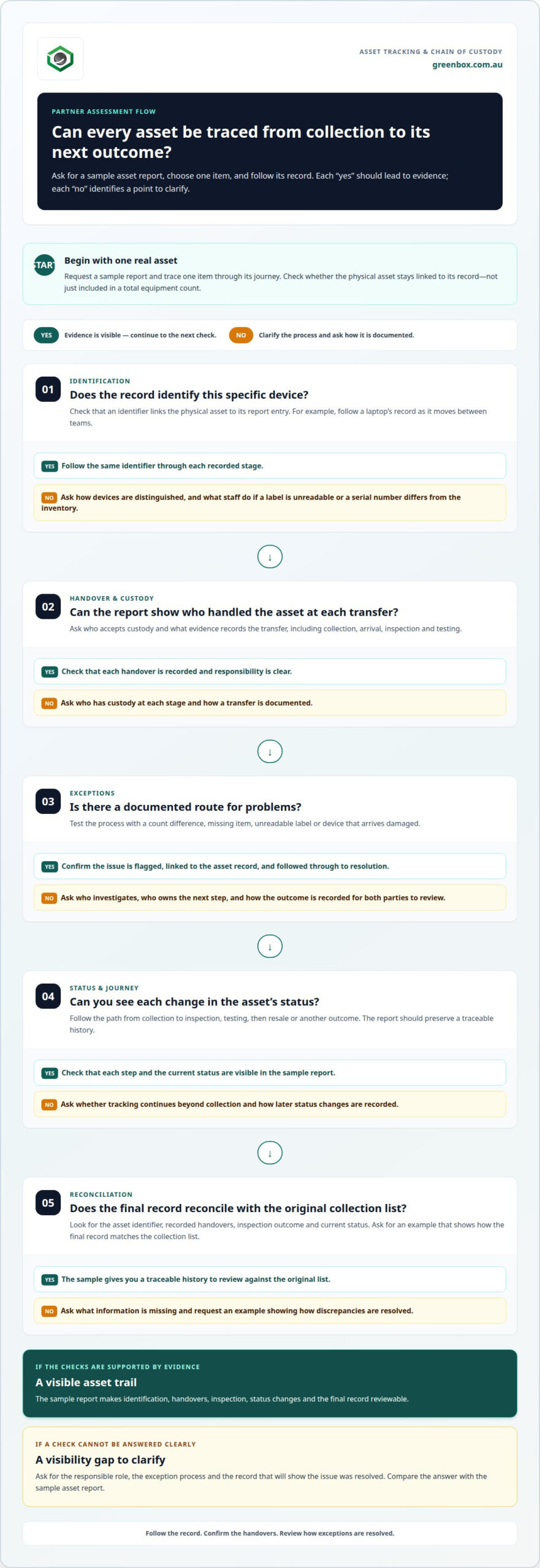
Ask how the partner tracks each asset and records who handles it throughout its lifecycle. A useful answer describes the journey from collection to inspection, testing and any later sale. It should explain how each item remains identifiable, rather than relying only on a total equipment count. For example, ask how a laptop’s record stays linked to that specific device as it moves between teams.
Request a sample asset report and trace one item through its journey. Check whether it shows the identifier, each recorded handover, inspection outcome and current status. The identifier should link the physical asset to its record. Ask what happens if a label is unreadable, a serial number differs from the inventory, or an item is missing. A sound process explains how staff flag and resolve exceptions.
Ask who has custody at each stage and what evidence records a transfer. Clarify how the provider documents collection, arrival, inspection and testing during resale. For instance, if a device arrives damaged, ask how its condition is recorded and linked to its asset record. Clear answers show where responsibility sits.
- Identification: How is each device distinguished from similar equipment?
- Handover: Who accepts custody, and how is the transfer recorded?
- Exceptions: How are count differences, damage or unreadable labels escalated?
Ask how reports handle changes in asset status. A device may move from inspection to testing, then to resale or another outcome. The report should make each step visible and preserve a traceable history. Request an example showing how the final record reconciles with the original collection list.
These questions reveal whether tracking covers the full process or stops at collection. If your organisation is planning a retirement project, IT asset recovery can form part of a controlled transition from active use to the next asset outcome.
3. Brand reputation and data security
Risks include unauthorised access, unclear handling responsibilities and weak data controls. These gaps can expose sensitive information or damage your reputation while equipment moves between sites.
Ask how each facility protects assets and restricts access. ITAD facilities may use restricted access, cameras, metal detectors and staff vetting. Ask which controls apply where your equipment is stored and how staff access is managed. For example, find out how visitors are authorised and recorded before entering a secure area.
Assess reputation as carefully as security processes. Look for consistent explanations across written procedures, audit material and customer references. Ask for an example of a project involving similar equipment or data sensitivity, then compare the described process with the controls and reporting you’ve seen. A mismatch between claims and evidence is a reason to ask more specific questions.
Ask who can access data-bearing devices during transport, storage and processing. Clarify whether subcontractors are involved and how their access is controlled. If a device is delayed or its status changes, ask how the event is recorded and who communicates it. A clear answer identifies the responsible role and next action.
- Facility controls: Which access restrictions, cameras or staff checks are used?
- Data access: Who can handle devices, and how is access recorded?
- Evidence: What records show that the agreed process was followed?
Ask about reputation as well as security statements. Request an explanation of how an incident is escalated, investigated and communicated. For instance, ask what happens if a device arrives with a broken seal or an unexpected label. The answer should connect the issue to a defined record and responsible person.
Examine sustainability claims alongside security evidence. Ask how the partner distinguishes equipment for reuse from equipment requiring another outcome. Clear records show how environmental objectives fit with secure handling, rather than relying on broad claims alone.
4. What services should an ITAD partner provide?
Map services to each stage of your equipment’s retirement. Start with collection and assessment, then ask how data-bearing devices are sanitised, reused, remarketed or recycled. A working laptop may follow a different route from a damaged drive. A clear service scope explains how each asset is assessed and which outcomes are available.
Data removal needs a defined method and evidence. Ask whether the provider uses software to sanitise reusable devices and when physical destruction is appropriate. Software-based removal can be a more sustainable alternative to destroying hardware. Request a certificate confirming data removal, and check that the records identify the relevant assets and completed process.
Consider reuse before destruction where possible. Ask how the provider decides whether an asset can be remarketed and what happens if testing finds a fault. A device that cannot be resold may require another secure outcome. The answer should connect its condition and data status to its final disposition.
- Assessment: How are condition and reuse potential evaluated?
- Data handling: Which sanitisation method suits each asset?
- Final outcome: How are reuse, resale or destruction recorded?
Ask how sustainability claims relate to the actual service stages. A carbon-neutral service claim should have a clear scope and explain which activities it covers. Ask how reusable equipment is separated from e-waste and how the partner reports the outcomes. This helps distinguish operational details from broad environmental language.
Check whether the proposed scope covers your asset mix. A retirement project involving laptops, servers and storage devices may require different handling decisions for each category. Ask about exceptions, such as equipment that fails testing or contains data that cannot be sanitised through software. Defined decision points make the service easier to assess.
For a structured discussion about your equipment’s end-of-life pathway, plan your IT asset disposition around secure data removal and responsible reuse.
Greenbox: Data Sanitisation and Destruction
Greenbox provides Data Sanitisation and Destruction for businesses retiring equipment that may hold sensitive information. This service supports organisations that need a defined data-handling outcome when devices leave service. IT Asset Recovery and Asset Remarketing can also support the transition of retired equipment, while Pre-Configuration and Imaging supports new hardware deployment.
Choosing an ITAD partner means weighing secure handling against responsible asset outcomes. Greenbox connects these needs through data sanitisation and destruction, recovery and remarketing. Discuss your equipment and requirements with Greenbox to understand how these services fit your asset lifecycle.
To discuss your organisation’s ITAD requirements, visit greenbox.com.au.
Turn your assessment into a clear next step
Use these questions to ask a potential ITAD partner as a decision framework, not just a procurement checklist. Before a project begins, align internal teams on what success means: secure data handling, visibility over assets, responsible end-of-life decisions and clear communication. This shared understanding keeps operational, security and sustainability priorities connected.
If your organisation is preparing to retire equipment, Greenbox provides Data Sanitisation and Destruction and IT Asset Recovery. Pre-Configuration and Imaging can support new hardware deployment as part of a broader technology lifecycle. These services offer a practical starting point for planning how retiring assets and incoming equipment fit your requirements.
Bring your asset needs and priorities into the conversation, then explore a suitable next step with Greenbox. Contact Greenbox about ITAD to discuss your requirements and move forward with a considered plan.
Frequently Asked Questions
Are they committed to sustainability?
Look for evidence that environmental goals shape decisions about retired equipment. Ask how the provider distinguishes reusable assets from items for recycling, and what records demonstrate each outcome. Request a sample sustainability report showing how equipment was categorised and what happened next. A clear account connects stated commitments to practical decisions, rather than relying on broad claims alone.
Do they actively protect your brand’s reputation?
The provider should treat your organisation’s name and information as sensitive throughout the project. Ask how staff are briefed on your handling requirements and whether external communications might identify your organisation. Consider a scenario where an asset is mistakenly associated with your business after retirement. The response should explain how the provider would investigate and communicate with your nominated contact.
Do they have a knowledgeable team?
A knowledgeable team can explain why different equipment needs different handling. Ask staff to walk through a practical scenario, such as retiring a mixed batch of laptops, servers and storage devices. Listen for clear reasoning about assessment, data-bearing components and suitable next steps. The explanation should help your team understand the process without relying on unexplained technical language or assurances alone.
Do they have robust chain-of-custody protocols?
Robust protocols link each asset to a recorded handover and a clear next destination. Ask how the provider handles a batch with missing or damaged identification labels. A useful answer explains how staff resolve uncertainty before processing and how final records reflect the decision. This tests whether the process can handle exceptions, not just straightforward collections.
Do they understand potential financial implications?
Ask how asset condition and resale potential affect financial outcomes. Find out how assessment findings are shared and how the provider distinguishes functional equipment from items with limited recovery potential. An older device, for example, may require a different decision from a recently used model. Clear reporting helps finance and technology teams understand the basis for each asset’s outcome.
Do they understand the standards, regulations, or requirements of your industry?
The provider should connect your organisation’s requirements with the steps in its proposed process. Explain your internal policies, data sensitivity and approval requirements, then ask how these shape project records and responsibilities. A financial organisation, for instance, may need specific evidence for internal review. The answer should demonstrate practical understanding without making broad claims about legal compliance.