

The lowest quote on your desk for decommissioning hardware might actually be the most expensive business decision you make this year. It’s easy to see ITAD as a simple line item or a “rubbish collection” task; however, focusing solely on the upfront invoice ignores the significant hidden costs of IT asset disposal that emerge long after the trucks leave your loading dock. You’ve likely felt the strain when your senior engineers are pulled away from high-value projects to manually log serial numbers or when you’re left chasing a paper trail for an upcoming audit.
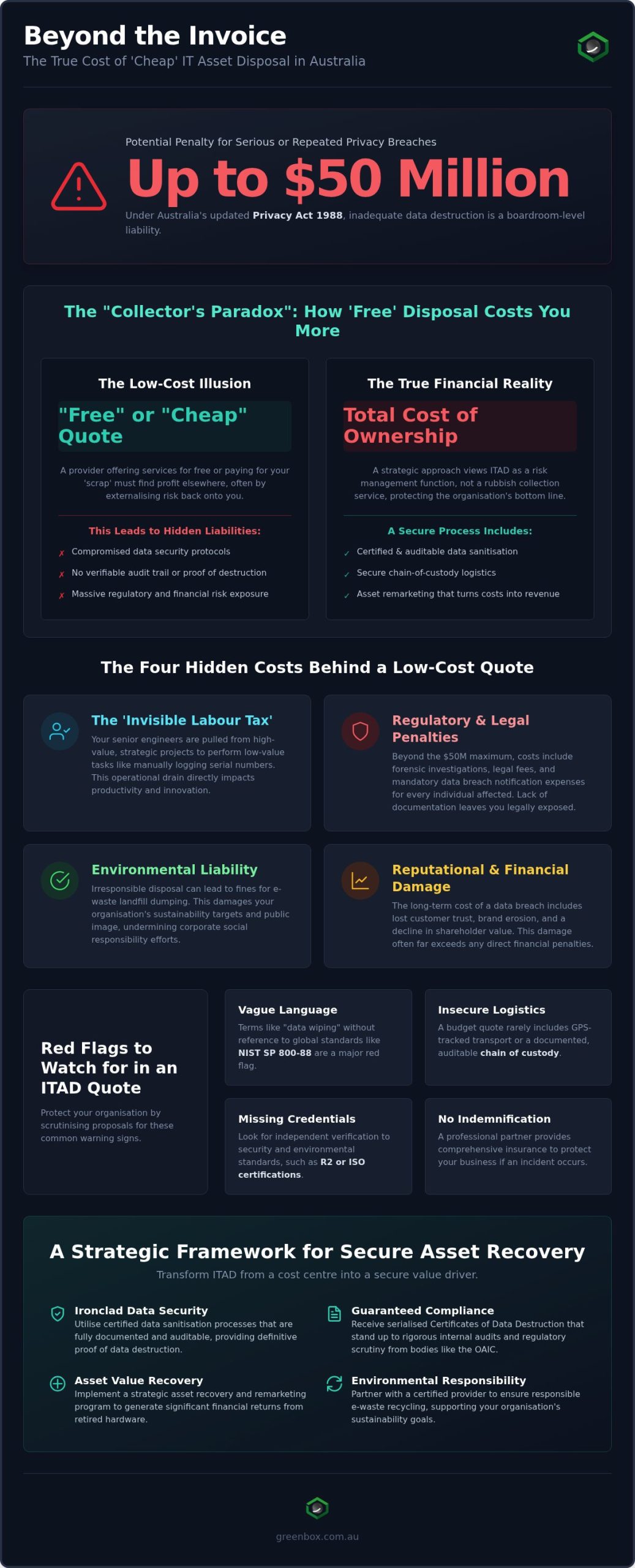
With serious privacy breaches now carrying penalties of up to $50 million under the Privacy Act, the stakes for your organisation have never been higher. We’ll show you how to move beyond the invoice to identify invisible financial and regulatory risks that turn “cheap” disposal into a major corporate liability. This guide provides a clear framework for IT asset disposition risk management, helping you lower hardware total cost of ownership while securing documented proof of data destruction and e-waste compliance.
Key Takeaways
- Recognise how low-cost quotes create the “Collector’s Paradox,” where the hidden costs of IT asset disposal arise from compromised security protocols and data risks.
- Navigate the severe financial implications of the Privacy Act, including potential penalties of up to $50 million for serious or repeated data breaches.
- Quantify the operational impact of the “Invisible Labour Tax” when your internal IT staff are reassigned to handle decommissioning instead of core business objectives.
- Align your hardware lifecycle with Australian environmental regulations to avoid landfill fines and support your organisation’s sustainability targets.
- Discover how a strategic approach to asset recovery and remarketing can transform a traditional cost centre into a significant financial value driver.
The True Price of ‘Free’: Why Low-Cost ITAD is a Financial Mirage
A low-cost quote for IT asset disposition often looks like a win for the procurement department. In reality, it usually represents a significant financial mirage. The true hidden costs of IT asset disposal are found in the gap between that initial service fee and the total risk liability your organisation carries. When a provider offers a price that seems too good to be true, they’re likely externalising their costs back onto your balance sheet in the form of risk. If the service isn’t being funded by a transparent fee, it’s being funded by cutting corners in areas you can’t afford to compromise.
This creates what we call the “Collector’s Paradox.” Providers who pay you for your “scrap” or offer free collection must find profit elsewhere. Often, this means skipping the rigorous, expensive security protocols required for modern data protection. If a recycler treats your old servers as mere commodities, they won’t invest in the high-grade sanitisation needed to prevent a data breach. You might also face “Technical Debt” in your disposal process; this is the compounding cost of fixing inadequate data sanitisation or incomplete asset logging months after the hardware has left your site.
The total expenditure of a failed ITAD project spans five critical areas: regulatory fines, operational downtime, the environmental impact of e-waste through illegal dumping, reputational damage, and direct financial loss. Understanding these links is essential for any leader responsible for corporate governance.
The Myth of the Zero-Cost Disposal Model
“Free” recyclers don’t operate on charity. They monetise your retired assets by reselling them on secondary markets as quickly as possible. This speed often comes at the expense of thoroughness. Without a premium service fee, these providers rarely offer the indemnification or comprehensive insurance required to protect your business if things go wrong. You won’t receive a serialised Certificate of Data Destruction that stands up to a rigorous audit, leaving you with no way to prove compliance to stakeholders or regulators when it matters most.
Identifying the Red Flags in a Quote
Protecting your organisation starts with scrutinising the fine print of every ITAD proposal. Watch for these warning signs that suggest a provider is prioritising their margins over your security:
- Vague Language: Be wary of terms like “data wiping” or “erasure” without reference to standards like NIST SP 800-88. Certified sanitisation is a specific, auditable process, not a general promise.
- Insecure Logistics: A budget quote rarely includes GPS-tracked vehicles or a documented chain of custody. If they can’t tell you exactly where your drives are at any given moment, your data is at risk.
- Missing Credentials: If the provider lacks R2 or ISO certifications, they haven’t been independently verified to meet global security and environmental standards.
Regulatory Penalties and the Cost of Non-Compliance in Australia
The financial landscape of hardware decommissioning has shifted dramatically following the 2026 updates to the Australian Privacy Act 1988. It’s no longer enough to simply dispose of hardware; you must now account for the data it once held. When an organisation fails to secure its retired assets, it faces the direct scrutiny of the Office of the Australian Information Commissioner (OAIC). The OAIC’s mandate involves auditing the entire lifecycle of hardware disposal to ensure that personal information is not just deleted, but permanently irretrievable. If your process lacks documentation, you’re effectively operating without a legal safety net.
A single “lost” laptop represents one of the most significant hidden costs of IT asset disposal. The hardware replacement cost is negligible compared to the forensic investigation fees required to determine exactly what data was on the drive. You’re also hit with the “Notification Cost,” which is the legal requirement to identify and inform every individual affected by a potential breach. These expenses compound quickly, often dwarfing the original value of the asset many times over.
The Escalating Fines for Data Mishandling
The maximum penalty for serious or repeated privacy breaches in Australia has reached $50 million, reflecting a regulatory environment that treats data security as a non-negotiable boardroom priority. This fine is only the beginning of the financial fallout. You must also factor in the logistical costs of mandatory notifications and the inevitable rise in insurance premiums. In 2026, the average cost of a data breach for a large enterprise continues to reach record highs, with US benchmarks now exceeding $10 million per incident.
Evidentiary Requirements for Government and Finance
For organisations in the government and financial sectors, “we think we wiped it” is an expensive legal defence that rarely holds up in court. Regulators require definitive proof of sanitisation. This is why the NIST 800-88 standard is the benchmark for Australian compliance. It provides a structured framework for data destruction that is both auditable and legally defensible.
Many firms mistakenly believe that physical destruction is the only safe route. However, software-based sanitisation is often more compliant because it generates a digital audit trail and serialised reporting for every device. It also supports secure asset recovery, allowing your organisation to recover value from hardware rather than paying to shred it. Greenbox provides the necessary audit trail to satisfy Australian regulators, ensuring you have a certified record of destruction for every asset in your fleet. Regulated industries such as legal practices face particularly acute exposure in this area; firms seeking sector-specific guidance on managing these obligations can benefit from reviewing the dedicated framework for ITAD for legal sector Australia, which addresses the unique compliance requirements under the Privacy Amendment and AML/CTF Act obligations.
Internal Resource Drain: The Operational Costs of Managing Disposal In-House
Many organisations attempt to manage decommissioning internally to save on service fees. This approach ignores the “Invisible Labour Tax,” which is the substantial opportunity cost of diverting skilled talent. When your internal IT team is tasked with manual data wiping, asset tagging, and logistics management, they aren’t merely performing a task; they’re being pulled away from core strategic projects. These operational inefficiencies are significant hidden costs of IT asset disposal that rarely appear on a budget spreadsheet or a procurement report.
Beyond labour, you must consider the “Real Estate Tax” associated with end-of-life hardware. Storing decommissioned servers and laptops in premium office space is an expensive use of square footage that could be better utilised for revenue-generating activities. This backlog often leads to “Project Creep,” where new hardware refreshes are delayed because the physical space or the administrative bandwidth to process the old equipment isn’t available. A bottleneck in disposal creates a ripple effect across the entire IT lifecycle, slowing down innovation and increasing the total cost of ownership for your fleet.
The True Cost of Internal Technical Labour
Compare the hourly rate of a Senior Systems Engineer against a dedicated ITAD specialist. Paying a high-salaried professional to run wiping software or pack boxes is a poor allocation of corporate capital. The “Distraction Cost” is even higher; if a critical security patch or infrastructure upgrade is delayed by days because the team was busy with decommissioning, the risk profile of the entire company rises. Greenbox provides technical labour solutions that handle these repetitive tasks at scale. This allows your internal teams to focus on high-value work that drives business growth while we manage the complexities of asset recovery.
Logistics and Chain of Custody Management
Managing the movement of assets introduces the risk of “Leakage.” This refers to devices that mysteriously vanish between the employee’s desk and the loading dock. Standard couriers and general logistics providers are a liability here. They lack the specialised training for handling data-bearing devices, and their insurance policies rarely cover the value of the information on the drive, only the physical weight of the metal. Secure packaging and specialised transport are operational necessities, not luxuries. Without a documented chain of custody, your organisation remains vulnerable to a breach that occurs while the hardware is in transit.
Environmental Liability and the Long-Term Cost of Irresponsible E-waste
Environmental stewardship in 2026 is no longer a peripheral concern; it’s a financial imperative. When hardware is improperly managed, your organisation faces a “Sustainability Tax” via the rising cost of carbon credits and potential litigation. These are significant hidden costs of IT asset disposal that can quietly erode your capital. Since July 2024, landfill bans for e-waste have been implemented nationally across all states and territories. Violating these regulations carries heavy penalties, with various jurisdictions enforcing business fines that can reach tens of thousands of dollars for improper disposal under environmental protection legislation.
The financial risks also extend to international movement. Following the January 2025 Basel Convention updates, moving e-waste across borders requires strict permits. In February 2026, the Australian government issued a fine of $19,800 for the illegal export of electronic waste. This demonstrates that the perceived savings from uncertified disposal routes are quickly negated by regulatory enforcement. Selecting a partner that prioritises ethical stewardship is a pragmatic step toward mitigating these long-term liabilities.
The Financial Impact of ESG Devaluation
Poor e-waste management directly threatens your corporate credit ratings and investment attractiveness. Financial institutions increasingly use ESG scores to determine risk profiles; an organisation linked to environmental negligence may find its borrowing costs increasing. Beyond the spreadsheet, the cost of remediation is a looming liability. If an uncertified recycler fails to process your equipment correctly, your organisation may be held responsible for cleaning up downstream environmental damage. Utilising R2-certified facilities is a pragmatic cost-avoidance strategy that ensures your assets are handled according to global standards.
Brand Damage and the Reputational Tax
Reputational damage often carries a “Front Page Cost” that is impossible to quantify but easy to feel. The sight of your corporate logo in an illegal dump causes a loss of customer trust that can take years to recover. This reputational tax translates into lost revenue and a weakened position during competitive tenders. Conversely, a transparent, sustainable disposal programme becomes a distinct advantage. By partnering with a carbon neutral ITAD service provider, you actively reduce your Scope 3 emissions. This partnership provides the documented proof of compliance required to satisfy both ESG auditors and your stakeholders’ expectations.
Mitigating ITAD Risk: A Strategic Framework for Secure Asset Recovery
The final stage of managing the hidden costs of IT asset disposal is a fundamental shift in perspective. Rather than treating decommissioning as a final, unavoidable expense, successful organisations view it as a strategic recovery phase. By adopting a “Full Lifecycle” approach, hardware is managed from initial configuration through to secure remarketing. This transition from a cost centre to a value driver requires a disciplined framework that balances security requirements with financial returns. It’s about moving away from reactive disposal and toward a controlled, predictable recovery process.
When evaluating potential partners, you must look beyond the service fee to the total risk-adjusted cost. A pragmatic checklist for your next ITAD tender should include several non-negotiable criteria. First, verify that the provider utilises R2-certified facilities to ensure global data and environmental standards are met. Second, require guaranteed serialised reporting for every data-bearing asset to ensure a complete audit trail. Third, confirm the provider maintains carbon-neutral operations to align with your corporate ESG mandates. Finally, ensure they offer software-based sanitisation options that meet NIST 800-88 standards, as this preserves the physical integrity of the hardware.
Maximising Asset Value Recovery
Choosing software-based sanitisation over physical shredding is a critical financial decision. While shredding is sometimes necessary for damaged media, it destroys the underlying hardware value. Software-based destruction allows for the “Refurbishment Premium,” where sanitised devices can be remarketed to recover capital. Remarketing commissions often offset the costs of secure data destruction entirely, turning an operational burden into a revenue stream. Greenbox acts as a strategic partner in this process, ensuring that your retired assets find a second life while your data remains permanently irretrievable.
Building a Secure ITAD Protocol
A secure protocol relies on a 100% audit trail that begins the moment an asset is logged for recovery. This chain of custody must be unbroken, providing visibility from your loading dock to the final certificate of destruction. Relying on a national, R2-certified provider ensures that these standards are maintained consistently across all your locations. This approach removes the operational burden from your internal teams and provides the peace of mind that comes with professional risk mitigation. Protect your enterprise and recover value with Greenbox ITAD services by integrating these high-standard protocols into your hardware lifecycle today.
Securing Your Organisation’s Future Through Strategic ITAD
Managing the hidden costs of IT asset disposal requires looking past the initial service quote to the long-term liabilities of data security and environmental compliance. You’ve seen how uncertified disposal routes lead to escalating regulatory fines and operational bottlenecks that drain your internal talent. Shifting to a strategic asset recovery model ensures your business remains compliant while extracting maximum value from retired hardware. It’s a pragmatic choice that replaces uncertainty with a documented audit trail and a controlled, predictable process.
Greenbox provides the steady hand needed for these complex transitions through our R2-certified facilities nationwide and carbon-neutral ITAD services. We bring deep expertise in government and enterprise security standards to every project, removing the operational burden from your IT teams and ensuring peace of mind. By prioritising rigorous sanitisation and ethical recycling, you protect your reputation and your balance sheet simultaneously. It’s time to turn your decommissioning process into a transparent, value-driven asset that supports your company’s financial health and environmental goals.
Secure your data and optimise your IT lifecycle with Greenbox
Frequently Asked Questions
What are the most common hidden costs of IT asset disposal?
The most frequent hidden costs of IT asset disposal include the “invisible labour tax” of internal IT staff and the “real estate tax” of storing legacy hardware. You must also account for the forensic investigation fees required if a device is lost. These expenses often dwarf the initial quote from a low-cost provider. Organisations frequently overlook the cost of notification requirements and the loss of productivity when technical teams manage decommissioning instead of core projects.
How does the Australian Privacy Act affect IT hardware disposal costs?
The Privacy Act 1988 mandates that organisations take reasonable steps to destroy or de-identify personal information. Compliance costs arise from the need for certified sanitisation processes and detailed record-keeping to satisfy OAIC audits. Serious breaches now carry penalties of up to $50 million. Investing in a documented, secure disposal process is a necessary insurance policy against the massive financial fallout and mandatory notification expenses associated with a data leak.
Is it cheaper to wipe hard drives in-house or outsource to an ITAD provider?
Outsourcing is typically more cost-effective when you calculate the opportunity cost of your internal engineering talent. A senior systems engineer’s hourly rate is significantly higher than an ITAD specialist’s fee. Professional providers use industrial-scale sanitisation tools that process hundreds of drives simultaneously with 100% accuracy. This frees your team for high-value work while ensuring the hidden costs of IT asset disposal don’t accumulate through slow, manual internal processes.
What is the financial risk of using a non-certified e-waste recycler?
Using an uncertified recycler exposes your organisation to substantial environmental fines and the cost of remediation. Under the Protection of the Environment Operations Act, businesses can be fined for illegal dumping even if they weren’t the ones who dumped the waste. You also face the risk of illegal e-waste export, which incurred a $19,800 fine in early 2026. These legal liabilities are compounded by the permanent damage to your brand’s reputation.
Can IT asset remarketing actually cover the cost of disposal?
Asset remarketing can often offset or entirely cover the costs of secure data destruction and logistics. By refurbishing and reselling hardware on secondary markets, you recover a portion of the original capital expenditure. This turns a traditional cost centre into a revenue stream. Greenbox manages the entire sales process on your behalf, retaining a commission while returning the bulk of the resale value to your organisation to lower the total cost of ownership.
What is a Certificate of Destruction and why is it worth the investment?
A Certificate of Destruction is a formal document that provides an auditable link between a specific asset’s serial number and its successful sanitisation. It serves as your primary legal defence during a regulatory audit or a data breach investigation. Without this document, your organisation has no way to prove it met its obligations under the Privacy Act. This proof of compliance is essential for satisfying both government regulators and corporate ESG stakeholders.
How does carbon-neutral ITAD help my business meet its ESG goals?
Carbon-neutral ITAD services directly reduce your organisation’s Scope 3 emissions, which are the indirect emissions occurring in your value chain. Partnering with a carbon-neutral provider like Greenbox allows you to report lower environmental impact figures to your board and investors. This documented commitment to sustainability improves your ESG rating. It also helps avoid the “sustainability tax” associated with non-compliant waste management, making your business more attractive to ethically minded investors and clients.
What happens if a data-bearing device is lost during transit?
If a device is lost during transit, your organisation is legally responsible for any data breach that follows. You must initiate a forensic investigation to determine the nature of the lost data and begin mandatory notification processes under the Notifiable Data Breaches scheme. This is why a secure chain of custody and GPS-tracked logistics are vital. Standard couriers lack the insurance and security protocols needed to protect your organisation from these high-stakes financial risks.