

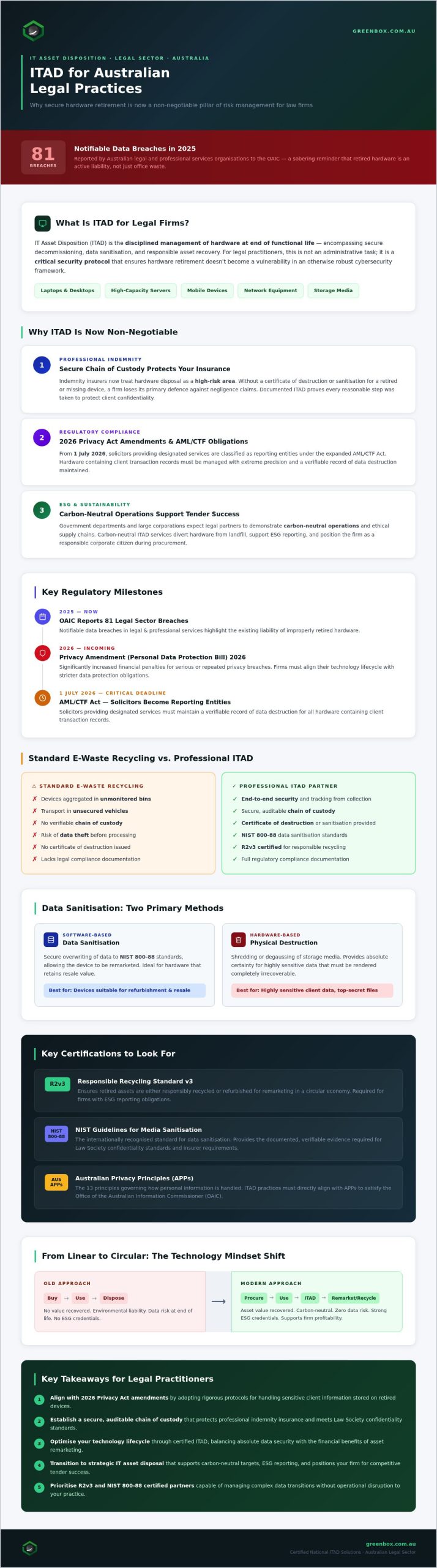
If your firm still treats retired hardware as mere office waste, you’re overlooking a liability that saw 81 Australian legal and professional services organisations report serious data breaches to the OAIC in 2025. It’s a sobering figure that highlights why a robust strategy for ITAD for legal sector Australia is now a non-negotiable pillar of risk management. You understand that protecting sensitive client files is the bedrock of your practice. However, as the Privacy Amendment (Personal Data Protection Bill) 2026 and new AML/CTF Act obligations for solicitors increase regulatory scrutiny, the complexity of tech refreshes can feel like a significant operational burden.
This guide provides a clear roadmap to align your technology lifecycle with these evolving Australian regulations, ensuring absolute data security and environmental compliance. You’ll learn how to establish a secure, auditable chain of custody that satisfies professional indemnity requirements while helping your firm meet essential carbon-neutral targets. We’ll also examine how asset remarketing can maximise your return on investment, turning retired hardware into a strategic financial asset that supports your bottom line and your commitment to a circular economy.
Key Takeaways
- Align your practice with the 2026 Privacy Act amendments by adopting rigorous protocols for handling sensitive client information stored on retired devices.
- Establish a secure, auditable chain of custody that protects your professional indemnity insurance and meets the highest Law Society confidentiality standards.
- Optimise your firm’s technology lifecycle through ITAD for legal sector Australia, balancing absolute data security with the financial benefits of asset remarketing.
- Transition from simple e-waste disposal to a strategic IT asset disposal policy that supports carbon-neutral targets and ESG reporting.
- Recognise the value of R2v3 and NIST 800-88 certifications in choosing a partner capable of managing complex data transitions without operational disruption.
Why IT Asset Disposition is Critical for Australian Legal Practices
ITAD for the Australian legal sector is the disciplined management of hardware at the end of its functional life within a firm. It encompasses the secure decommissioning, sanitisation, and responsible recovery of assets ranging from laptops to high-capacity servers. For legal practitioners, this isn’t merely an administrative task; it’s a critical security protocol. It ensures that the physical transition of hardware doesn’t become a vulnerability in an otherwise robust cybersecurity framework. By treating hardware retirement as a formal process, firms protect the integrity of their data long after a device has left the desk.
Professional indemnity insurance providers now view hardware disposal as a high-risk area. A failure to demonstrate a secure chain of custody for retired assets can complicate insurance renewals or lead to increased premiums. When a firm cannot provide a certificate of destruction or sanitisation for a missing device, they lose their primary defence against claims of negligence. Secure ITAD for legal sector Australia provides the necessary documentation to satisfy these insurers, proving that the firm has taken every reasonable step to protect client confidentiality.
Many firms mistakenly assume that standard Electronic waste (e-waste) recycling is sufficient for their needs. While these services handle the physical breakdown of components, they often lack the rigorous security standards required for legal confidentiality. Standard recyclers might aggregate devices in unmonitored bins or transport them in unsecured vehicles. This creates opportunities for data theft before the hardware is processed, whereas a professional ITAD partner provides end-to-end security and tracking.
The High Cost of Data Breaches in Legal Services
The 81 notifiable data breaches reported by the Australian legal and professional services sector in 2025 serve as a stark warning. Reputational damage from a leak is often permanent, as clients expect absolute discretion regarding their sensitive files. Under the 2026 Privacy Act amendments, organisations face significantly increased financial penalties for serious or repeated privacy breaches, reflecting the high value placed on personal data protection. A strategic ITAD framework eliminates the risk of “dumpster diving” or the unauthorised resale of hardware that still contains sensitive client data. Firms advising clients in banking or investment should also be aware that the ITAD for financial services Australia sector recorded 157 notifiable data breaches in 2025, underscoring how data disposal risks extend across the entire professional services landscape.
Meeting ESG Targets through Sustainable ITAD
Environmental, Social, and Governance (ESG) criteria are now central to major legal tenders. Government departments and large corporations expect their legal partners to demonstrate carbon-neutral operations and ethical supply chains. Utilising carbon-neutral ITAD services supports these sustainability credentials by diverting hardware from landfill and prioritising asset recovery. This transparency is a powerful tool during the procurement process, positioning the firm as a responsible corporate citizen.
Modern practices are shifting from a linear “buy-use-dispose” mindset to a circular technology economy. By engaging R2-certified providers, firms ensure their retired assets are either responsibly recycled or refurbished for remarketing. This approach doesn’t just reduce environmental impact; it also recovers value from old hardware. It supports the firm’s financial health while meeting modern ethical standards, proving that technical success and responsible practice are inseparable.
Navigating Regulatory Compliance: Privacy Act and Law Society Standards
Legal practices in Australia operate under a unique set of compliance pressures that extend far beyond simple data storage. Navigating Regulatory Compliance requires a deep understanding of how physical hardware intersects with digital privacy obligations. Beyond the Australian Privacy Principles (APPs), firms must now account for the expanded Anti-Money Laundering and Counter-Terrorism Financing (AML/CTF) Act. From 1 July 2026, solicitors providing designated services are classified as reporting entities. This change means hardware containing client transaction records must be managed with extreme precision. ITAD for legal sector Australia is no longer just about disposal; it’s about maintaining a verifiable record of data destruction that satisfies both the OAIC and AUSTRAC.
An auditable chain of custody provides a chronological paper trail for every asset. It records the movement from the firm’s office to the sanitisation facility, including the name of the handler and the specific method of data erasure used. This level of detail is vital for meeting Law Society guidelines on client confidentiality. It transforms a logistical task into a robust compliance exercise, ensuring that no device leaves the firm’s control without a documented resolution.
The Privacy Act 1988 and Hardware Decommissioning
Under APP 11.2, firms must take “reasonable steps” to destroy or de-identify personal information that is no longer needed. In the context of hardware, “reasonable” is increasingly defined by the ability to produce a formal Certificate of Destruction. This document serves as your primary evidence during a regulatory audit. During office relocations or mergers, the risk of “lost” devices spikes. A structured decommissioning process ensures every laptop and server is accounted for, preventing sensitive data from remaining on-site or vanishing during the move.
Professional Standards and Risk Mitigation
The Solicitor Capability Framework emphasises the need for technological competence and risk management. This responsibility extends to the selection of third-party vendors. Vetting an ITAD provider involves more than checking a price list; it requires verifying their security protocols and facility certifications. This rigour is especially important for managing the “Shadow IT” risks associated with hybrid work. Devices used in home offices often bypass firm-level security, making professional data sanitisation and recovery services essential for maintaining a uniform security posture across the entire practice.
By integrating these standards into your standard technology refresh cycle, you remove the operational burden from your internal IT team. This proactive approach ensures that every retired asset is handled with the same level of care as an active case file, protecting the firm’s reputation and its clients’ most sensitive information.
Secure Data Sanitisation vs. Physical Destruction for Legal Hardware
A common misconception within Australian law firms is that physical destruction is the only foolproof way to prevent a data breach. While seeing a hard drive reduced to fragments offers a certain visceral reassurance, it isn’t always the most secure or sustainable choice. Modern ITAD for legal sector Australia focuses on a risk-based approach, often prioritising forensic-level sanitisation over shredding. This shift is driven by the need to balance stringent confidentiality with the firm’s environmental responsibilities. By choosing the right method for each asset, you protect your clients’ interests while supporting a circular economy.
The NIST 800-88 standard is the gold standard for media sanitisation in high-compliance environments. It provides clear guidelines for “Clear,” “Purge,” and “Destroy” actions, allowing firms to tailor their disposal strategy to the sensitivity of the data and the type of media. Following these globally recognised protocols ensures that your data destruction is legally defensible and technically absolute, regardless of whether the hardware is reused or recycled. These same rigorous standards underpin the secure lifecycle framework used for ITAD in Australian financial services, where APRA CPS 234 compliance demands an equally precise approach to hardware decommissioning.
Software-Based Sanitisation: Security Meets Sustainability
Software-based sanitisation uses advanced algorithms to overwrite data, making forensic recovery impossible. This method is particularly effective for high-end legal laptops and servers that still have significant functional life. By sanitising rather than shredding, your firm can engage in asset remarketing, which recovers value and offsets the cost of new technology. In 2026, software sanitisation is the preferred method for SSDs because it utilises cryptographic erase and internal controller commands to purge data across all memory cells, avoiding the risks of physical shredders that may miss the tiny flash chips. This approach ensures your firm meets its ESG targets without compromising on security.
When Physical Destruction is Necessary
Physical destruction remains the correct choice for assets that are obsolete, non-functional, or contain exceptionally sensitive “top-secret” classifications. If a drive cannot be accessed for software wiping due to mechanical failure, shredding is the only way to ensure data remains inaccessible. When choosing between on-site and off-site shredding, firms must weigh the convenience of immediate destruction against the higher security controls found in a dedicated, R2-certified facility. For a comprehensive understanding of how to navigate these decisions, the Australian guide to secure hardware decommissioning and hard drive destruction provides a definitive framework for resolving the confusion between NIST sanitisation standards and physical shredding. On-site services provide immediate peace of mind, while off-site processing often allows for more granular material recovery.
Once hardware is physically destroyed, the remaining materials must be managed according to Australian e-waste regulations. It’s vital that your partner uses R2-certified recycling streams to ensure that the shredded glass, plastic, and precious metals don’t end up in landfill. This closed-loop process ensures that even when hardware reaches its absolute end-of-life, its disposal remains consistent with the professional and ethical standards of the Australian legal profession. Strategic ITAD for legal sector Australia ensures that every component is handled with precision, from the initial data purge to the final material recovery.
Building a Robust ITAD Framework for Your Firm
Effective management of retired assets requires moving beyond ad-hoc disposal toward a formalised IT asset disposal policy (ITADP). This document serves as the internal standard for how every data-bearing device is tracked, handled, and decommissioned. By embedding ITAD for legal sector Australia into your firm’s governance, you ensure that security isn’t left to chance during a busy technology refresh. A robust framework provides the structure needed to manage high-compliance transitions with minimal operational disruption.
Staff training is a vital, yet often overlooked, component of this framework. Employees must understand that a retired laptop is not just a piece of hardware, but a mobile repository of sensitive client information. Clear protocols for the secure storage of devices awaiting collection prevent accidental loss or “Shadow IT” risks. When your team is trained to treat end-of-life hardware with the same care as active case files, the firm’s overall security posture is significantly strengthened.
Step-by-Step Implementation for Legal ITAD
Implementing a lifecycle strategy involves four distinct phases to ensure no asset is overlooked:
- Step 1: Inventory and Categorisation: Document every asset, noting its data sensitivity and potential for remarketing.
- Step 2: Partner Selection: Engage a certified, carbon-neutral provider that offers a transparent, auditable chain of custody.
- Step 3: Secure Logistics: Use GPS-tracked vehicles and secure containers for on-site collections to eliminate transport vulnerabilities.
- Step 4: Reporting and Review: Audit your sanitisation reports and environmental impact statements to confirm compliance and ESG progress.
Maximising ROI through Strategic Remarketing
Timing your technology refresh is essential for recovering the highest possible value from your hardware. Most legal laptops retain significant market value if they’re retired while still under warranty or within a three-to-four-year cycle. By prioritising refurbishment over recycling, your firm supports a circular economy while generating remarketing credits. These credits can be used to directly offset the costs of new hardware deployment, turning a traditional cost centre into a strategic financial advantage.
A disciplined approach to ITAD allows for accurate monitoring of both financial and environmental outcomes. Monthly or quarterly reports provide the data needed for board-level ESG disclosures, proving that the firm is meeting its carbon-neutral commitments. To begin optimising your firm’s hardware lifecycle, consider a tailored approach to IT asset recovery and remarketing that balances security with fiscal responsibility.
Greenbox: Certified National ITAD Solutions for the Legal Profession
Greenbox operates as a specialised extension of your firm’s IT and compliance teams. We provide a comprehensive suite of services that manage the entire technology lifecycle, from initial pre-configuration and imaging to secure asset recovery and data sanitisation. For firms with a broad Australian footprint, our national logistics capability ensures a consistent security posture across every office, regardless of location. This unified approach eliminates the risks associated with fragmented local disposal arrangements, providing a single, reliable standard for ITAD for legal sector Australia.
Our status as a carbon-neutral organisation reflects a deep commitment to environmental stewardship that aligns with the ESG targets of modern legal practices. Every process is conducted within R2-certified facilities, ensuring that e-waste recycling and asset recovery meet the most rigorous international standards. This combination of technical excellence and ecological responsibility positions Greenbox as a visionary leader in the field, capable of protecting both your firm’s data and its reputation for ethical practice.
Security and Transparency as Standard
We believe that visibility is the foundation of trust. Our clients gain real-time visibility into the status of their assets throughout the sanitisation and disposal process. This transparency is backed by comprehensive reporting designed to satisfy the specific requirements of Law Society and AUSTRAC audits. By adhering to the highest international data security standards, we provide a definitive, auditable record that your data has been handled with absolute precision. This removes the uncertainty from hardware decommissioning, allowing your partners to focus on their core legal work.
A Partnership Focused on Your Firm’s Reputation
Managing a technology refresh is a significant operational burden that can distract from billable activities. Greenbox removes this weight by providing a seamless, end-to-end solution for IT lifecycle management. We don’t just dispose of hardware; we partner with you to achieve a sustainable, zero-waste future through carbon-neutral ITAD services and strategic asset remarketing. This partnership ensures that your firm’s commitment to professional excellence is reflected in its environmental outcomes.
Getting started with a secure ITAD audit for your practice is a straightforward process. Our specialists work with you to assess your current inventory and identify opportunities for value recovery and risk mitigation. By integrating our certified national solutions into your firm’s strategy, you secure a partnership defined by competence, integrity, and a steady ambition for a more secure and sustainable legal sector.
Securing Your Firm’s Future through Strategic Asset Management
The evolution of Australian privacy laws and professional standards has transformed hardware retirement into a strategic risk management priority. By adopting a formalised framework, your practice ensures that sensitive client information is destroyed with technical precision while meeting the rigorous demands of professional indemnity insurers. Transitioning to a circular technology model doesn’t just satisfy ESG targets; it recovers significant capital through asset remarketing, turning a potential liability into a financial asset that supports your firm’s bottom line.
Implementing a comprehensive strategy for ITAD for legal sector Australia provides the peace of mind that comes from a transparent, auditable chain of custody. Greenbox stands ready to assist your practice with our R2v3 certified facilities, 100% carbon neutral operations, and a national secure logistics network specifically designed for high-compliance environments. Secure your firm’s data with Greenbox’s certified ITAD services today and ensure your technology lifecycle reflects the same integrity and excellence as your legal practice. Taking these steps now positions your firm as a leader in both security and sustainability.
Frequently Asked Questions
What is the difference between ITAD and simple e-waste recycling for law firms?
ITAD is a comprehensive lifecycle management service, whereas e-waste recycling is merely the physical breakdown of materials. ITAD for legal sector Australia prioritises data sanitisation and an auditable chain of custody. It ensures that sensitive client files are forensically removed before any material recovery occurs. Standard recycling often lacks the secure logistics and certified sanitisation protocols required to meet strict legal confidentiality and Privacy Act obligations.
Does physical shredding of hard drives guarantee compliance with the Privacy Act?
Physical shredding alone doesn’t guarantee compliance without a documented chain of custody and a certificate of destruction. The Privacy Act 1988 requires “reasonable steps” to destroy or de-identify personal information. If the transport or storage of the drives before shredding is insecure, a firm remains liable for potential breaches. Compliance is achieved through a combination of secure handling, R2-certified processing, and verifiable reporting that proves data is permanently inaccessible.
How does remarketing retired IT assets benefit a firm’s bottom line?
Remarketing allows a firm to recover the residual value of its hardware, which can then be used to offset the cost of new technology deployments. By refurbishing and reselling devices that are still functional, firms turn a disposal expense into a revenue stream. This process is managed through asset remarketing commissions, providing a clear financial return. It supports a circular economy while ensuring the firm’s budget is utilised with maximum efficiency.
What certifications should a legal sector ITAD provider hold in Australia?
A reputable provider should hold R2v3 (Responsible Recycling) and NIST 800-88 certifications for data sanitisation. These standards ensure that both the environmental and security aspects of disposal meet international best practices. Additionally, look for ISO certifications such as ISO 27001 for information security and ISO 14001 for environmental management. For firms with high ESG targets, choosing a carbon-neutral organisation certified by Climate Active provides an extra layer of professional assurance.
Can we securely dispose of mobile devices and tablets through ITAD?
Yes, professional ITAD services include specialised protocols for mobile devices and tablets. These assets often contain vast amounts of cached client data and must undergo the same rigorous sanitisation as laptops or servers. Modern software-based sanitisation handles the unique encryption and storage architectures of mobile hardware. This ensures that all personal information is purged, allowing the device to be safely remarketed or recycled according to Australian e-waste standards.
How does carbon-neutral ITAD contribute to our firm’s ESG reporting?
Carbon-neutral ITAD services directly reduce your firm’s Scope 3 emissions by ensuring that hardware disposal doesn’t add to your carbon footprint. By using a partner that is a carbon-neutral organisation, you can include verifiable data in your ESG reports regarding diverted landfill and reduced environmental impact. This transparency is increasingly vital for firms participating in government or corporate tenders, where sustainability credentials are often a key selection criterion for legal partners.
What documentation do we need to provide to auditors regarding hardware disposal?
Auditors typically require a Certificate of Data Sanitisation or a Certificate of Destruction for every retired asset. This documentation must link the specific serial number of the device to the date and method of erasure. A comprehensive ITAD partner provides these reports as part of an auditable chain of custody. These records prove to Law Society or Privacy Act auditors that the firm has fulfilled its legal obligations to protect sensitive information.
Is on-site data destruction necessary for high-security legal files?
While on-site destruction offers immediate visibility, it isn’t always strictly necessary if you use a partner with end-to-end secure logistics. Secure, GPS-tracked transport and locked collection bins provide a high level of protection for assets moving to a sanitisation facility. The decision depends on your firm’s specific risk assessment and the sensitivity of the data involved. Professional ITAD for legal sector Australia offers both options to ensure that every security requirement is met.