

Did you know that 16% of companies have experienced a high-profile data breach simply because they failed to properly dispose of retired hardware? For Australian IT leaders, the pressure to achieve secure hard drive destruction Australia wide while navigating the proposed Privacy Amendment (Personal Data Protection) Bill 2026 is immense. You aren’t just clearing out a storeroom; you’re managing a significant corporate liability. It’s a complex transition where the stakes for your reputation couldn’t be higher.
This guide provides a definitive framework to master the strategic process of retiring IT assets. We will help you resolve the confusion between NIST sanitisation standards and physical shredding, ensuring you obtain the certification required to satisfy any auditor. You’ll learn how to implement a carbon-neutral disposal path that meets corporate sustainability goals without compromising security. It’s time to turn hardware decommissioning from a logistical burden into a disciplined, verifiable risk-management strategy.
Key Takeaways
- Understand how the proposed 2026 privacy legislation impacts your data obligations and why simple file deletion falls short of enterprise security standards.
- Compare physical shredding against software-based sanitisation to choose the most effective method for secure hard drive destruction Australia requires for your specific media.
- Master a structured framework for hardware decommissioning that maintains a rigorous chain of custody from the initial audit through to final disposal.
- Learn how to obtain verifiable certification for data destruction to satisfy auditors and ensure compliance during national IT rollouts.
- Discover how to integrate carbon-neutral IT asset disposition to meet sustainability targets while maintaining high-level security protocols.
The Hidden Risks of Improper IT Hardware Retirement
The reality of corporate risk is often found in the items we discard. A study by the Osterman Group found that 16% of surveyed companies suffered a data breach specifically due to the improper disposal of data-bearing devices. This isn’t merely a technical oversight; it’s a fundamental failure in corporate risk management. When assets reach their end-of-life, they often sit in unsecured storerooms or are handed to general waste contractors who lack the rigorous protocols for secure hard drive destruction Australia requires to meet modern standards.
Many organisations mistakenly believe that formatting a drive or deleting files is sufficient. This overlooks the technical reality of Data remanence, where sensitive information persists on the physical media even after software commands suggest it’s gone. For enterprise-grade security, these residual traces must be systematically sanitised or physically destroyed to ensure they can’t be recovered by malicious actors. Without a professional intervention, your “deleted” data remains a readable asset for anyone with basic recovery tools.
Beyond data security, there’s the growing problem of “off-the-books” e-waste. With approximately 50 million kg of e-waste generated globally every year, Australian businesses face increasing scrutiny over their disposal paths. Discarding hardware without a tracked, carbon-neutral process creates an environmental liability. This can tarnish a brand’s sustainability credentials as quickly as a data leak, making a documented disposal path essential for modern corporate governance.
Data Breaches Beyond the Firewall
Retired assets are a high-value target for cyber criminals. A hard drive leaving your facility without being properly decommissioned is a portable database of your intellectual property, client details, and financial records. The financial penalties are severe; however, the loss of stakeholder trust is often permanent. Physical storage isn’t “safe” just because it’s out of sight. Without a documented chain of custody, that device is a liability for your reputation. You must ensure that every asset is tracked from the moment it’s decommissioned until its final destruction.
Compliance and the Australian Regulatory Landscape
Compliance is a legal mandate, not an option. The Australian Privacy Principles (APP) 11 requires organisations to take reasonable steps to destroy or de-identify personal information that’s no longer needed. The proposed Privacy Amendment (Personal Data Protection) Bill 2026 introduces even stricter requirements, including a 72-hour notification window for eligible breaches. Relying on uncertified providers is a significant gamble. A formal Certificate of Destruction from an R2-certified specialist is now a non-negotiable requirement for internal audits. This documentation proves your organisation met its legal obligations through secure hard drive destruction Australia wide, providing the peace of mind that auditors and regulators demand.
What is Secure Hardware Decommissioning?
Secure hardware decommissioning is far more than a logistical exercise; it’s a critical phase of the IT asset lifecycle that demands technical precision. While simple disposal focuses on the removal of physical clutter, professional decommissioning prioritises the permanent elimination of data and the mitigation of regulatory risk. For enterprise and government organisations, this process transforms retired equipment into a controlled output, ensuring that every serial number is accounted for from the desk to the destruction facility. This level of oversight is essential for maintaining a robust secure hard drive destruction Australia wide strategy.
The Decommissioning Lifecycle Explained
Hardware decommissioning is the systematic process of retiring IT assets while ensuring data security and environmental compliance.
The transition from active use to “end-of-life” status requires a formalised protocol to prevent assets from slipping into a security vacuum. Visibility is the cornerstone of this transition. A rigorous chain of custody ensures that devices aren’t left unattended in loading docks or unmonitored vehicles. By implementing a structured framework, organisations can identify each asset, secure its data, and then determine the most responsible disposal path. This disciplined approach removes the operational burden from your internal IT teams while providing a verifiable audit trail for compliance officers.
Data-Bearing Devices: More Than Just Hard Drives
A common vulnerability in many retirement strategies is the narrow focus on desktop computers. Modern office environments are saturated with “hidden” data-bearing devices that require the same level of scrutiny as a primary server. Digital printers, sophisticated networking gear, and mobile devices all store sensitive information that can be exploited if not properly managed. Standardising your decommissioning across all hardware categories ensures no device becomes a weak link in your security perimeter.
The technical requirements for sanitisation also vary significantly between hardware types. Traditional Magnetic Hard Disk Drives (HDDs) and modern Solid State Drives (SSDs) require different erasure techniques to be effective. Following the NIST Guidelines for Media Sanitization is the industry benchmark for addressing these differences. These standards define the “Clear,” “Purge,” and “Destroy” methods, providing a technical roadmap for achieving total data security. For organisations managing complex national rollouts, partnering with a specialist in IT asset recovery ensures these standards are applied consistently across every location. This strategic approach not only protects your data but also maximises the potential for value recovery through responsible remarketing or recycling.
Shredding vs. Sanitisation: Choosing the Right Destruction Method
The decision between physical destruction and software-based sanitisation isn’t merely a technical one. It’s a strategic choice that balances risk mitigation with environmental responsibility. While many providers focus exclusively on shredding, a sophisticated approach to secure hard drive destruction Australia wide requires a deeper understanding of how different methods impact your security posture and your corporate sustainability targets. You shouldn’t have to choose between a secure outcome and a responsible environmental footprint. A disciplined strategy integrates the right method for the right asset class.
Physical Shredding: The Finality of Destruction
Industrial shredding offers an absolute end-point for data-bearing media. These high-torque machines pulverise drives into fragments typically smaller than 20mm, making data recovery physically impossible. This method is often mandated by specific government security protocols or for devices that are physically damaged and cannot be accessed via software. However, the trade-off is total. Once a drive is shredded, its economic value drops to zero. It moves directly from a functional asset to e-waste, which can conflict with broader corporate sustainability goals if applied indiscriminately to all hardware. It’s a high-standard solution for high-sensitivity data, but it requires careful integration into your broader waste management strategy.
NIST 800-88: The Gold Standard for Sanitisation
Software-based sanitisation, specifically following the NIST 800-88 standard, provides a more nuanced path for modern enterprises. By using “Purge” and “Clear” commands, this method ensures that data is irrecoverable while keeping the physical hardware intact for future use. This is the preferred method for asset remarketing, allowing organisations to recover value from their retired equipment. It’s a cornerstone of a circular economy, extending the lifespan of hardware and significantly reducing the carbon footprint associated with manufacturing new devices. When your organisation chooses sanitisation, you aren’t just protecting data; you’re actively contributing to a carbon-neutral ITAD framework.
Degaussing remains an alternative for magnetic media like tapes or older hard drives. It uses powerful magnetic fields to neutralise data. While effective for certain legacy media, it’s often redundant for modern SSDs and, like shredding, renders the hardware unusable for future remarketing. A seasoned professional assesses each asset category to determine the most efficient method, ensuring that security protocols are met without unnecessary environmental cost. This methodical approach provides the peace of mind that every risk has been considered and every asset handled with precision.
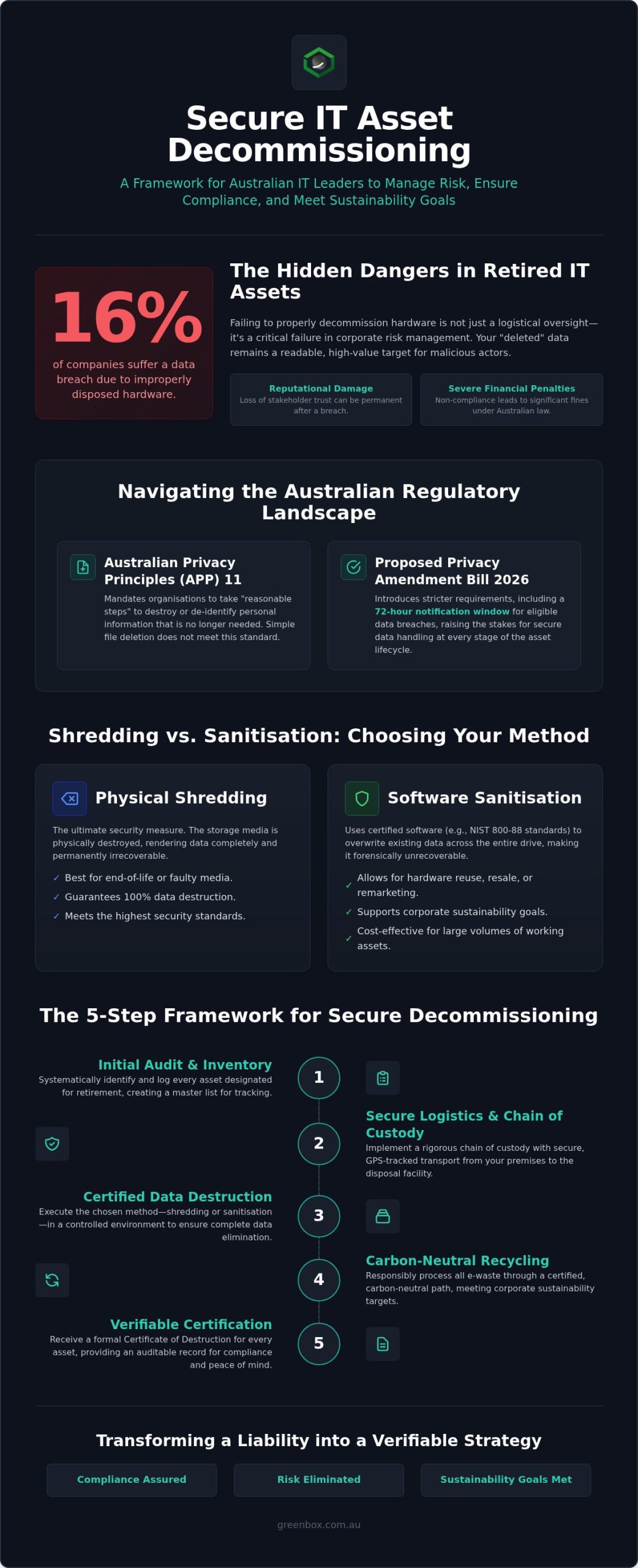
A Step-by-Step Framework for Secure Hardware Decommissioning
Successful decommissioning is a disciplined sequence of events that transforms a logistical challenge into a verifiable risk-management outcome. It moves beyond simply moving boxes; it’s about maintaining a meticulous record of every data-bearing device as it transitions from active service to final disposal. A structured framework ensures that secure hard drive destruction Australia wide is executed with technical precision, providing the transparency required for modern corporate governance.
- Phase 1: Asset Auditing and Inventory Management. Every decommissioning project begins with a baseline audit. We match physical serial numbers against your internal asset register to identify any discrepancies before the equipment leaves its secure environment.
- Phase 2: Secure On-site Storage and Chain of Custody. Retired assets are placed in locked, tamper-evident bins. This prevents unauthorised access during the critical window between decommissioning and collection.
- Phase 3: Logistics and Secure Transport. Equipment is moved in GPS-tracked vehicles operated by vetted personnel. This ensures a seamless transition to the processing centre without gaps in visibility.
- Phase 4: Data Sanitisation or Physical Destruction. Assets undergo the chosen method of destruction, whether that’s NIST-standard sanitisation for remarketing or industrial shredding for e-waste recycling.
- Phase 5: Reporting and Certification. The process concludes with the issuance of a formal Certificate of Destruction, providing the definitive proof required for compliance and audit purposes.
Maintaining the Chain of Custody
Visibility is the most effective tool against data loss. A rigorous chain of custody tracks an asset from the moment it leaves a staff member’s desk until it reaches the shredder. This requires more than just a signature on a manifest. It involves the use of tamper-evident seals and secure vehicles that are monitored in real-time. Your internal protocols should also include clear handover procedures. Staff handling retired equipment must be trained to treat these assets with the same level of security as active production servers.
The Importance of Certified Reporting
A Certificate of Destruction is your organisation’s primary defence during an external audit. This document must be detailed, linking each serial number to a specific date, location, and destruction method. It serves as an immutable record that your organisation has met its legal obligations under the Australian Privacy Act. These reports also play a vital role in your ESG reporting. By linking destruction data to your corporate sustainability metrics, you can demonstrate a transparent, carbon-neutral disposal path. For organisations ready to secure their hardware lifecycle, engaging a partner for certified data sanitisation ensures that every step of this framework is handled with the highest level of integrity.
Implementing a National ITAD Strategy with Greenbox
Managing a national fleet of hardware requires more than local waste collection. It demands a partner capable of integrating security protocols across every branch and office. Greenbox provides a comprehensive, carbon-neutral ITAD framework that simplifies this complexity. By centralising your secure hard drive destruction Australia wide through a single, accountable provider, you eliminate the inconsistencies that often lead to data exposure. This strategic alignment ensures that every asset, regardless of its location, is handled with the same rigorous commitment to data security and environmental stewardship.
Our approach is built on the principle that technical excellence and ecological responsibility are inseparable. We don’t just dispose of equipment; we manage its entire transition. This includes identifying opportunities for asset remarketing to maximise your return on investment. By extending the life of functional hardware through secure sanitisation, we help your organisation achieve its sustainability targets while recovering significant capital. It’s a pragmatic solution that serves both your financial health and the planet’s future.
Why R2 Certification Matters for Your Business
R2 certification is the global benchmark for responsible recycling and data destruction. In Australia, this means our facilities are held to the highest standards of transparency and ethical processing. We ensure that every component is tracked and recycled in a way that prevents toxic e-waste from entering landfills. Choosing an R2-certified partner reduces your operational burden by providing a fully managed, end-to-end service. You gain the peace of mind that comes from knowing your decommissioning process is backed by a globally recognised authority, protecting you from the legal and environmental risks of uncertified disposal.
Ready to Secure Your Hardware Lifecycle?
Every organisation has unique requirements, whether you’re in the financial sector, government, or a large enterprise. We tailor our decommissioning programmes to match your specific security needs and corporate goals. By leveraging our expertise in both destruction and remarketing, you can transform a necessary security task into a value-generating strategy. It’s time to move beyond simple disposal and adopt a disciplined, national ITAD strategy that protects your reputation and supports a circular economy.
Enquire about our secure hardware decommissioning services and discover how we can streamline your next national rollout with a carbon-neutral, security-first approach.
Securing Your Organisation’s Future through Strategic ITAD
Effective hardware retirement is no longer a back-office task; it’s a fundamental pillar of corporate risk management. We’ve explored how a structured framework protects your reputation from data breaches while ensuring full compliance with the Australian Privacy Act. By distinguishing between physical shredding and NIST-standard sanitisation, your organisation can balance security with sustainability, turning retired assets into a source of value rather than a liability.
Achieving secure hard drive destruction Australia wide requires a partner who understands the high stakes of enterprise and government security. Greenbox provides a steady, experienced hand for these complex transitions, offering R2-certified and carbon-neutral operations that align with your ethical and operational standards. Our national logistics and rigorous chain of custody protocols remove the operational burden from your teams, allowing you to focus on your core objectives with total peace of mind.
It’s time to transform your hardware lifecycle into a disciplined, verifiable asset. Partner with Greenbox for secure, carbon-neutral IT asset disposition and take the first step towards a more secure and sustainable future for your organisation.
Frequently Asked Questions
What is the difference between data wiping and hard drive destruction?
Data wiping, or sanitisation, is a software-based method that overwrites information to make it irrecoverable while keeping the hardware functional for reuse. Hard drive destruction is a physical process, such as industrial shredding, that pulverises the media into small fragments. While wiping supports a circular economy through asset remarketing, physical destruction is the preferred choice for drives that are physically non-functional or governed by strict government security mandates.
Is physical shredding the only way to comply with Australian privacy laws?
No, physical shredding isn’t the only compliant method under the Australian Privacy Act. Australian Privacy Principle 11 requires organisations to take reasonable steps to destroy or de-identify personal information. Software-based sanitisation that meets the NIST 800-88 standard is a legally recognised and highly secure alternative. The key to compliance is maintaining a verifiable audit trail and obtaining a formal Certificate of Destruction to prove the data is permanently irrecoverable.
How much does secure hard drive destruction cost for Australian businesses?
Costs are determined by the volume of assets, the required security standards, and the logistical complexity of the national project. Every enterprise engagement is unique, necessitating a tailored assessment of your hardware fleet. While some projects focus on the cost-efficiency of bulk physical destruction, others prioritise value recovery through asset remarketing commissions. We recommend a consultation to align the decommissioning process with your specific corporate budget and security requirements.
What is a Certificate of Destruction and why do I need one?
A Certificate of Destruction is a formal document that provides an immutable record of the data elimination process. It links specific serial numbers to the date, location, and method of destruction used. You need this document to satisfy internal and external auditors, proving that your organisation has met its legal obligations under the Notifiable Data Breaches scheme. It’s a critical component of your risk management strategy and corporate governance.
Can SSDs be securely wiped, or must they be shredded?
SSDs can be securely wiped using specialised sanitisation software that addresses the unique architecture of flash storage. Unlike traditional magnetic drives, SSDs require specific commands to ensure data is removed from all memory cells, including over-provisioned areas. If an SSD cannot be accessed or the sanitisation fails, physical shredding is the necessary fallback for secure hard drive destruction Australia wide. This ensures that no residual data remains on the silicon fragments.
How does hardware decommissioning support my company’s ESG goals?
Strategic decommissioning supports ESG goals by prioritising hardware reuse and responsible recycling. By choosing a carbon-neutral partner like Greenbox, you reduce the environmental footprint of your IT operations. Software-based sanitisation extends asset lifespans through remarketing, while R2-certified recycling ensures that non-functional components are processed ethically. This transparent approach provides measurable data for your sustainability reporting and demonstrates a commitment to a circular economy and modern ethical standards.
What happens to my old hardware after it is decommissioned?
After decommissioning, hardware follows a path of either remarketing or ethical recycling. Functional devices undergo certified sanitisation and are refurbished for resale, with commissions often returned to the client to maximise ROI. Non-functional or high-security assets are physically shredded. The resulting raw materials, such as precious metals and plastics, are then recycled through R2-certified facilities to ensure zero e-waste reaches landfill, protecting both your data and the planet.
Does Greenbox provide on-site data destruction services across Australia?
Greenbox provides a comprehensive national logistics framework to manage data destruction for organisations across the country. Our managed services include secure collection and transport using GPS-tracked vehicles and vetted personnel. This ensures a rigorous chain of custody from the moment an asset leaves your facility until its final processing. By centralising your disposal through a national partner, you achieve consistent security standards and secure hard drive destruction Australia wide across all your corporate locations.