

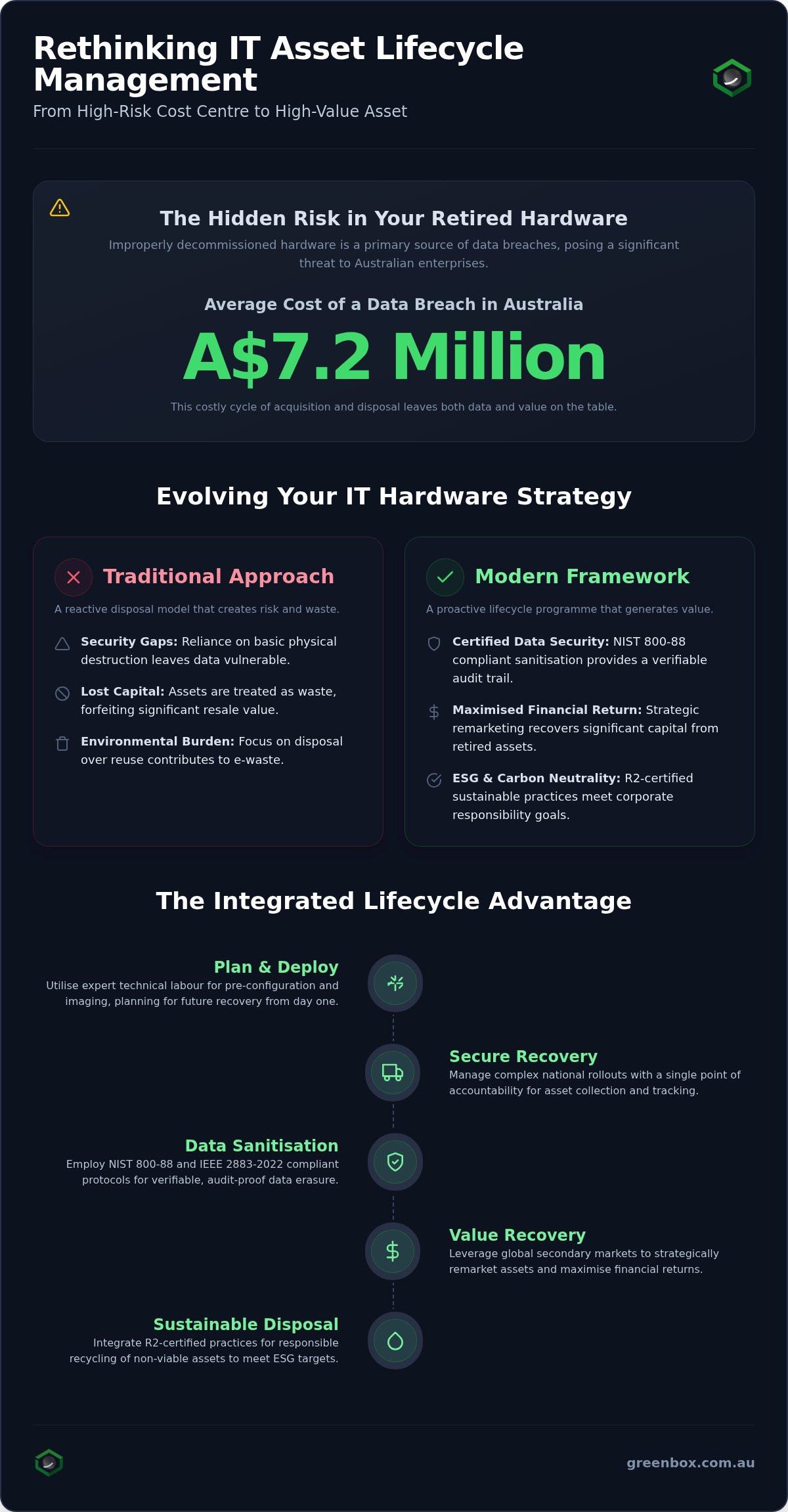
Did you know the average cost of a data breach has climbed to over A$7.2 million, with a significant portion of risks originating from improperly decommissioned hardware? For many Australian enterprises, the traditional approach to hardware is a costly cycle of acquisition and disposal that leaves both data and value on the table. You’re likely already focused on optimising IT asset lifecycle management to curb these rising operational costs and satisfy increasingly strict ESG requirements. It’s a complex task that requires more than just a bin for e-waste; it demands a disciplined, end-to-end strategy.
We understand that managing thousands of devices across a national footprint is a high-stakes logistical challenge. This article provides a strategic framework to transform your technology lifecycle into a secure, value-generating, and sustainable programme that meets rigorous Australian standards. We will explore how to integrate NIST-compliant data sanitisation, professional asset recovery, and carbon-neutral disposal into a single, seamless workflow. By shifting from a disposal mindset to a recovery-first model, your organisation can protect its data, recover significant capital, and meet its carbon-neutral targets with total confidence.
Key Takeaways
- Transition from reactive disposal to a proactive enterprise framework to eliminate security gaps and operational waste across your technology footprint.
- Learn why software-based sanitisation and NIST-compliant protocols provide superior data security and audit transparency compared to simple physical destruction.
- Maximise financial returns by optimising IT asset lifecycle management and leveraging global secondary markets for strategic asset remarketing.
- Reduce the burden on internal teams by utilising expert technical labour for off-site pre-configuration and imaging during large-scale national rollouts.
- Meet your organisation’s ESG and carbon-neutral targets by integrating sustainable, R2-certified practices into your technology retirement programme.
Transforming Your IT Lifecycle: Moving Beyond Simple Disposal
In 2026, the era of reactive hardware disposal has ended. Australian enterprises now recognise that hardware retirement is a critical governance function rather than a back-office logistics task. A fragmented approach to decommissioning often leaves significant security gaps and results in millions of dollars in lost capital across the country. By optimising IT asset lifecycle management, organisations can close these gaps and ensure that every device transition is handled with precision and professional oversight.
The Limitations of Traditional E-waste Disposal
Basic e-waste recycling often focuses on material recovery but ignores the high-stakes requirement for data security. If your process doesn’t include NIST 800-88 compliant sanitisation, you’re leaving your organisation vulnerable to breaches. Beyond security, unmanaged hardware stockpiles represent a hidden operational burden. These “dead” assets occupy valuable floor space and lose resale value every day they sit idle. Moving from simple compliance to active risk mitigation allows you to turn these liabilities into recovered capital. It’s a shift that replaces the “disposal” mindset with a strategic recovery model.
The Integrated Lifecycle Strategy Explained
Effective management begins long before a device reaches its end-of-life. By integrating Software Asset Management with hardware tracking, IT leaders gain full visibility into their fleet. Choices made during configuration and deployment, such as utilising expert technical labour for imaging, directly influence how easily that asset can be recovered and remarketed later. This foresight ensures that the eventual retirement of the device is a planned financial event rather than an emergency expense. In the 2026 business environment, ITAD has evolved into a strategic business metric that measures an organisation’s ability to balance technological agility with fiscal and environmental responsibility.
Greenbox serves as the steady hand for complex national transitions. We provide a unified framework that integrates security, sustainability, and value recovery into a single point of accountability. This “Greenbox Advantage” ensures that every device follows a rigorous, R2-certified path. We don’t just dispose of hardware; we protect your reputation and your bottom line through optimising IT asset lifecycle management across the entire organisation. Our end-to-end approach removes the operational burden from your internal teams, providing peace of mind through meticulously documented processes and certified results.
Strengthening Data Security Through Certified Sanitisation Protocols
Data security isn’t just an IT concern; it’s a legal and ethical obligation. In the Australian regulatory environment, the cost of a data breach has risen to an average of over A$7 million, making the retirement of hardware a critical risk point. Optimising IT asset lifecycle management involves more than just clearing a hard drive. It requires a verifiable process that aligns with IT Service Management best practices to maintain a complete audit trail. Many organisations mistakenly believe that physical shredding is the only secure option. However, software-based sanitisation often provides a more robust, verifiable result while maintaining the hardware’s remarketing potential.
NIST 800-88 Standards and Corporate Compliance
NIST 800-88 Rev. 1 remains the authoritative guideline for media sanitisation in both government and financial sectors. Modern storage technologies like SSDs and NVMe drives require specific technical procedures that go beyond simple data overwriting. These are now complemented by the IEEE 2883-2022 standard, which provides engineering-focused guidance for modern media. Without these protocols, residual data can remain in hidden sectors or wear-levelling blocks. By adhering to these rigorous standards, your organisation avoids the catastrophic reputational damage and financial penalties associated with a breach. It’s about providing absolute certainty that every byte of sensitive information is gone.
The Greenbox Sanitisation Workflow
Our workflow is designed around the principles of optimising IT asset lifecycle management, ensuring that security is never compromised for speed. We follow a disciplined, three-step process to guarantee results:
- Secure Collection. We establish a secure chain of custody from your site. Every asset is scanned and tracked using GPS-monitored logistics to prevent any loss during transit.
- R2-certified Processing. Devices are moved to our high-security, R2-certified facilities. Here, technical labour is applied to perform sanitisation in a controlled environment by cleared professionals.
- Verification and Certification. Each device is independently verified to ensure the sanitisation was successful. We then issue a formal Certificate of Sanitisation, which serves as a critical document for your internal audits and compliance checks.
If you’re concerned about your current retirement protocols, you can explore our certified data sanitisation services to ensure your fleet is managed to the highest Australian standards. This methodical approach removes the operational burden from your staff while providing the documented proof required by modern governance frameworks.
Maximising Financial Returns: The Art of Strategic Asset Remarketing
For many Australian enterprises, retired IT assets are viewed as a logistical burden or a sunk cost. However, a strategic approach shifts this perspective, treating decommissioned hardware as recoverable capital. By optimising IT asset lifecycle management, organisations can unlock significant residual value that would otherwise be lost to simple recycling. Greenbox facilitates this transition by transforming end-of-life equipment into a revenue stream through a disciplined remarketing programme. It’s a process that balances the need for security with the objective of maximum capital recovery.
Remarketing vs. Recycling: A Decision Framework
Determining whether an asset should be remarketed or recycled depends on its age, condition, and technical specifications. High-spec servers and enterprise-grade laptops often retain substantial value even after a three-year primary lifecycle. While basic recycling ensures environmental compliance, strategic remarketing can offset the costs of new technology refreshes. This financial return becomes a critical metric for IT leads who need to justify procurement budgets. Aligning these decisions with the Canadian Centre for Cyber Security guidance ensures that security remains the priority even when financial recovery is the goal. We assess every asset against rigorous criteria to ensure it’s a viable candidate for resale before it enters our refurbishment pipeline.
The Global Secondary Market Advantage
Greenbox leverages a global network of secondary market buyers to achieve higher valuations for your hardware. Limiting resale to the local Australian market can lead to price saturation, particularly during large-scale national rollouts. By accessing international demand, we ensure your assets reach the highest bidder. Our process involves skilled technical labour to clean, test, and grade every device. This refurbishment adds tangible value before the equipment enters its second life. Despite the focus on resale, our R2-certified facilities maintain rigorous security standards. Every device is sanitised to NIST 800-88 levels before it leaves our control, ensuring your data never enters the secondary market.
Financial transparency is a core pillar of our service. We provide detailed reporting that tracks resale returns alongside your security certificates. This integrated view allows you to see the exact financial recovery achieved through optimising IT asset lifecycle management. It provides your finance team with clear visibility into the total cost of ownership and the capital recovered at the end of the asset’s primary use. This methodical approach ensures that your technology retirement programme is as fiscally responsible as it is secure.
Streamlining Operations: Optimising Configuration and Deployment
Large-scale hardware rollouts often create significant internal bottlenecks for Australian enterprises. When internal IT teams are forced to spend weeks unboxing, imaging, and tagging new devices, high-level strategic projects are inevitably sidelined. By optimising IT asset lifecycle management at the point of acquisition, your organisation can ensure that deployment is a catalyst for productivity rather than a source of operational friction. Shifting the technical burden to an experienced partner allows for a faster, more accurate transition that scales across national footprints without compromising security or quality.
Imaging and Technical Configuration
Standardising the user experience starts with consistent, secure device imaging. Our expert technical labour handles the configuration process in a controlled, off-site environment. This ensures every laptop, workstation, or server is “desk-ready” and fully compliant with your corporate security protocols before it reaches the end-user. We integrate asset tagging and inventory management from day one, providing your procurement leads with total visibility. This meticulous preparation eliminates the common configuration errors that often plague large deployments, ensuring that your staff can remain productive from the moment they receive their new equipment.
Logistics and Rollout Management
Managing the complex logistics of a national refresh requires a steady, experienced hand to coordinate multiple corporate sites simultaneously. We employ a “swap-and-go” model designed to minimise employee downtime to the absolute minimum. Our teams simultaneously recover old assets while deploying new ones, which prevents the accumulation of unmanaged hardware in storage rooms. This synchronised approach reduces storage lag and ensures that decommissioned devices enter the security and recovery pipeline immediately. Managed deployment provides the operational peace of mind that comes from a predictable, professional, and fully documented transition.
Integrating these front-end services into your broader strategy is essential for optimising IT asset lifecycle management. It creates a seamless flow that connects procurement, deployment, and eventual retirement into a single, efficient workflow. You can learn more about how our managed deployment and configuration services can reduce the burden on your internal IT staff while accelerating your next technology refresh. This proactive management ensures your technology investments are protected and productive from the very first day of service.
Future-Proofing ESG Goals with a Carbon-Neutral Partner
Environmental, Social, and Governance (ESG) metrics have transitioned from optional corporate social responsibility initiatives to mandatory performance indicators for Australian enterprises. Stakeholders now demand transparent data on how organisations manage their physical footprint, particularly regarding technology. Optimising IT asset lifecycle management offers a direct, measurable pathway to satisfying these requirements. By treating hardware retirement as a core sustainability pillar, businesses can move beyond vague promises toward a disciplined circular economy model that prioritises reuse and ethical material recovery.
Meeting Australian Sustainability Standards
Aligning your technology retirement with national environmental standards requires more than just a commitment to recycling. It demands a partnership with a provider that operates within a rigorous, R2-certified framework. This certification is the global benchmark for responsible electronics disposal, ensuring that non-functional components are handled with technical precision and ethical oversight. For an Australian brand, a zero-landfill policy isn’t just an ecological win; it’s a critical layer of protection against environmental liability. It ensures that no part of your decommissioned fleet ends up in a landscape where it could cause reputational or ecological damage. This methodical approach to optimising IT asset lifecycle management guarantees that your organisation remains compliant with evolving Australian regulations.
Actionable ESG Reporting
The true value of a sustainable ITAD programme lies in the ability to translate technical activities into measurable outcomes for your annual reports. Greenbox provides the specific data points required to document your success, including detailed landfill diversion rates and carbon savings. We issue Carbon Omission Certificates after asset processing, providing your sustainability officers with verified proof of the environmental benefits achieved through hardware refurbishment and reuse. This data allows you to move from general statements to concrete figures, demonstrating exactly how many tonnes of e-waste were diverted from landfill. Partnering with a carbon-neutral organisation like Greenbox ensures that your technology lifecycle is managed by a vision-led leader who shares your long-term ethical business goals.
Adopting a circular IT model is a pragmatic response to the global e-waste crisis, which saw 62 million metric tons generated in 2022 alone. By extending the life of your hardware through strategic remarketing and ensuring responsible recycling for the rest, you’re directly contributing to a more sustainable future. This integrated strategy ensures that your technical success and responsible practices are inseparable. It provides a steady, reliable framework that supports your organisation’s journey toward carbon-neutral targets while maintaining the highest standards of data security and fiscal responsibility.
Securing Your Enterprise Future Through Strategic Lifecycle Excellence
Managing a technology fleet across Australia requires more than just logistical oversight; it demands a disciplined framework that integrates security, financial recovery, and environmental stewardship. By optimising IT asset lifecycle management, your organisation can transform decommissioned hardware from a liability into a strategic asset. We’ve explored how NIST-compliant data sanitisation protocols protect your reputation, while global remarketing networks recover significant capital for your next refresh cycle.
Greenbox provides the steady hand needed for these complex transitions. As a recognised AFR Sustainability Leader with R2-certified facilities across Australia, we ensure every device is handled with technical precision and ethical care. Our processes remove the operational burden from your internal teams, providing the peace of mind that comes from documented results and transparent reporting.
It’s time to move beyond simple disposal and embrace a circular technology model that supports your long-term ESG goals. Optimise your IT lifecycle with Greenbox today and secure a more sustainable, value-driven future for your enterprise. We look forward to helping you navigate your next national transition with total confidence.
Frequently Asked Questions
How does Greenbox ensure data security during the transport of our devices?
Greenbox maintains a secure chain of custody by scanning every asset at the point of collection and using GPS-monitored logistics. This disciplined approach ensures that no hardware is lost or accessed during transit between your site and our processing centres. We treat the logistics phase as a high-stakes security operation, providing the same level of protection for your retired assets as you would for your live production environment.
What is the difference between R2 certification and standard e-waste recycling?
R2 certification is the global gold standard for responsible electronics disposal, whereas standard recycling often lacks technical rigour. While basic recyclers might focus solely on scrap metal value, R2-certified facilities must adhere to strict protocols for data security, environmental protection, and worker safety. This certification ensures that non-functional parts are managed ethically and that every downstream partner meets the same high Australian standards.
Can Greenbox help our organisation achieve carbon-neutral IT goals?
We directly support your sustainability targets by operating as a carbon-neutral organisation. Optimising IT asset lifecycle management with a carbon-neutral partner allows you to document landfill diversion and carbon savings for your annual ESG reports. We provide Carbon Omission Certificates after asset processing, giving your team verified data to prove the environmental benefits of your technology retirement programme and circular economy initiatives.
How do I know if my retired IT assets have any resale value?
Resale suitability typically depends on a device’s age, condition, and technical specifications. High-spec enterprise servers and premium laptops often retain significant value after a three-year primary lifecycle. Our technical labour teams clean, test, and grade your assets to determine their marketability. We leverage a global secondary market network to ensure your hardware reaches the highest bidder, maximising the financial return for your organisation.
Does Greenbox provide a Certificate of Destruction for every device?
Yes, we issue a formal Certificate of Sanitisation or Destruction for every device we process. This document is a critical audit requirement that proves your hardware was handled according to NIST 800-88 compliant sanitisation protocols. It provides the legal and regulatory evidence needed to satisfy corporate governance and reputation management standards, ensuring that your data security obligations are fully met and documented.
How can we integrate Greenbox services into our existing office relocation plan?
Greenbox services can be seamlessly integrated into your relocation timeline through our managed recovery and deployment workflows. We simultaneously recover legacy hardware while deploying pre-configured “desk-ready” devices to your new site. This synchronised approach reduces storage lag and minimises employee downtime. Our technical labour teams handle the complex logistics of national rollouts, allowing your internal IT staff to focus on critical migration tasks.
What types of IT equipment can Greenbox manage for my business?
We manage a comprehensive range of enterprise-grade technology, including laptops, workstations, servers, and networking gear. Our facilities are equipped to handle large volumes of data-bearing devices and specialised storage infrastructure like NVMe drives. Whether you’re refreshing a fleet of mobile devices or decommissioning a national data centre, our framework ensures that every asset is tracked, secured, and processed with professional precision.
How does the asset remarketing commission structure work?
Our remarketing programme operates on a transparent revenue-sharing model where Greenbox retains a percentage of the final resale value as a commission. This fee covers the technical labour required for refurbishment, grading, and managing the global sales process. You receive detailed reporting that tracks these financial returns alongside your security certificates. This integrated view provides your finance team with clear visibility into the capital recovered through optimising IT asset lifecycle management.