

What if your most sensitive corporate secrets aren’t actually gone, but are simply waiting to be discovered on a ‘cleared’ hard drive? Many Australian IT leaders live with the quiet anxiety that ‘zombie data’ might resurface from retired assets, even after they’ve been supposedly wiped. It’s a valid concern, especially as the perceived friction between international NIST data sanitisation standards and the Australian Information Security Manual (ISM) often creates more confusion than clarity.
We understand that you’re under immense pressure to maintain 100% security while meeting increasingly ambitious sustainability goals. You shouldn’t have to compromise your reputation for the sake of the planet. This guide will help you master the complexities of NIST 800-88 Revision 2, ensuring your corporate data is truly irretrievable and your ITAD processes remain fully compliant with Australian privacy laws.
We’ve developed a clear framework for data sanitisation, delivering a strategy that balances technical excellence with ecological stewardship. You’ll learn how to navigate the latest September 2026 ISM updates, implement a robust verification programme, and secure the certificates of destruction required for a flawless audit trail. By the end, you’ll have the tools to transform a significant operational burden into a streamlined, secure, and sustainable asset recovery process.
Key Takeaways
- Move beyond simple file deletion by implementing a rigorous sanitisation programme that ensures data is permanently irretrievable from retired enterprise hardware.
- Master the selection of Clear, Purge, or Destroy methods to meet NIST data sanitisation standards based on the specific confidentiality requirements of your corporate information.
- Navigate the intersection of global benchmarks and local regulations by aligning your sanitisation protocols with the Australian Government Information Security Manual (ISM).
- Secure your organisation’s reputation with a documented chain of custody and official certificates of destruction that provide a comprehensive audit trail for every asset.
- Integrate sustainability into your security strategy by opting for carbon-neutral ITAD services that prioritise both rigorous data protection and ecological stewardship.
Understanding NIST Data Sanitisation Standards in the Australian Landscape
NIST 800-88 serves as the definitive global benchmark for ensuring that information on retired devices remains permanently inaccessible. While it originated in the United States, it’s become the cornerstone of NIST data sanitisation standards for Australian enterprises seeking to mitigate the catastrophic risks of a data breach. For local organisations, the media lifecycle doesn’t end when a laptop is closed for the final time; it ends only when the data it once held is proven to be unrecoverable. This transition from active use to final disposition is a critical governance hurdle that requires more than just good intentions.
Relying on simple file deletion or “emptying the bin” is a dangerous fallacy. Deletion merely removes the pointers to data, leaving the actual binary information intact on the drive. This residual data on enterprise hardware represents a significant liability under Australian Privacy Principle 11, which mandates that organisations take reasonable steps to destroy or de-identify personal information. A structured approach to sanitisation ensures that your business isn’t just checking a box, but actually removing the threat of “zombie data” that could haunt your reputation years later.
What is Media Sanitisation?
The core objective of this process is to render data recovery infeasible for a given level of effort. This process, formally known as Data sanitization, differs significantly from basic formatting. It involves methodical techniques like overwriting, cryptographic erasure, or physical shredding. Without a disciplined, software-driven programme, human error becomes your greatest vulnerability. Manual processes are prone to oversight, and one missed drive can lead to a million-dollar compliance failure.
Why NIST 800-88 Rev. 2 is the Gold Standard
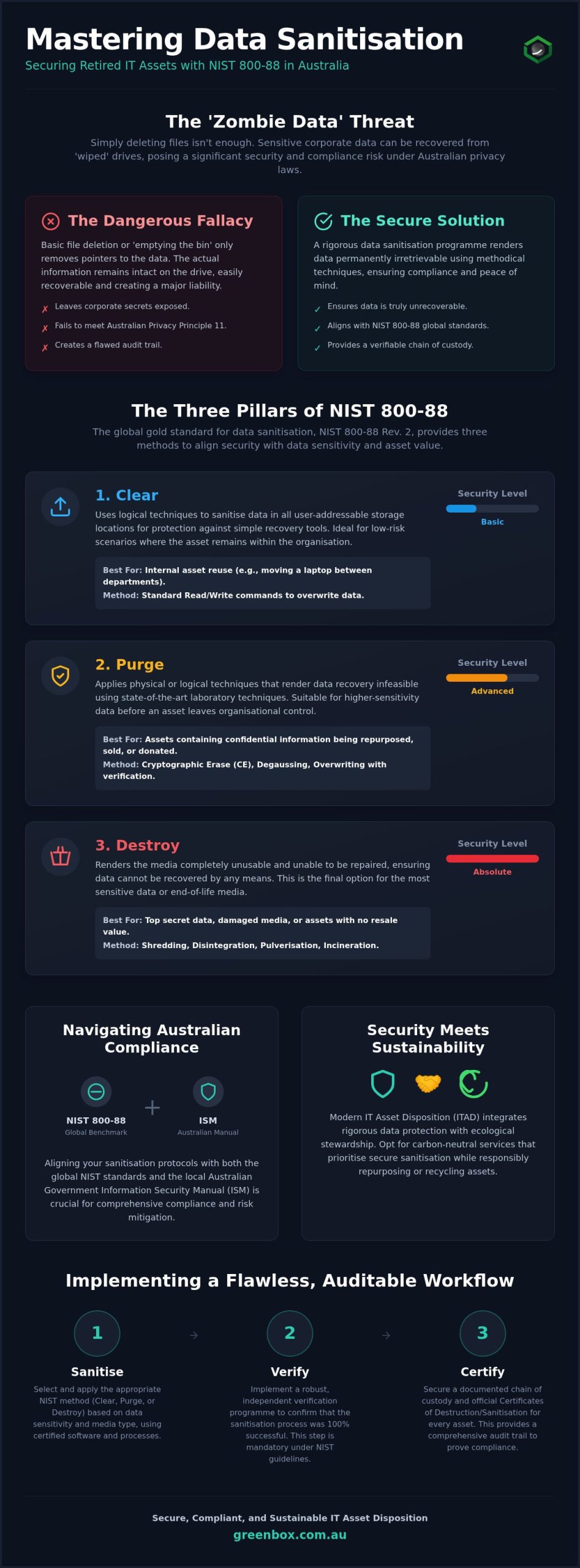
Older standards were designed for magnetic spinning disks and are largely ineffective for modern storage. NIST 800-88 Revision 2, released in September 2025, addresses the specific complexities of SSDs and NVMe drives. These modern technologies distribute data across flash cells in ways that traditional overwriting cannot reach. The latest NIST data sanitisation standards shift the focus from specific “passes” to a comprehensive programme of verification. In this framework, the act of sanitisation is only complete once it’s been verified and documented, providing the audit trail necessary for modern Australian corporate compliance.
The Three Pillars of NIST 800-88: Clear, Purge, and Destroy
The NIST 800-88 framework is built on the pragmatic principle that not all data requires the same level of intervention. Choosing the correct path depends entirely on the media type and the sensitivity of the information it holds. A “one-size-fits-all” strategy is often inefficient. It either leaves security gaps by under-treating high-risk data, or it destroys financial and environmental value by shredding low-risk assets that could be repurposed. Adhering to these NIST data sanitisation standards allows Australian enterprises to align their security posture with their specific risk appetite while avoiding unnecessary waste.
Every category within the framework requires a rigorous verification step. This isn’t a “set and forget” process. It requires a documented check to confirm the sanitisation was successful. Without this verification, the audit trail is incomplete, leaving the organisation vulnerable during a compliance review. Matching the sanitisation level to the confidentiality of the information ensures that resources are allocated where they matter most, protecting both the balance sheet and the brand’s reputation.
NIST Clear: The Baseline for Internal Reuse
NIST Clear employs standard Read/Write commands to overwrite data. It’s the baseline for assets intended for internal reuse within the same organisation. While effective for low-sensitivity information, it has limitations. It doesn’t typically address hidden or remapped sectors on a drive. If you’re moving a laptop from the finance department to the marketing team, Clear is often sufficient, provided the risk of laboratory-level recovery is deemed acceptable for that specific internal transition.
NIST Purge: The Enterprise Standard for Remarketing
Purge is the enterprise standard for hardware destined for the secondary market. It uses firmware-level commands to render data recovery “infeasible” even in a laboratory environment. This method is critical for modern storage like SSDs, where standard overwriting fails to reach every flash cell. According to the NIST Guidelines for Media Sanitization, Purge provides a significantly higher level of assurance than Clear. Because the hardware remains functional, Purge supports asset remarketing, allowing organisations to recover value from their retired fleet.
NIST Destroy: When Physical Obliteration is Necessary
When drives are physically damaged or contain extreme-security data, NIST Destroy is the final resort. This involves shredding, pulverising, or incinerating the media. While it offers the highest level of security, it comes with a heavy environmental cost. Physical destruction eliminates any chance of reuse, turning potential resources into e-waste. It’s a choice that should be reserved for the most sensitive scenarios to maintain a balance between security and sustainability. If you’re looking to implement these NIST data sanitisation standards without the operational burden, consider partnering with an expert in certified data sanitisation to ensure every asset is handled with precision.
NIST vs. the Australian Government Information Security Manual (ISM)
While NIST 800-88 is an American technical publication, it serves as a critical operational pillar for Australian enterprises. Navigating the intersection of US technical specifications and Australian regulatory frameworks requires a nuanced understanding of how these systems overlap. For many local organisations, the NIST data sanitisation standards provide the practical methodologies that support the broader security mandates issued by domestic authorities. This alignment is essential for maintaining a consistent security posture in a globalised digital economy.
The Australian Signals Directorate (ASD) provides high-level guidance through the Australian Government Information Security Manual (ISM). While the ISM outlines the requirements for protecting sensitive information, it frequently aligns with the technical rigor found in NIST 800-88. This is particularly relevant for government contractors and agencies governed by the Protective Security Policy Framework (PSPF). The PSPF mandates that data must be rendered unrecoverable before disposal, and the NIST framework offers the most reliable way to achieve this outcome without reinventing the wheel.
Mapping NIST Categories to ISM Controls
The ISM contains specific controls regarding media sanitisation and destruction that every IT leader must address. When an organisation seeks to sanitise media for reuse or disposal, the NIST “Purge” method often satisfies the ISM’s requirements for making data recovery infeasible. It’s a pragmatic solution that avoids the total loss of hardware value while meeting strict security thresholds. In the Australian context, the process must be overseen or verified by an Authorised Officer. This individual ensures that the chosen NIST data sanitisation standards are applied correctly and that the risk to the organisation is fully mitigated before the asset leaves the control of the business.
Privacy Act Compliance and Data Disposition
Compliance with the Privacy Act 1988 is a non-negotiable requirement for Australian businesses. Specifically, Australian Privacy Principle (APP) 11 requires organisations to take reasonable steps to destroy or de-identify personal information that is no longer needed. Failing to do so can lead to significant penalties and lasting reputational damage. A NIST-compliant audit trail acts as a vital shield during a regulatory investigation. By maintaining a detailed record of every asset, the method used, and the final outcome, you demonstrate a commitment to rigorous security. Third-party ITAD providers play a crucial role here. They maintain the compliance chain from the moment the hardware leaves your facility until the final certificate of destruction is issued. This end-to-end visibility ensures that your data disposition is not just a technical task, but a fully documented component of your corporate governance.
Implementing a NIST-Compliant ITAD Workflow
Transitioning hardware from active service to a sanitised state requires more than a software tool; it demands a disciplined workflow. Implementing these NIST data sanitisation standards across a diverse fleet requires a methodical approach that accounts for every device. A NIST-compliant ITAD programme ensures that every asset is tracked from the moment it’s decommissioned until the final data destruction is verified. This process is built on a rigorous chain of custody that bridges the gap between your secure facility and the processing centre. Whether you’re managing loose drives from a decommissioned SAN or integrated drives within a fleet of laptops, the standard remains the same. Every single piece of media must be tracked individually to prevent data leakage.
Independent verification is the final safeguard in this process. NIST recommends that a portion of sanitised media be sampled and checked by someone other than the original technician. This adds a layer of accountability that internal processes often lack. It’s this level of detail that separates a high-standard operation from a basic disposal service. Without independent sampling, you’re relying entirely on the initial process without a safety net.
Inventory and Asset Tracking
The “No Asset Left Behind” rule is the foundation of secure logistics. Every serial number must be reconciled at the point of collection to ensure the inventory matches the physical shipment. This prevents assets from “going dark” during transit. Documenting the “State of the Media” before processing begins is equally vital. We record whether drives are functional, damaged, or encrypted, as this determines the appropriate NIST data sanitisation standards to apply. Secure, GPS-tracked vehicles and vetted personnel ensure that your hardware is protected against unauthorised access throughout the journey to the processing centre.
Verification and Certification
A simple shredding receipt doesn’t meet the requirements of a modern audit. NIST mandates a formal “Certificate of Sanitisation” for every unique serial number processed. This document is your primary evidence of compliance during a regulatory review. An audit-ready certificate must include the specific method used, the name of the technician, and the results of the verification check. It’s the difference between assuming data is gone and proving it. For organisations that value transparency and security, our IT asset recovery services provide the end-to-end documentation required to satisfy both internal stakeholders and external auditors.
Greenbox: Certified Sanitisation and Sustainable ITAD
Greenbox serves as a strategic partner for organisations that refuse to choose between ironclad security and environmental responsibility. We integrate the most rigorous NIST data sanitisation standards into a carbon-neutral service model, ensuring that your decommissioned hardware doesn’t become a liability for your reputation or the planet. Our operations are anchored by R2 certification, a global standard that validates our commitment to both data protection and responsible electronics recycling. This dual focus allows us to manage the complex transitions of enterprise-grade hardware with a level of precision that meets the requirements of Australia’s most sensitive sectors.
Transparency is the foundation of our partnership model. We provide enterprise partners with full visibility into the lifecycle of every asset. This isn’t a passive service; it’s an end-to-end management system that ensures every serial number is accounted for and every byte of data is proven irretrievable. By aligning our technical execution with your broader financial and ethical goals, we remove the operational burdens typically associated with large-scale IT asset disposition.
Security Meets Sustainability
Shredding is often viewed as the ultimate security measure, but it’s frequently an unnecessary blow to the circular economy. Greenbox prioritises NIST Purge as the “planet-safe” alternative to physical destruction. This software-based method allows us to render data unrecoverable while preserving the integrity of the hardware. By extending the lifecycle of sanitised equipment, we significantly reduce e-waste and support your organisation’s sustainability targets. As a carbon-neutral organisation, we ensure that every step of the ITAD process, from secure transit to final remarketing, is handled with the smallest possible ecological footprint.
The Greenbox Advantage for Government and Enterprise
Our national coverage ensures that whether your assets are in a central hub or a remote location, they are handled within high-security facilities by vetted technical staff. We understand the unique requirements of the Australian government and financial sectors, where the chain of custody is paramount. Our partners gain access to a customised portal for real-time asset tracking, providing the visibility needed to manage large fleets with confidence. This methodical approach ensures that your audit trail is always complete and your compliance is never in question. Secure your reputation with Greenbox certified data sanitisation and transform your retired IT assets into a testament to your corporate integrity.
Securing Your Enterprise Legacy with Confidence
Implementing a rigorous data disposal strategy is no longer just a technical requirement; it’s a fundamental pillar of corporate governance. By mastering the three pillars of Clear, Purge, and Destroy, you ensure that retired assets don’t become a security liability. Aligning your internal workflows with the Australian Government Information Security Manual (ISM) and global NIST data sanitisation standards allows you to protect your organisation’s reputation while meeting the strict demands of APP 11. This methodical approach transforms a potential risk into a documented, secure, and predictable process.
Greenbox provides a steady, experienced hand to manage these complex transitions. Our national Australian operations and R2 certified facilities offer the transparency and visibility you need for a flawless audit trail. We help you balance the high stakes of data security with a commitment to environmental stewardship through our carbon-neutral service model, ensuring your sustainability goals are met without compromising protection. You don’t have to manage the burden of “zombie data” alone.
Take the first step toward a more secure and sustainable disposition strategy. Request a Secure ITAD Consultation and NIST Compliance Review today. You can achieve a secure, compliant, and sustainable future for your IT assets with a partner that values integrity as much as you do.
Frequently Asked Questions
What is the difference between NIST 800-88 and DoD 5220.22-M?
NIST 800-88 is the modern, risk-based standard that replaced the older DoD 5220.22-M. While the DoD standard was designed for magnetic spinning disks and required multiple overwriting passes, NIST 800-88 focuses on the specific media type and data sensitivity. It’s more effective for modern storage like flash media and SSDs. Most Australian enterprises now prioritise NIST data sanitisation standards because they offer a more scientifically rigorous and efficient approach to data destruction.
Does NIST 800-88 apply to Solid State Drives (SSDs)?
Yes, NIST 800-88 Revision 2 specifically addresses the unique challenges of sanitising SSDs and other flash-based storage. Traditional overwriting methods used for hard drives don’t work effectively on SSDs due to wear-levelling and over-provisioning. NIST provides clear instructions for using firmware-level commands, such as cryptographic erasure or block erase, to ensure that data in all storage cells is rendered unrecoverable. This makes it the preferred standard for modern enterprise fleets.
Is physical shredding required to meet NIST data sanitisation standards?
Physical shredding is only one of the three methods defined by NIST, and it’s typically reserved for physically damaged media or extreme-security requirements. The “Clear” and “Purge” methods allow for software-based sanitisation that keeps the hardware functional. For most Australian businesses, software-driven Purge is the optimal choice. It meets rigorous NIST data sanitisation standards while supporting the circular economy by allowing assets to be refurbished and remarketed rather than ending up as e-waste.
What should be included in a NIST-compliant Certificate of Destruction?
A valid certificate must provide a complete audit trail for each unique serial number. It should document the specific sanitisation method used, such as NIST Purge, along with the date of processing and the name of the technician. Crucially, it must include the results of the verification step, proving that the data is truly irretrievable. This document is your primary evidence for compliance with Australian privacy laws and is essential for passing any formal security audit.
How does NIST 800-88 align with the Australian ISM?
NIST 800-88 provides the technical methodologies that allow organisations to meet the high-level security controls found in the Australian Government Information Security Manual (ISM). While the ISM sets the requirements for protecting sensitive information, it doesn’t always prescribe the exact technical steps for every drive type. Using NIST standards ensures that your technical execution is globally recognised and satisfies the ASD’s guidelines for rendering data unrecoverable before an asset leaves your control.
Can I perform NIST-compliant sanitisation in-house?
While possible, performing NIST-compliant sanitisation in-house is often operationally difficult and carries significant risk. It requires specialised software, vetted staff, and a rigorous verification programme to meet the standard’s documentation requirements. Most Australian enterprises find that partnering with an R2-certified provider is more efficient. This ensures a professional chain of custody and delivers the independent certification needed to satisfy auditors, all while removing the technical and administrative burden from internal IT teams.
What is the “Purge” method in NIST 800-88?
The Purge method uses firmware-level commands to make data recovery infeasible even in a sophisticated laboratory environment. It’s more thorough than the “Clear” method because it addresses hidden areas of the drive that standard software can’t reach. Purge is the enterprise standard for assets destined for remarketing. It provides a high level of assurance for sensitive data while keeping the hardware intact, allowing organisations to recover financial value from their retired equipment.
How does data sanitisation impact the resale value of my IT assets?
Choosing software-based sanitisation like NIST Purge significantly increases the resale value of your IT assets compared to physical destruction. Shredding turns a valuable laptop or server into low-value scrap metal. By using certified software erasure, you maintain the hardware’s functionality while ensuring total data security. This allows for effective asset remarketing, which can offset the costs of your ITAD programme and contribute directly to your organisation’s financial health and sustainability goals.