

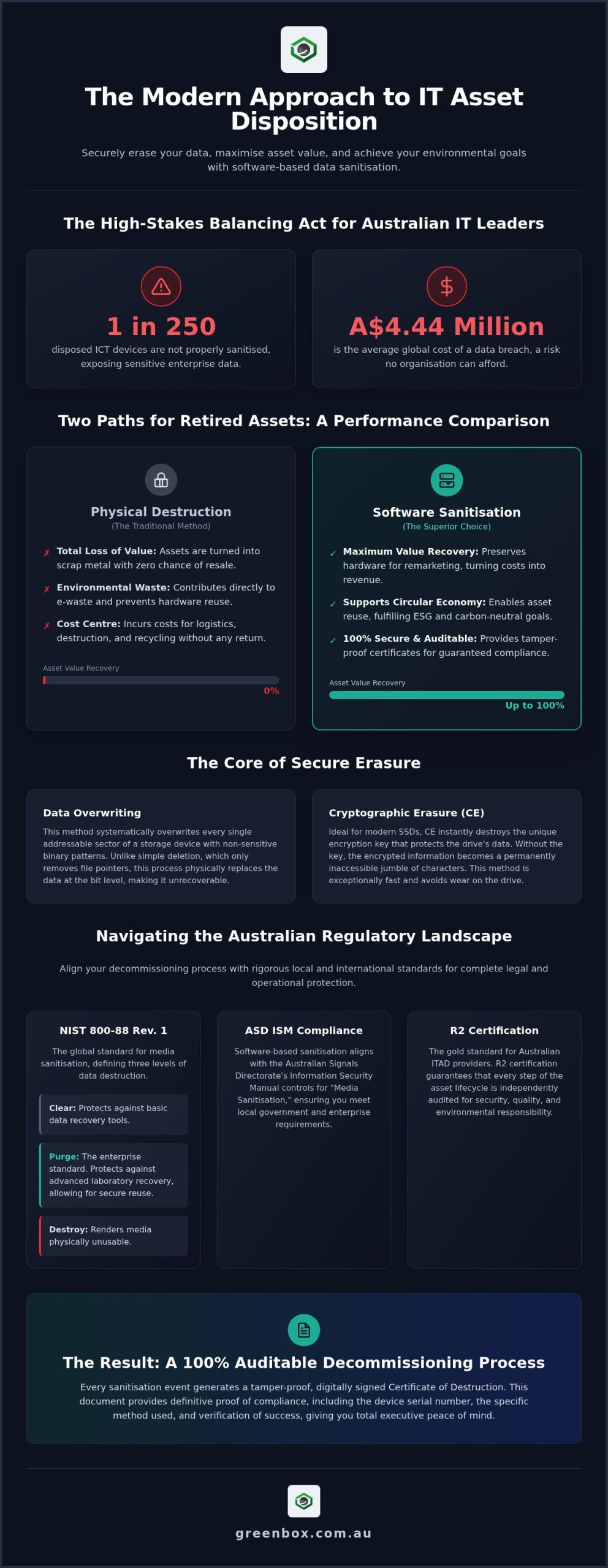
Did you know that an estimated 1 in every 250 disposed ICT devices is not properly sanitised, leaving a trail of sensitive enterprise data exposed? For Australian IT leaders, the traditional “shred everything” approach feels safe, but it often results in significant environmental waste and the total loss of asset resale value. We understand the pressure you’re under to eliminate the risk of a data breach, which now carries an average global cost of A$4.44 million, while also hitting ambitious carbon-neutral targets. It’s a complex balancing act that requires a more sophisticated strategy than physical destruction alone.
This guide demonstrates why software based data sanitisation is the superior choice for modern enterprises seeking 100% secure, auditable results. You’ll discover how to maintain strict compliance with the latest Australian ISM and NIST 800-88 standards while recovering maximum value from your retired hardware. We’ll examine the move from high-waste disposal to a secure circular economy, ensuring your data’s permanently erased and your ESG obligations are met with absolute precision.
Key Takeaways
- Learn why overwriting data is the only secure way to ensure permanent erasure, moving beyond the significant risks of simple formatting or deletion.
- Understand how to navigate the Australian regulatory landscape by meeting the latest ISM requirements and NIST 800-88 Revision 1 standards.
- Discover why software based data sanitisation is the key to achieving carbon-neutral goals by preserving hardware for the circular economy.
- Explore how to transform your retired assets from a cost centre into a revenue source through professional remarketing and value recovery.
- Establish a 100% auditable decommissioning process with tamper-proof certificates of destruction that guarantee compliance and transparency.
Beyond the Shredder: What is Software-Based Data Sanitisation?
Enterprise security requires more than just making files disappear from a directory. For many organisations, the default response to hardware retirement is physical destruction. However, this method is often unnecessary and environmentally taxing. What is data erasure? At its core, software based data sanitisation is the methodical process of overwriting every addressable sector of a storage device with non-sensitive binary patterns. Unlike simple deletion, which only removes the file’s index entry, true sanitisation ensures the underlying data is physically replaced at the bit level.
Standard formatting or “emptying the bin” leaves the actual data blocks intact on the drive. Forensic software can easily reconstruct this information, posing a massive liability for Australian enterprises. Professional software based data sanitisation utilises multiple overwrite passes to achieve a state of “unrecoverable data.” This process is backed by a robust audit trail. Every erasure event generates a digitally signed certificate of destruction, providing the definitive proof required for compliance audits and executive peace of mind.
The Core Mechanism of Data Overwriting
Effective sanitisation software interacts directly with the drive’s firmware to ensure every sector, including hidden or remapped blocks, is addressed. It’s not just about writing zeros; it’s about following rigorous protocols like the NIST 800-88 standard. Sanitisation is the process of rendering data on storage media irretrievable by even the most advanced laboratory forensic techniques. This level of precision differentiates professional-grade tools from basic consumer utilities, ensuring that no residual magnetic or electronic signatures remain.
The Role of Cryptographic Erasure
For modern storage, particularly Solid State Drives (SSDs), cryptographic erasure (CE) offers a highly efficient alternative. CE works by instantly destroying the unique encryption key used to protect data on a self-encrypting drive. Without the key, the encrypted data becomes a meaningless string of characters that’s impossible to decrypt. This method is exceptionally fast; it’s often preferred for high-capacity SSDs where traditional multiple-pass overwriting would take hours or cause excessive wear. By leveraging internal drive encryption, CE provides a secure transition for assets destined for the secondary market.
Compliance and Standards: Navigating the Australian Regulatory Landscape
For Australian organisations, data security isn’t just a best practice; it’s a regulatory mandate. The Australian Signals Directorate (ASD) provides the essential framework for this through the Information Security Manual (ISM). Adopting software based data sanitisation ensures that your decommissioning process aligns with these rigorous local expectations. While international benchmarks are vital, understanding how they intersect with Australian law is what provides true legal and operational protection for your board and stakeholders.
R2 certification has emerged as the gold standard for Australian ITAD providers. This certification guarantees that every step of the asset lifecycle, from collection to final erasure, is independently audited for security and environmental responsibility. It provides a level of transparency that’s essential for government and financial sectors, where the cost of a compliance failure is simply too high to ignore.
NIST 800-88: Clear, Purge, and Destroy
The NIST 800-88 guidelines define three distinct levels of sanitisation to help organisations manage risk. “Clear” applies basic techniques to protect against simple data recovery tools. “Purge” involves more robust methods, such as professional overwriting or cryptographic erasure, to protect against advanced laboratory-level recovery. Finally, “Destroy” renders the media physically unusable.
For most enterprise hardware, the “Purge” level is the preferred standard. It allows for the secure reuse of assets while maintaining a high security posture. To remain compliant, your certificate of destruction must be comprehensive. It should include the device serial number, the specific sanitisation method used, verification of success, and a tamper-proof digital signature. This document is your primary defence during a security audit.
Meeting ASD and ISM Requirements
The ISM contains specific controls for “Media Sanitisation” that Australian government agencies and their contractors must follow. Professional software based data sanitisation is recognised as a valid method for media destined for reuse or remarketing. For high-security environments, these requirements are even stricter, necessitating the verified overwriting of all addressable locations to ensure no residual data remains.
Managing these complex requirements internally can be an operational burden. Partnering with a specialist like Greenbox IT Asset Disposition ensures your organisation meets government-grade compliance without diverting your internal IT resources. This partnership provides the peace of mind that comes from a steady, experienced hand managing your most sensitive transitions, ensuring every retired asset is handled with absolute precision and integrity.
Software Sanitisation vs. Physical Destruction: A Performance Comparison
Many Australian enterprises believe that physical shredding is the ultimate security measure. It’s a visual, visceral process that feels final. Yet, this perception ignores the technical reality of modern high-density storage. A single fragment of a shredded platter or flash chip can still hold substantial amounts of data, a risk known as “shredder residue.” Professional software based data sanitisation eliminates this risk by ensuring the data itself is destroyed before the hardware is even considered for its next phase. This method safeguards your business by providing a level of forensic unrecoverability that physical destruction simply cannot guarantee for modern, high-capacity drives.
Software-based methods offer a superior chain of custody compared to traditional disposal. Every device is tracked by its unique serial number through a central management console. This generates a tamper-proof record that proves exactly when and how each asset was cleared. Physical shredding often relies on manual logs or low-resolution video, which are difficult to reconcile against an enterprise-wide inventory during a high-stakes audit. By choosing a software-led approach, you gain a transparent, verifiable history for every data-bearing asset in your fleet.
The Hidden Costs of Physical Shredding
Choosing to shred hardware results in a 100% loss of the asset’s residual value. It effectively turns a potential revenue stream into a disposal cost, removing any chance of asset recovery. Beyond the financial impact, the environmental toll is significant. Shredding creates a mixed-material residue of plastics, metals, and rare earth elements that is notoriously difficult to separate and recycle. This process contributes directly to Australia’s growing e-waste problem. There’s also a notable security gap; transporting active data-bearing drives to a shredding facility introduces a window of vulnerability that software based data sanitisation closes at the point of decommissioning.
Operational Efficiency at Scale
Managing the retirement of thousands of devices requires a methodical approach that shredding cannot match. Software protocols allow IT teams to process entire racks of servers or hundreds of laptops simultaneously, whether they’re in a central office or a remote data centre. This scalability is essential for maintaining momentum during large-scale technology refreshes. For organisations with a distributed remote workforce, software sanitisation is the superior choice. It allows for secure erasure to be triggered remotely, ensuring data is protected the moment a device leaves an employee’s hands, rather than waiting for it to be shipped to a physical destruction site.
Implementing a Secure Sanitisation Protocol Across Your Organisation
Deploying a robust security framework requires more than just high-quality tools; it demands a disciplined, end-to-end governance strategy. For Australian enterprises, this begins with a clear policy for device end-of-life management that leaves no room for ambiguity. Integrating professional software based data sanitisation into your existing IT asset management (ITAM) system allows for the automatic ingestion of destruction reports, creating a single source of truth for your compliance audits. This structured approach removes the operational burden from your internal teams while ensuring every data-bearing asset is accounted for.
Step 1: Asset Identification and Triage
Effective triage ensures that resources are allocated based on risk. You must identify which devices require the “Purge” level of sanitisation, typically those holding sensitive corporate or government data, versus those that only need a “Clear” level process for general office use. Once identified, these assets should be moved to a secure, restricted-access holding area. This prevents the accidental reuse or loss of active drives before they’ve been sanitised. Maintaining strict serial number tracking from the exact moment of decommissioning is the only way to guarantee a flawless chain of custody throughout the entire lifecycle.
Step 2: Partner Selection and Audit
Selecting a partner is a strategic decision that affects both your security and your reputation. Your chosen ITAD provider should demonstrate a commitment to modern ethical standards, such as R2-certified facilities and a proven track record in high-security processing for government and financial sectors. It’s also vital to ensure they provide Carbon Neutral ITAD Services to help your organisation meet its broader ESG and carbon-neutral targets. Beyond certifications, you should perform periodic audits of your provider’s sanitisation logs and process workflows. This transparency builds a partnership based on trust and technical excellence, ensuring your data remains protected at a national scale.
If you’re seeking a disciplined strategist to manage your next technology refresh, contact Greenbox to discuss a tailored sanitisation programme.
Maximising Asset Value: The Link Between Sanitisation and Remarketing
Many organisations view IT decommissioning as a pure cost centre, a final operational hurdle to be cleared before moving on to new technology. However, by adopting software based data sanitisation, you can transform these retired assets into tangible working capital. Unlike physical destruction, which renders hardware worthless and adds to disposal fees, professional overwriting preserves the functional integrity of the device. This allows your enterprise to participate in the secondary market, recovering significant residual value that would otherwise be lost in a shredder. We position our partners to see retired fleet not as waste, but as a recoverable financial resource.
Greenbox acts as a steady, experienced hand in this transition, ensuring that your security requirements are met while simultaneously boosting your bottom line. By maintaining the hardware’s condition, we enable a seamless move from decommissioning to resale. This pragmatic approach aligns your technical security protocols with your financial health, proving that rigorous data protection and asset value recovery aren’t mutually exclusive goals.
The Circular Economy in Corporate IT
The circular economy is built on the principle that products should remain in use for as long as possible, and in corporate IT, reuse is always superior to recycling. When you choose software based data sanitisation, you’re directly supporting “Zero Waste to Landfill” initiatives. This isn’t just an environmental win; it’s a strategic reputational advantage. Extending the lifecycle of a laptop or server significantly reduces the carbon footprint associated with manufacturing new equipment. As a carbon-neutral organisation, we help you demonstrate a commitment to ethical standards that resonates with modern stakeholders, shareholders, and government bodies alike. Technical success and responsible practice are inseparable in a forward-thinking business strategy.
Remarketing: Recovering Value Securely
The process of recovering value begins with meticulous refurbishment. Once data is forensically erased and verified, the hardware is cleaned, tested, and prepared for the secondary market. Successful Asset Remarketing can provide a substantial budget offset, effectively funding your next technology refresh or major hardware rollout. This creates a self-sustaining cycle where the value recovered from yesterday’s fleet helps pay for tomorrow’s innovation. It’s a disciplined strategy that removes operational burdens while providing the peace of mind that comes with a 100% secure, auditable process. By choosing a partner that understands both the high stakes of data security and the nuances of the global hardware market, you ensure your organisation achieves maximum efficiency at every stage of the asset lifecycle.
Contact Greenbox to organise your secure data sanitisation programme today.
Future-Proofing Your Enterprise Data Strategy
Adopting a disciplined approach to asset retirement is no longer just an IT requirement; it’s a strategic business imperative. By transitioning from high-waste physical destruction to software based data sanitisation, your organisation achieves a state of forensic unrecoverability while upholding the highest Australian ISM and NIST standards. This shift not only protects your most sensitive information but also enables a circular economy where retired hardware is transformed into working capital through professional remarketing. You’ve seen how a methodical protocol can turn a potential liability into a sustainable advantage.
Greenbox provides the steady hand needed to manage these complex transitions at scale. As Australia’s premier carbon-neutral ITAD provider, we offer R2-certified facilities and national service coverage that guarantee security and transparency for both government and enterprise sectors. You can now eliminate operational burdens and meet your ESG targets with absolute confidence in your data’s permanent erasure. Secure your corporate data with Greenbox’s certified sanitisation services and take the first step toward a more secure, sustainable, and profitable asset lifecycle. We look forward to helping you lead the way in responsible technology management.
Frequently Asked Questions
What is the difference between data erasure and data sanitisation?
Data erasure is the general process of removing data from a storage device, while data sanitisation is the higher standard that guarantees information is rendered forensically unrecoverable. While erasure might include simple overwriting, sanitisation involves verified, multi-pass protocols that meet specific compliance benchmarks. For enterprises, sanitisation provides the definitive assurance that no residual data remains, even when subjected to advanced laboratory recovery techniques, making it the essential choice for risk management.
Is software-based sanitisation compliant with Australian Government standards?
Yes, software based data sanitisation is fully compliant with the Australian Government Information Security Manual (ISM) when performed using certified tools. The ISM provides specific controls for media sanitisation that allow for the reuse of devices if data is overwritten according to ASD-approved protocols. This ensures that government agencies and their contractors can securely decommission hardware while maintaining strict adherence to national cybersecurity requirements and data protection laws.
Can data be recovered after a software-based sanitisation process?
No, data cannot be recovered after a professional sanitisation process that meets NIST 800-88 or ISM standards. These protocols involve overwriting every addressable sector of the drive with non-sensitive patterns, effectively replacing the original bits. Unlike basic deletion, which only removes the file index, sanitisation destroys the actual data blocks. This level of precision ensures that even advanced forensic tools used by sophisticated actors cannot reconstruct the original information.
How long does it take to sanitise a standard corporate laptop?
The time required depends on the drive’s capacity and the specific sanitisation protocol selected. A standard corporate laptop with a 256GB or 512GB SSD typically takes between 30 minutes and two hours to complete a verified “Purge” level erasure. High-capacity hard drives or servers may require more time for multiple overwrite passes. However, using professional tools allows for bulk processing, where hundreds of devices are sanitised simultaneously to maintain operational efficiency.
Does software-based sanitisation work on Solid State Drives (SSDs)?
Yes, software based data sanitisation is highly effective for SSDs, though it requires specific techniques like cryptographic erasure or firmware-based commands. Traditional magnetic overwriting isn’t always suitable for SSD architecture due to wear-levelling and over-provisioning. Professional tools address these challenges by interacting directly with the drive’s controller to ensure all data, including blocks in hidden areas, is permanently cleared without damaging the hardware’s functional integrity or reducing its resale value.
What is a Certificate of Destruction and why do I need one?
A Certificate of Destruction is a formal, digitally signed document that provides an auditable record of the sanitisation process. It includes critical details like the device serial number, the method used, and verification of success. You need this document to demonstrate compliance with the Privacy Act 1988 and various international security standards. It serves as your primary evidence during a security audit, proving that your organisation has fulfilled its legal obligations.
Can we perform software sanitisation in-house or should we use a provider?
While you can perform erasure in-house, partnering with a certified ITAD provider like Greenbox removes the significant operational burden and liability. Professional providers use R2-certified facilities and high-speed infrastructure to manage bulk decommissioning with absolute precision. We provide independent verification and tamper-proof reporting that is difficult to replicate internally. This partnership ensures that your security protocols are managed by experts, allowing your internal IT team to focus on core business objectives.
How does software-based sanitisation impact our ESG and sustainability reporting?
Software-based methods significantly enhance your ESG performance by supporting the circular economy. Unlike physical destruction, which creates e-waste and destroys asset value, sanitisation allows hardware to be refurbished and resold. This extends the product lifecycle and reduces the carbon footprint associated with new hardware production. By choosing a carbon-neutral provider, you can include these measurable outcomes in your sustainability reporting, demonstrating a commitment to ethical standards and environmental responsibility.