

Deleting a file can make it disappear from view while leaving personal information recoverable on the device. That risk makes Australian privacy act compliant data destruction more than a technical task. First decide whether the information still needs to be kept. Then choose a method that makes it inaccessible when retention is no longer justified.
Privacy obligations can sit alongside legal and business retention duties, as well as the need to keep an audit trail. A basic delete or format may not be enough, but destroying information too early can create its own compliance problems. This guide explains how APP 11 applies, when exceptions may allow information to be retained, and how to connect retention decisions with effective, traceable sanitisation.
You’ll also learn how to document the process without keeping unnecessary personal information, and how secure handling can fit into a controlled IT asset recovery and end-of-life workflow. Greenbox supports Australian organisations with data sanitisation and destruction, alongside responsible asset recovery, remarketing and recycling. This connects information security with the next steps in an asset’s lifecycle.
Key Takeaways
- Australian privacy act compliant data destruction starts with a documented decision about whether personal information is still needed, not with choosing a deletion tool.
- Apply APP 11.2 when information is no longer needed for a permitted purpose, while accounting for applicable legal, regulatory and business retention duties.
- Match the approach to the required outcome: routine file deletion, sanitisation for reuse and physical destruction are not interchangeable.
- Build a traceable workflow that links the approved scope and asset identification to sanitisation, verification and appropriate downstream handling.
- After secure sanitisation, IT assets may be suitable for recovery and remarketing or, where appropriate, responsible e-waste recycling.
What Australian Privacy Act-compliant data destruction means for businesses
Australian privacy act compliant data destruction means deciding how to handle personal information when it is no longer needed for a permitted purpose, then carrying out that decision appropriately. It involves more than choosing how to clear a device. An organisation needs to establish whether the information is covered by its privacy obligations, whether it must still be retained, and what action is suitable when it no longer needs it.
The Privacy Act 1988 establishes the Australian Privacy Principles (APPs), which include requirements for protecting personal information. For an organisation covered by the Act, this can mean safeguarding information throughout its lifecycle, including when records or IT assets reach the end of their use. The exact obligations depend on the organisation, the information and the circumstances.
What does APP 11 require when personal information is no longer needed?
APP 11.1 requires an APP entity to take reasonable steps to protect personal information it holds from misuse, interference and loss, and from unauthorised access, modification or disclosure. “Reasonable steps” is a risk-based standard, not a single prescribed security measure. The sensitivity and volume of the information, likely risks and the entity’s circumstances all inform what is reasonable.
APP 11.2 addresses information that has reached the end of its useful, permitted purpose. In plain English, an entity must take reasonable steps to destroy or de-identify personal information it holds when it no longer needs it for any purpose for which it may be used or disclosed. Exceptions include information in a Commonwealth record and information the entity is required by law, or by a court or tribunal order, to retain. Other retention obligations may also be relevant, so disposal should follow a review rather than an automatic schedule alone.
Secure data sanitisation makes information inaccessible or irretrievable through an appropriate process. Ordinary file deletion may only remove the visible reference to it. A device can appear empty while information remains recoverable, so don’t assume that a user-facing delete command has achieved the required outcome. Assess the outcome in context.
Who needs to consider the Australian Privacy Principles?
An APP entity is an organisation or Australian Government agency covered by the Privacy Act. Coverage depends on the entity’s characteristics and activities, and some organisations may be covered even when a general small-business exemption would otherwise apply. The Act’s scope is not identical for every Australian business, so a business should establish whether it is an APP entity before treating APP 11 as its governing requirement.
Other rules can shape the decision too. State and territory privacy laws may apply to public-sector bodies or particular activities, while sector-specific laws and record-keeping requirements can affect how long certain information must be kept. A practical assessment connects privacy coverage with retention duties and the organisation’s actual information holdings. This helps prevent both premature disposal and unnecessary retention, while keeping security decisions aligned with the legal context.
When should a business retain, destroy or de-identify personal information?
Start with the information’s purpose, not the age of the device or the convenience of disposal. Under APP 11.2, an APP entity must take reasonable steps to destroy or de-identify personal information it holds when it no longer needs it for a permitted purpose. That does not mean every record should be destroyed as soon as its original business use ends.
The APP 11.2 exceptions include personal information contained in a Commonwealth record, and information an entity is required by or under Australian law, or by a court or tribunal order, to retain. Other legal, regulatory and contractual duties may also affect what an organisation should keep. Review retention first. Sanitisation should follow an approved decision about what information may be removed and what must remain accessible.
How should organisations decide whether information is still needed?
Use a documented review that links each record type to its purpose, authorised use and retention schedule. A retention schedule is a practical control, but it should reflect applicable obligations and be reviewed when requirements or business purposes change. Avoid blanket decisions based only on a device’s age, a project’s end date or a general preference to keep records indefinitely.
Before equipment leaves service, identify the business owner responsible for the information and ask them to record the decision. A useful review considers:
- What information is stored, who it relates to and why it was collected or created.
- Whether there is still an authorised business purpose for using or disclosing it.
- Whether an applicable law, regulatory requirement, court order or contract requires retention.
- Whether the information can be de-identified while preserving a legitimate business use.
- Who approved the decision, when it was made and which records or assets it covers.
If a potential retention duty is unclear, refer the matter to the appropriate legal, compliance or records-management lead before authorising disposal. This helps distinguish information that is genuinely no longer needed from information that has simply become less visible in day-to-day operations.
What if information must be retained but its device is being retired?
For example, a departing employee’s device may contain records subject to a retention requirement. The organisation can preserve those records in its authorised environment while preparing the device for reuse or another end-of-life outcome. The records owner should define what must transfer and confirm the transfer before sanitisation proceeds. If only some information needs to be kept, identify that scope clearly rather than retaining the entire device’s contents by default. Proactively managing shared media—such as using dedicated platforms like Bestever.pics to collect photos from corporate events and team gatherings—also helps keep non-essential personal imagery off work hardware in the first place.
This sequence makes Australian privacy act compliant data destruction more defensible: identify the information, confirm its retention status, approve the scope, then release the asset for sanitisation. Once the scope is settled, managed IT asset recovery can connect secure handling with an appropriate downstream outcome.
Which data destruction approach supports a defensible privacy process?
Once the retention decision is made, select a method that matches the required outcome. No single technique suits every asset or risk profile. A device intended for remarketing may need a different approach from faulty media that can’t be reused. Data sensitivity and organisational policy also shape the decision.
The options differ in what happens to the information and storage media:
- File deletion removes a file from ordinary view, but may not remove the underlying information from the storage device. Don’t assume that deleting files or formatting a drive provides effective sanitisation.
- Software-based sanitisation applies a process intended to make stored information inaccessible while allowing a suitable device to be reused. The outcome depends on the device and the sanitisation method used.
- Physical destruction renders the storage media unusable. It may suit assets that aren’t suitable for reuse or situations where organisational policy calls for destruction, but it also removes the media’s reuse potential.
For Australian privacy act compliant data destruction, support the method with a clear rationale. Consider the storage technology, information sensitivity, asset condition, intended next use, and any relevant policy or contractual requirements. Operational constraints matter too: the method must suit the assets being processed and the organisation’s ability to manage them securely through the next stage.
When can software-based sanitisation support reuse?
Software-based sanitisation can support reuse when the asset remains suitable and the selected process fits its storage type and risk context. Decide what level of sanitisation is required, then align the process with the device, the information it held and whether it will be reused internally or prepared for another owner.
Keep the decision and outcome linked to the asset record. The enterprise guide to certified data sanitisation provides further detail on standards and certification.
When might physical destruction be appropriate?
Physical destruction may be appropriate when a device is damaged, incompatible with a suitable sanitisation process, not intended for reuse, or covered by a policy requiring that outcome. It isn’t automatically more compliant or more secure in every situation. The decision should reflect the data risk and the organisation’s approved requirements.
Destruction doesn’t end the asset’s lifecycle. Storage media and other components still need appropriate downstream handling. Where reuse is unsuitable, responsible recycling can help ensure information security decisions are considered alongside the environmental management of end-of-life IT equipment.
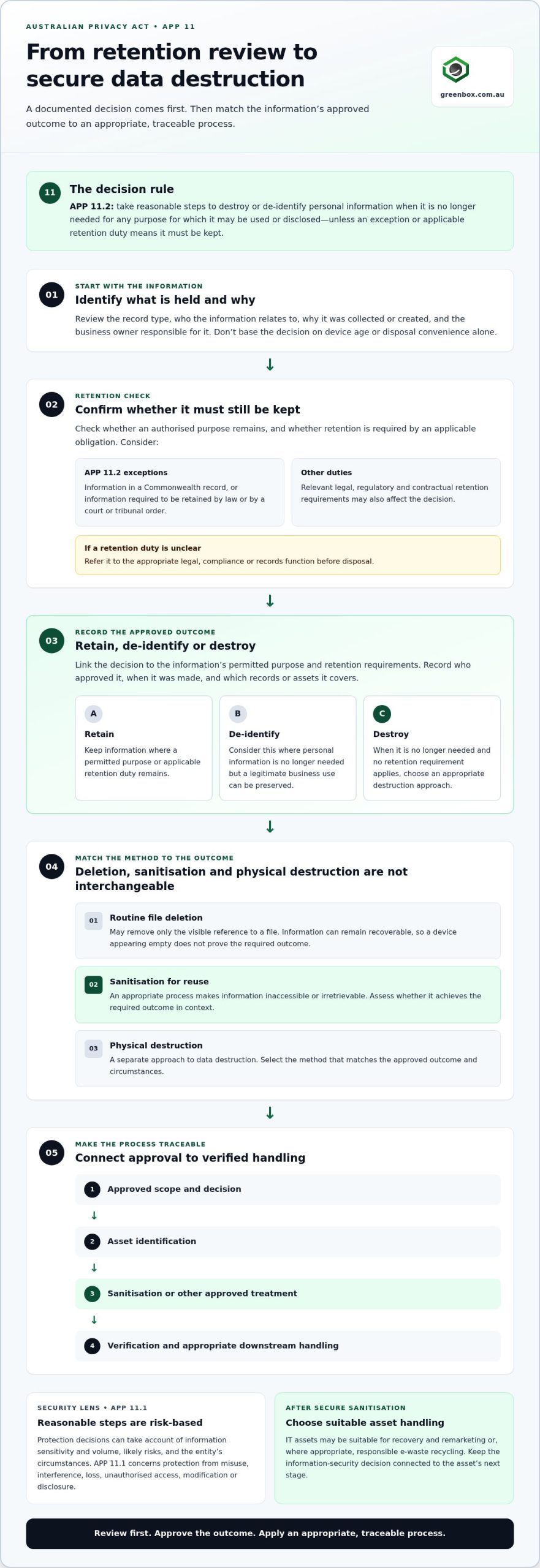
How to build a traceable Australian data destruction workflow
A reliable workflow connects the retention decision to the physical asset and its final processing outcome. Make each hand-off visible and assign an accountable owner to each step. This gives the organisation a practical record to review, while recognising that documentation supports oversight but does not, on its own, establish compliance.
Build the process in sequence so equipment isn’t released for reuse, remarketing or recycling before its approved data-handling requirements are complete:
- Approve the scope. Record which asset groups are included, who authorised processing and the intended outcome. Resolve retention holds or exceptions before equipment enters the sanitisation stage.
- Identify each asset. Capture a unique asset identifier and reconcile the list against the equipment collected. Investigate missing, unlisted or mismatched items rather than assuming they’re covered.
- Control handling and transfer. Record movement between collection, storage and processing stages, noting the responsible party or location at each hand-off. Restrict access to equipment awaiting processing.
- Sanitise and verify. Record the method applied and the outcome for each asset. If processing fails or the result can’t be established, keep the item out of the approved downstream stream and escalate it for an agreed resolution.
- Confirm the next asset outcome. Link completed processing to the decision to reuse, remarket or recycle the asset. Keep exceptions visible until they’re resolved and recorded.
This sequence supports Australian privacy act compliant data destruction by linking governance, asset handling and completion evidence. It also helps teams find gaps, such as a device on the collection list with no recorded processing outcome.
What should a data destruction control record capture?
Keep the record useful and proportionate. It should show what was authorised, what was processed and whether the intended result was achieved, without copying personal information from the device into the evidence file. A control record may capture:
- Asset identifier and relevant device details.
- Decision authority and approved scope.
- Sanitisation method, processing status and relevant dates.
- Verification outcome, exceptions, failures and escalation results.
- Downstream handling outcome and the record’s own retention requirements.
Apply access controls to these records and set a retention period based on their operational, legal and audit purpose. Avoid retaining unnecessary names, files or data extracts simply to prove that processing occurred. The evidence should document the process, not recreate the information being removed.
How should assets be controlled from collection to processing?
Reconcile inventory at collection and again at key hand-offs. Use consistent identifiers so each processing result can be matched to the correct asset, and record transfers between authorised locations or responsible parties. If an item is missing, damaged or inconsistent with the approved scope, pause its progression and document the issue. A clear custody trail supports internal oversight and makes follow-up more targeted.
For managed handling within an end-of-life IT process, explore Greenbox data sanitisation and destruction.
How Greenbox supports secure, responsible end-of-life IT asset handling
Privacy decisions don’t end when information is sanitised. Retiring equipment still needs a controlled route through recovery, assessment and its next destination. Greenbox combines data sanitisation and destruction with corporate IT asset recovery, remarketing and e-waste recycling, helping organisations connect information security with responsible hardware handling.
The right outcome depends on the asset and the organisation’s approved requirements. Equipment suitable for another use may follow a reuse or remarketing pathway after the required sanitisation. Assets unsuitable for reuse can be directed to appropriate recycling. These are distinct pathways, not a single destination for every device.
How does managed ITAD connect data security with asset recovery?
Managed IT asset disposition (ITAD) links the handling of data-bearing equipment with its recovery and end-of-life processing. Instead of treating sanitisation as a disconnected task, an organisation can include it in the broader asset lifecycle: recover the hardware, apply the relevant data-handling decision, then determine its appropriate next step.
For example, a serviceable device may be considered for remarketing after sanitisation, while damaged or unsuitable equipment may proceed to e-waste recycling. The pathway should reflect the asset’s condition and the organisation’s requirements. A secure process also makes clear which assets have been processed and what outcome follows, supporting the organisation’s governance and oversight.
This approach helps align Australian privacy act compliant data destruction with reuse and responsible resource management. Sanitisation addresses information risk; recovery and downstream handling address what happens to the hardware. Neither decision replaces the other.
Greenbox’s sustainable IT asset recovery case study illustrates how secure enterprise asset handling can be considered alongside lifecycle management.
What can businesses expect from Greenbox’s approach?
Greenbox provides Australian ITAD services, including data sanitisation and destruction, asset recovery, remarketing and e-waste recycling. Founded in 2000, the business supports organisations with the recovery and sustainable processing of corporate IT hardware. Its operations include R2-certified facilities, and Greenbox is a carbon-neutral organisation.
These details provide context about Greenbox’s operations; they don’t, by themselves, determine whether an organisation has met its legal obligations. Businesses remain responsible for making appropriate retention and sanitisation decisions for their information. Greenbox supports the secure handling of assets and their onward processing within an end-of-life IT workflow.
For organisations reviewing retired equipment, the practical benefit is a connected approach: sanitisation is considered before reuse or remarketing, while assets unsuitable for those pathways can be directed to recycling. The process can be aligned with the organisation’s scope and requirements, without assuming every device follows the same route.
To plan a secure, responsible end-of-life process for your organisation, discuss your organisation’s secure IT asset lifecycle.
Make your next asset transition a controlled one
Use your next hardware refresh to make the process repeatable. Set a clear approval point before assets leave service, assign responsibility for unresolved retention questions, and build secure handling into the transition plan from the outset. A consistent approach makes future asset cycles easier to manage, without treating each retirement as a one-off exercise.
Australian privacy act compliant data destruction is strongest when privacy decisions and IT asset management work together. With a defined process, your organisation can approach end-of-life equipment with greater clarity, protect information appropriately and consider responsible outcomes for the hardware.
Discuss your organisation’s secure IT asset lifecycle with Greenbox and take the next step towards a more controlled, responsible approach.
Frequently Asked Questions
What does the Australian Privacy Act require when a business no longer needs personal information?
For an APP entity, APP 11.2 requires reasonable steps to destroy personal information or ensure it’s de-identified when it’s no longer needed for a permitted purpose. Exceptions include information that’s part of a Commonwealth record or must be retained under Australian law or a court or tribunal order. For example, pause a scheduled deletion if a relevant retention hold applies. Check current OAIC guidance and the obligations relevant to your organisation.
Does the Privacy Act require businesses to physically destroy every device that held personal information?
No. The obligation concerns the information, not automatically the device. A suitable sanitisation process may allow serviceable hardware to be reused, while physical destruction may be appropriate for some assets or policies. For example, a business could consider reusing a working laptop after its information has been appropriately sanitised, while directing damaged media down another pathway. The method should reflect the device, data sensitivity, intended outcome and applicable requirements.
Is deleting files or formatting a drive enough for Privacy Act-compliant data destruction?
Not necessarily. Deletion or formatting may leave underlying information on the device, so neither should automatically be treated as secure sanitisation. For Australian privacy act compliant data destruction, match the process to the storage device and information, then retain evidence that the chosen process was completed. A practical control is to flag failed or inconclusive processing for review rather than releasing that asset for reuse or remarketing.
Can a business retain personal information instead of destroying it?
Yes, retention may be appropriate if the information is still needed for a permitted purpose or a retention exception applies. Record the reason, the responsible owner and the next review point, and restrict access to people with a current business need. For example, an organisation may retain a defined set of records while removing unrelated data from a retiring asset. If the basis for retention is uncertain, seek appropriate legal advice.
What happens if a business destroys personal information that it was required to retain?
Destroying records prematurely can create legal, compliance and operational issues, including difficulty responding to a later records request or meeting an applicable retention duty. Before processing, check for relevant legal requirements, court or tribunal orders, records obligations and internal holds. If information must remain available, preserve it in an authorised environment and confirm the transfer before sanitising the original asset. Escalate unclear cases to the appropriate legal or records-management team.
Does a certificate of destruction prove Privacy Act compliance?
No. A certificate can support evidence that a defined process was completed, but it can’t establish that the organisation made the right retention decision or met every privacy obligation. Keep it with relevant asset identifiers, approval details and processing outcomes so the record can be interpreted later. Avoid attaching files or personal data as proof. Set access and retention controls for certificates and related records, as you would for other governance evidence.