

Carbon neutral IT asset disposition involves more than sending retired devices for recycling. It means measuring greenhouse gas emissions, reducing avoidable emissions and balancing any remainder with carbon offsets. For Australian businesses, a credible account also needs evidence of how equipment was handled, including reuse, recycling and material recovery.
It’s understandable to want a clear environmental outcome from an IT refresh, but a carbon-neutral claim needs more than a recycling total. This guide explains how emissions are expressed as carbon dioxide equivalent, how reuse and recovered materials affect end-of-life outcomes, and how businesses can document these results for sustainability reporting. It also distinguishes carbon neutrality from net zero and explains where certified recycling and offsetting fit. Climate Active is an Australian example of carbon-neutral certification, with claims subject to independent third-party verification. The result is a clearer basis for reporting the impact of retired IT assets without overstating what the process achieves.
Key Takeaways
- Separate emissions measurement, emissions reductions and offsets to describe the environmental impact of retired IT assets clearly.
- Use carbon dioxide equivalent to account for greenhouse gases in a consistent way when preparing sustainability reporting.
- Consider reuse and material recovery alongside recycling to show how end-of-life equipment can retain value and reduce demand for new resources.
- Understand how Australian e-waste and hazardous-waste requirements apply to IT disposal, and how secure, documented handling supports responsible reporting.
Certified IT recycling and sustainability reporting
Certification can help substantiate claims about emissions, offsets and recycling, but it does not make every stage of an IT asset’s lifecycle carbon neutral. A credible report separates emissions reductions from offsets and records the evidence behind each result. This makes the environmental impact of equipment retirement clearer and more useful for sustainability reporting.
Climate Active is an Australian Government program supporting voluntary climate action by Australian businesses. Its Carbon Neutral Standard draws on the Greenhouse Gas Protocol, the Australian Standard (AS) ISO 14064 series, ISO 14040 series and ISO 14065:2013. Climate Active carbon-neutral claims are subject to independent third-party verification. Certification therefore involves more than stating that a process supports climate change action: the claim needs evidence and verification against the relevant standard.
How can Australian businesses choose a certified IT asset disposition provider? Look for relevant, verifiable certifications and clear records covering collection, data handling, reuse and recycling. Check that the evidence shows what happened to each asset, rather than relying on a general sustainability statement.
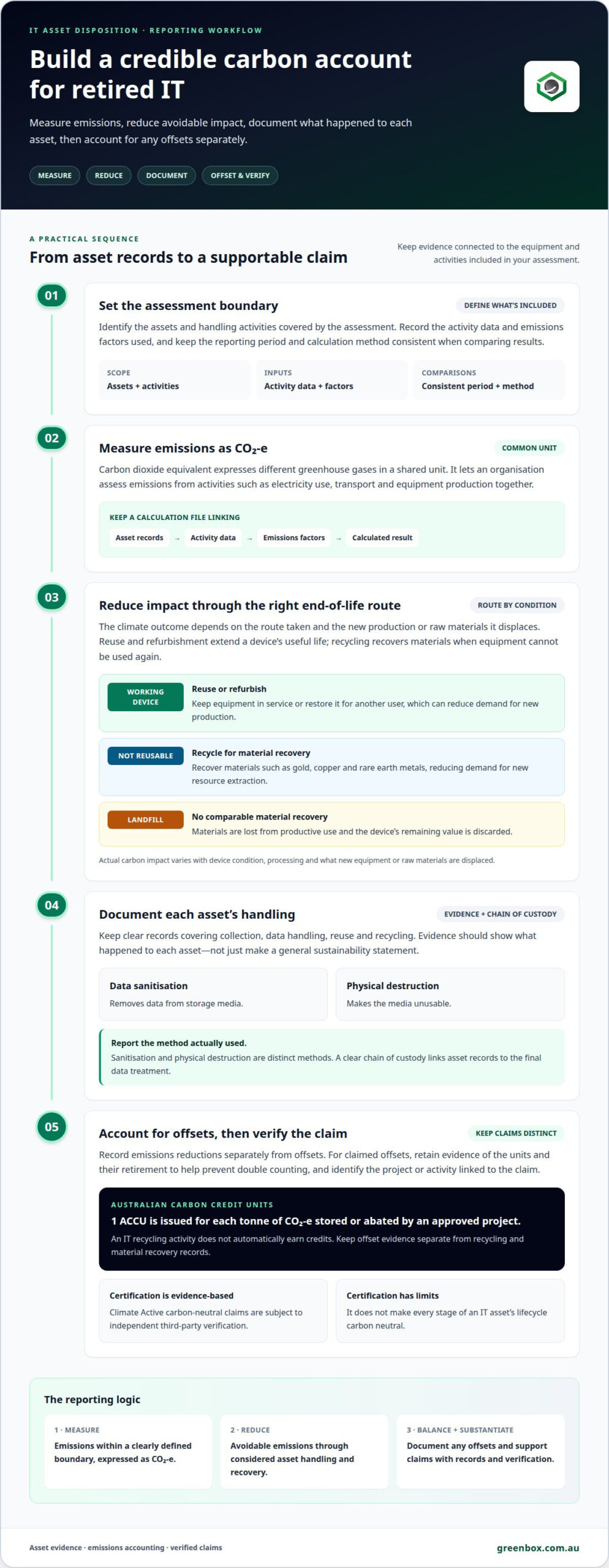
Data security is another part of responsible disposition. A documented process should state whether each device underwent data sanitisation or physical destruction and retain a record of the action taken. Sanitisation removes data from storage media; physical destruction makes the media unusable. These are distinct methods, so reports should not describe one as the other. A clear chain of custody links asset records to the final data treatment, supporting internal controls and reporting.
Environmental reporting should distinguish recycling outcomes from carbon credits. Australian Carbon Credit Units may be issued to primary producers under the Carbon Credits (Carbon Farming Initiative) Act 2011 for eligible offsets projects, according to the Federal Register of Legislation. That provision does not mean every IT recycling activity earns credits. Reports should identify the project or activity linked to any claimed credits, alongside evidence of recycling and material recovery. This separation helps businesses present a sustainable outcome without treating certification, recycling and offsetting as interchangeable.
Greenhouse gas emissions measured as carbon dioxide equivalent
Carbon dioxide equivalent (CO₂-e) expresses different greenhouse gases in a common unit, allowing an organisation to assess emissions from activities such as electricity use, transport and equipment production together. For IT asset disposition, define the assessment boundary first: identify the assets and handling activities included, then record the activity data and emissions factors used. Keep the reporting period and calculation method consistent when comparing results.
How should businesses verify emissions reductions and carbon offsets from ITAD? Keep records of the baseline, the activity that reduced emissions and the calculation behind the claimed reduction. For offsets, retain evidence of the units and their retirement to prevent double counting. The Clean Energy Regulator issues one Australian Carbon Credit Unit for each tonne of carbon dioxide equivalent stored or abated by an approved project.
Accounting treatment depends on why an organisation holds carbon credits. Under IAS 2, inventory is generally measured at the lower of cost and net realisable value. Certified offsets held for sale in an entity’s ordinary business may qualify as inventory. Under IAS 38, a transferable, tradable certified offset may meet the definition of an intangible asset; qualifying assets are initially measured at cost. The revaluation model is available when an active market exists.
Broker-trader measurement requires a separate classification assessment. Establish whether offsets are held for trading in the ordinary course of business or to address the organisation’s own emissions. The broker-trader measurement exemption should not be treated as automatic: the entity’s activities and the purpose of its holdings determine which accounting approach is relevant. Under IFRS 9, contracts to acquire or sell offsets with a net settlement feature may fall within the standard’s scope.
Keep a calculation file that links asset records, activity data, emissions factors, reductions and offset evidence. For example, an asset-level recovery record can support the activity data used in an emissions assessment. A documented IT asset recovery process can help connect disposition records with reporting inputs.
E-waste recycling and material recovery
Reusing end-of-life IT can avoid some demand for new production, while recycling recovers materials from devices that cannot be used again. The climate outcome depends on the route taken and the resources it displaces.
Reuse, refurbishment and recycling impacts
Reuse keeps a working device in service. Refurbishment restores equipment for another user, while recycling separates recoverable materials. Both can reduce demand for new production, and reuse and refurbishment also extend a device’s useful life.
Recycling can recover gold, copper and rare earth metals, reducing demand for new resource extraction. Landfill offers no comparable recovery: materials are lost from productive use, and the device’s remaining value is discarded. The actual carbon impact varies with device condition, processing and what new equipment or raw materials are displaced. For example, a working laptop reused instead of replaced avoids some new production, while a damaged device may be better directed to material recovery.
For sustainability reporting, distinguish equipment that is reused, refurbished, recycled or sent for disposal. Record the route and recovered materials rather than treating all diverted equipment as an equal climate benefit. Carbon credits may relate to eligible abatement projects, but recycling is not automatically equivalent to a credit or an emissions reduction. Keep material recovery evidence separate from offset claims to support a transparent climate commitment.
Risks of exporting or improper disposal
Exporting used IT equipment without clear destination and processing records can weaken traceability. Improper disposal can expose workers and the environment to hazardous components, while discarded devices may contain recoverable materials and stored business data.
For Australian organisations, a practical risk is losing visibility over what happens after collection. Equipment described as reusable may instead be dismantled or discarded if its condition and end destination aren’t documented. Keep asset inventories, transfer records and downstream treatment evidence together. This supports responsible decisions and helps establish whether each device was reused, refurbished, recycled or disposed of. It also ensures carbon claims rely on documented handling rather than assumed outcomes.
Which Australian e-waste and hazardous-waste regulations apply to IT asset disposal?
For an Australian business, identify applicable requirements by mapping the disposal pathway, the asset’s waste classification and the jurisdictions involved. A laptop retained for reuse follows a different pathway from equipment dismantled for material recovery. Cross-border movement adds another consideration. Record the destination and treatment route so the organisation can explain how each asset was handled.
Start with an inventory that distinguishes whole devices, components and materials. For example, a mixed collection of laptops, monitors and damaged equipment may require separate handling decisions. Document whether each item is reused, recycled or disposed of, and retain transfer and downstream treatment records. These records support traceability and help identify where environmental and hazardous-waste requirements may apply.
Data obligations also matter during disposal. The Privacy Act and APRA are relevant considerations for secure data destruction and compliance. A device sent for recycling may still contain business information, so record data treatment alongside its environmental destination. Link the asset identifier to the sanitisation or physical destruction record, then retain both with the collection and processing documentation.
For a practical review, assemble the records in a consistent sequence:
- List the asset type, condition and storage media.
- Record the collection location, destination and any transfer between facilities.
- Document whether equipment was reused, dismantled, recycled or disposed of.
- Match data sanitisation or destruction evidence to each relevant asset.
This process helps teams assess the right requirements for each disposal stream without treating all e-waste as one category. It also creates a clearer audit trail for environmental reporting and internal data controls. Greenbox’s IT asset recovery service can support secure, traceable handling of end-of-life equipment.
Applicable requirements depend on the asset’s waste classification, whether it is reused, recycled or disposed of, and the jurisdictions involved, including any cross-border movement. The Privacy Act and APRA are relevant considerations for secure data destruction and compliance.
Greenbox: Carbon Neutral ITAD Services
Greenbox provides carbon-neutral IT asset disposition services for Australian businesses managing retired technology and sustainability reporting. Its IT Asset Recovery supports the secure return and assessment of equipment, helping determine whether assets can be recovered for further use or need responsible end-of-life handling.
Greenbox’s Data Sanitisation and Destruction addresses information stored on devices before they leave an organisation’s control. Data sanitisation meets military-grade security standards. For businesses deploying replacement hardware, Pre-Configuration and Imaging supports preparing new equipment for rollout. Together, these services connect asset transition, data security and environmental management across the IT lifecycle.
Greenbox operates as a carbon-neutral organisation with R2-certified facilities. Contact Greenbox to discuss Carbon Neutral ITAD Services for your business’s asset disposition needs.
Make your next IT refresh part of a stronger plan
Set the direction for retired equipment before the next refresh begins. Decide how your organisation will assess reusable assets, protect stored information and record end-of-life outcomes. Bringing these decisions into refresh planning connects environmental reporting with operational and data-security priorities, rather than leaving disposal as a last-minute task.
A considered approach to carbon neutral IT asset disposition gives teams a practical basis for improving future decisions. Greenbox’s IT Asset Recovery supports the handling of retired equipment, while Data Sanitisation and Destruction addresses data on storage media, meeting military-grade security standards. For incoming hardware, Pre-Configuration and Imaging supports deployment planning. These services can fit into different stages of an organisation’s technology transition.
To discuss how these services may fit your asset lifecycle, contact Greenbox about IT disposition. A clear plan can help your team move into its next refresh with greater confidence and purpose.
Frequently Asked Questions
What does carbon-neutral IT asset disposition mean?
Carbon neutral IT asset disposition means balancing greenhouse gas emissions associated with retiring technology against eligible offsets, after considering opportunities to reduce emissions. For a practical assessment, define which stages are included, such as collection, data handling, refurbishment and recycling. This boundary helps teams avoid attributing benefits from unrelated activities to IT disposal. Carbon-neutral claims should reflect the measured scope and supporting evidence.
How is the carbon footprint of IT asset disposition measured?
Measure the footprint by recording relevant activities and applying suitable emissions factors within the defined reporting boundary. For example, an asset batch may involve transport, facility energy use and processing, while reuse can affect demand for replacement equipment. Keep source records and assumptions with the calculations, and distinguish direct reductions from offsets. Consistent boundaries make comparisons between disposal projects more meaningful for sustainability teams.
What are the steps for carbon-neutral IT asset disposition in Australia?
Begin by defining the asset group and reporting boundary, then arrange secure data treatment before equipment leaves organisational control. Data sanitisation should meet military-grade security standards. Assess each item for continued use, refurbishment, material recovery or disposal. Retain records linking asset identifiers to handling outcomes, emissions calculations and any offset evidence. For example, a laptop suitable for reuse needs a different documented outcome from a damaged device sent for material processing.
What data security standards and certificates should ITAD providers offer?
Look for data sanitisation aligned with military-grade security standards, documented destruction outcomes and environmental processing supported by relevant certification. A destruction certificate should identify the work completed and connect it to the affected assets, giving security teams an auditable record. Greenbox’s data sanitisation meets military-grade security standards, and its facilities are R2-certified. These credentials address distinct concerns: protection of stored information and responsible e-waste processing.