

A destruction certificate records a completed process, but it does not prove on its own that every data-bearing asset was sanitised correctly. It is a written record that can identify the assets, the destruction method and the completion date. That distinction explains the importance of a certificate of data destruction: it creates an audit trail, while the strength of the evidence depends on the detail recorded and the process behind it.
Secure disposal is easier to oversee when it is traceable as well as carefully managed. A useful certificate links the work to identifiable assets and records how their data was sanitised, helping support internal reviews and compliance assessments. This article explains what a Certificate of Destruction does and does not prove, which details make it more useful as evidence, and how sanitisation methods and standards fit into the picture. It also covers what to consider when assessing whether destruction records support your organisation’s data security and environmental responsibilities.
Key Takeaways
- Assess destruction records against your organisation’s audit and compliance needs, rather than treating a certificate as automatic proof of compliance.
- Look for enough asset-level detail to connect the documented outcome to the equipment that was sanitised.
- Understand how the chosen sanitisation method and verification approach affect the strength of the evidence.
- See how secure data disposal can fit into a broader IT asset recovery and reuse process.
Is your data destruction process compliant with Australian standards?
For Australian businesses, a destruction certificate supports compliance by recording how data-bearing equipment was handled. It matters because responsibility for sensitive data continues until that information is properly destroyed.
Certificates for audits and compliance
A certificate is a compliance record linking a completed destruction process to identifiable assets and documented methods. During an audit, it helps an organisation show what happened to retired equipment, such as hard drives, rather than relying on an undocumented handover.
Useful records can include asset identifiers, the destruction method, completion date and applicable standards. These details help auditors trace the outcome against internal data protection procedures. An electronic certificate can be filed with asset registers and disposal records to create a verifiable trail for later review. It supports an audit, but does not establish by itself that every regulation or organisational control has been met.
Australian privacy and data security
Australian privacy and data security compliance requires organisations to account for sensitive information through disposal, not only during active use. Businesses and individuals handling sensitive information remain responsible for it until it is properly destroyed.
That responsibility makes disposal records relevant to privacy reviews and internal controls. For example, an organisation retiring hard drives should be able to connect each asset to its recorded sanitisation outcome. When a customer requests deletion, the record can help demonstrate that data was permanently destroyed rather than simply removed from routine access. A certificate supports this evidence trail, while the organisation’s wider procedures and applicable regulations determine its compliance position.
Liability, client trust and audit trails
An audit trail connects the asset, the destruction event and its supporting documentation, helping organisations account for disposal decisions. This matters when a client, auditor or internal risk team asks how sensitive information was handled.
ISO 27001 is an industry standard, and destruction documentation can support compliance efforts. SOC 2 does not mandate certificates, but organisations may use them as evidence for security and confidentiality criteria. NAID AAA certification is another credential identified as adding value to destruction records. These credentials can inform a compliance assessment, but they do not replace review of the actual process and its evidence.
Keep certificates with related disposal records, and set retention according to organisational needs and data sensitivity. A suggested retention range is 5-7 years, depending on those factors. The certificate of data destruction is important because it gives teams a traceable record to support audits, demonstrate responsible data handling and maintain client trust.
Certificate of destruction as proof of secure data disposal
A destruction certificate can provide a written record of the disposal process. Treat it as evidence of handling, not conclusive proof that every data-bearing asset was sanitised correctly.
Certificates for disposal providers
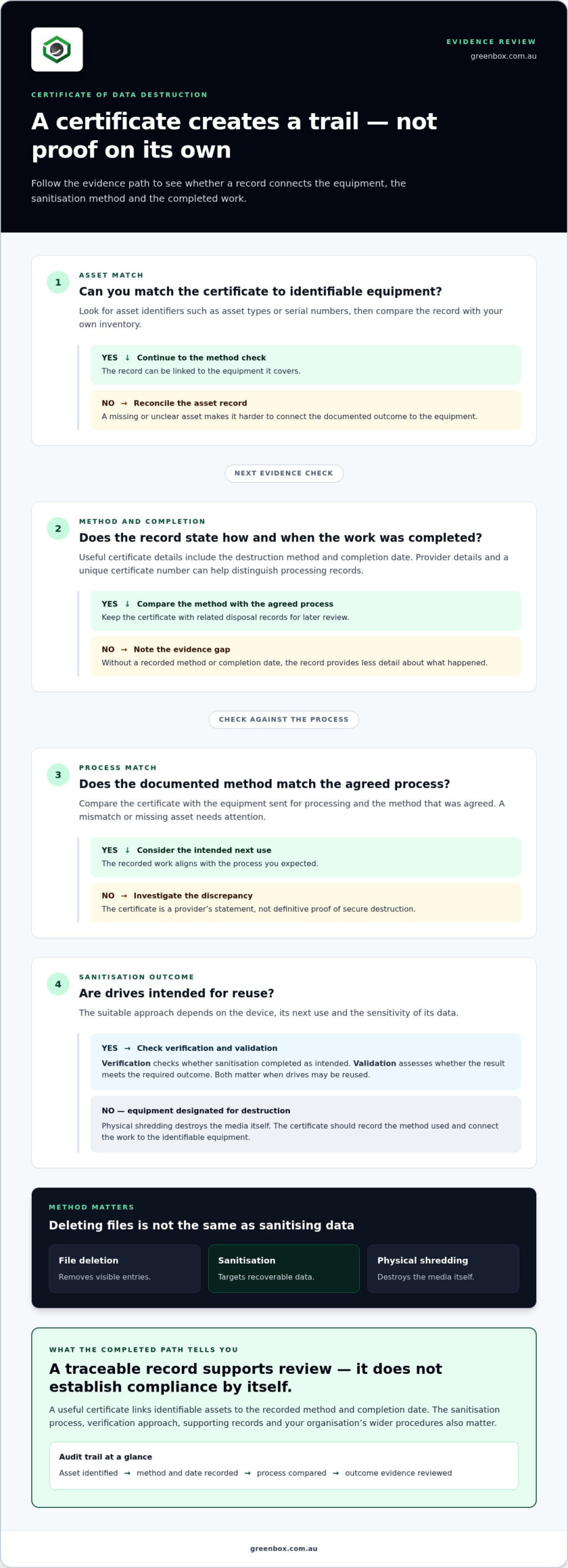
For IT asset disposal, the certificate links a provider’s work to the equipment sent for processing. It can identify asset types, serial numbers, the destruction method and completion date, giving organisations a record to compare with their own inventory.
That comparison matters: a certificate is a statement from the service provider, not definitive proof of secure destruction. If an asset is missing from the record, or the documented method does not match the agreed process, the discrepancy needs attention. A unique certificate number and provider details also help distinguish one processing record from another.
Internal disposal practices should reflect the sensitivity of the information and the asset’s next use. Equipment intended for reuse presents a different recovery risk from equipment designated for destruction. A risk-based approach matches sanitisation and verification to the data and storage media, then retains records showing how the decision was carried out.
Improper disposal and data breach risks
Improper disposal can leave sensitive information accessible on equipment that has left an organisation’s control. For example, a hard drive passed on without effective sanitisation may still contain files, even if the computer no longer starts.
Secure disposal reduces this exposure by addressing data before reuse, resale or recycling. The certificate documents the outcome and supports traceability if questions arise about handling. It cannot prevent a data breach on its own: the sanitisation process, asset identification and supporting records all matter. Clear evidence also helps teams distinguish completed work from equipment still awaiting processing.
Organisations refining these controls can consider secure data disposal support to connect sanitisation records with asset handling.
Sanitisation standards and verification
Deleting files removes visible entries, while sanitisation targets recoverable data. Physical shredding destroys the media itself. The suitable approach depends on the device, its next use and the sensitivity of its data.
Erasure verification and validation
Verification checks whether sanitisation completed as intended; validation assesses whether the result meets the required outcome. Both matter when drives may be reused, because a successful operation alone does not establish that sensitive data is unrecoverable.
NIST SP 800-88 Rev. 2 describes Clear as logical sanitisation for user-addressable storage areas, suitable for lower-risk reuse. Purge is stronger and aims to make recovery infeasible, even with state-of-the-art laboratory techniques. Records should identify the method and verification approach.
Vendor accountability and verification
Verification can help organisations compare a vendor’s records with the intended sanitisation outcome. This helps assign responsibility across the disposal chain, particularly when a downstream vendor handles data-bearing devices.
Under R2v3 Appendix A, Downstream Vendor Qualification subsection 8(d)(4), R2 facilities must obtain records showing destruction of data on data-bearing IT assets and components when a downstream vendor performs sanitisation. That record supports accountability by linking the downstream activity to documented evidence.
Destruction methods and verification
Deleting files usually removes references to data, but does not necessarily sanitise the storage. Wiping applies a sanitisation technique to a drive, while physical shredding breaks media into pieces and prevents its reuse.
NIST SP 800-88 Rev. 2 distinguishes Clear from Purge according to the intended protection against recovery. Select a method suited to the media and risk, then retain evidence of the method and its verification. A responsible process makes the treatment of each device traceable.
Evidence recorded on certificates
A useful certificate connects the sanitisation outcome to the specific device and work performed. Include the device model and manufacturer, serial number, media type, method and technique, verification method, responsible person, date and location.
NIST SP 800-88 Rev. 2 superseded Rev. 1 in Sep 2025. Its certificate may be kept as a paper document or electronic record. Together, the asset identifiers, date, method and verification details make the record more useful for review and audit.
Certificate of destruction as evidence of data sanitisation
A certificate becomes meaningful evidence when it connects the destruction process to the sanitisation outcome for specific assets. This link helps an organisation demonstrate how secure data handling was completed, rather than simply recording that equipment left storage.
For example, an asset register may show a hard drive’s serial number and destination, while the certificate records the sanitisation method and result. Matching these records lets reviewers trace the device from retirement to completion. If a certificate covers a batch, its asset list should still identify each relevant device. The audit trail is stronger when records reconcile, not merely when a document exists.
Standards and assurance frameworks can inform what evidence an organisation retains. IEEE’s standard for sanitising storage identifies Subclause 5.2 as recommending proof of storage sanitisation that meets compliance requirements. The practical value is traceability: a reviewer can relate the stated method to the intended outcome and assets, then identify gaps that need follow-up.
Assess the certificate alongside process records. Check whether it connects:
- the assets and storage media included in the work;
- the sanitisation or physical destruction method used;
- the completion record to the relevant asset register or disposal batch.
These links help distinguish sanitisation from downstream handling. For instance, a certificate describing shredding should correspond to assets designated for physical destruction, not devices set aside for reuse. When equipment is sanitised for reuse, the record should support that specific outcome. This distinction helps teams document the process without implying that every asset followed the same route.
Use the certificate as one part of an evidence set, alongside inventory and processing records. For organisations strengthening secure data handling across retired equipment, data sanitisation and destruction can support a documented disposal process.
Greenbox: Data Sanitisation and Destruction
Greenbox provides Data Sanitisation and Destruction for organisations managing retired, data-bearing IT assets. It is a practical next step when equipment is leaving use and secure sanitisation needs to be considered alongside its next destination.
Where assets may be recovered or remarketed, data handling and asset decisions can be considered together. Greenbox also offers IT Asset Recovery and Asset Remarketing, supporting a managed transition from retired equipment to its potential next use. Its R2-certified facilities and carbon-neutral operations reflect a focus on security and environmental responsibility.
For organisations planning data disposal, Greenbox’s services can align sanitisation with broader IT asset lifecycle requirements. Contact Greenbox to discuss your organisation’s data sanitisation and destruction needs.
Put your next asset decision on a clear footing
The importance of a certificate of data destruction goes beyond closing a disposal task. It can inform how your organisation manages asset records, assigns responsibility and plans for equipment’s next stage. Treating data sanitisation as part of asset lifecycle planning connects secure handling with operational decisions, rather than leaving documentation until equipment is already moving.
Consider how your requirements change when devices are retired, recovered or prepared for redeployment. Greenbox’s Pre-Configuration and Imaging service supports the deployment side of that lifecycle, alongside its IT asset management work. Aligning asset plans with data-handling requirements helps teams set a clear direction for equipment before it leaves service.
Define the outcome you need, whether that involves disposal or preparing equipment for another role, and make the supporting records part of the plan. Discuss secure data disposal with Greenbox and take the next step with clarity.
Frequently Asked Questions
What is a Certificate of Destruction?
A Certificate of Destruction is a provider-issued record stating that specified materials or data-bearing assets were destroyed or sanitised. It links completed work to a disposal event, but is not independent verification by itself. For example, a business can compare the certificate with its asset register to identify which retired devices were processed and which remain unresolved. That distinction matters during audits and internal reviews.
How can I obtain a certificate of erasure?
Arrange data erasure through a provider and request the certificate as part of the completion records. Give the provider an accurate asset list, then compare the returned record with that list before filing it. If a device is missing or an identifier differs, resolve the discrepancy while processing details are accessible. Keep the certificate with related disposal and asset records.
How do enterprises and ITADs confirm secure erasure across devices?
Enterprises and ITADs can reconcile each device received against its processing outcome using serial numbers or other asset identifiers. Separate completed items from exceptions, such as a device that failed sanitisation or needs a different method. Reviewing exceptions prevents an overall batch completion from obscuring an individual asset that still requires secure handling.
What is a certificate of data destruction and what details should it include?
A certificate is a formal record of data destruction or sanitisation, prepared by the service provider. For useful traceability, look for a unique certificate identifier, provider details, the applicable standard and the person responsible for the work. The record should also make clear which assets and media it covers. These details distinguish the document from a general invoice or collection receipt.
Does Australian privacy law require organisations to securely destroy personal information?
Australian privacy obligations require careful handling of personal information, including at the end of its useful life. The key distinction is between information an organisation still needs or must retain and information it no longer requires. A destruction certificate can support disposal records, but does not establish compliance by itself. Organisations need disposal practices that fit their privacy obligations and retention requirements.
What do the Australian Privacy Principles say about retaining and destroying personal information?
The Australian Privacy Principles address how organisations handle personal information, including its security and retention. In practice, organisations should identify when information is no longer needed, consider any obligation to retain it, then securely destroy or de-identify it where appropriate. A retention schedule can help teams apply that decision consistently across records, devices and storage systems.