

A secure IT refresh does not treat every retired device as waste. For Australian firms, financial services IT asset disposal compliance starts with an accurate inventory, secure data sanitisation or destruction, and records showing what happened to each asset. Working equipment can be assessed for reuse or resale, while end-of-life devices are sent for responsible recycling.
Financial institutions know that retired laptops, servers, printers and copiers can contain sensitive information. The challenge is to manage security, environmental responsibility and asset value together, while maintaining visibility as equipment moves through disposal.
This guide explains how financial services firms can manage those priorities during an IT refresh. You’ll learn how inventory and audit records support control, how data destruction and recycling fit into the process, what to assess in an ITAD partner, and how refurbishment and resale can recover value from suitable hardware.
Key Takeaways
- Build a reliable asset inventory that tracks each device through decommissioning, data treatment and final disposition.
- Match data sanitisation or destruction to the device and its security requirements, then retain clear disposal records for audit purposes.
- Include printers, copiers and network equipment in disposal planning, as well as laptops and servers.
- Separate working hardware from end-of-life equipment so suitable assets can be reused or resold, while others are directed to responsible recycling.
- Assess ITAD partner capabilities across data security, documentation, asset recovery and environmental responsibility.
How Did a Major Financial Services Firm Achieve Secure and Compliant IT Asset Disposition During a Major IT Refresh?
A controlled refresh begins with a complete device inventory and risk assessment, then tracks each asset through data destruction, storage and final disposition. Update asset records and retain disposal evidence for future audits.
Disposal process from inventory to final disposal
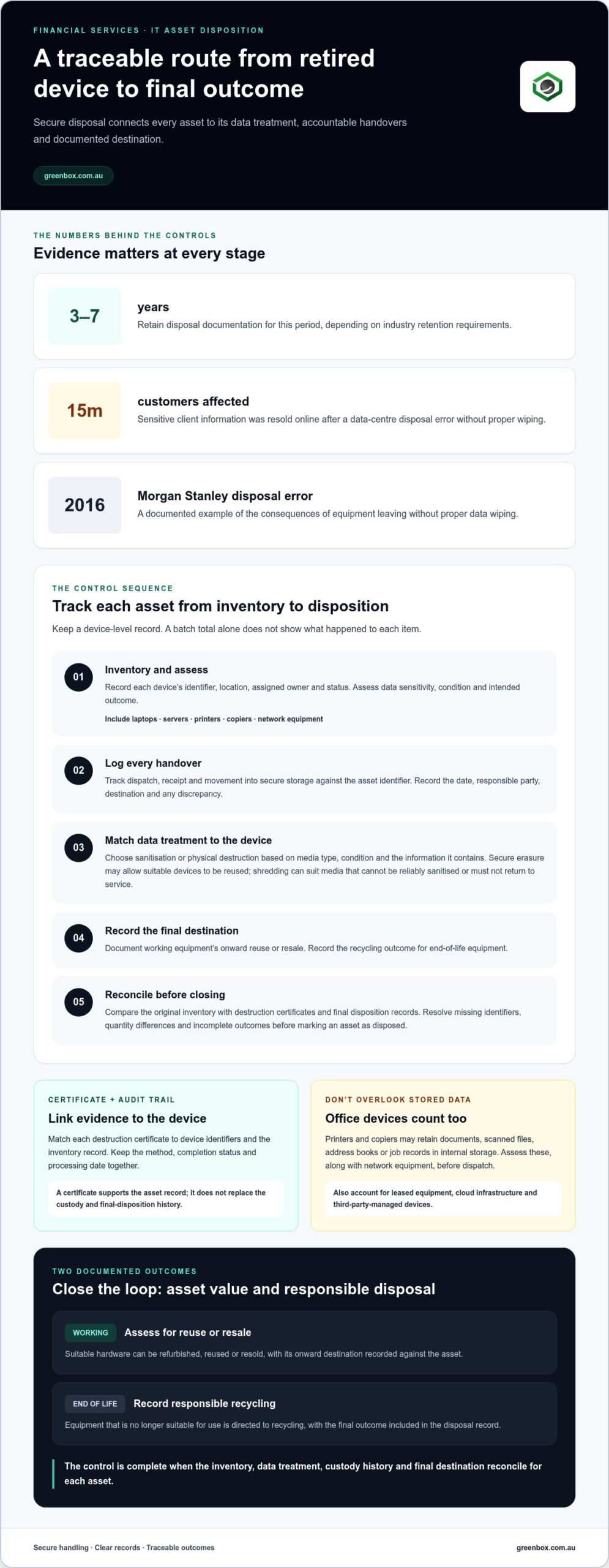
The disposal process tracks each retired asset from identification to its final outcome. This matters because an untracked device can expose sensitive data or leave an unexplained gap in the firm’s records.
Record each device, its asset identifier, location, assigned owner and status. Include laptops, servers, printers, copiers and network equipment, all of which may hold sensitive data. Assess each item’s data sensitivity, condition and intended outcome to determine whether sanitisation, physical destruction, reuse or recycling is appropriate. Attach the decision to the asset record rather than relying on a general batch description. This creates a clear lifecycle record for security and sustainability reviews.
Chain-of-custody tracking and audit documentation
Chain-of-custody tracking records who controls an asset and where it moves, from collection through final processing. This matters because auditability depends on linking each device to documented actions and accountable handovers.
Log every transfer against the asset identifier, including dispatch, receipt and movement into secure storage. Record the date, responsible party, destination and any discrepancy, such as a missing device or mismatched serial number. Reconcile collection records against the original inventory when equipment arrives for processing. If a device is separated from its batch, document the change and retain its individual trail. These steps let reviewers trace each asset without relying on memory or shipment totals.
Data destruction certificates and audit trails
A data destruction certificate records that sanitisation or destruction was completed for identified devices. It matters because the firm needs evidence linking the security action to the specific equipment processed.
Match each certificate to device identifiers and the corresponding inventory record. Keep the destruction method, completion status and processing date together in the audit trail. A certificate should support, not replace, the full asset record: on its own, it does not explain collection, custody or final disposition. Retain disposal documentation for three to seven years, depending on industry retention requirements. This creates a defined evidence trail across the disposal lifecycle.
Secure storage and final disposal audits
Secure storage protects retired equipment between collection, data destruction and final disposition. This matters because sensitive data remains at risk until its storage media has been properly sanitised or destroyed.
Control access and reconcile incoming assets against transfer records. Before closing the process, compare the original inventory with destruction certificates and final disposition records. Resolve missing identifiers, quantity differences and incomplete outcomes before marking assets as disposed. For working equipment, document its onward reuse or resale; for end-of-life equipment, record its recycling outcome. These checks connect data security with environmental practices and create a traceable record for future review.
Financial-sector data security and IT asset disposition
Decommissioned financial-sector devices can retain sensitive data after staff stop using them. Effective disposal links data security and asset records to the final outcome, whether reuse or recycling.
Data exposure from improperly disposed assets
Improper disposal creates exposure if storage media leaves the firm before its data is sanitised or destroyed. Deleting a file usually marks its space as available, but underlying data may remain accessible until it is overwritten.
Morgan Stanley’s 2016 data-centre disposal error resulted in sensitive client information being resold online without proper wiping, affecting 15 million customers. In Australia, improper disposal can expose customer information, prompt incident response and reporting, and attract regulatory scrutiny. These consequences make documented data handling part of the disposal decision, not an administrative task after equipment leaves the premises.
Hidden data in office and smart devices
Office and smart devices can store information beyond the computer drives listed on a standard decommissioning schedule. Printers and copiers, for example, may retain documents, scanned files, address books or job records in internal storage.
Include these devices and network equipment in the inventory, and assess each for stored data before dispatch. Policies should also cover leased equipment, cloud infrastructure and third-party-managed devices. Record who controls each asset, which party handles its data, and how access or stored information is addressed at offboarding. This closes gaps between company-owned hardware and technology managed under contracts or external platforms.
On-site wiping and physical destruction
On-site wiping sanitises data at the firm’s premises, while physical destruction renders storage media unusable. The appropriate method depends on the media type, its condition and the information it contains.
Secure erasure overwrites existing data and can allow suitable devices to be reused. Physical destruction, such as shredding, may suit storage media that cannot be reliably sanitised or must not return to service. Degaussing uses powerful magnetic fields on certain media but makes devices unusable. Set the required outcome before collection, then link the result to the device record. This protects security without sending every working asset directly to recycling.
Recognised data sanitisation standards
NIST 800-88 is a named media-sanitisation standard covering approaches such as overwriting, degaussing and physical destruction, depending on media type and classification. A standard helps frame the method, but firms must still match it to each device and their security requirements.
A financial firm’s financial services IT asset disposal compliance programme should define sanitisation criteria and apply them consistently to company-owned and managed devices. Strong financial services IT asset disposal compliance also depends on recording the selected method, completion status and asset identifier. This gives security and compliance teams evidence to review and keeps asset handling aligned with the firm’s risk controls.
Where sanitisation enables reuse, link the verified outcome to the device’s onward disposition. If the media must not return to service, record its physical destruction. These distinctions make financial services IT asset disposal compliance easier to demonstrate across device types and disposal decisions.
Secure IT asset disposal practices can connect data handling with responsible recovery and recycling.
E-waste risks and environmental compliance
In Australia, responsible IT asset disposal balances data security, environmental impact and total handling costs. Reuse or resale can retain value from working hardware, while recycling supports material recovery from end-of-life equipment.
Cost and disposal risks
Costs and disposal risks can be overlooked when a firm considers collection alone rather than each asset’s handling and final outcome. A laptop with reusable components follows a different path from damaged storage media that requires physical destruction. Unrecorded equipment can also add reconciliation work and make responsible practices harder to demonstrate.
For financial services organisations, improper handling creates two distinct exposures: sensitive data may remain accessible, and electronic materials may enter unsuitable waste streams. These risks can affect customers, operations and sustainability reporting. Assess each device’s condition, data sensitivity, storage type and reuse potential before deciding its route. This links security requirements with environmental outcomes, rather than treating disposal as a transport task.
Compare costs across the lifecycle: secure handling, data treatment, transport, material recovery and any value retained through reuse. The balance depends on asset condition and the required security outcome. A reusable device may have a different financial outcome from one that must be destroyed. Keep these factors visible in the decision record instead of treating the lowest immediate handling cost as the only measure.
Comparing disposal options
Disposal options vary in how they protect data, manage environmental impact and affect overall cost. Secure erasure can preserve suitable equipment for reuse, while physical destruction removes storage media that should not return to service. Recycling supports material recovery from equipment that has reached end of life.
For a working laptop, sanitisation followed by remarketing may balance security with asset recovery. For a failed drive containing sensitive data, physical destruction may be more appropriate, although the device cannot be reused. Recycling can then recover materials from hardware with no practical second life. The right route depends on the media, condition, data risk and intended outcome.
The scale of the environmental challenge is clear: the world generated 62 million tonnes of e-waste in 2022, and only 22.3% was formally collected and recycled. These global figures underline why organisations should distinguish reuse from recycling and record the final route for each asset. A sustainability review can compare what was reused, resold, destroyed or recycled, giving reporting teams a clearer account of disposal outcomes.
Compare options by asking what each achieves: does sanitisation make reuse appropriate, does physical destruction address the security risk, and does recycling provide a responsible route for unusable hardware? Record the deciding factors alongside the asset outcome. This makes trade-offs clear to finance, security and sustainability teams and supports consistent decisions across an IT refresh.
ITAD partner certifications and capabilities
Certifications and documented capabilities help financial firms assess how an ITAD partner manages security, environmental handling and asset records. They provide useful evidence, but firms still need to match the partner’s processes to their equipment and risk controls.
ITAD vendor certifications and insurance
Certifications describe standards or practices a provider follows; insurance addresses specified losses under an insurance policy. Both matter because a certificate alone does not explain how a particular shipment, server or data destruction activity is covered.
Compare the scope of relevant certifications with the work required, including collection, sanitisation, storage and final disposition. For insurance, review the policy details and how they apply to transit, asset loss and data incidents. These are separate checks: insurance does not demonstrate certified data destruction, and certification does not prove insurance cover.
ISO 9001, ISO 14001 and ISO 27001 are standards identified in ITAD processes. Their relevance depends on what the provider’s documented scope covers. A financial firm can map that scope against its own requirements, such as controlled handling of servers, accurate asset records and environmental practices. This comparison makes gaps easier to identify before a refresh begins.
Selecting a certified ITAD provider
Selecting a certified ITAD provider means assessing its documented processes, credentials and ability to account for assets. This matters because a financial firm needs evidence of secure handling and final outcomes, not simply a certificate displayed in isolation.
Start by matching the provider’s capabilities to the asset lifecycle. A programme involving data-bearing servers, for example, needs defined sanitisation or destruction, controlled transfers and disposal documentation. Check that certificates and reports identify the equipment processed rather than describing only a general procedure. Then compare the evidence with internal security, procurement and environmental controls.
Accreditation and documentation support auditability. Keep relevant provider certifications, process records and asset-level reports with the firm’s disposal records. Confirm that the documented scope matches the work, including any subcontracted handling. This gives compliance and finance teams a clearer basis for reviewing the provider relationship and its regulatory relevance.
R2 and e-Stewards certifications
R2 and e-Stewards are certifications named in ITAD guidance for providers. They matter as indicators to consider when assessing environmental responsibility and the management of retired electronics.
Assess certification alongside operational evidence. A firm disposing of servers, printers and network equipment needs to understand how the provider documents data treatment, reuse and recycling outcomes. Review the relevant certificate and its scope, then link it to records for the assets being handled. This distinguishes general credentials from evidence of completed work.
NAID AAA certification and proof of compliance with NIST 800-88 wiping standards are also cited as criteria for ITAD vendors. These provide additional reference points for data destruction capability. Compare them with the firm’s required security outcomes, then retain supporting documentation with disposal records. Together, certifications and asset-level evidence help create a more complete view of partner performance.
IT asset value recovery through resale and refurbishment
Resale and refurbishment can recover value from working financial-sector hardware while extending its useful life. Data security must be a condition of reuse, not an afterthought.
Assess assets for a second life
Separate functional equipment from devices that are damaged, obsolete or unsuitable for reuse. A working laptop and a failed server need different disposition pathways. Assess condition, specifications, age and resale demand to determine whether refurbishment is practical. Data sensitivity also matters: sanitisation must be completed before equipment leaves the firm’s control for resale. This assessment helps organisations avoid treating every decommissioned device as either immediate waste or guaranteed resale stock.
Secure data before refurbishment
Data sanitisation enables reuse without carrying sensitive information into a new ownership environment. Deleting files is not enough, because underlying data may remain accessible until overwritten. Choose a sanitisation method suited to the storage media and security requirements, then retain records linking the result to each device. Where media cannot be reliably sanitised, physical destruction can prevent reuse. That may rule out resale of the device, but protects against unauthorised access.
For example, a firm may sanitise a working laptop, test its functionality and prepare it for remarketing. A server with storage media that cannot meet the firm’s security requirements may instead need destruction. Document the distinction before either asset moves to its next stage. This shows why one item was resold and another removed from use.
Balance recovery, risk and sustainability
Refurbishment and resale can recover value from suitable hardware and extend device life. Returns depend on factors such as condition, specifications and demand, while the security pathway determines whether resale is appropriate. Non-working equipment can be recycled instead, keeping end-of-life electronic materials in a responsible recovery process. A clear asset assessment links financial outcomes with environmental handling.
Resale also requires controlled records. Retain the device identifier, sanitisation outcome, condition assessment and final disposition with the asset record. This gives finance teams a basis for reconciling recovered value and lets security and compliance teams trace how sensitive equipment left the organisation. Accurate records also support sustainability reporting by distinguishing reused or resold assets from recycled ones.
Make resale one considered outcome within the disposal lifecycle, not the default for every asset. Explore asset remarketing for suitable equipment as part of a secure value-recovery strategy.
Greenbox: Data Sanitisation and Destruction
Greenbox supports financial firms managing retired technology through Data Sanitisation and Destruction, IT Asset Recovery and Asset Remarketing. These services link secure data handling with decisions about which equipment may be suitable for recovery or resale.
Use Data Sanitisation and Destruction when devices hold sensitive information and need secure treatment before leaving the organisation. IT Asset Recovery and Asset Remarketing help firms assess suitable hardware for another use, while Pre-Configuration and Imaging supports preparation of replacement equipment for deployment. Together, these services can support a planned IT refresh, aligning asset disposition with security and value-recovery priorities.
Contact Greenbox to discuss your financial services IT asset disposal requirements.
Build Disposal Into Your Next Refresh
Make asset disposition part of refresh planning, rather than leaving it until equipment is ready to leave the workplace. Involving security, finance and technology teams early helps align decisions about data, reuse and records. For financial services IT asset disposal compliance, shared ownership can make each refresh a clearer, more consistent operational process.
Greenbox supports this work through Data Sanitisation and Destruction and IT Asset Recovery. Pre-Configuration and Imaging can also help prepare replacement equipment, linking outgoing assets with the next stage of the technology lifecycle.
Set out your priorities for data handling, asset recovery and refresh planning, then contact Greenbox about secure ITAD to discuss your requirements. A considered plan can help your team approach the next transition with greater clarity and confidence.
Frequently Asked Questions
How does an ITAD vendor differ from a standard recycler?
An ITAD provider manages more of an asset’s end-of-life process than recycling alone. It can coordinate data sanitisation or destruction, assess equipment for recovery or resale, and direct unusable hardware to recycling. A standard recycler focuses primarily on processing electronic materials. For a financial firm retiring mixed equipment, the distinction matters: data-bearing devices need controlled handling and documented outcomes before their materials are recycled.
What happens to data on devices that are donated or resold?
Sanitise or destroy data before donating or reselling a device. The method depends on the storage media, device condition and security requirements. Secure erasure can overwrite data and allow a suitable device to be reused; physical destruction is an option when media must not return to service. Link the sanitisation result to the device record so the organisation can show the data was handled before transfer.
What records should you keep after disposing of IT assets?
Keep the asset identifier, description, last recorded owner, disposition outcome and supporting evidence, such as transfer records and data destruction documentation. Add resale, donation or recycling records so finance and sustainability teams can reconcile each device’s final destination. Retain disposal records for three to seven years, depending on industry retention requirements. A batch record, for example, should still let an auditor trace an individual server or laptop.
What regulations apply to the disposal of IT assets?
Applicable regulations depend on where an organisation operates, its industry and the information held on its equipment. GDPR, HIPAA and WEEE may apply depending on location and industry, while SOX and FFIEC guidelines are relevant to financial firms’ data-protection duties. PIPEDA relates to secure IT disposal for financial institutions in Canada. Australian firms should distinguish obligations applying to their own operations from overseas rules relevant to other markets.
Who is responsible for IT asset disposition in an organization?
IT managers or IT operations teams usually coordinate IT asset disposition, with finance, compliance and facilities teams also potentially involved. Responsibilities work best when each team has a defined role: IT identifies and tracks devices, compliance reviews control and recordkeeping needs, finance reconciles asset value, and facilities supports physical collection. For a leased printer, involve the contract owner so return arrangements and data handling are addressed together.
What Australian laws and regulations govern IT asset disposal by financial services firms?
Australian firms need to map disposal to the privacy, information-security, records and environmental obligations relevant to their operations. The applicable framework depends on the firm’s regulatory status, the information stored and the equipment’s destination. Overseas requirements such as GDPR, HIPAA or WEEE are not automatically Australian rules; they may matter where a firm operates across jurisdictions or handles information covered by them. Document the firm’s own controls and their rationale.
What APRA CPS 234 requirements apply to secure disposal of IT assets and data?
For an APRA-regulated firm, include asset retirement in its information-security control framework. Define how data-bearing equipment is identified, protected during handling, sanitised or destroyed, and removed from asset records only after its outcome is documented. Apply the same governance to third-party-managed devices by assigning responsibility for data handling and evidence. The practical test is whether the firm can account for the security treatment of every retired asset.
How should banks and financial services firms securely erase or destroy data on computers, servers, phones and backup media?
Match the treatment to the storage media and required security outcome. NIST 800-88 or DoD 5220.22-M methods are identified for data destruction; secure erasure can support reuse, while physical destruction suits media that must not return to service. Include phones, server drives and removable or backup media in the inventory. Deleting files alone doesn’t permanently remove underlying data, so record the method and outcome for each device.