

What if retiring technology created as much risk as keeping it in service? For Australian organisations, IT asset disposal Australia involves more than clearing equipment from a storeroom. Devices may still hold sensitive information, and unclear handovers make final outcomes difficult to verify. Under the Privacy Act 1988, organisations must take reasonable steps to destroy or de-identify personal information they no longer need.
A well-planned process protects data, keeps assets visible from collection to final disposition and supports responsible e-waste management. This guide explains how to plan a collection, sanitise data and decide which equipment may be reused, remarketed or recycled.
You’ll learn what to track through the chain of custody, why documented sanitisation and asset outcome records matter, and how Australian requirements can shape end-of-life decisions. Greenbox brings secure data sanitisation, IT asset recovery, asset remarketing and e-waste recycling together in an end-to-end approach, reducing internal coordination while keeping environmental responsibility part of each asset’s outcome.
Key Takeaways
- Plan IT asset disposal Australia as a controlled process, not a one-off equipment clearance.
- Use an asset register and condition records to keep devices traceable from collection to final outcome.
- Match each asset to reuse, remarketing or recycling based on its condition, age, functionality and sanitisation needs.
- Coordinate stakeholders, records and collection timing to manage equipment across teams and sites.
- Use a connected recovery process to support secure handling, responsible material recovery and clearer reporting.
IT Asset Disposal: Risks for Australian Businesses
IT asset disposal is the controlled retirement, recovery and final disposition of business technology. It involves more than removing equipment from desks or sending every retired device for recycling. A well-managed process keeps each asset visible, protects any information it holds and directs it to an appropriate outcome, such as reuse, remarketing or recycling.
Put simply, IT asset disposal is the traceable management of retired technology, from collection and data sanitisation to a secure, responsible final outcome. For businesses, this connects four priorities: data security, asset visibility, value recovery and environmental responsibility. Treating IT asset disposal Australia as a lifecycle process helps ensure that security and environmental outcomes are managed together, not as unrelated tasks.
Which business devices belong in an IT asset disposal programme?
Include all technology leaving business use: desktop computers, laptops, servers, storage devices, networking equipment and workplace technology such as monitors and printers. Mobile phones and tablets belong in the same controlled process. See the mobile device disposal guide for more detail.
Damaged, obsolete or apparently empty devices still need controls. A faulty computer may contain a functioning storage drive, while a reset device may still require proper sanitisation. Record and assess data-bearing equipment rather than assuming its condition means its information is inaccessible.
Why disposal is more than an e-waste decision
Data exposure is one risk. Under the Australian Privacy Act 1988, organisations must take reasonable steps to destroy or de-identify personal information they no longer need. Incomplete asset records create another risk. If equipment disappears from an inventory before its outcome is documented, the organisation may struggle to establish where it went or whether its data was handled securely.
Unmanaged stockpiles add practical complications. As retired devices accumulate, they can become harder to identify, assess and route appropriately. Electronic waste also raises environmental concerns. The global electronic waste issues overview describes the wider impacts associated with end-of-life electronics. For further Australian business context, read the Australian business e-waste recycling guide.
Keep security and material recovery distinct, but connected. Sanitise or destroy data according to the device and its sensitivity, then assess the hardware for reuse, remarketing or recycling. Don’t leave the data security decision implicit in the later environmental decision, and don’t make recycling the default for equipment that may have a useful next life.
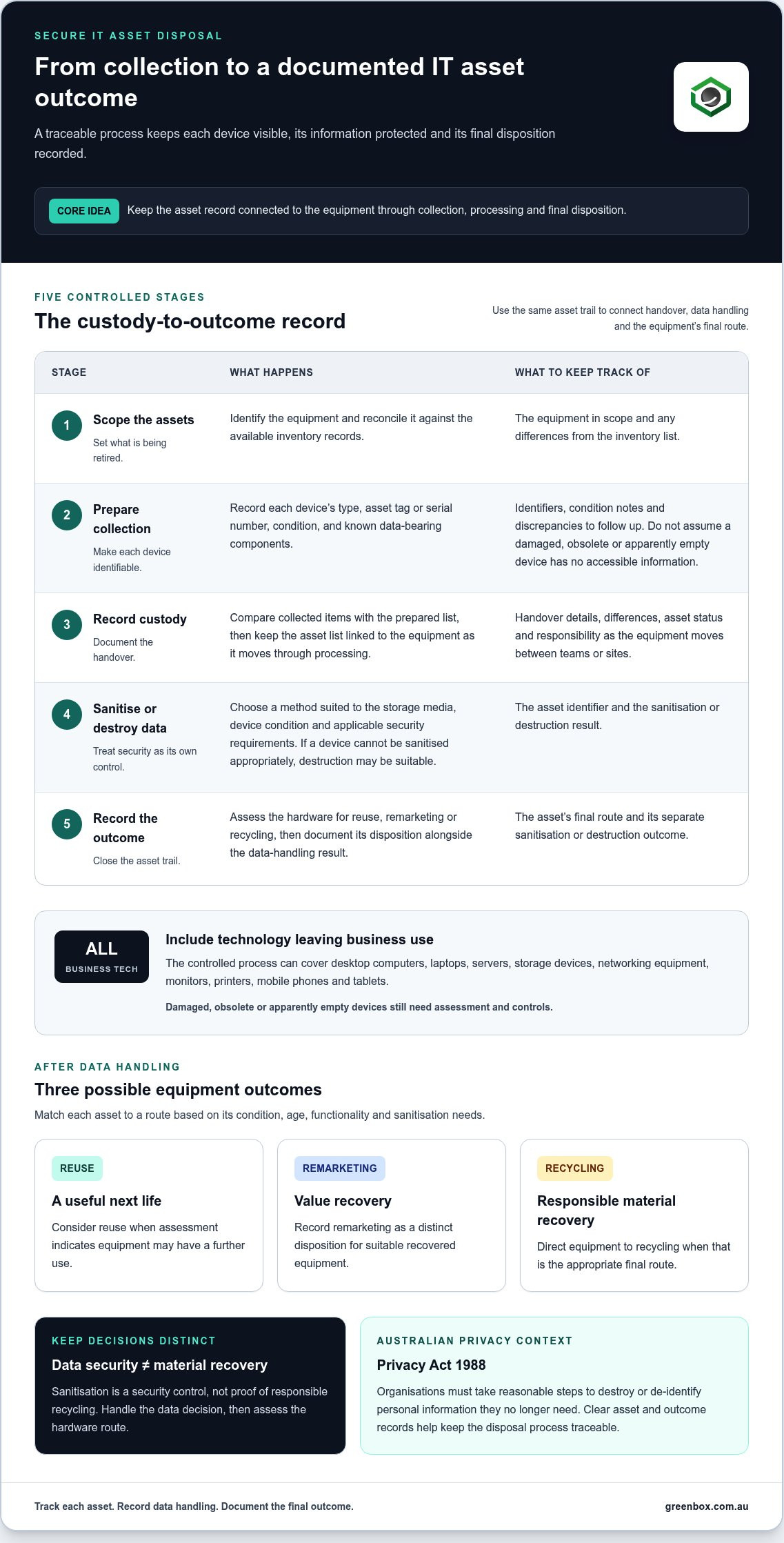
How secure IT asset disposal moves from collection to a documented outcome
A reliable process starts before equipment leaves the workplace. For IT asset disposal Australia-wide, an asset register and clear handover records help organisations track each device through collection, processing and its final outcome, including when multiple teams or sites are involved.
- 1. Scope the assets. Identify the equipment being retired and reconcile it against available inventory records.
- 2. Prepare the collection. Record each device’s type, asset tag or serial number, condition and known data-bearing components. Note discrepancies so they can be followed up rather than left unaccounted for.
- 3. Record custody. Document the handover and keep the asset list connected to the equipment as it moves through processing. This makes responsibility and status easier to track.
- 4. Sanitise or destroy data. Select a method suited to the storage media, device condition and applicable security requirements.
- 5. Determine and record the outcome. Assess the equipment for reuse, remarketing or recycling, then record its disposition alongside the sanitisation result.
What happens during collection and asset tracking?
A useful register includes more than a total device count. Record identifiers, condition and any known drives or other data-bearing components so each laptop, server or storage device can be matched to its record. Condition notes also help explain why an asset was suitable for recovery or directed to recycling.
At handover, compare the collected items with the prepared list and record any differences. This creates a traceable starting point for processing. Greenbox’s IT asset recovery connects collection with downstream handling, reducing the internal coordination needed to manage retired business hardware.
How are data and final outcomes documented?
Sanitisation is a distinct security control, not proof that equipment has been responsibly recycled. The method should reflect the media and its condition, as well as the organisation’s security requirements. Where a device can’t be sanitised appropriately, destruction may be the suitable path. For more detail, read the certified data sanitisation guide.
Keep the record clear: identify the asset, note the sanitisation or destruction outcome, then document whether it was reused, remarketed or recycled. This connects information security evidence to the asset’s final disposition without treating them as the same decision. The Australian Government’s National Television and Computer Recycling Scheme provides recycling for households and small businesses. Organisations planning larger programmes need a process suited to their asset volumes and tracking needs.
Documented custody makes disposition verifiable: track every asset from handover to its recorded data and end-of-life outcome. Greenbox connects recovery, data sanitisation, remarketing and recycling through end-to-end IT asset recovery.
Reuse, remarketing or recycling: compare IT asset disposal outcomes
Retired equipment doesn’t all need the same outcome. Assess each asset based on its condition, age, functionality and whether its data can be securely sanitised. This asset-by-asset approach helps organisations identify equipment with a useful next life and direct unsuitable hardware to responsible recycling.
| Outcome | Suitable for | Potential benefit | Key consideration |
|---|---|---|---|
| Reuse | Functional equipment that can serve another purpose within the organisation. | Extends the asset’s useful life and may reduce the need for replacement equipment. | Assess condition and suitability for the intended use; sanitise data before reassignment. |
| Remarketing | Working equipment with potential demand beyond the organisation. | Supports further use and may enable value recovery, depending on asset suitability and resale outcomes. | Securely sanitise data and assess each device. Resale proceeds and eligibility aren’t guaranteed. |
| Recycling | Damaged, obsolete or otherwise unsuitable equipment that can’t be recovered for continued use. | Enables materials to be managed through responsible e-waste processing rather than treating the device as reusable stock. | Consider how equipment and materials will be processed and what downstream environmental outcome is recorded. |
When can equipment be reused or remarketed?
Working condition is only one part of the assessment. Consider age, performance, completeness and remaining useful life. A functional laptop may still be unsuitable for a particular use, while other equipment may retain value in a different setting. Address data sanitisation before reuse or remarketing so information protection doesn’t depend on the asset’s next owner. Greenbox’s asset remarketing manages suitable retired equipment through its resale process. Recovery depends on the individual assets and their market suitability.
When is responsible recycling the right outcome?
Recycling is appropriate when damage, age or functionality makes continued use or recovery unsuitable. It should be a considered outcome, not the automatic destination for every retired device. Responsible processing focuses on handling equipment and its materials appropriately, with environmental outcomes included in the asset’s final record. For broader context on secure handling and sustainability, read the secure, sustainable IT disposal guide.
For IT asset disposal Australia-wide, a sound framework doesn’t favour resale over recycling or the reverse. It matches each device to a secure, practical outcome and records the reason for that decision. This gives a clearer view of what was recovered, what was remarketed and what required recycling, without assuming every asset will qualify for reuse or generate value.
How to plan IT asset disposal across your Australian organisation
A business-wide disposal cycle runs more smoothly when teams agree on scope, responsibilities and records before collection begins. A consistent framework helps IT, facilities, security and sustainability stakeholders work from the same asset information, including where devices are held and what evidence they need at the end.
What should teams prepare before a disposal cycle?
- Set the scope: list device categories, asset owners and the teams or sites holding equipment. Identify data-bearing devices, including storage components.
- Confirm internal responsibilities: name the people who approve retirement, prepare assets and oversee handover. Clarify how exceptions, such as missing or damaged equipment, will be recorded.
- Reconcile asset records: capture available identifiers, device type, condition and location. Flag gaps so an unlisted item doesn’t disappear from view during collection.
- Coordinate timing and access: agree when equipment will be ready, where it will be staged and who will manage handover across distributed teams and sites.
- Define reporting needs: decide what stakeholders require for oversight, such as custody records, sanitisation outcomes and each asset’s final disposition.
These preparations make collection easier to coordinate and give teams a shared reference point. Greenbox’s recovery, data sanitisation and recycling services connect key stages of the programme, reducing the internal effort involved in coordinating separate asset outcomes.
How can organisations assess security and environmental controls?
Map each stage to your organisation’s requirements: how custody is recorded, how data is sanitised or destroyed, and how assets are assessed for remarketing or recycling. Agree in advance what information final reports should contain so security teams and sustainability stakeholders can review the relevant outcomes.
Greenbox operates R2-certified facilities and is a carbon-neutral organisation. These are distinct considerations within a disposal programme: facility certification relates to the facilities, while carbon-neutral status describes the organisation. Your compliance team can assess which current obligations apply to your organisation and how they should inform its process.
Greenbox connects recovery, sanitisation and responsible recycling in a managed lifecycle. Learn more about secure IT asset disposal with Greenbox.
How Greenbox manages secure, sustainable IT asset disposal Australia-wide
Greenbox brings recovery, data sanitisation, asset remarketing and e-waste recycling together in an end-to-end process for Australian businesses. This gives each retired asset a clear path through the lifecycle, connecting secure handling with an appropriate next outcome rather than treating all equipment as a single disposal batch.
What does Greenbox’s end-to-end service bring together?
Recovery and coordinated logistics move retired equipment into processing, where each asset can be assessed and tracked. Data sanitisation or destruction addresses information security. The equipment then receives a separate assessment. Suitable assets may be prepared for remarketing, while devices that aren’t appropriate for continued use can be directed to e-waste recycling.
This asset-by-asset approach makes security and sustainability complementary. A working laptop and a damaged storage device may need different handling and outcomes, but both should remain visible throughout the process. Greenbox’s Australian operations support organisations through these connected stages, reducing the need for internal teams to coordinate separate pathways for recovery, sanitisation and final disposition.
Greenbox operates R2-certified facilities and is a carbon-neutral organisation. These are distinct credentials: R2 certification applies to its facilities, while carbon-neutral status describes the organisation. Alongside remarketing and recycling, they reflect an approach that considers environmental responsibility together with secure handling and asset recovery.
How does a business move from planning to action?
Start with a clear scope. Identify the device types and volumes due for retirement, note which assets contain data-bearing components, and decide what records stakeholders need for oversight. Agree on the handover process and the information that should connect each asset to its sanitisation and final outcome.
Then shape the service around the organisation’s equipment volumes and requirements. A planned refresh involving laptops across several teams may need a different coordination approach from a smaller group of servers or storage devices. Consistent asset records help maintain visibility across both.
With IT asset disposal Australia, the objective is a controlled process that links every asset to secure handling and a responsible disposition. Explore Greenbox’s IT asset disposal service to plan a secure, sustainable programme around your assets and reporting requirements.
Give every retired asset a clear next step
A well-planned IT asset disposal Australia programme brings security, accountability and environmental responsibility into one controlled process. Keep devices traceable from collection to their final outcome, and assess each asset individually for secure reuse, remarketing or recycling. Not every device will be suitable for recovery, so documented decisions matter as much as the final destination.
Greenbox supports Australian businesses with IT asset lifecycle services, including recovery, data sanitisation, remarketing and e-waste recycling. Its R2-certified facilities and carbon-neutral organisation status reflect a focus on secure handling and responsible outcomes.
Start by defining the assets in scope, identifying data-bearing devices and deciding what records your stakeholders need. Then build a process that fits your organisation’s requirements and keeps each outcome visible. Discuss a secure, sustainable IT asset disposal programme with Greenbox.
Frequently Asked Questions
What does IT asset disposal include?
IT asset disposal includes the controlled retirement, recovery and disposition of business technology. The process can cover computers, servers, storage devices, mobile devices and networking equipment, from collection and custody tracking through data sanitisation or destruction. Each asset is then assessed for an appropriate outcome, such as internal reuse, remarketing or recycling. Asset records connect these steps, helping organisations understand what happened to each device.
How is IT asset disposal different from e-waste recycling?
IT asset disposal manages the full end-of-life process, while e-waste recycling is one possible final outcome. ITAD includes organising collection, maintaining asset visibility, addressing data security and assessing equipment for reuse, remarketing or recycling. Recycling focuses on processing equipment that is unsuitable for continued use or recovery. Separating these stages helps businesses protect information and avoid sending potentially reusable equipment straight to recycling.
Can business IT equipment be reused after data sanitisation?
Yes, suitable business equipment may be reused after its data has been securely sanitised. Sanitisation addresses information on the device, but it doesn’t determine whether the hardware is fit for another role. Consider the equipment’s condition, age, functionality and remaining useful life. A device that passes these checks may be reassigned or remarketed; damaged or unsuitable equipment may be directed to recycling instead.
How do businesses keep track of IT assets during disposal?
Use an asset register to connect each device with its collection and processing records. Capture available identifiers, such as asset tags or serial numbers, alongside device type, condition and known data-bearing components. Compare the list with equipment at handover and record discrepancies. Then link custody updates, sanitisation results and final disposition to each asset record. This creates a practical audit trail rather than a count of equipment alone.
What happens to data-bearing devices during IT asset disposal?
Data-bearing devices are identified and handled according to the storage media, device condition and the organisation’s security requirements. Data may be sanitised using a suitable method or destroyed where sanitisation isn’t appropriate. A device shouldn’t be treated as safe simply because it’s damaged, old or appears empty. Record the sanitisation or destruction outcome against the asset before its reuse, remarketing or recycling pathway proceeds.
How can a business plan IT asset disposal across Australia?
Start by defining the device types and volumes in scope, identifying asset owners and data-bearing equipment, and deciding what records stakeholders require. Coordinate timing, handover and access across teams and sites, then set expectations for reporting and final outcomes. Greenbox provides Australian businesses with IT asset lifecycle services, including recovery, data sanitisation, remarketing and recycling, supporting a managed approach for different organisational requirements.
What records should a business retain after IT asset disposal?
Retain records that connect each asset to its handover, security treatment and final outcome. Useful information includes asset identifiers, device type and condition, custody details, sanitisation or destruction results, and whether the equipment was reused, remarketed or recycled. Record discrepancies and exceptions as well. Your organisation’s compliance team can advise which records it should retain and for how long under its internal policies and applicable obligations.