

What if every retired laptop or server had a clear, defensible record of where it went, how its data was protected and what happened to its materials? That is the opportunity behind ITAD ESG reporting: connecting asset disposition decisions to traceable evidence, rather than simply counting devices processed.
Building that account can be harder than it sounds. Retirement data is often spread across IT, finance, procurement and sustainability teams, while environmental claims need consistent records to stand up to scrutiny. It is also important to distinguish activity, such as the number of assets collected, from outcomes, such as documented reuse or recycling. Without that distinction, a report can claim more than the evidence supports.
This guide explains which ITAD data can support ESG disclosures and how to create a repeatable evidence trail for retired technology. It covers how secure data sanitisation, asset recovery, remarketing and e-waste recycling fit into the same lifecycle, and how to describe environmental outcomes accurately. With a structured approach, ITAD records can give your sustainability team a more reliable basis for reporting and connect operational decisions with corporate accountability.
Key Takeaways
- Separate asset-handling activity from outcomes supported by clear records, such as documented reuse or recycling.
- Build a consistent asset record with device category, quantity, identifier, disposition date and recorded outcome.
- Use ITAD ESG reporting to organise operational evidence, while keeping emissions calculations aligned with a stated boundary and method.
- Assign clear responsibilities across IT, sustainability, procurement, finance and assurance teams to make reporting repeatable.
- See how recovery, data sanitisation, remarketing and recycling can contribute traceable information to your internal reporting process.
What ITAD ESG reporting can, and cannot, show about retired technology
ITAD ESG reporting is the structured use of information from IT asset disposition in an organisation’s environmental, social and governance reporting. It can make the retirement of computers, servers and other equipment more visible, but it does not automatically prove a sustainability benefit or satisfy a reporting requirement.
Reportable ITAD evidence is information traceable to a documented activity or outcome. An environmental claim goes further and needs supporting evidence, a relevant reporting boundary and a defensible method.
This distinction helps teams with different responsibilities work from the same evidence. IT may hold asset identifiers and sanitisation records; procurement may manage supplier processes; risk teams may focus on data governance; and sustainability teams may assess relevance to disclosures. Bring the records together, then assess them against the organisation’s materiality assessment and applicable reporting framework. A metric is not automatically material just because it can be measured.
Which ESG topics can IT asset disposition inform?
ITAD records may inform discussion of resource use, product life extension, electronic waste handling and data governance. Reuse or remarketing can indicate that an asset continued to be used, while recycling records can help describe how equipment was handled at end of life. The electronic waste stream includes discarded electrical and electronic equipment, making responsible handling an important consideration when retiring assets.
Social or governance relevance depends on an organisation’s policies and reporting scope. For example, data sanitisation records may support internal controls and responsible information management. Assess these connections rather than assuming them. No single ITAD measure is material to every organisation.
Activity data is not the same as an ESG outcome
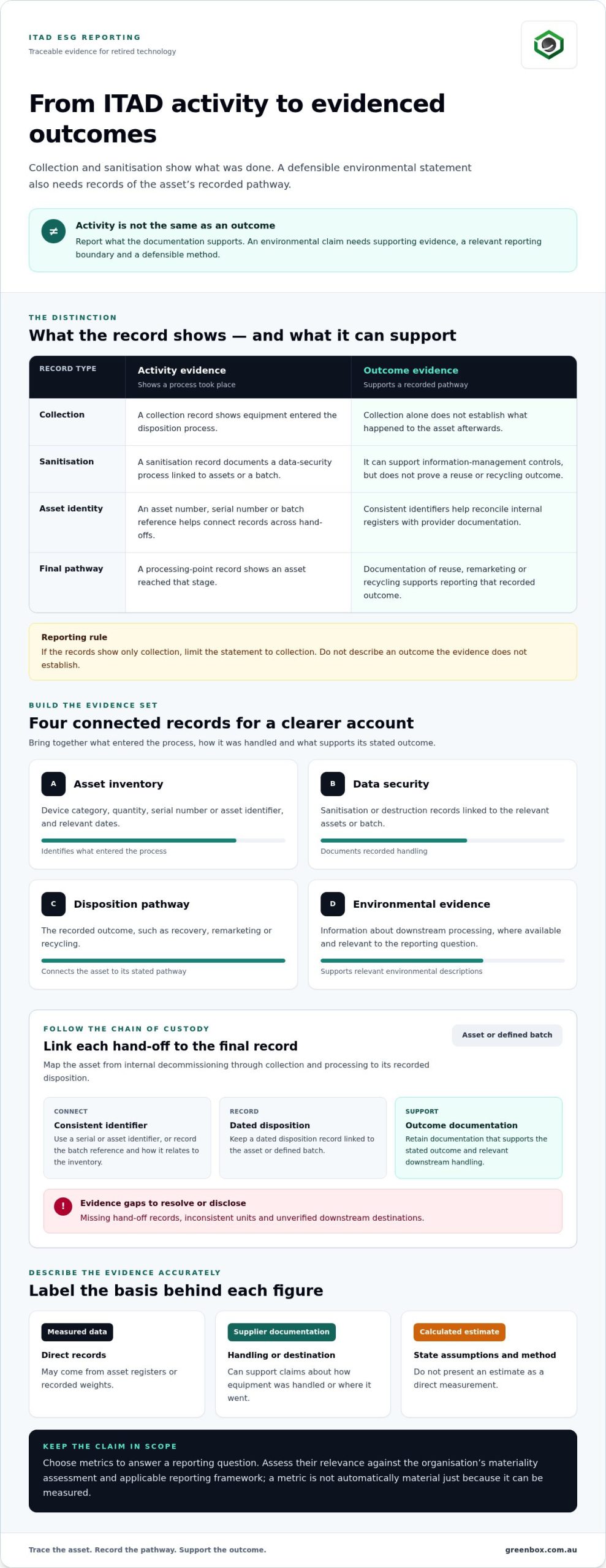
Collection and sanitisation are activities. They show that equipment was received or that a data-security process was recorded, but they do not establish what happened to the asset afterwards. An evidenced outcome needs records supporting the stated disposition, such as documented reuse, remarketing or recycling. Downstream destination information matters because an environmental statement should reflect the asset’s recorded pathway, not simply its arrival at a processing point.
For example, an asset-register entry identifies a laptop by its asset number and device category. A collection record shows it entered the disposition process, while a sanitisation record relates to data governance. If later documentation records its final pathway as reuse, the organisation has stronger evidence for reporting that outcome. If the records show only collection, the defensible statement is limited to collection. Clear records help teams explain what happened without overstating impact.
Which ITAD data and evidence belong in a corporate IT sustainability report?
A useful ITAD evidence set brings together four types of information: asset inventory, data security, disposition pathway and environmental evidence. Together, they show what entered the process, how it was handled and what records support its final outcome.
- Asset inventory: device category, quantity, serial number or asset identifier, and relevant dates.
- Data security: sanitisation or destruction records linked to the relevant assets or batch.
- Disposition pathway: the recorded outcome, such as recovery, remarketing or recycling.
- Environmental evidence: information about downstream processing, where available and relevant to the reporting question.
Label the type of evidence behind each figure. Measured data may come from asset registers or recorded weights; supplier documentation can support claims about handling or destination; calculated estimates rely on stated assumptions and methods. These sources have different strengths, so do not present an estimate as a direct measurement. As a supplementary reference, the US EPA’s guidance on electronics recycling discusses responsible handling in the United States and should not be treated as Australian regulatory guidance.
A practical minimum evidence trail links an asset or defined batch to a dated disposition record and documentation supporting its stated outcome. The right level of detail depends on the organisation’s reporting purpose and controls, rather than a universal ITAD checklist.
Build an auditable chain of custody for retired IT
Map each hand-off from internal decommissioning through collection and processing to the recorded disposition. Use consistent serial or asset identifiers to reconcile internal registers with provider documentation. If individual tracking is not practical, record the batch reference and how it relates to the inventory. Missing hand-off records, inconsistent units and unverified downstream destinations are evidence gaps to resolve or disclose.
Greenbox operates R2-certified facilities. Certification can inform an organisation’s assessment of processes, but reporting should still rely on records relevant to the specific assets and outcomes being described.
Choose metrics that answer a reporting question
Start with the reporting question, then select metrics that the evidence can support. Depending on available records, these could include devices processed, sanitised, recovered, remarketed or recycled. Keep reuse and recycling figures separate because they describe different pathways. For each metric, record its source, reporting period, boundary, calculation method and data owner. This gives reviewers a clear route from the reported figure back to its supporting evidence.
Greenbox’s IT asset disposition services bring recovery, sanitisation, remarketing and recycling into the asset lifecycle, supporting the collection and documentation of disposition information for internal review.
How to connect ITAD evidence with ESG standards and emissions reporting
Map ITAD records to the reporting framework in use
Australian organisations should identify which Australian Sustainability Reporting Standards (ASRS) and other disclosure requirements apply to them, and confirm current scope and phase-in arrangements using authoritative Australian guidance. The ASRS include AASB S1 and AASB S2; their relevance depends on the organisation’s circumstances and applicable requirements. The ISSB standards provide an international reference point, while the GRI 306: Waste Standard addresses waste-related reporting. Mapping ITAD evidence to a framework is a starting point, not proof that a disclosure requirement has been met.
For each proposed disclosure, record the reporting criterion, the evidence supporting it and any limitations. A recycling record, for example, may support a statement about a documented disposition pathway, but it does not by itself quantify emissions avoided or establish a broader environmental impact.
Keep Scope 3 and avoided-emissions claims defensible
Emissions calculations need a defined boundary, a suitable method, relevant activity data and applicable emissions factors. Scope 3 classification depends on the reporting entity’s boundary and chosen methodology, so check current authoritative guidance before assigning a category or factor. State the period covered and document assumptions, exclusions and data limitations.
Keep evidence types distinct. A direct operational record, supplier documentation and a calculated estimate do not mean the same thing. A comparison with a hypothetical alternative is different again and requires a defensible method and transparent assumptions. In ITAD ESG reporting, distinguish measured emissions from estimates and comparative claims rather than presenting them as interchangeable.
“Avoided-emissions claims require a defensible method; they must not be inferred from recycling totals alone.”
| Evidence type | What it can support | What to clarify |
|---|---|---|
| Direct operational records | Recorded collection, sanitisation or disposition activity | Period, asset or batch coverage, units and source |
| Supplier evidence | Documented processing or disposition information | Which assets or batches it covers and the stated outcome |
| Calculated estimates | Emissions or other derived metrics | Boundary, method, activity data, factors and assumptions |
This separation gives reviewers a clearer path from disclosure to source evidence and helps the organisation report only what its records and methodology can substantiate.
How to prepare ITAD information for a corporate ESG report
A repeatable process turns dispersed records into evidence that can be reviewed and traced. For ITAD ESG reporting, agree on the reporting question first, then gather the information needed to answer it and retain a clear record of how the final figures were prepared.
A six-step process for collecting and validating ITAD data
- Define the reporting question. Set the reporting boundary and period, identify the intended disclosure, and appoint an accountable data owner.
- Extract the records. Gather asset-register information and disposition documentation for the agreed period.
- Standardise the data. Align device categories, units, dates and identifiers so records can be compared and matched.
- Reconcile the totals. Compare internal asset records with provider documentation and reported figures. Investigate duplicates, unmatched items and other exceptions.
- Retain supporting evidence. Keep relevant source records alongside calculations, including notes explaining estimates or incomplete data.
- Review and approve. Document the method, assumptions, limitations and approval before publishing figures or claims.
Assign clear responsibilities
A responsibility matrix helps prevent gaps between teams. Define who prepares each input, who reviews it and who approves its use in the report.
- IT: supplies asset-register data, identifiers and decommissioning records.
- Sustainability: maps the information to the reporting question and checks how outcomes are described.
- Procurement: coordinates relevant supplier records and disposition documentation.
- Finance: reviews figures and supports reconciliation with internal controls where relevant.
- Assurance stakeholders: assess whether the evidence, methodology and approvals support the proposed disclosure.
Prepare for assurance and internal review
Preserve source documents, calculation workpapers, version history and approval records in an organised location. A reviewer should be able to trace a reported total back to its inputs and understand how missing or incomplete records were handled. Record any estimation method and its limitations rather than silently filling data gaps.
For additional context on enterprise lifecycle management, read the sustainable IT asset recovery case study. A structured disposition process can make it easier to coordinate asset recovery, data sanitisation, remarketing and recycling records for internal review.
To align asset retirement with traceable disposition information, explore Greenbox ITAD services for business technology lifecycle needs.
How Greenbox ITAD can support more traceable ESG reporting
Greenbox’s IT asset recovery, data sanitisation, remarketing and e-waste recycling services can provide operational inputs to an organisation’s reporting process. By managing these activities across the asset lifecycle, Greenbox supports clients in organising disposition information for internal review. Your organisation remains responsible for deciding how that evidence fits its reporting framework, boundaries and methodology.
Bring security, recovery and environmental handling together
Retiring technology involves more than deciding where equipment goes. Data sanitisation and destruction address information security, while recovery, remarketing and recycling establish different pathways for physical assets. Keeping records of these processes together can help teams review data governance and environmental handling without treating them as the same outcome.
Greenbox operates R2-certified facilities. This provides context about its recycling operations, but certification alone does not determine the environmental result for a particular client or asset. Where records support the distinction, report remarketed equipment and recycled materials as separate disposition pathways. Do not combine reuse figures with recycling totals or turn them into an emissions claim without an appropriate method and supporting evidence.
Turn reporting needs into an operational ITAD brief
Set evidence expectations before the disposition programme begins. Agree on the asset fields required, the reporting period, how identifiers will be matched and which records teams need to review each pathway. For example, a sustainability team may need a consistent way to reconcile asset quantities, while IT needs sanitisation information linked to the relevant assets or batches. Clear requirements help procurement, IT and sustainability coordinate the information they will use later.
For more context on secure data handling, read the enterprise guide to certified data sanitisation. The e-waste recycling business guide provides further background on business recycling considerations. These resources can help teams frame operational questions, while the organisation’s reporting criteria determine how collected evidence is presented.
Greenbox’s lifecycle services support a more organised view of asset retirement, from secure handling to recorded disposition pathways. To discuss your organisation’s ITAD requirements and evidence needs, talk with Greenbox about ITAD.
Turn ITAD records into a stronger reporting process
Credible ITAD ESG reporting starts with evidence that can be traced from retired assets to their recorded disposition. Keep activity data distinct from documented outcomes, and connect each metric to its source, reporting period and method. This helps teams explain what the records show without claiming more than they support.
A repeatable process also makes collaboration easier. IT, procurement, sustainability, finance and assurance teams can agree on data owners, reconcile records and review limitations before information enters a corporate report. Environmental statements, particularly emissions or avoided-impact claims, need an appropriate method and supporting evidence.
Greenbox brings recovery, data sanitisation, remarketing and e-waste recycling into the IT asset lifecycle, with R2-certified facilities supporting its operations. These services provide operational information for internal review, while your organisation determines how that evidence fits its reporting framework and methodology.
Discuss your ITAD reporting requirements with Greenbox and take the next step towards a clearer, more traceable approach to retired technology.
Frequently Asked Questions
What is ITAD ESG reporting?
ITAD ESG reporting is the structured use of information from IT asset disposition in an organisation’s environmental, social and governance reporting. It can include asset records, data sanitisation information and documented disposition pathways. Show what the evidence supports: a collection record demonstrates collection, while a separately documented reuse or recycling outcome supports a more specific statement about what happened to the equipment.
How can ITAD data support a corporate sustainability report?
ITAD data can provide operational evidence about how retired technology was handled, helping sustainability teams explain relevant practices and outcomes. Records may show quantities processed, data-security steps and documented asset pathways. Map this information to your reporting boundary, material topics and chosen framework. ITAD records can contribute evidence, but they do not automatically meet every disclosure requirement or establish a wider environmental benefit.
What ITAD metrics should a business include in ESG reporting?
Choose metrics that answer a reporting question and are supported by consistent records. Depending on the evidence available, these may include device quantities collected or sanitised, and assets documented as recovered, remarketed or recycled. Keep different pathways separate rather than combining them into one total. For each metric, record its source, reporting period, boundary, calculation method and data owner so reviewers can understand how it was compiled.
Can ITAD reduce Scope 3 emissions?
ITAD may be relevant to a Scope 3 assessment, but whether and how it is included depends on the organisation’s reporting boundary and chosen methodology. Do not assume that reuse or recycling automatically reduces reported emissions. Any calculation needs suitable activity data, a stated method and applicable emissions factors. Keep measured emissions, estimates and comparisons with an alternative scenario distinct, and document assumptions and limitations.
What evidence should an ITAD provider supply for ESG reporting?
Useful evidence may include asset or batch identifiers, quantities, relevant dates, sanitisation records, custody documentation and records of the disposition pathway. Downstream processing information can support claims about what happened after collection, where available. The evidence needed depends on the organisation’s reporting question. Reconcile provider documentation with internal asset records, and distinguish direct records from supplier statements and calculated estimates.
Do Australian businesses have to include ITAD in sustainability reporting?
No, there is no universal requirement for every Australian business to report a specific ITAD metric. Obligations depend on the organisation and the reporting requirements that apply to it. Australian Sustainability Reporting Standards, including AASB S1 and AASB S2, may be relevant for entities within their scope. ITAD information may support a material disclosure, but organisations should assess applicability and reporting treatment against current authoritative guidance.
How do you avoid greenwashing when reporting ITAD outcomes?
Make claims no broader than the evidence. Separate activities, such as collection or sanitisation, from documented outcomes, such as a recorded reuse or recycling pathway. Do not infer avoided emissions from recycling totals alone. For environmental calculations or comparisons, state the boundary, method, data sources and assumptions, and explain material limitations. Use precise language so readers can tell what was measured, what a supplier documented and what was estimated.