

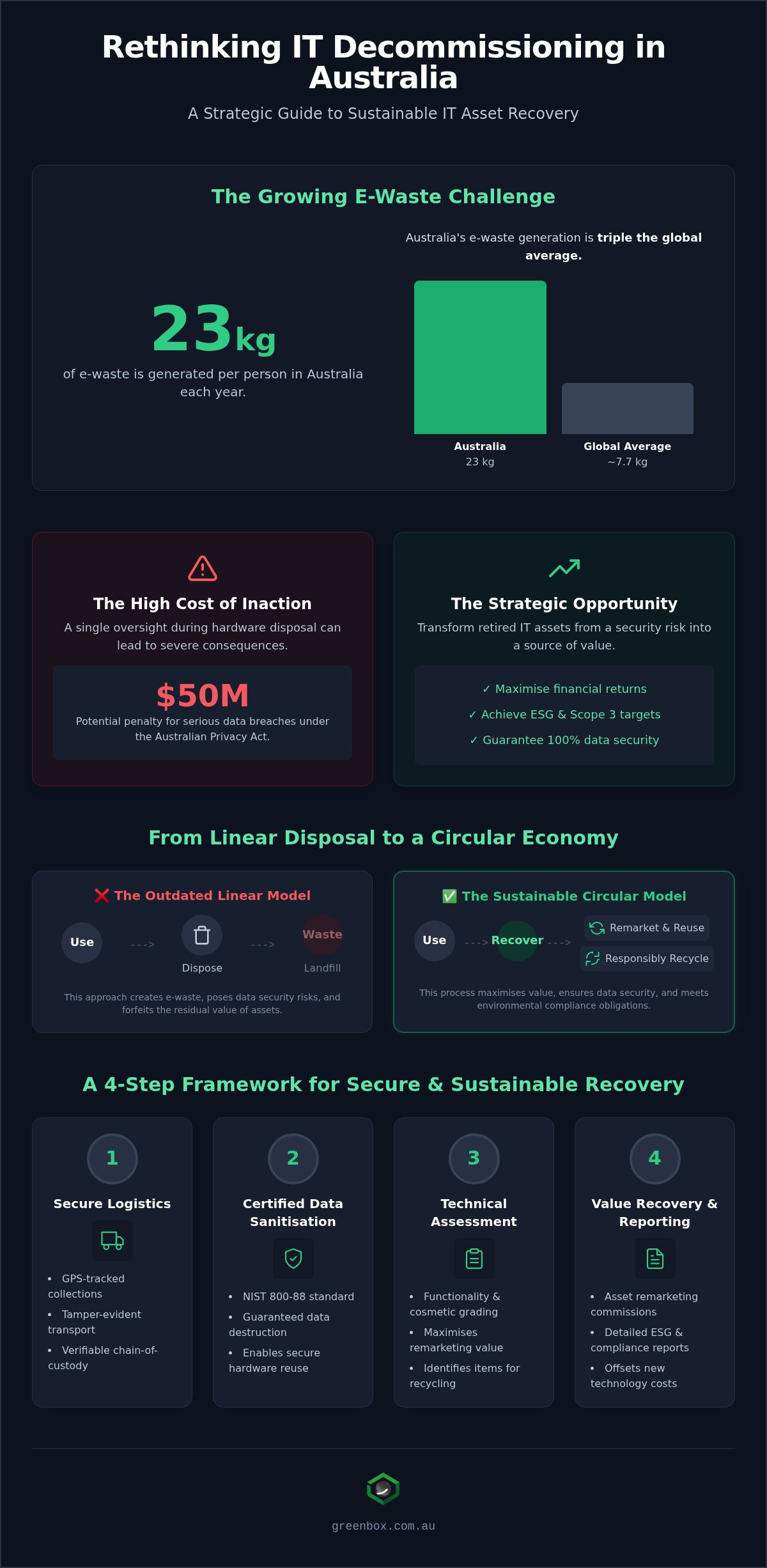
Australians now generate approximately 23 kilograms of e-waste per person every year, a figure that is triple the global average and underscores the urgent need for sustainable IT asset recovery within the enterprise sector. You likely recognise the mounting pressure to align hardware decommissioning with the Recycling and Waste Reduction Act 2020 while protecting your organisation from devastating data breaches. It’s a high-stakes environment where a single oversight during a national rollout could lead to penalties of up to $50 million under the Privacy Act.
We agree that managing the transition of thousands of devices is a logistical challenge that shouldn’t compromise your environmental commitments. This article demonstrates how a strategic recovery programme transforms retired hardware from a security risk into a source of financial value and ESG achievement. You’ll learn how to implement a secure lifecycle strategy that provides a 100% data security guarantee and maximises returns through professional asset remarketing.
We’ll examine a structured approach to enterprise hardware disposal that integrates NIST-standard sanitisation with carbon-neutral processes to meet your Scope 3 targets. This framework ensures your path to a circular economy is both profitable and protected.
Key Takeaways
- Learn how to transition from traditional disposal to a circular model that extracts maximum residual value from your retired enterprise hardware.
- Master the framework for secure decommissioning, from rigorous chain-of-custody protocols to NIST 800-88 certified data sanitisation.
- Discover how sustainable IT asset recovery and R2-certified processing ensure strict compliance with evolving Australian landfill bans and federal environmental regulations.
- Identify strategies to offset new technology costs by leveraging professional asset remarketing and carbon-neutral disposal programmes.
- Gain insights into managing complex, large-scale national hardware rollouts with a partner that prioritises both data security and ESG milestones.
The Evolution of Corporate IT Asset Recovery in Australia
The Australian corporate sector has reached a critical turning point in how it handles end-of-life technology. For years, hardware decommissioning was viewed primarily as a waste management problem. Today, the establishment of the National Environmental Protection Agency on 1 July 2026 and the commencement of the Waste Avoidance and Resource Recovery (e-waste) Amendment Regulations 2026 in Western Australia have formalised a new standard. Businesses are shifting from simple disposal to a model of sustainable IT asset recovery. This transition is driven by a need to meet ambitious Scope 3 emission targets and the reality that traditional e-waste recycling often fails to address the sophisticated data security requirements of a modern enterprise.
Beyond the Bin: Why Sustainable Recovery Matters
The environmental cost of unmanaged technology refreshes is no longer a hidden metric. With Australians generating approximately 23 kilograms of e-waste per person annually, the pressure on landfill is unsustainable. A strategic approach integrates the principles of a circular economy, where devices are kept in use for as long as possible through refurbishment and remarketing. This isn’t just about being green; it’s about risk mitigation. Traditional recycling methods sometimes lack the rigorous chain-of-custody required to prevent data leaks. Under the Privacy Act, serious interference with privacy can now result in penalties of up to $50 million. Sustainable recovery ensures that environmental stewardship and data protection are handled as a single, integrated process.
The Financial Case for Strategic Asset Recovery
Modern ITAD (IT Asset Disposition) has moved from an operational cost centre to a significant value-recovery opportunity. When a company refreshes its fleet, the residual value in the outgoing hardware often remains untapped. By engaging in professional sustainable IT asset recovery, organisations can recoup capital through asset remarketing commissions. These funds can directly offset the costs of new hardware deployments. There are several ways this strategy improves the bottom line:
- Residual Value Capture: Turning retired laptops and servers into liquid capital via secondary markets.
- Operational Efficiency: Reducing the internal technical labour burden during bulk hardware rollouts.
- ESG Compliance: Meeting carbon-neutral targets without the need for expensive, standalone offset programmes.
Large-scale national rollouts involve immense logistical complexity. Partnering with a specialist allows internal IT teams to step back from the manual labour of decommissioning, imaging, and logistics. This ensures that the transition to new technology is seamless, secure, and carbon-neutral. It’s a pragmatic strategy that satisfies the Chief Financial Officer and the Chief Sustainability Officer alike.
A Framework for Sustainable IT Asset Lifecycle Management
A structured framework for sustainable IT asset recovery transforms a chaotic hardware refresh into a predictable, high-performance operation. Security is the absolute priority. The process begins with secure logistics and a verifiable chain-of-custody for every data-bearing device leaving your premises. Without this foundation, even the most advanced environmental programme risks a catastrophic data breach. A professional sustainable IT asset recovery model follows four critical steps:
- Secure Logistics: Tamper-evident transport and GPS-tracked collection of all devices.
- Certified Sanitisation: Applying NIST 800-88 standards to ensure data is irrecoverable.
- Technical Assessment: Determining if an asset is suitable for remarketing or must be recycled.
- Compliance Reporting: Generating detailed audits for internal stakeholders and regulators.
Certified Data Sanitisation: The Security Baseline
Software-based sanitisation is now the preferred method for enterprise-grade security. Unlike physical shredding, which destroys the material value of a device, software sanitisation allows the hardware to be safely reused. This supports the circular economy while meeting the most stringent NIST 800-88 guidelines. Every retired asset must receive a formal Certificate of Destruction or Sanitisation to satisfy legal requirements. Adhering to international e-waste compliance and security standards ensures your organisation remains audit-ready while fulfilling corporate social responsibility mandates. For a deeper dive into local requirements, consult The Enterprise Guide to Certified Data Sanitisation in Australia 2026.
Maximising Value through Asset Remarketing
Remarketing is the engine that drives financial sustainability in ITAD. Once a device is sanitised and refurbished, it enters a secondary market where enterprise-grade hardware remains in high demand. This process extends the lifecycle of the technology and generates a direct return on investment. Many organisations use these remarketing commissions to fund future hardware deployments, effectively turning a liability into a liquid asset. Engaging a secure asset recovery partner provides the technical expertise required to manage these transitions at scale. We balance the pursuit of resale value with a uncompromising focus on data security; if a device cannot be safely sanitised, it is diverted to environmentally compliant e-waste recycling to recover precious metals and raw materials.
Case Study: Achieving Carbon Neutrality and Value Recovery
A recent large-scale technology refresh for a prominent Australian enterprise serves as a benchmark for sustainable IT asset recovery. The project involved managing the decommissioning of more than 5,000 data-bearing devices distributed across multiple national sites. The primary objective was to replace an ageing fleet while ensuring that every retired unit was accounted for, sanitised, and processed without increasing the organisation’s carbon footprint. By integrating recovery with deployment, the business successfully transitioned to new hardware with zero operational downtime.
Project Logistics and Secure Decommissioning
Organising national collections requires a methodical approach to avoid disrupting daily business activities. For this project, a combination of secure onsite data destruction and offsite sanitisation was utilised. This dual-protocol strategy ensured that high-risk storage media were neutralised before leaving the secure perimeter, while other assets were transported in GPS-tracked, locked vehicles to R2-certified facilities. This level of precision is essential when implementing a framework for sustainable IT asset lifecycle management. It allows for a seamless handover where end-of-life hardware management becomes an invisible, highly efficient background process.
Quantifying the Sustainability Impact
The results of this partnership extended well beyond simple logistics. The organisation achieved 100% landfill diversion, ensuring that no part of the 5,000-unit fleet contributed to Australia’s growing e-waste problem. Detailed reporting provided the client with verifiable metrics on carbon offsets and material recovery. These data points were directly integrated into their annual ESG statement, providing stakeholders with transparent evidence of the company’s commitment to the circular economy.
Financially, the project moved beyond the traditional cost-heavy model of hardware disposal. Through a transparent asset remarketing programme, the residual value of the enterprise-grade laptops and servers was captured and returned to the client. These remarketing commissions significantly offset the service fees, effectively reducing the total cost of the technology refresh. This pragmatic outcome proves that technical success and responsible environmental practice aren’t just compatible; they’re financially advantageous for the modern enterprise.
Navigating Australian E-waste Compliance and Security Standards
The regulatory landscape for electronics in Australia shifted significantly on 1 July 2026 with the formal establishment of the National Environmental Protection Agency. This new authority, combined with the commencement of the Waste Avoidance and Resource Recovery (e-waste) Amendment Regulations 2026 in Western Australia, has raised the bar for corporate accountability. For any enterprise, sustainable IT asset recovery is no longer just a best practice; it’s a legal necessity. Failing to adhere to these evolving standards risks heavy financial penalties and, perhaps more importantly, irreparable damage to your organisation’s reputation.
Key Certifications to Demand from Your Provider
Standard ISO certifications are a necessary baseline, but they don’t go far enough for high-stakes hardware decommissioning. You should prioritise partners who hold R2V3 (Responsible Recycling) certification. This standard is specifically designed for the ITAD industry, ensuring that every component is tracked through its entire lifecycle and that no toxic materials end up in landfill. Additionally, carbon-neutral status is now a critical requirement. As organisations race toward net-zero, your ITAD provider must offer carbon-neutral services to help you meet your Scope 3 emission targets. We also recommend verifying the security credentials of the technical labour teams. In the government and financial sectors, ensuring that the personnel handling your data-bearing devices have undergone rigorous background checks is a non-negotiable security requirement.
The Compliance Checklist for IT Managers
Establishing a secure hardware decommissioning protocol requires a methodical approach that leaves no room for error. You’ll need to account for every device from the moment it’s unplugged until the final certificate of destruction or sanitisation is issued. This includes using GPS-tracked transport and tamper-evident packaging to prevent data breaches during transit. Many organisations find it effective to integrate their recovery efforts into a broader ITAD for Financial Services in Australia framework, which aligns security with strict financial regulations.
To maintain compliance, ensure your checklist covers:
- Strict adherence to NIST 800-88 standards for all data sanitisation.
- Verification of 100% landfill diversion for all non-marketable components.
- Full audit trails and serialised reporting for every retired asset.
Following these steps ensures that your sustainable IT asset recovery programme is robust, transparent, and fully aligned with 2026 standards. If you’re ready to secure your fleet and meet your sustainability goals, consider a secure ITAD solution that handles the complexity for you.
Partnering with Greenbox for Secure, Sustainable ITAD
Greenbox has established itself as the “safe pair of hands” for the Australian government and enterprise sectors since 2000. We understand that a technology refresh is more than just a hardware swap; it’s a high-stakes transition involving sensitive data and rigorous environmental targets. Our commitment to sustainable IT asset recovery ensures that every device is handled with absolute precision. We operate with a national footprint that allows us to manage complex, multi-site rollouts with a level of consistency and security that smaller providers cannot match. This scale is matched by our dedication to transparency, providing you with a clear audit trail for every asset in your fleet.
Our remarketing and reporting platforms provide real-time visibility into the status of your equipment, from the initial collection to the final sale or recycling stage. This data is essential for modern compliance, providing the audit evidence required for ESG reporting and financial accountability. We maintain a carbon-neutral organisation status, ensuring that our services support your broader net-zero commitments without compromise. This integrated approach allows you to meet your sustainability goals while maintaining the highest standards of data protection.
End-to-End Lifecycle Services
We provide a comprehensive suite of services that covers the entire hardware lifecycle. This begins with pre-configuration and imaging at our secure facilities, ensuring that new devices are ready for immediate deployment. When it’s time for decommissioning, our sustainable IT asset recovery framework takes over. We customise every project to meet your specific security needs, whether that requires onsite data destruction or high-volume offsite sanitisation. As an Australian-owned business with over two decades of expertise, we offer a level of local context and reliability that global competitors often lack. We don’t just dispose of hardware; we manage its entire transition with a focus on value and security.
Next Steps for Your Technology Refresh
Initiating a secure recovery programme shouldn’t add to your operational burden. Our team of specialists is ready to help you conduct a comprehensive asset recovery audit to identify the residual value in your current fleet. This assessment allows you to plan your budget with greater accuracy, using remarketing commissions to fund future technology investments. By outsourcing the logistics and technical labour to us, your internal IT teams can remain focused on core business objectives rather than the manual work of hardware decommissioning.
Contact our specialists today to receive a tailored sustainability and security proposal. We’ll work with you to design a secure lifecycle strategy that protects your data, satisfies your environmental mandates, and maximises your financial returns.
Securing Your Enterprise Legacy in a Circular Economy
The transition toward a circular economy is no longer a peripheral sustainability goal; it’s a core business imperative for the modern Australian enterprise. By adopting a structured approach to sustainable IT asset recovery, your organisation can simultaneously mitigate the $50 million risk of data breaches and achieve significant ESG milestones. We’ve explored how professional remarketing transforms retired hardware into liquid capital, effectively funding your next technology refresh while ensuring 100% landfill diversion.
Managing national hardware rollouts requires a partner with the scale and credentials to handle immense complexity. Greenbox provides that steady hand. As an Australian-owned and operated business since 2000, we combine R2-certified facilities with carbon-neutral organisation status to deliver peace of mind. This ensures that your decommissioning process is as secure as it is environmentally responsible. We invite you to partner with Greenbox for secure, sustainable IT asset recovery today and transform your end-of-life hardware into a strategic advantage. Your path to a secure, carbon-neutral technology lifecycle is ready to begin.
Frequently Asked Questions
What is sustainable IT asset recovery compared to standard recycling?
Sustainable IT asset recovery differs from standard recycling by prioritising the reuse and refurbishment of devices over immediate material destruction. While recycling focuses on breaking down hardware to recover raw materials, a sustainable recovery model seeks to extend the technology’s lifecycle. This approach reduces the environmental footprint of a technology refresh and allows organisations to capture residual financial value through asset remarketing, ensuring that recycling is only a final resort for non-functional equipment.
Is software-based data sanitisation as secure as physical shredding?
Software-based data sanitisation is exceptionally secure when performed to NIST 800-88 standards. It ensures that data is completely irrecoverable while preserving the physical integrity of the hardware. This allows the device to be refurbished and reused, which is a core requirement for a circular economy. In contrast, physical shredding destroys the asset’s residual value and contributes to e-waste. For most enterprise-grade storage, certified sanitisation provides the optimal balance of security and environmental responsibility.
How does Greenbox calculate the resale value for remarketed IT assets?
We determine the resale value of remarketed IT assets through a comprehensive technical assessment and real-time analysis of secondary market demand. After our specialists test and refurbish the hardware, we leverage our global sales network to achieve the maximum possible return. Greenbox typically operates on a transparent commission-based model. We retain a percentage of the final sale price to cover processing and sales costs, returning the majority of the financial value to your organisation.
Does Greenbox provide a certificate of destruction for every device?
Yes, we provide a serialised Certificate of Destruction or Sanitisation for every data-bearing device we process. This documentation is a critical component of your audit trail and demonstrates compliance with the Privacy Act and international security standards. Each certificate confirms that the specific asset has undergone rigorous NIST-standard sanitisation or physical destruction, giving your IT and compliance teams total peace of mind that all corporate data has been permanently removed.
Can Greenbox manage IT asset recovery for remote Australian employees?
We provide comprehensive national coverage to manage sustainable IT asset recovery for remote and hybrid workforces across Australia. Our secure logistics network handles the collection of individual devices from residential addresses or regional satellite offices with the same level of chain-of-custody tracking used for major corporate headquarters. This ensures that hardware decommissioning remains consistent and secure, regardless of where your employees are located, removing the logistical burden from your internal IT department.
What certifications should I look for in a sustainable ITAD provider?
You should prioritise a provider that holds R2 (Responsible Recycling) certification, which is the global gold standard for the ITAD industry. This certification ensures that every component is tracked and that no hazardous e-waste ends up in landfill. Additionally, look for ISO 9001, 14001, 27001, and 45001 certifications. These credentials verify that the provider maintains rigorous standards for quality management, environmental stewardship, information security, and occupational health and safety across their national facilities.
How do carbon-neutral ITAD services help with Scope 3 emission reporting?
Carbon-neutral ITAD services provide the verifiable data needed to satisfy Scope 3 emission reporting requirements. By choosing a partner that operates with a carbon-neutral status, your organisation can account for the environmental impact of your hardware’s end-of-life phase. We provide detailed reports on carbon offsets achieved through refurbishment and the tonnage of e-waste diverted from landfill. This transparency allows your sustainability team to integrate accurate, audit-ready metrics directly into your annual ESG statements.
What happens to IT equipment that has no resale value?
Equipment that has no residual resale value is diverted to our environmentally compliant e-waste recycling programme. We dismantle these assets to recover precious metals and raw materials, such as copper, gold, and aluminium, which are then returned to the manufacturing supply chain. This process adheres to strict Australian standards, ensuring that 100% of the material is diverted from landfill. It’s a pragmatic solution that ensures even your oldest hardware contributes to a circular economy.