

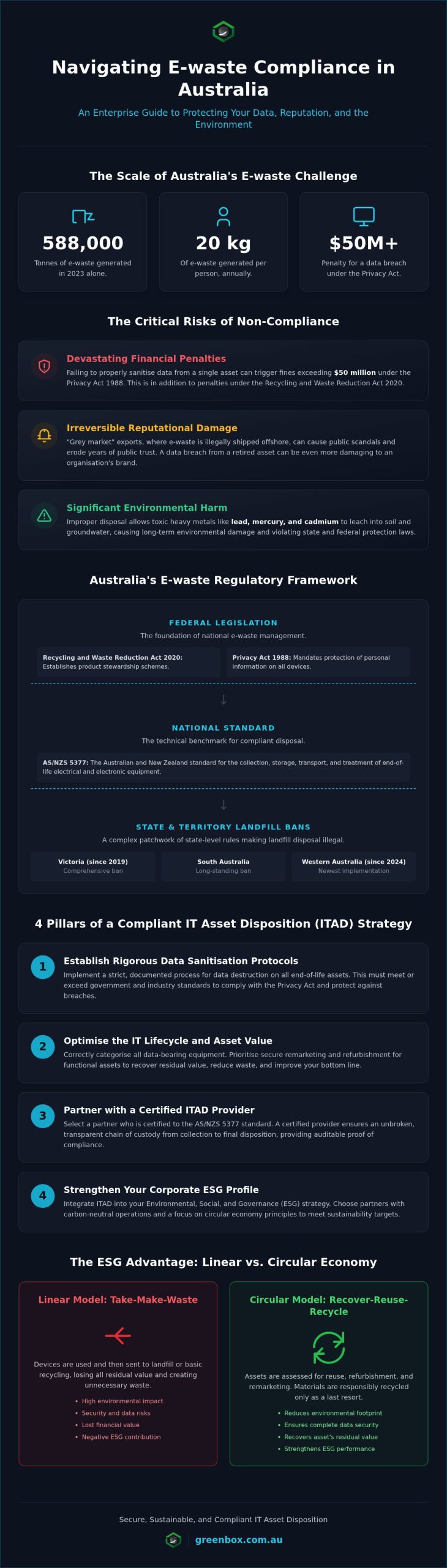
Did you know that failing to properly sanitise data on a single decommissioned laptop could now trigger penalties of $50 million or more under the Privacy Act 1988? As the National Environmental Protection Agency begins its oversight in 2026, the need for airtight e-waste compliance Australia wide has become a non-negotiable priority for every enterprise. With Australians generating approximately 20 kg of electronic waste per person annually, the scale of the challenge is matched only by the severity of the regulatory oversight.
You’re likely finding that retiring IT assets is no longer a simple logistics task. It’s a critical intersection of cybersecurity and corporate responsibility where the cost of an error is measured in both financial loss and damaged public trust. This reference provides the clarity you need to manage these complex transitions with confidence while protecting your organisation’s integrity and meeting rigorous ESG targets.
We’ll break down the technical requirements of AS/NZS 5377, explain the impact of current state-level landfill bans, and outline a strategic framework for selecting an ITAD partner that protects your reputation and your bottom line.
Key Takeaways
- Identify the specific obligations for your organisation under the National Television and Computer Recycling Scheme (NTCRS) and the latest state-level landfill bans.
- Navigate the complexities of e-waste compliance Australia requires by implementing the AS/NZS 5377 standard for secure and sustainable hardware disposal.
- Protect your enterprise from substantial financial and reputational damage by establishing a rigorous data sanitisation protocol for all end-of-life assets.
- Optimise your IT lifecycle strategy by correctly categorising data-bearing equipment and leveraging asset remarketing to recover residual value.
- Strengthen your corporate ESG profile by partnering with carbon-neutral providers that offer transparent, end-to-end chain of custody reporting.
Understanding the E-waste Landscape in Australia
Corporate e-waste in Australia encompasses any electrical or electronic equipment that an organisation no longer requires. This definition extends far beyond damaged hardware; it includes functional devices replaced during lifecycle refreshes, such as servers, laptops, and networking infrastructure. For a comprehensive look at how these materials are managed nationally, Understanding the E-waste Landscape in Australia provides essential context on the evolution of our waste systems and the shift toward regulated product stewardship.
Relying on basic recycling is no longer a viable strategy for modern enterprises. Traditional recyclers often focus solely on material recovery, which leaves significant gaps in security and legal accountability. E-waste compliance is the strict adherence to both environmental protection laws and data security regulations throughout the asset’s disposal lifecycle. Achieving robust e-waste compliance Australia wide requires a rigorous framework to ensure toxic components like lead, mercury, and cadmium don’t leach into the environment. With 588,000 tonnes of e-waste generated in Australia in 2023 alone, the environmental stakes haven’t been higher.
The Legal and Reputational Risks of Non-Compliance
The regulatory environment has shifted from voluntary participation to mandatory accountability. Under the Recycling and Waste Reduction Act 2020, which replaced the Product Stewardship Act 2011, businesses face stringent requirements and significant potential fines for failing to manage end-of-life electronics correctly. Non-compliance doesn’t just result in fines. It opens the door to devastating reputational damage. “Grey market” exports, where e-waste is illegally shipped to developing nations, can lead to public scandals that tarnish a brand for years. Crucially, the Privacy Act 1988 now imposes penalties exceeding $50 million for data breaches, making the physical destruction of hardware a core component of e-waste compliance Australia requires for legal safety.
E-waste as a Pillar of Corporate ESG Strategy
Modern boards now view e-waste management as a key metric for Environmental, Social, and Governance (ESG) performance. Transitioning from a linear “take-make-waste” model to a circular economy approach allows organisations to meet ambitious sustainability targets while reducing operational overheads. Compliant ITAD services facilitate this by prioritising the refurbishment and remarketing of devices over simple shredding. This process extends the life of technology and reduces the demand for raw material extraction, which is vital for preserving natural resources. By integrating carbon-neutral ITAD practices, enterprises can directly offset the environmental footprint of their digital infrastructure while demonstrating a clear commitment to sustainable IT disposal and ethical governance.
The Regulatory Framework for Australian Businesses
The regulatory architecture governing e-waste compliance Australia wide is anchored by the Recycling and Waste Reduction Act 2020. This legislation provides the federal framework for product stewardship, managed directly by the Department of Climate Change, Energy, the Environment and Water (DCCEEW). While the Act places significant responsibility on “liable parties”—typically the manufacturers and importers who must fund recovery schemes—corporate end-users aren’t exempt from scrutiny. Enterprises are responsible for ensuring their retired assets enter authorised streams, particularly as the National Environmental Protection Agency, established in July 2026, begins ramping up enforcement of waste diversion targets.
A primary mechanism for this is the National Television and Computer Recycling Scheme (NTCRS). While the NTCRS provides a baseline for recycling computers and peripherals, large-scale organisations often find that basic scheme participation doesn’t cover the high-security requirements of enterprise-grade hardware. For these entities, compliance involves a dual obligation: meeting environmental recovery rates while simultaneously satisfying the rigorous data protection standards mandated by the Privacy Act.
State-Specific Landfill Bans and Regulations
Navigating the Australian landscape is complicated by varying state laws. Victoria led the way with a comprehensive e-waste landfill ban in 2019, which significantly influenced national policy. Since then, South Australia and Western Australia (which introduced its ban in 2024) have implemented strict prohibitions, with South Australian violations carrying fines of up to $30,000. Managing these variations state-by-state is an administrative burden for national organisations. Adopting a unified national standard for all sites is the only way to mitigate the legal risk of accidental non-compliance in stricter jurisdictions.
Reporting and Documentation Requirements
Robust compliance relies on an immutable audit trail. A “Certificate of Destruction” is the essential document required for any compliance audit, proving that an asset has been processed in accordance with AS/NZS 5377. This documentation must be supported by a transparent chain of custody that tracks the device from the moment it leaves your facility to its final disposition. Integrating certified data sanitisation Australia wide into your workflow ensures that these documents are not just paperwork, but verified proof of both environmental and data security compliance. To simplify this process, many organisations rely on professional ITAD partners to manage the entire reporting lifecycle, providing peace of mind during internal and external audits.
Essential Standards for E-waste Compliance and Data Security
Technical standards provide the only objective method for verifying that an IT asset has been handled correctly once it leaves your facility. Relying on a provider’s promise is insufficient; you need documented proof of rigorous operational protocols. While ISO 14001 establishes a high-level framework for environmental management, it doesn’t offer the granular technical requirements necessary for handling complex electronics. True e-waste compliance Australia wide depends on specific industry certifications that govern the entire downstream chain of custody, ensuring that materials are recovered responsibly and data is destroyed permanently.
These standards act as a safeguard for your organisation. They bridge the gap between high-level policy and shop-floor execution. By requiring partners to maintain specific certifications, you ensure that your decommissioned hardware isn’t merely shifted to a different location, but is processed through a audited system designed to maximise material recovery and eliminate security vulnerabilities.
AS/NZS 5377: The Australian Benchmark
AS/NZS 5377 is the definitive standard for the collection, transport, and treatment of electrical and electronic equipment in Australia and New Zealand. It sets out strict requirements for the safe storage of hazardous components, preventing the leakage of toxic substances during transit. The standard mandates specific recovery targets, prioritising the extraction of valuable materials and energy over landfill disposal. Adherence to AS/NZS 5377 serves as a legally defensible shield, protecting businesses from the severe liabilities associated with illegal e-waste dumping or improper downstream handling. It ensures that every stage of the recycling process meets Australian environmental expectations and safety regulations.
R2 Certification: Beyond Local Requirements
For enterprises managing sensitive data, R2 (Responsible Recycling) certification is the global gold standard. The latest version, R2v3, places a heavy emphasis on logical and physical data destruction, making it the preferred choice for sectors with high security requirements. This certification is particularly vital because it enforces strict controls on where materials end up. R2 ensures no e-waste is illegally exported to developing nations, where primitive processing methods cause significant environmental and human health crises. Maintaining R2 status requires a rigorous, ongoing auditing process that examines every link in the recycler’s downstream chain. This level of transparency provides the certainty that your retired assets won’t reappear in a “grey market” scandal or a data breach report years after they’ve been decommissioned.
Building a Compliant E-waste Management Strategy
Establishing a robust strategy for e-waste compliance Australia wide requires moving beyond reactive disposal toward a structured lifecycle management approach. This begins with a thorough audit of your current IT asset inventory to identify exactly what is reaching end-of-life. You must categorise these items into data-bearing assets, such as servers and solid-state drives, and non-data-bearing assets like cables or monitors. This classification dictates the level of security required during the initial collection phase. Implementing a secure on-site collection protocol, using locked bins and restricted access areas, ensures that sensitive hardware doesn’t go missing before it leaves your facility. A structured approach to e-waste compliance Australia demands ensures that no step in the lifecycle is left to chance.
Logistics remain a common point of failure for many enterprises. Vetting third-party logistics (3PL) providers is essential to maintain a secure chain of custody. You should verify that transport vehicles are GPS-tracked and that all personnel have undergone appropriate background checks. This meticulous planning removes the operational burden from your internal teams while guaranteeing that every device is accounted for from the moment it leaves your loading dock until its final disposition. Reliable logistics provide the peace of mind that your data remains protected during every kilometre of the journey.
Selecting a Certified ITAD Partner
Choosing the right partner is the most critical decision in your compliance journey. You must demand proof of certifications including R2v3, ISO 14001, and AS/NZS 5377 to ensure the highest levels of environmental and data security. A capable partner will provide advanced data sanitisation services that meet or exceed NIST 800-88 standards. For a deeper look at how these processes work in practice, explore our insights on sustainable IT asset recovery. This level of technical vetting protects your organisation from the legal risks and reputational damage associated with improper disposal methods.
The Financial Benefits of Compliant Disposal
Compliance is often viewed as a cost centre, yet a strategic approach unlocks significant financial value. Asset remarketing allows organisations to recover residual value from functional hardware, often offsetting the entire cost of the recycling process. Additionally, rigorous tracking prevents “ghost assets” from remaining on your balance sheet, which avoids unnecessary insurance premiums and software licensing fees. By prioritising secure refurbishment and resale, you transform a waste challenge into a sustainable recovery model that supports your bottom line. To begin optimising your asset lifecycle and capturing this value, consider partnering with Greenbox ITAD services for a transparent and secure transition.
Future-Proofing Compliance with Greenbox ITAD Solutions
Greenbox delivers a national, end-to-end framework specifically engineered to simplify the intricate web of Australian e-waste laws. By centralising all asset recovery and recycling activities through a single, authoritative partner, organisations eliminate the fragmented oversight that often leads to compliance gaps. Our facilities operate with R2 certification, ensuring every stage of the process meets the highest global standards for safety and security. Real-time visibility is provided through secure asset tracking portals, allowing your team to monitor the status of every device from initial collection through to its final disposition. This level of transparency is essential for maintaining e-waste compliance Australia wide, providing a verified audit trail that satisfies both internal governance and external regulators.
Managing complex transitions requires a partner that understands the high-stakes nature of data security and logistics. Our framework removes the operational burden from your IT and procurement teams by handling every logistical detail with precision. Whether you are managing a single-site refresh or a national rollout, our steady, experienced hand ensures that your assets are protected and your legal obligations are met without compromise. We bridge the gap between technical excellence and ecological stewardship, ensuring your retired hardware is managed with the discipline it deserves. For a forward-looking perspective on how leading organisations are approaching these challenges, our guide to sustainable IT disposal enterprise trends and frameworks for 2026 outlines the strategies shaping the industry.
Carbon Neutral IT Asset Disposition
As a carbon-neutral organisation, Greenbox provides a distinct advantage for enterprises striving to meet ambitious ESG and carbon-neutral targets. We offset the carbon footprint associated with the logistics and processing of your retired IT assets, turning a standard operational task into a measurable sustainability win. Our clients receive detailed environmental impact reports that translate recycling and recovery activities into concrete data for annual corporate reviews. This synergy between high-security data destruction and zero-landfill goals ensures that your environmental stewardship never comes at the expense of your data security. We treat sustainability as a core business metric rather than an afterthought, helping you achieve maximum efficiency in your green initiatives.
Transparent Reporting and Chain of Custody
The Greenbox approach is built on meticulous item-level tracking and rigorous certification. Every asset is scanned and logged upon collection, establishing an unbreakable chain of custody that persists through sanitisation and material recovery. This granular level of detail ensures every single asset is accounted for, providing the documentation required to mitigate legal and reputational risks. Our reporting provides the empirical evidence needed to prove your commitment to ethical standards and regulatory requirements. To secure your organisation’s future and streamline your disposal processes, enquire about a compliant ITAD framework for your organisation today.
Securing Your Corporate Legacy through Strategic ITAD
Achieving total e-waste compliance Australia wide is a multifaceted commitment that demands rigorous attention to both environmental stewardship and data security. As we’ve explored, navigating the intersection of federal legislation and state-level landfill bans requires a structured approach that prioritises certified standards like AS/NZS 5377 and R2v3. By transitioning from simple disposal to a strategic recovery model, your organisation doesn’t just mitigate legal risk; it also unlocks residual value and strengthens its ESG profile.
Managing these high-stakes transitions is simpler when you have a disciplined partner capable of providing an end-to-end chain of custody. With R2-certified facilities nationwide and a status as a certified carbon-neutral organisation, Greenbox offers the technical expertise required to meet the most stringent government and enterprise security standards. We ensure that every asset is accounted for and every data-bearing device is sanitised with absolute precision. It’s time to transform your decommissioned hardware from a liability into a benchmark of corporate responsibility.
Partner with Greenbox for certified, carbon-neutral e-waste compliance and lead your organisation toward a more secure, sustainable future.
Frequently Asked Questions
What is the National Television and Computer Recycling Scheme (NTCRS)?
The National Television and Computer Recycling Scheme (NTCRS) is a federal product stewardship program that requires manufacturers and importers to fund the collection and recycling of electronic waste. Established under the Recycling and Waste Reduction Act 2020, it ensures that a significant portion of hardware is diverted from landfills. While it provides a baseline for recycling computers and peripherals, enterprises often require more specialised services to meet the higher security and reporting standards necessary for corporate data protection.
Is e-waste disposal mandatory for businesses in Australia?
Yes, e-waste disposal is effectively mandatory for Australian businesses due to a combination of state-specific landfill bans and federal environmental legislation. In jurisdictions like Victoria and Western Australia, it’s illegal to send electronics to landfill. Additionally, the Privacy Act 1988 mandates the secure destruction of personal information stored on hardware, making compliant disposal a legal necessity. Failing to meet these obligations can result in severe financial penalties and significant reputational damage.
What is the difference between e-waste recycling and ITAD?
E-waste recycling focuses primarily on the breakdown of devices into raw materials like plastic and metal. In contrast, IT Asset Disposition (ITAD) is a comprehensive lifecycle management service that includes secure data sanitisation, hardware refurbishment, and asset remarketing. While recycling is a single step, ITAD ensures end-to-end chain of custody, maximising the residual value of equipment while maintaining the highest levels of security and e-waste compliance Australia requires for enterprise-grade hardware.
How does AS/NZS 5377 protect my corporate data?
AS/NZS 5377 is the official Australian and New Zealand standard for the collection, storage, and treatment of electrical equipment. While it defines environmental recovery targets, it also sets out rigorous protocols for the secure handling and destruction of data-bearing components. By adhering to this standard, businesses ensure that their decommissioned hardware is managed through an audited process that prevents unauthorised access to sensitive information during the logistics and recycling phases.
Can my business be fined for improper e-waste disposal?
Your business can face substantial fines for improper disposal. Under state laws, such as those in South Australia, violations of landfill bans can lead to penalties of up to $30,000. More critically, if a discarded device leads to a data breach because it wasn’t properly sanitised, penalties under the Privacy Act 1988 can exceed $50 million. These financial risks make it essential to partner with a certified provider that offers documented proof of compliant disposal.
What should be included in a Certificate of Destruction?
A Certificate of Destruction should include specific details that provide a complete audit trail for each asset. This typically encompasses the device’s serial number, the date and method of destruction, and a formal declaration of compliance with standards like NIST 800-88 or AS/NZS 5377. This document serves as your primary evidence during a compliance audit, proving that data-bearing components were sanitised and that the hardware was processed through an environmentally responsible stream.
How do state-specific landfill bans affect my national operations?
State-specific landfill bans create a fragmented regulatory landscape that can complicate national logistics. Victoria, South Australia, and Western Australia have implemented strict bans, while other regions may have different requirements. For national organisations, the safest and most efficient strategy is to adopt a single, high-standard compliance framework across all sites. This unified approach eliminates the risk of accidental non-compliance in stricter jurisdictions and simplifies the internal management of end-of-life IT assets.
Why is R2 certification important for Australian enterprises?
R2 certification is the global benchmark for responsible recycling and secure data destruction. For Australian enterprises, it provides the assurance that an ITAD partner has been rigorously audited for environmental safety, worker health, and data security. R2v3 specifically focuses on downstream accountability, ensuring that your retired hardware isn’t illegally exported or handled by unverified third parties. This certification is a critical component of achieving the robust e-waste compliance Australia demands for modern corporate governance.