

Is your retired hardware a liability waiting to happen, or is it the untapped key to your organisation’s 2026 sustainability targets? For most Australian enterprises, the traditional approach to decommissioning technology has become a significant source of anxiety. You’re likely balancing the constant threat of data breaches against the mounting pressure to report on Scope 3 emissions and e-waste diversion. It’s a complex landscape where meeting R2v3 and NIST 800-88 standards often feels like a moving target.
We understand that sustainable IT disposal shouldn’t be an operational burden that compromises your security. This article explores how leading organisations are integrating rigorous data sanitisation with circular economy principles to achieve verified carbon-neutral outcomes. You’ll discover how to transform retired assets into recovered capital through strategic remarketing while ensuring every drive is wiped with absolute precision. We’ll preview the frameworks that will define IT asset disposition in 2026, from automated environmental reporting to the financial benefits of a circular lifecycle. By the end of this guide, you’ll have a clear roadmap for a secure, certified, and fiscally responsible disposal process.
Key Takeaways
- Shift from traditional waste management to a circular economy model that maximises asset value and reduces environmental impact.
- Protect your organisation’s reputation by integrating NIST-standard data sanitisation as the non-negotiable first step of your decommissioning process.
- Optimise your budget by leveraging asset remarketing to fund new technology deployments through recovered capital.
- Establish a compliant, national strategy for sustainable IT disposal using a structured five-step framework designed for 2026 standards.
- Streamline your sustainability reporting with verified carbon-neutral ITAD services that simplify the complexities of Scope 3 emission tracking.
The Evolution of Sustainable IT Disposal in Australia
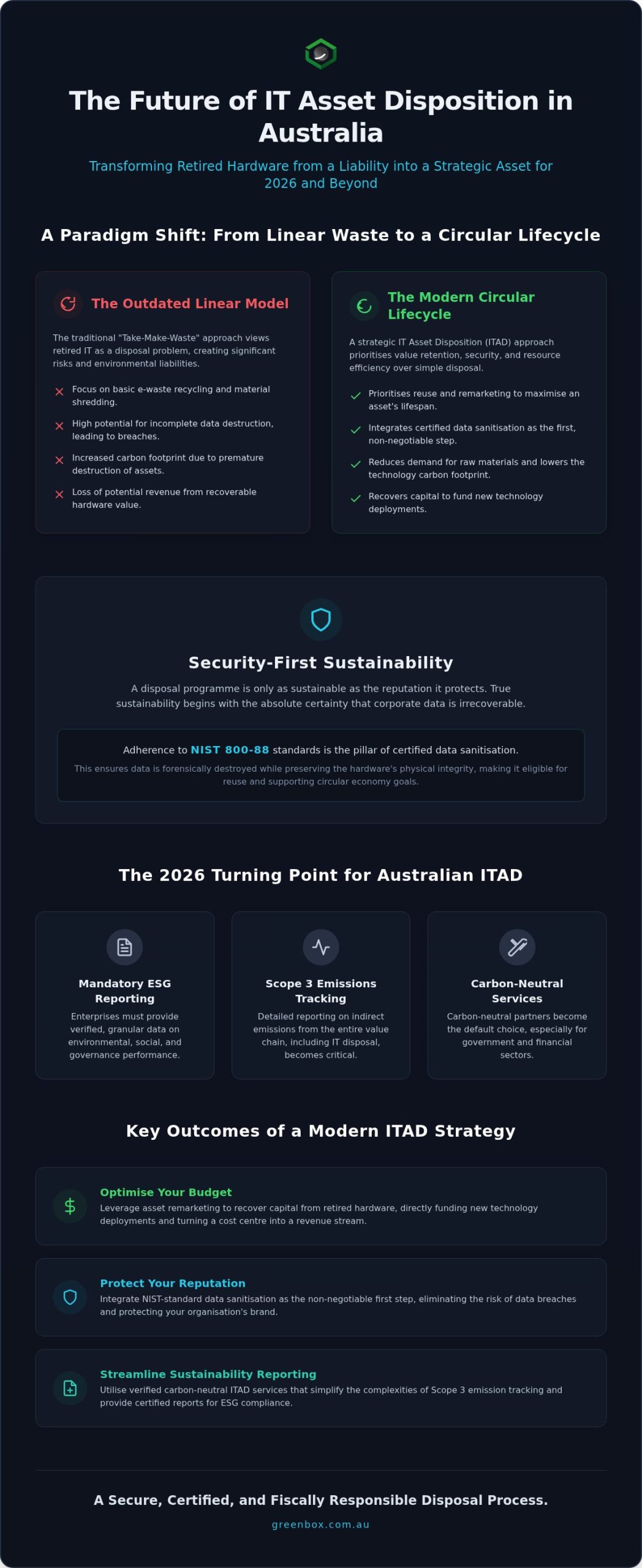
The concept of sustainable IT disposal has shifted from a back-office waste problem to a boardroom strategic priority. In the past, Australian enterprises often viewed disposal as a simple logistics exercise: get the old gear out and ensure it’s recycled. Today, the definition has expanded. True sustainability now requires the seamless integration of high-level data sanitisation with circular economy principles. It’s a move away from the traditional e-waste model, which often prioritises material recovery through shredding, toward IT Asset Disposition (ITAD), which prioritises the continued utility of the device itself.
Modern ITAD bridges the gap between technical security and environmental stewardship. While traditional recycling focus on breaking down materials, a sustainable approach seeks to preserve the energy and resources already embedded in the hardware. This transition reflects a deeper understanding of technology lifecycles, where the goal is to keep assets functional for as long as possible before they reach their end-of-life stage.
From Linear Waste to Circular Lifecycle
The outdated “Take-Make-Waste” model has become a significant liability for modern businesses. It’s no longer acceptable to simply dispose of hardware when its primary lease ends. Instead, lifecycle management focuses on extending the operational utility of every laptop, server, and mobile device. This approach keeps assets in use for as long as possible, reducing the demand for raw materials and lowering the carbon footprint of the technology stack. Implementing sustainable IT asset recovery allows organisations to meet their Corporate Social Responsibility (CSR) goals while maintaining the highest levels of security.
Why 2026 is a Turning Point for ITAD
As we approach 2026, the Australian regulatory environment is undergoing a fundamental transformation. Mandatory ESG reporting is no longer a distant requirement; it’s a core business metric that demands granular transparency. Enterprises are now expected to provide verified data on their Scope 3 emissions and e-waste diversion rates. This shift has made carbon-neutral service providers the default choice for government and financial sectors. Reliability in reporting is now just as critical as reliability in data destruction.
The priorities have changed. While recycling remains a necessary final step, “reuse” is now the primary objective. This ensures that functional technology doesn’t end up in a landfill prematurely. In the context of IT, the circular economy is a systemic approach to technology management that prioritises value retention and resource efficiency over disposal and replacement.
- Asset remarketing provides a second life for hardware in secondary markets, offsetting the cost of new deployments.
- Certified data destruction ensures that security is never sacrificed for environmental goals.
- Carbon-neutral logistics minimise the impact of the transition process itself, aligning with national net-zero targets.
Security-First Sustainability: Why Data Protection Comes First
An IT disposal programme is only as sustainable as the reputation it protects. While the environmental focus often rests on landfill diversion, a data breach represents a catastrophic failure of governance. It’s a failure that carries its own environmental and operational toll. Remediating a breach requires energy-intensive forensic audits, massive legal paper trails, and the potential replacement of compromised infrastructure. For a modern enterprise, sustainable IT disposal must begin with the absolute certainty that corporate data is irrecoverable.
Adhering to NIST 800-88 standards ensures that data is destroyed while preserving the physical integrity of the device. This is a critical pillar of certified data sanitisation Australia. When hardware is kept intact through software-based sanitisation, it remains eligible for a second life. This directly supports circular economy goals by avoiding the energy-intensive process of smelting shredded materials. Security and sustainability are not competing interests; they are mutually reinforcing goals.
The Risk of Incomplete Data Destruction
Misconceptions about “wiping” drives often lead to significant risk. Simple formatting or factory resets are not sufficient for forensic-level security. Software-based sanitisation is the preferred method for sustainable IT disposal because it allows for reuse without the waste generated by physical shredding. However, this process must be backed by a verifiable Certificate of Destruction. This document serves as the final audit trail, providing peace of mind that the chain of custody remained unbroken from the moment the device left your facility.
R2v3 Certification: The Gold Standard for 2026
By 2026, R2v3 certification will be the non-negotiable benchmark for transparency. This standard demands that providers prove exactly where every component ends up, preventing e-waste from being dumped in unauthorised landfills. It ensures downstream accountability across the entire supply chain. For sectors with extreme risk profiles, such as ITAD for financial services Australia, this level of rigor is essential. Partnering with an expert in carbon-neutral ITAD allows your organisation to mitigate risk while meeting the highest ethical standards. This structured approach ensures that your technical success and responsible practices are inseparable.
Asset Remarketing: Driving ROI Through Sustainability
Asset remarketing serves as the financial engine of a high-performance sustainable IT disposal strategy. It transforms what was once an operational expense into a strategic source of capital. For Australian enterprises, this “Value Recovery” model allows the proceeds from retired hardware to directly fund new technology rollouts. By 2026, the most successful organisations won’t just be disposing of hardware; they’ll be managing a secondary asset portfolio that offsets the total cost of ownership.
The logistics of this process are meticulous. Before any device enters the secondary market, it undergoes a rigorous refurbishment phase. This includes deep cleaning, hardware testing, and imaging to ensure the equipment meets professional standards. Remarketing commissions align the interests of the client and the ITAD provider perfectly. Both parties are incentivised to achieve the highest possible resale price, ensuring that the enterprise receives maximum value for its legacy investments.
Maximising Resale Value Securely
Timing is the most critical factor in value recovery. Decommissioning assets while they still possess significant processing power allows for a much higher return on investment. By 2026, market demand for “second-life” enterprise hardware like high-spec laptops and servers will continue to grow. Organisations that plan their refreshes around these market peaks can often recover a substantial portion of their initial outlay. However, this resale must never compromise brand protection. Every device must be stripped of corporate identifiers and undergo certified sanitisation before it’s released, ensuring that your security posture remains as robust in the secondary market as it was in your own data centre.
Remarketing vs. Recycling: A Trend Analysis
The environmental case for remarketing is as compelling as the financial one. Manufacturing a single new laptop requires significant energy and raw material extraction. In contrast, refurbishing an existing unit for a second life preserves the carbon already “spent” during its initial production. This extension of the device’s utility directly supports a business’s Scope 3 emission targets by reducing the need for new equipment manufacturing in the broader supply chain. From a financial perspective, asset recovery often completely offsets the costs associated with logistics and secure data destruction. This creates a self-sustaining cycle where responsible environmental practice pays for itself through recovered capital.
Building a Compliant E-waste Management Framework
Implementing a national sustainable IT disposal strategy requires more than just a collection schedule. It demands a structured, five-step framework that ensures every asset is accounted for from decommissioning to final disposition. By 2026, the complexity of corporate hardware will require a methodical approach to maintain security and environmental integrity across multiple sites.
A robust framework follows a logical progression of security and sustainability:
- Step 1: Audit and Inventory. Create a definitive register of all data-bearing devices, including serial numbers and current physical locations, before any hardware moves.
- Step 2: Logistics and Chain of Custody. Arrange for secure, tracked transport that maintains a documented line of responsibility from your office to the processing facility.
- Step 3: Sanitisation. Apply the appropriate NIST-standard method for each asset type, ensuring that software-based wiping is used whenever reuse is a possibility.
- Step 4: Disposition. Filter assets based on their condition, directing viable hardware to remarketing channels and end-of-life units to certified recycling.
- Step 5: Reporting and Verification. Issue final certificates of destruction and environmental impact statements to satisfy ESG and internal audit requirements.
Navigating National E-waste Compliance
State-based variations in regulation can create significant hurdles for organisations operating across Australia. Understanding the specific e-waste compliance Australia requirements is essential for maintaining your social licence to operate. This includes participating in Product Stewardship Schemes and meeting zero-waste-to-landfill targets that are increasingly mandated by government procurement policies. Accurate reporting on these metrics isn’t just a compliance task; it’s a core component of your 2026 corporate responsibility profile.
Logistics and Secure Chain of Custody
Managing bulk collections across a national footprint introduces significant risk if not handled by a specialist. High-risk data assets require more than a standard courier. They need secure transit solutions that include GPS tracking and tamper-evident seals to prevent unauthorised access during movement. A single national provider simplifies this process, offering a uniform standard of security and reporting regardless of where your offices are located. This consistency is the only way to ensure your sustainable IT disposal programme remains audit-ready at all times. If your current logistics feel fragmented, it’s time to partner with an ITAD strategist who can provide a seamless, nationwide solution.
Greenbox: Leading Australia’s Carbon-Neutral ITAD Future
Greenbox stands as the steady hand for Australian organisations navigating the complexities of modern technology lifecycles. We provide more than just a disposal service; we offer a comprehensive partnership that spans the entire life of an asset. From initial pre-configuration and imaging during deployment to secure sustainable IT disposal at the end of use, our end-to-end approach ensures that every transition is handled with meticulous planning. This holistic view of asset management allows our clients to maintain peak operational efficiency while meeting the most stringent ethical and environmental standards.
Our status as a carbon-neutral organisation is a core business metric, not an afterthought. By partnering with us, enterprises can directly contribute to their own sustainability targets, simplifying the often-complex tracking of Scope 3 emissions. We manage the logistics, the security, and the environmental outcomes, removing the operational burdens that often stall large-scale technology refreshes. It’s a pragmatic solution for a high-stakes environment.
The Greenbox Advantage
Precision is the hallmark of our data sanitisation process. We utilise methods that exceed global benchmarks, ensuring that every drive is handled with the rigor required by the government and financial sectors. Our R2-certified facilities across Australia provide a 100% compliant pathway for e-waste processing, backed by transparent reporting and detailed asset tracking. When you receive a certificate from Greenbox, you’re receiving verified proof that your assets were managed with total integrity. This level of visibility is essential for maintaining a secure chain of custody and meeting your internal audit requirements.
Partnering for a Sustainable Tomorrow
We specialise in customised solutions tailored to the unique requirements of government departments, educational institutions, and large-scale enterprises. This sector-specific expertise ensures that we understand the regulatory pressures and security risks you face daily. The peace of mind provided by a secure, carbon-neutral partnership allows your IT team to focus on innovation rather than disposition. Securing the future of your organisation requires a partner who treats data security and environmental stewardship as inseparable goals. Discover how Greenbox can optimise your IT asset lifecycle today.
Securing Your Organisation’s 2026 Technology Legacy
As Australian enterprises transition toward 2026, the integration of data security and environmental stewardship is no longer optional. It’s a core business metric. You’ve seen how rigorous NIST 800-88 sanitisation protects your reputation while enabling hardware reuse, and how asset remarketing transforms disposal into a value-recovery strategy. By adopting a structured framework, your organisation can navigate complex e-waste regulations with total transparency and confidence.
Achieving sustainable IT disposal requires a partner who understands that technical excellence and ecological responsibility are inseparable. From R2-certified facilities to verified carbon-neutral reporting, every step of the process must be handled with precision. This proactive approach doesn’t just mitigate risk; it builds a foundation for long-term fiscal and environmental success. It’s time to remove the operational burden of decommissioning and focus on your next phase of growth.
Partner with Greenbox for Carbon-Neutral ITAD and secure the peace of mind that comes with a certified, end-to-end solution. We’re ready to help you lead the way in responsible technology management.
Frequently Asked Questions
What is sustainable IT disposal for businesses?
Sustainable IT disposal for businesses is the strategic integration of certified data sanitisation with circular economy principles to manage end-of-life hardware. Rather than simply discarding old gear, this approach prioritises asset recovery and reuse to minimise environmental impact. It ensures that every device is handled through a secure chain of custody, protecting corporate reputation while meeting modern sustainability targets. This method transforms technology management from a waste problem into a resource-efficient lifecycle.
How does ITAD differ from standard e-waste recycling?
IT Asset Disposition (ITAD) is a comprehensive lifecycle management service, whereas standard e-waste recycling is typically limited to material recovery. ITAD includes secure logistics, NIST-standard data destruction, and asset remarketing to recover capital. Recycling usually involves shredding devices to extract raw materials like gold or copper. By choosing ITAD, Australian enterprises ensure their hardware is assessed for potential reuse before being committed to the final recycling stage.
Is software-based data sanitisation as secure as physical shredding?
Software-based sanitisation is exceptionally secure when performed to NIST 800-88 standards. It overwrites data at the binary level, making it forensic-level irrecoverable while keeping the physical hardware intact for a second life. Unlike physical shredding, which destroys the asset’s utility and increases waste, software wiping supports a circular economy. This makes it the preferred choice for sustainable IT disposal, as it allows functional technology to be refurbished and resold securely.
What certifications should a sustainable IT disposal provider have?
A reputable provider should hold R2 certification, which is the global benchmark for responsible electronics recycling and data security. For 2026 compliance, verify that facilities are updated to the R2v3 standard. Additionally, look for carbon-neutral organisation status and expertise in NIST 800-88 sanitisation protocols. These credentials ensure that your provider meets the rigorous transparency and accountability requirements expected by government and financial sectors across Australia.
Can my business actually make money from old IT equipment?
Your organisation can certainly recover capital through asset remarketing. When hardware like laptops, servers, or mobile devices are decommissioned while they still have market value, they can be refurbished and resold. The provider typically manages the entire sales process and retains a commission, returning the remaining proceeds to your business. This recovered capital can significantly offset the costs of logistics and secure data sanitisation for your entire fleet.
How does sustainable IT disposal help with ESG reporting?
Sustainable IT disposal provides the verified data needed for accurate Scope 3 emission reporting and e-waste diversion metrics. By partnering with a carbon-neutral provider, you can include their certified environmental impact statements in your annual ESG disclosures. This level of transparency demonstrates a commitment to zero-waste-to-landfill targets and responsible resource management. It simplifies the reporting process by providing a clear, audit-ready trail of every asset’s final outcome.
What happens to IT equipment that cannot be refurbished?
Equipment that has reached the absolute end of its functional life is processed through environmentally compliant e-waste recycling. At R2-certified facilities, these assets are carefully dismantled to recover precious metals and base materials for reuse in new manufacturing. This ensures that even non-functional technology contributes to the circular economy rather than ending up in a landfill. The process is fully documented, providing your organisation with a final certificate of recycling for compliance.
Does Greenbox offer services for residential e-waste?
Greenbox does not offer residential e-waste drop-off or consumer electronics retail services. Our operations are strictly focused on providing high-level ITAD and lifecycle management for government departments, educational institutions, and large-scale enterprises. We specialise in managing bulk collections and complex data security requirements that residential services aren’t equipped to handle. For household e-waste, we recommend checking with your local council for their specific community recycling programmes.