

Could a single logo on a service provider’s website be the only thing protecting your enterprise from a catastrophic data breach? For many Australian IT leaders, the search for a reliable R2 certified ITAD provider often feels like a choice between blind trust and endless manual auditing. You’re right to feel cautious about the high stakes involved in asset disposal. Between the threat of reputation damage from data leaks and the growing pressure to hit corporate ESG targets, the margin for error has never been smaller. We recognise that managing these complex transitions requires a steady, experienced hand to ensure nothing is left to chance.
This article provides the clarity you need to separate marketing claims from the rigorous security benchmarks that actually matter. We’ll outline a clear framework for evaluating your ITAD partners to ensure full compliance with Australian privacy laws. You’ll discover how to secure your data, meet your carbon-neutral goals, and achieve maximum value recovery for your retired hardware. By the end of this guide, you’ll understand why R2 certification is the essential benchmark for Australian enterprise IT and how to manage your assets with absolute confidence.
Key Takeaways
- Understand why R2 certification serves as the essential global benchmark for electronics security and sustainability within the Australian enterprise sector.
- Distinguish between simple compliance claims and the rigorous, auditable verification required to be a truly R2 certified ITAD provider.
- Learn why the hierarchy of reuse and advanced software-based data sanitisation often provide superior security and environmental outcomes compared to physical shredding.
- Master a practical framework for auditing downstream recyclers to ensure your data and brand equity remain protected throughout the entire asset lifecycle.
- Discover how to align your IT asset recovery processes with corporate ESG targets by integrating carbon-neutral services into your operational strategy.
Beyond the Badge: Why R2 Certification is Non-Negotiable for Australian ITAD
R2 (Responsible Recycling) is the pre-eminent global standard governing the sustainable and secure management of electronic equipment. While many local businesses offer e-waste disposal, generic recycling is fundamentally insufficient for modern enterprise hardware. These devices contain sensitive intellectual property and personal data that require more than just a physical breakdown. Engaging an R2 certified ITAD provider ensures that your assets are managed through a rigorous, auditable process that prioritises data security and environmental responsibility over simple scrap recovery.
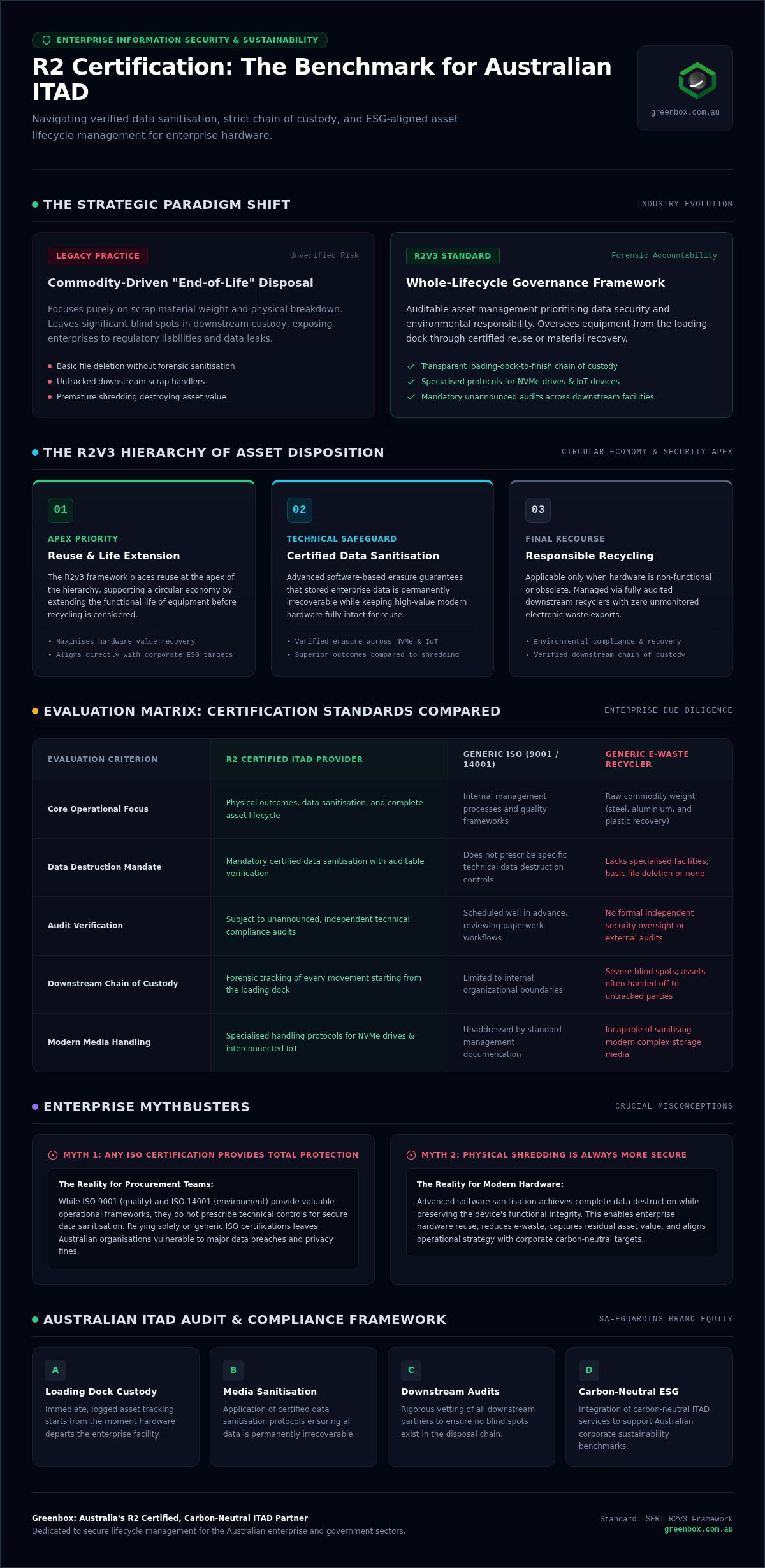
By 2026, the industry has shifted decisively from “end-of-life” disposal toward a “whole-lifecycle” management model. This transition reflects a sophisticated understanding of asset value and risk. Central to this is the requirement for a Certified Data Sanitisation process. This ensures that every data-bearing device is treated with precision, moving beyond basic deletion to verified erasure. It’s no longer enough to simply dispose of hardware; you must manage its entire transition with a steady, experienced hand.
What Does an R2 Certified ITAD Provider Actually Do?
An R2 certified partner operates under the R2v3 standard, which mandates strict controls on data security and environmental integrity. This involves a transparent “Chain of Custody” that begins the moment an asset leaves your loading dock. Every movement is tracked, and every process is documented to prevent data leakage or environmental mismanagement. This level of forensic detail is why R2 is the preferred standard for the Australian government sector and other highly regulated industries. It provides a level of assurance that generic providers cannot match, particularly when applying various data sanitization methods to ensure information is permanently irrecoverable.
The Evolution from R2v3 to Modern Lifecycle Requirements
The R2v3 standard has evolved to address the complexities of modern hardware, including high-speed NVMe drives and interconnected IoT devices. These components require specialised handling that older standards didn’t anticipate. The modern framework places “Reuse” at the apex of the hierarchy, supporting a circular economy by extending the functional life of equipment before recycling is even considered. R2v3 is the most rigorous framework for IT asset disposition in 2026. This evolution ensures that your organisation meets its ESG targets while maintaining a secure, end-to-end management path for every retired device.
Myth #1: ‘All ITAD Certifications Offer the Same Level of Protection’
A common misconception among procurement teams is that any ISO badge provides sufficient coverage for data security. This is a dangerous oversimplification. While ISO 9001 (quality) and ISO 14001 (environment) are valuable management frameworks, they don’t prescribe the specific technical controls required for secure data destruction. Using a local rubbish removalist who claims to handle “e-waste” might satisfy a basic recycling need, but it leaves your enterprise exposed to significant data liability and potential regulatory fines.
The gap between a general recycler and an R2 certified ITAD provider is defined by accountability. Generic recyclers often focus on the commodity value of the materials, such as the weight of the steel or plastic. They may lack the sophisticated facilities needed to sanitise modern storage media. Without the rigorous oversight of the R2 standard, your retired assets could easily end up in a downstream facility that lacks any formal security protocols, creating a blind spot in your chain of custody.
R2 vs. Generic ISO Standards: A Critical Comparison
ISO standards focus on the process of management, whereas the SERI R2 Standard focuses on the physical outcomes of the asset. This distinction is vital for risk mitigation. R2 mandates specific technical requirements for data sanitisation and environmental integrity that generic certifications ignore. One of the most critical differences is the role of unannounced audits. While ISO audits are typically scheduled well in advance, R2 facilities must be ready for inspection at any moment. This ensures that high standards are a daily operational reality rather than a temporary performance for an auditor. R2 also addresses the “downstream vendor” problem by requiring providers to track every component until it reaches its final destination, a level of visibility ISO does not provide.
The Hidden Danger of ‘Self-Certified’ Providers
There’s a massive legal gulf between being “compliant” and being “certified.” Anyone can claim their processes are EPA-compliant, but without a third-party certificate, these are merely unsubstantiated promises. Relying on a vendor’s word creates a significant gap in your risk management strategy. In a high-stakes audit, self-certification is effectively meaningless because it lacks independent verification. Navigating e-waste compliance in Australia requires verifiable proof of destruction to satisfy both privacy laws and environmental regulations. If your partner cannot provide a current R2 certificate from an accredited body, your organisation bears the ultimate responsibility for any subsequent data leak or illegal dumping. You can review our certification status to see how we maintain these rigorous benchmarks across all our facilities.
Myth #2: ‘Physical Shredding is Always More Secure than Data Sanitisation’
Many organisations default to physical destruction because it feels final. It’s a visual confirmation of security. However, this “shred everything” approach is often a blunt instrument that ignores the precision of modern data management. An R2 certified ITAD provider understands that software-based sanitisation is frequently more secure and significantly more sustainable. Shredding perfectly functional enterprise hardware creates unnecessary e-waste and destroys latent financial value that could otherwise support your budget.
The Security Logic of Software-Based Sanitisation
Software-based sanitisation, including purging or clearing, follows strict protocols like the NIST 800-88 guidelines. These methods ensure data is irrecoverable even by advanced forensic laboratory techniques. In contrast, physical shredding can be flawed; if the shred size is too large, data-bearing chips can survive the process intact. The SERI R2 standard mandates that every individual serial number receives a verifiable Certificate of Sanitisation. This provides a digital audit trail that physical scrap simply cannot offer. Adopting sustainable IT disposal practices ensures your data security doesn’t come at the cost of your ESG targets.
Remarketing vs. Recycling: Maximising Asset Value Recovery
Moving toward a circular economy allows your business to recoup significant costs. R2-certified providers focus on the hierarchy of reuse, refurbishing assets to extend their functional life. This isn’t just about environmental stewardship; it’s a pragmatic financial strategy. Treating corporate IT asset recovery as a potential profit-centre rather than a cost-centre allows you to maximise the return on your initial hardware investment. This end-to-end approach removes the operational burden of disposal while injecting value back into your IT budget.
How to Audit an R2 Certified ITAD Provider in the Australian Market
Identifying a legitimate R2 certified ITAD provider requires a methodical approach that goes beyond reviewing a website footer. Your first step should always be a direct verification through the official SERI directory. This database is the only authoritative source to confirm that a specific facility’s certification is current and valid. Once you’ve confirmed their status, you should evaluate the depth of their reporting. A reliable partner provides a secure client portal that offers real-time visibility into the status of every asset. This level of transparency ensures that your environmentally compliant IT disposal practices are supported by auditable data rather than mere assertions.
You should also scrutinise the provider’s own carbon footprint and sustainability metrics. In 2026, enterprise ESG reporting requires precise figures on the emissions generated during the logistics and processing of retired hardware. Ask potential partners for their specific carbon-neutral certifications and how they calculate the environmental impact of their services. A provider who can’t provide these metrics is likely creating a gap in your own corporate responsibility reporting.
Verifying Downstream Vendor Transparency
An R2 certified partner’s responsibility doesn’t end at their loading dock. They’re required to track every asset until it reaches its “final disposition”, which could be a verified reuse channel or a specialised smelter for material recovery. This rigorous tracking is your best protection against the risk of illegal e-waste export. If your hardware is found in an unregulated overseas landfill, your brand will face the consequences regardless of your vendor’s promises. When you review a “Downstream Vendor” audit report, you should see a clear, unbroken map of the asset’s journey. This document confirms that every component has been handled by a facility that meets R2 standards for safety and environmental integrity.
Aligning ITAD with the Australian Privacy Act
The Australian Privacy Act and the Notifiable Data Breaches (NDB) scheme have made vendor oversight a critical legal priority. Your organisation remains responsible for personal information even after it has been handed over to a third party for disposal. If a recycler fails to secure your data, your business is the one that will face an OAIC investigation and potential fines. An R2 certified provider mitigates this risk by following standardised, high-security protocols that are designed to withstand regulatory scrutiny. You must ensure that your partner issues a formal document for every disposal event. In the Australian legal context, a ‘Certificate of Destruction’ is a mandatory requirement to prove that you’ve met your statutory obligations for data protection. Contact our team today to review our comprehensive reporting framework and see how we protect your brand equity.
Greenbox: Australia’s R2 Certified, Carbon-Neutral ITAD Partner
Greenbox stands as a carbon-neutral leader in the Australian ITAD landscape, providing a steady, experienced hand for organisations managing high-stakes technology transitions. As a fully R2 certified ITAD provider, we operate a network of secure facilities designed to meet the rigorous demands of the government, education, and financial sectors. Our approach moves beyond simple disposal; we provide a comprehensive framework that integrates security, logistics, and sustainability into a single, seamless workflow. By centralising these functions, we remove the operational burden from your internal teams, allowing you to focus on core business objectives while we manage the complexities of asset management.
End-to-End Security from Configuration to Remarketing
We manage the entire technology lifecycle to ensure there are no gaps in your chain of custody. This process begins with pre-configuration and imaging, where we prepare new hardware for immediate deployment according to your specific requirements. This service-led approach ensures your team is equipped faster, reducing downtime during refreshes. When assets reach the end of their first life, our secure recovery and data sanitisation services ensure that every device is cleared of sensitive information before entering the next phase. Having a single partner for both new hardware rollouts and old hardware disposal provides a consistent, auditable trail that simplifies compliance. Our commitment is to achieve maximum efficiency for our clients’ technology budgets by identifying remarketing opportunities that recoup value from retired assets, effectively transforming a traditional cost centre into a recovery stream.
Achieving ESG Goals through Sustainable IT Recovery
Partnering with a carbon-neutral ITAD provider directly improves your corporate sustainability reporting by providing verifiable data on reduced environmental impact. In an era where ESG targets are a core business metric, the ability to demonstrate responsible e-waste recycling and carbon-neutral logistics is a significant differentiator. We don’t just process hardware; we provide the peace of mind that comes from a partnership-focused approach to data security and ecological stewardship. This integrated logic ensures that technical success and responsible practice are inseparable, protecting your brand equity and the planet’s future simultaneously. Partner with Greenbox for R2-certified ITAD solutions to secure your data and streamline your asset lifecycle management with a disciplined, visionary strategist.
Securing Your Enterprise Future with Auditable Standards
The distinction between simple compliance claims and third-party certification is the foundation of modern risk management. This guide has detailed how a rigorous framework protects your brand equity and ensures your technology lifecycle aligns with Australian privacy laws. By prioritising the hierarchy of reuse and adopting verified data sanitisation over indiscriminate shredding, your organisation can protect its reputation while achieving critical ESG targets. These disciplined processes remove the operational burden from your teams, allowing you to manage hardware refreshes with absolute precision.
As a premier R2 certified ITAD provider, Greenbox delivers the steady, experienced hand required for these high-stakes transitions. Our status as a Carbon Neutral Organisation, combined with our R2v3 Certified Facilities and Full Chain of Custody Documentation, provides the transparency your auditors demand. We remain committed to helping you maximise the value of your retired assets while maintaining the highest levels of security and environmental integrity. It’s about moving beyond the badge to achieve genuine operational excellence.
Secure your enterprise data with Greenbox’s R2-certified ITAD services and take the next step toward a more secure, sustainable technology lifecycle today.
Frequently Asked Questions
What is an R2 certified ITAD provider and why does it matter in Australia?
An R2 certified ITAD provider is a facility that has been independently audited to meet the global standard for the responsible recycling and reuse of electronic equipment. In Australia, this certification is vital because it provides a verified framework for data sanitisation and environmental management. Choosing a certified partner ensures that your enterprise hardware is handled with a disciplined, end-to-end approach that protects your corporate reputation and meets strict local regulatory requirements.
Is R2 certification different from ISO 14001 for e-waste recycling?
Yes, the two standards serve different purposes. While ISO 14001 is a broad management framework for environmental impact, R2 is specifically engineered for the electronics industry. R2v3 includes rigorous requirements for data security, worker health, and the tracking of materials through the entire downstream supply chain. Unlike generic ISO standards, a certified provider must prove the physical outcome of every asset, ensuring that no component is mismanaged or illegally exported.
How can I verify if an Australian ITAD vendor is actually R2 certified?
You should always verify a provider’s status by searching the official Sustainable Electronics Recycling International (SERI) directory. This online database lists every facility that holds a current, valid certification. It’s important to check that the specific facility handling your assets is listed, as certification is location-specific rather than company-wide. Legitimate providers will also be transparent about their audit history and will provide current certificates upon request during your procurement process.
Does R2 certification cover data destruction for mobile devices and SSDs?
Yes, the modern R2v3 standard includes specific appendices for data sanitisation that cover a wide range of hardware, including mobile devices and Solid State Drives (SSDs). These storage media require different erasure techniques compared to traditional hard drives. A certified provider uses specialised software and physical protocols to ensure that information on NVMe drives or encrypted smartphones is permanently irrecoverable. This process is backed by a serialised Certificate of Sanitisation for each individual device.
What happens to my data-bearing devices if they are not shredded?
Devices that are not shredded undergo a rigorous software-based sanitisation process, often referred to as purging or clearing. This method follows the NIST 800-88 standard to overwrite all data sectors, making the information impossible to retrieve even with forensic tools. Once verified as clean, these functional assets can be refurbished and remarketed. This approach supports a circular economy and allows your organisation to recoup value from retired hardware without compromising on security protocols.
Can an R2 certified provider help my business meet its carbon-neutral goals?
Partnering with an R2 certified ITAD provider like Greenbox significantly supports your ESG targets. We operate as a carbon-neutral organisation, meaning the emissions associated with your asset recovery and recycling are offset or mitigated. By prioritising the reuse of functional hardware over energy-intensive shredding, we help reduce the overall carbon footprint of your IT lifecycle. This provides your sustainability team with auditable data to include in corporate carbon-neutral reporting and environmental impact statements.
Are there specific Australian laws that require using a certified ITAD provider?
While Australian law doesn’t explicitly name “R2” certification, the Privacy Act and the Notifiable Data Breaches (NDB) scheme mandate that organisations take reasonable steps to protect personal information from unauthorised access or loss. Using a certified provider is the most effective way to demonstrate that you’ve met this legal duty of care. If a data leak occurs through an uncertified recycler, your organisation remains legally liable for the failure to implement rigorous vendor oversight.
What is the difference between R2v3 and older versions of the standard?
R2v3 is the most current and rigorous version of the standard, introducing more stringent requirements for data security and downstream transparency. It places a greater emphasis on the core requirements that all facilities must meet, alongside specialised appendices for specific processes like data sanitisation or reuse. This version was designed to handle the complexities of modern hardware and cloud-integrated devices, ensuring that every asset is tracked with higher precision than was required under older versions.