

By 2026, the traditional discard and forget approach to retired hardware has become a significant financial and reputational liability for Australian enterprises. You likely feel the mounting pressure to maintain environmentally compliant IT disposal while meeting increasingly strict data protection and reporting requirements. It’s no longer enough to simply recycle. You need to verify where every gram of e-waste goes while ensuring not a single byte of sensitive information leaves your organisation’s control.
This guide provides a clear, actionable framework to align your corporate IT lifecycle with Australian standards while protecting your data and enhancing your ESG performance. We’ll show you how to secure your supply chain, meet ambitious Net Zero targets, and generate the verifiable data required for rigorous audits. We will examine the shift from basic recycling to carbon-neutral asset recovery and the specific protocols required to maintain a secure, circular supply chain.
Key Takeaways
- Understand the critical shift from basic e-waste recycling to a holistic IT asset disposition strategy that prioritises data security and material recovery.
- Navigate the Australian regulatory landscape by aligning your operations with AS/NZS 5377 standards and international R2 certifications for total risk mitigation.
- Maximise your corporate budget and ESG impact by favouring IT asset remarketing and the circular economy over traditional destruction methods.
- Develop a rigorous framework for environmentally compliant IT disposal using a comprehensive checklist for auditing inventory and selecting certified partners.
- Simplify your ESG reporting and accelerate Net Zero progress by integrating carbon-neutral ITAD services into your hardware lifecycle management.
What is Environmentally Compliant IT Disposal?
For many years, corporate IT disposal was treated as a back-of-house logistics problem. It usually involved calling a scrap metal merchant or a basic recycler to haul away outdated desktops and servers. In 2026, this approach is obsolete. True environmentally compliant IT disposal is a sophisticated, end-to-end process that protects your data while ensuring that no part of your hardware ends up in a landfill. It represents a fundamental shift from simple electronic waste recycling to a holistic asset disposition strategy.
This modern framework doesn’t just look at the end of a product’s life. It views technology through the lens of the circular economy, where the goal is to extract maximum value from assets before they are responsibly processed. Compliance isn’t a single checkbox. It’s a continuous commitment to security and sustainability that spans the entire decommissioning phase.
The Core Pillars of Compliance
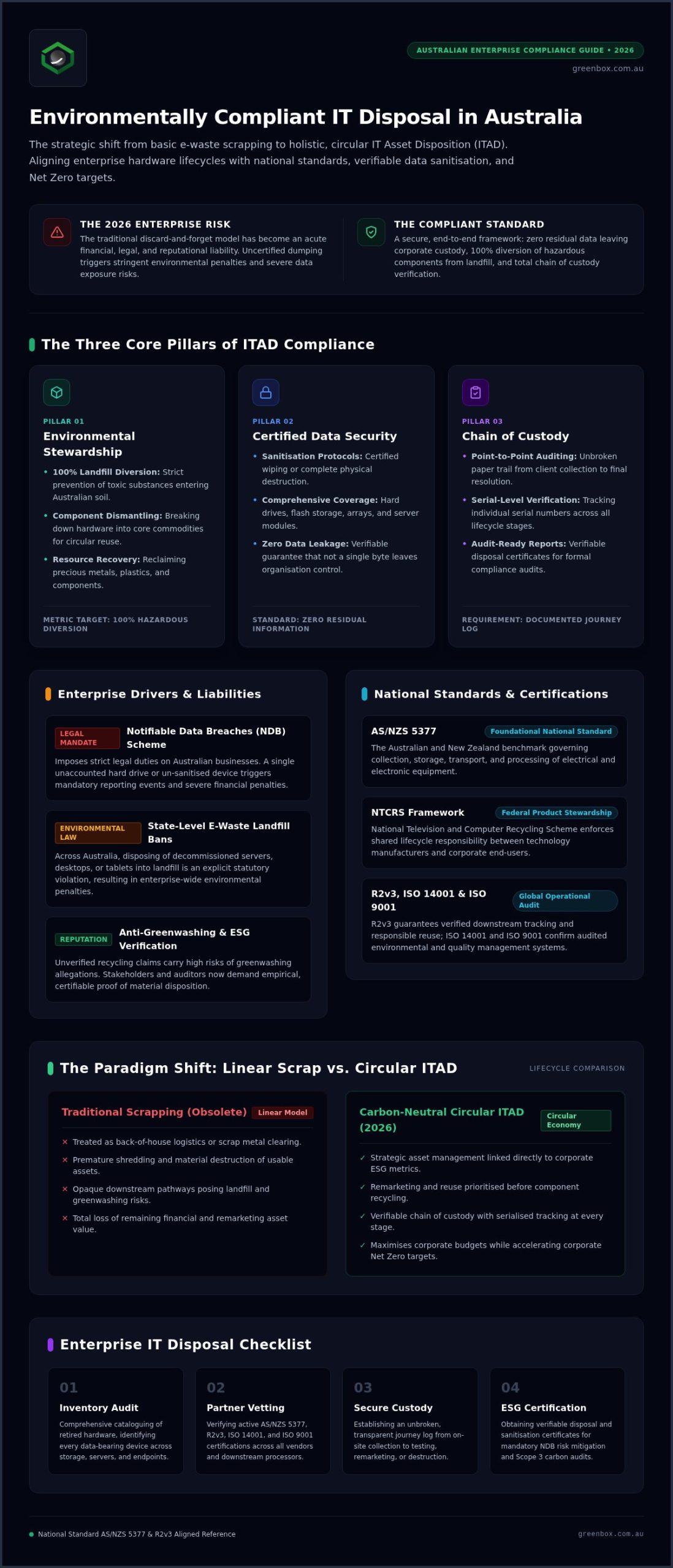
To be considered truly compliant, an IT disposal strategy must rest on three critical foundations that ensure operational integrity:
- Environmental stewardship: This involves diverting 100% of hazardous materials from landfill. It requires a partner who can dismantle hardware into its raw components to recover precious metals and plastics for reuse.
- Data security: Compliance is impossible without certified data sanitisation. Every data-bearing device, from hard drives to flash storage, must be wiped or physically destroyed to ensure no residual information leaves the organisation.
- Chain of custody: You must maintain a transparent, documented journey for every asset. This includes detailed reporting from the moment of pick-up to the final point of disposition or remarketing.
Why Compliance Matters for Australian Enterprises
Australian organisations face unique pressures that make professional ITAD essential. The risk of greenwashing allegations is at an all-time high, and stakeholders now demand verifiable proof of sustainability claims. Relying on uncertified vendors can lead to significant reputational damage if your hardware is found in an unauthorised dump. This is why environmentally compliant IT disposal has become a core business metric rather than an afterthought.
Beyond environmental concerns, the Notifiable Data Breaches (NDB) scheme places a heavy legal burden on companies to protect personal information. A single lost drive can trigger a mandatory reporting event and result in heavy fines. By aligning IT operations with national sustainability frameworks, you transform a potential liability into a strategic advantage that supports your broader ESG targets.
The Australian Regulatory Landscape for ITAD in 2026
Australian enterprises operate within a rigorous regulatory framework that demands transparency and accountability. The foundational standard for this sector is AS/NZS 5377, which provides a comprehensive blueprint for the collection, storage, and processing of electrical and electronic equipment. Achieving environmentally compliant IT disposal requires a deep understanding of how these national standards intersect with state-level mandates. Compliance isn’t a static achievement. It’s an ongoing operational requirement that protects your organisation from the legal and financial fallout of improper e-waste management.
Federal oversight is primarily managed through the National Television and Computer Recycling Scheme (NTCRS). This scheme enforces product stewardship, ensuring that manufacturers and end-users share the responsibility for an asset’s entire lifecycle. Simultaneously, state-level landfill bans on e-waste have become more stringent across the country. These bans mean that simply throwing away a tablet or a server is no longer just poor practice; it’s a direct violation of environmental law. By integrating these requirements into your corporate policy, you ensure a secure transition from active use to responsible disposition.
Essential Certifications to Look For
Identifying a qualified partner involves verifying specific certifications that guarantee both security and sustainability. You should look for the following credentials:
- R2v3: This is the global gold standard for responsible electronic reuse and recycling. It ensures that every asset is tracked and that downstream vendors meet the same high standards.
- ISO 14001 and ISO 9001: These international standards verify that a provider has robust environmental and quality management systems in place to handle complex logistics.
- NAID AAA: This certification is the benchmark for secure data destruction. It provides peace of mind that your data-bearing media is handled with forensic-level precision.
Reporting and Documentation Requirements
Audit readiness is a critical component of any ITAD strategy. Every disposal project must generate a comprehensive paper trail that starts with a Certificate of Destruction. This document should detail the specific serial numbers of the assets processed and the method of sanitisation used. For organisations focused on ESG performance, environmental impact statements are equally vital. These reports measure landfill diversion rates and carbon savings, providing the verifiable data needed for corporate sustainability disclosures.
For a deeper look at these requirements, see our guide on Navigating E-waste Compliance in Australia. Maintaining this level of documentation ensures your environmentally compliant IT disposal process stands up to the most rigorous internal and external audits. Partnering with a specialist for IT Asset Recovery allows you to automate this reporting while ensuring your retired hardware is managed with total integrity.
Circular Economy: Remarketing vs. Traditional Recycling
Enterprises often view decommissioned hardware as a burden. This mindset ignores the inherent value remaining in professional-grade equipment. The circular economy model prioritises reuse over destruction, transforming retired assets into a revenue stream while fulfilling environmentally compliant IT disposal obligations. By choosing remarketing, you ensure that functional devices continue their lifecycle elsewhere, which significantly reduces the demand for new manufacturing and the extraction of virgin resources.
The waste hierarchy is a fundamental principle of modern sustainability. It places reuse at the top because it preserves the energy and materials already invested in a product. Recycling, while necessary for broken items, requires significant energy to break down components and recover raw materials. Extending the life of a laptop or server by just two years can drastically lower your organisation’s Scope 3 emissions. This pragmatic approach supports your ESG targets by minimising the carbon footprint associated with your technology stack.
The Process of Asset Remarketing
Remarketing requires a disciplined approach to quality control. Every device undergoes rigorous testing and grading to determine its potential for a second life. This isn’t a casual resale process. It’s a high-standard operation where security is the absolute priority. Data sanitisation must occur before any asset moves toward a new user to ensure total privacy. For a practical example of this in action, review our Sustainable IT Asset Recovery Case Study to see how secure lifecycle management delivers both environmental and financial results.
When Recycling is the Only Option
Not every piece of hardware can be refurbished. When assets reach the true end of their functional life, the focus shifts to total material recovery. This involves dismantling hardware into constituent parts to extract precious metals and rare earth elements. A “Zero Landfill” goal means ensuring that even the smallest plastic or glass components are diverted into secondary manufacturing streams. This prevents hazardous substances like lead and mercury from entering the ecosystem.
Working with certified electronics recyclers ensures that these processes meet international standards for environmental safety. This final stage of environmentally compliant IT disposal ensures that no hazardous materials leak into the environment, completing the circle of responsible asset management. It’s a methodical process that turns waste into a resource, protecting the planet while maintaining your corporate integrity.
Checklist for an Environmentally Compliant IT Disposal Policy
An effective policy for environmentally compliant IT disposal begins long before the hardware leaves your facility. It requires a disciplined approach to asset tracking and risk management. Start by conducting a comprehensive audit of your current inventory. You must identify all data-bearing devices, including often overlooked items like multi-function printers, IoT sensors, and network switches. Once identified, establish a secure on-site storage protocol. Leaving retired hardware in unsecured common areas or loading docks creates an unnecessary security vacuum that risks a data breach before the disposal process even begins.
You must also define your requirements for data sanitisation versus physical destruction. While physical shredding offers absolute finality for end-of-life assets, it destroys the residual value of the hardware. Software-based sanitisation allows for the recovery of materials and the potential for remarketing, which directly supports your sustainability goals. For more insights on how these strategies are evolving, read about Sustainable IT Disposal Trends for 2026. Clear definitions in your policy ensure that every asset is handled according to its specific security level and reuse potential.
Vetting Your ITAD Provider
Choosing the right partner is a strategic decision that impacts your ESG standing. You should demand proof of carbon-neutral operations and detailed environmental reporting to ensure your environmentally compliant IT disposal programme is legitimate. Verify their downstream recycling partners to confirm that no materials are exported illegally to developing nations. To avoid being misled by surface-level credentials, review our analysis of R2 certified ITAD providers: myth vs reality for Australian enterprise IT before making your selection. A provider must also demonstrate the capability to handle national logistics securely, ensuring a consistent chain of custody across all your Australian sites. Transparency in these areas is non-negotiable for modern enterprise compliance.
Integrating Disposal into the Refresh Cycle
Integrate disposal into your hardware refresh cycle at the point of purchase. By planning for decommissioning during the procurement phase, you can select hardware that is easier to refurbish or recycle. Use software-based sanitisation where possible to preserve the hardware’s value for the circular economy. This requires close alignment between IT and ESG teams to ensure that technical requirements don’t compromise sustainability outcomes. To start building your own framework, explore our Carbon Neutral ITAD Services to see how we integrate security with sustainability.
Greenbox: Leading Australia in Carbon Neutral ITAD
Greenbox operates at the intersection of technical excellence and ecological stewardship. We provide a single framework where security and sustainability are not competing interests, but rather integrated components of a high-performance ITAD strategy. By choosing a carbon-neutral lifecycle partner, your organisation ensures that its environmentally compliant IT disposal efforts are backed by verifiable action. We manage the high-stakes logistics of data sanitisation and asset recovery, allowing your internal teams to focus on core business objectives without the weight of operational risk.
Our R2 certified ITAD provider facilities serve as centres of excellence for hardware processing. Every asset recovered enters a transparent, end-to-end system that tracks its journey from your loading dock to its final disposition, whether through sustainable remarketing or responsible recycling. This level of visibility is particularly critical for the government and financial sectors, where the integrity of the supply chain is paramount. We act as a steady, experienced hand, ensuring that your data security and environmental obligations are met with total precision.
A Truly National Approach to IT Lifecycle Management
Managing large-scale rollouts and decommissioning projects requires a partner with a deep understanding of Australian logistics. Greenbox provides seamless coverage across all states and territories, ensuring that your disposal policy is applied consistently regardless of location. We bring a disciplined strategy to complex transitions, having managed some of the nation’s most significant enterprise hardware refreshes. This experience allows us to anticipate risks and implement rigorous security protocols that protect your data at every touchpoint.
Our commitment to international standards of compliance means your hardware is handled according to the most current global benchmarks. We don’t just follow the rules; we set the pace for responsible asset management in Australia. This national reach, combined with our specialised expertise in pre-configuration and imaging, allows us to support your technology stack from initial deployment to final recovery.
Taking the Next Step in Your ESG Journey
The data generated during the ITAD process is a powerful tool for your corporate sustainability reporting. Greenbox provides the detailed environmental impact statements required to meet ambitious ESG targets and satisfy internal audits. This reporting converts a technical task into a core business metric, demonstrating your organisation’s commitment to the circular economy. You gain the peace of mind that comes from a certified, transparent process that leaves nothing to chance.
Aligning your technology refresh with a sustainable framework is a strategic investment in your brand’s future health. We invite you to consult with one of our specialists on your next hardware refresh to ensure your environmentally compliant IT disposal strategy is both secure and carbon-neutral.
Securing Your Legacy Through Sustainable Lifecycle Management
Transitioning to environmentally compliant IT disposal is no longer just a regulatory hurdle; it’s a strategic opportunity to strengthen your organisation’s ESG framework. By prioritising the circular economy through asset remarketing and certified recycling, you transform retired hardware into a powerful vehicle for carbon reduction and financial recovery. The complexity of the 2026 landscape demands a steady partner who understands the high stakes of data security and national logistics.
Greenbox provides the authoritative expertise needed for these complex transitions. With R2-certified facilities nationwide and carbon-neutral service delivery, we ensure your assets are managed with absolute precision. As specialists in government and enterprise ITAD, we deliver the verifiable reporting required for rigorous audits and total peace of mind. We remove the operational burden of decommissioning, allowing you to focus on your core business goals.
Secure your enterprise reputation with Greenbox environmentally compliant IT disposal. You don’t have to manage this transition alone; we’re ready to help you build a secure and sustainable technology legacy that benefits both your bottom line and the planet.
Frequently Asked Questions
What is the difference between e-waste recycling and ITAD?
E-waste recycling is specifically the physical breakdown of hardware for raw material recovery. In contrast, ITAD (IT Asset Disposition) is a comprehensive lifecycle service. It encompasses secure logistics, certified data sanitisation, and asset remarketing. While recycling focuses on end-of-life processing, ITAD manages the entire transition of retired assets. It’s a strategy that ensures both data security and environmental compliance across the organisation’s technology stack.
Is it better to shred hard drives or use software-based sanitisation?
The choice depends on your security policy and the asset’s future. Shredding offers physical finality for end-of-life drives but prevents any potential reuse. Software-based sanitisation using certified tools allows for environmentally compliant IT disposal by wiping data while keeping the hardware functional for remarketing. This supports the circular economy by extending the device’s lifecycle. It’s a more sustainable choice if the hardware still has functional value.
How does environmentally compliant IT disposal help our ESG reporting?
It provides verifiable data on landfill diversion and carbon savings for your annual reports. Professional providers issue detailed impact statements that quantify the volume of materials recovered and the emissions avoided through refurbishment. This evidence is critical for corporate sustainability disclosures and meeting Net Zero targets. It transforms a waste task into a measurable business metric that demonstrates ethical stewardship to your stakeholders.
What certifications should I look for in an Australian ITAD provider?
You should prioritise R2 (Responsible Recycling) and NAID AAA certifications. R2 ensures that the provider follows international standards for environmental and worker safety throughout the supply chain. NAID AAA is the benchmark for secure data destruction. Additionally, look for ISO 14001 for environmental management and proof of carbon-neutral operations to align with modern corporate responsibility standards. These credentials guarantee a high-standard, disciplined approach to asset management.
Can we get money back from our old IT equipment through remarketing?
Yes, functional enterprise-grade hardware often retains significant residual value. A professional partner can refurbish and resell these assets on your behalf, returning a percentage of the resale value to your budget. This asset remarketing offset helps fund your next hardware refresh. It makes the entire decommissioning process more cost-effective. You’ll find it’s an efficient way to support sustainable technology reuse while managing costs.
Are there legal penalties for improper e-waste disposal in Australia?
Yes, organisations face significant risks under federal and state environmental laws. Improper disposal can lead to heavy fines for violating landfill bans on electrical equipment. If the disposal leads to a data breach, the Notifiable Data Breaches (NDB) scheme mandates reporting. This can result in severe financial penalties and long-term reputational damage for the enterprise, making certified disposal a legal necessity for all Australian businesses.
How do I ensure data security during the transport of retired assets?
Security is maintained through a strict chain of custody. This involves using GPS-tracked vehicles, security-cleared personnel, and locked transit containers. Every asset should be scanned at the point of collection and again upon arrival at the processing facility. This documented journey ensures that devices aren’t lost or tampered with before they undergo certified data sanitisation. It’s the only way to guarantee the integrity of your data during transit.
What happens to the materials recovered during the recycling process?
Hardware is dismantled into raw components such as plastics, glass, and circuit boards. These materials are then processed to recover precious metals like gold, silver, and palladium, along with rare earth elements. These recovered resources are returned to manufacturing supply chains to create new products. This process is a cornerstone of environmentally compliant IT disposal, preventing hazardous material leakage and reducing the need for destructive mining practices.