

What happens to a retired business laptop after collection, and can your organisation prove it? Choosing an e-waste recycling business Australia organisations can depend on means looking beyond pickup. Devices may hold sensitive data, and usable equipment should not automatically be treated as waste.
That uncertainty is familiar to IT, procurement and sustainability teams. A consumer drop-off point may suit a household item, but organisations managing equipment fleets need a process that covers secure data handling, asset recovery and responsible material processing. When equipment is spread across multiple sites, consistent records matter even more.
This guide explains how to assess a business e-waste recycling partner in Australia. It covers what to ask about collection records, data sanitisation or destruction, equipment assessment, remarketing and end-of-life recycling, so you can compare providers on evidence rather than broad environmental claims. You’ll also learn how to consider reuse before material recovery and what an audit trail should show. The goal is to protect information, support your sustainability requirements and understand where business devices go next.
Key Takeaways
- Business e-waste services differ from household drop-off options. Check that the provider’s process suits your equipment volumes and requirements.
- Choosing an e-waste recycling business Australia organisations can trust starts with checking its security controls, process documentation and reporting.
- Ask how data-bearing devices are sanitised or destroyed, and how that step is recorded separately from physical recycling.
- Prepare an inventory that separates data-bearing devices from other equipment, then confirm collection logistics for every site.
- Find out whether reusable equipment can be assessed for remarketing before end-of-life materials are sent for recovery.
What does e-waste recycling for Australian businesses actually involve?
Business e-waste recycling is the controlled collection, assessment and processing of retired workplace electronics and IT equipment, with separate steps for protecting data, assessing reuse and recovering materials. It involves more than removing old devices from an office. A managed programme should identify what equipment is collected, how data-bearing items are handled and what happens to each category after intake.
This differs from taking household items to a residential drop-off point. Australia’s National Television and Computer Recycling Scheme provides a separate recycling pathway for eligible televisions and computers. Organisations with larger equipment volumes, or devices beyond the scheme’s scope, may need a provider whose business services match their inventory and handling requirements. For background on the scheme’s introduction and national context, see Electronic waste in Australia.
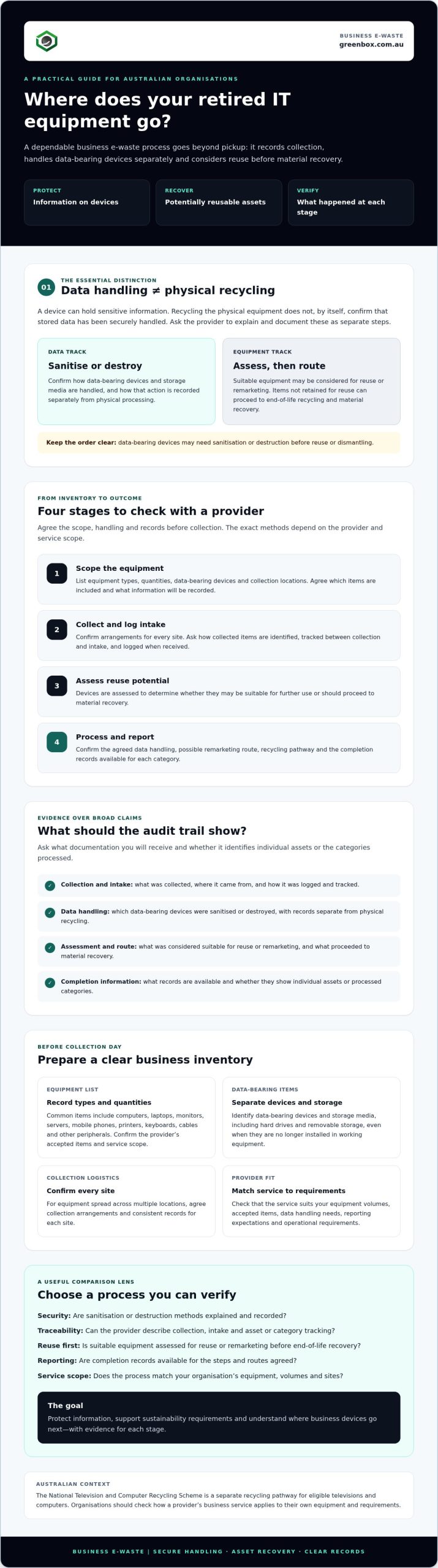
Data protection and environmental recovery need to be considered together, but they are different tasks. A computer or phone may contain information that needs sanitisation or destruction before the device is reused or dismantled. Physical recycling addresses the equipment and its materials; it does not, by itself, confirm that stored data has been securely handled. Ask how the provider documents each step.
Which business devices can enter an e-waste programme?
Common examples include desktop computers, laptops, monitors, servers, mobile phones, printers, keyboards, cables and other peripherals. Accepted items and available handling depend on the provider’s confirmed service scope. Before arranging collection, list equipment types and quantities, then identify storage media and data-bearing devices separately. Include hard drives and removable storage, even if they are no longer installed in working equipment.
How is e-waste recycling different from general rubbish disposal?
General rubbish disposal does not necessarily provide the sorting, traceability or specific data handling business equipment may require. A managed process can provide clearer records of collection, intake, assessment and downstream handling. Ask what documentation you’ll receive and whether it identifies individual assets or the categories processed.
Equipment in suitable condition may be considered for reuse or remarketing before material recovery. Items that cannot be reused may instead be dismantled or processed to recover materials, depending on their condition and the provider’s process. Ask how the provider records these routes so you can see what happened to each category, rather than treating every retired device as indistinguishable waste.
When comparing an e-waste recycling business in Australia, check that its service is designed for organisational equipment, not just household drop-offs. Confirm accepted items, data handling, reporting and whether reusable assets are considered before end-of-life processing.
What happens to business e-waste from collection through recovery?
A managed business e-waste process usually moves through a series of agreed stages. The steps, handling methods and records depend on the provider and the service scope, so confirm them before collection.
- Scope: Identify equipment types, quantities, data-bearing devices and collection locations. Agree which items are included and what information will be recorded.
- Collection and intake: Equipment is collected under the agreed arrangements, then received and logged for assessment. Ask how items are identified and tracked between collection and intake.
- Assessment: Devices are checked to determine whether they may be suitable for further use or should proceed to material recovery.
- Processing and reporting: Data handling is completed as agreed. Suitable assets may be considered for remarketing, while equipment not retained for reuse can proceed to recycling. Confirm what completion records are available.
The National Television and Computer Recycling Scheme provides useful context for Australia’s television and computer recycling arrangements. Check how a provider’s service applies to your own equipment, volumes and operational requirements.
How should data-bearing equipment be handled?
Identify laptops, servers, phones, hard drives and other storage devices before collection. Ask how access to these items is controlled and what evidence or reporting demonstrates that the agreed data process was completed. Data sanitisation and physical destruction are distinct approaches: sanitisation aims to remove stored information, while destruction physically damages the storage media. The appropriate method depends on the device, its condition and your organisation’s requirements. For more detail, read this enterprise guide to certified data sanitisation.
When can equipment be reused, remarketed or recycled?
Assessment helps determine the next route for each asset. Equipment in suitable condition may be considered for reuse or remarketing, subject to assessment and the agreed service scope. This can keep a usable device in circulation instead of sending it directly for material recovery. Remarketing is a possible outcome, not a guarantee.
Items not retained for further use can proceed to recycling, where equipment is processed for material recovery. Keep this stage distinct from data sanitisation: recycling addresses the physical device, while data handling addresses information stored on it. Ask how the provider records both outcomes so your organisation can follow the process from intake through final processing.
If you’re assessing an e-waste recycling business Australia organisations can engage for managed IT equipment, compare its recovery, data sanitisation and recycling services against your requirements. You can also review Greenbox’s business e-waste services as one option for equipment recovery and recycling.
How can you compare e-waste recycling businesses in Australia?
Compare providers against the same requirements, not just their headline claims. Check what happens to data-bearing equipment, which facilities and processes are covered by any certification, whether equipment can be traced through processing, and what records your organisation receives. Also check that collection arrangements suit your equipment volumes and site footprint, particularly when devices are held at multiple locations.
| What to assess | Questions to ask |
|---|---|
| Security controls | How are data-bearing devices identified and handled? What sanitisation or destruction evidence is provided? |
| Certification scope | Can the provider supply current certificates and clarify which facilities, activities and processes they cover? |
| Traceability and reporting | What collection, intake and processing records can you expect? Can records connect assets to their reported outcomes? |
| Collection logistics | Can the agreed collection plan accommodate your equipment types, volumes and locations? |
| Recovery outcomes | How are suitable assets considered for reuse or remarketing, and how are recyclable materials and residual waste managed and documented? |
What security and certification evidence should buyers request?
Request current certificates and verify their scope rather than assuming they cover every site, service or downstream process. Ask for sample asset-level records and confirmation of what evidence is supplied after sanitisation or destruction. Certification can support due diligence, but it does not automatically prove every outcome in your service arrangement. For more context on certification and recovery, read this guide to R2-certified IT asset recovery.
How do you compare recycling-only and lifecycle service models?
A recycling-focused service may suit equipment already identified for end-of-life processing. A lifecycle model may also include IT asset recovery, data sanitisation and remarketing, so suitable equipment can be assessed before material recovery. The right fit depends on asset condition, data risk and your organisation’s requirements. Ask providers which steps are included, which are optional and how each outcome will be reported.
Downstream handling matters as much as collection. Clean Up Australia’s e-waste information and statistics offers broader environmental context, while your provider should explain how your equipment and recovered materials are managed. When comparing an e-waste recycling business Australia organisations can engage, look for evidence that connects the proposed process to records you can review.
How should your organisation prepare for business e-waste collection?
Good preparation helps prevent equipment being missed, data-bearing devices being overlooked or expectations differing from the agreed scope. Start with an inventory, review internal handling requirements, then confirm the collection plan and documentation before approving the work.
What should an e-waste inventory include?
Build a list that gives your team and provider a clear view of what is being collected and how it should be handled. For each item or equipment group, record:
- Equipment type, quantity and known condition.
- Whether it contains storage media or other data-bearing components.
- Ownership and the site or internal location where it is held.
- Any handling requirements, such as keeping particular devices separate.
- Known preferences for reuse, remarketing, sanitisation or recycling.
Separate data-bearing equipment from non-data items in both the inventory and handling plan. If a device’s status is unclear, flag it for review rather than assuming it contains no data. This gives the provider a clear basis for confirming the service scope.
What should you confirm before approving a provider?
Ask the provider to set out the process in writing. Confirm which equipment is included, who is responsible at each stage, how collection and intake are recorded, and what documentation you’ll receive when processing is complete. For data-bearing devices, clarify the agreed sanitisation or destruction approach and how exceptions, missing items or assets that cannot be processed as planned will be reported.
Check the proposed downstream routes as well. Ask how suitable assets may be assessed for reuse or remarketing, how other equipment is recycled, and what information is available about material recovery or residual waste. The records should make the agreed outcomes clear, rather than relying on a general sustainability statement.
Review any certification, environmental or carbon-neutral claims against the service proposed. Request current evidence and check its scope, including the facilities or processes it covers. Claims should relate to the work being approved, not be treated as blanket proof of every outcome.
Finally, confirm collection logistics, including equipment volumes, site access arrangements, locations, timing and any preparation expected from your team. If your organisation has multiple sites, establish how each will be handled and how records will remain consistent. Greenbox’s sustainable IT asset recovery case study offers an example of recovery considerations in an enterprise context.
Use this checklist when assessing an e-waste recycling business Australia organisations may engage, then compare each provider’s answers with your security, operational and sustainability requirements. To discuss business IT asset recovery and e-waste recycling, contact Greenbox about your collection requirements.
Why consider Greenbox for business e-waste recycling in Australia?
Greenbox provides IT asset recovery, data sanitisation and destruction, e-waste recycling and asset remarketing for organisations. Bringing these services together can help businesses plan secure processing and responsible recovery through one service relationship, rather than treating every retired device as a recycling-only item. Greenbox serves organisations nationally, which may suit businesses coordinating equipment across multiple sites.
How does Greenbox connect secure recovery with responsible recycling?
Data sanitisation addresses information stored on devices, while asset recovery and recycling address the equipment and its next destination. Keeping these steps within an agreed service scope can help organisations clarify responsibilities and request records of the work completed. If assessment finds equipment suitable for further use, remarketing may be considered. It is a potential outcome, not a guarantee. Equipment not retained for reuse or remarketing can proceed to recycling, subject to the agreed process.
Greenbox describes its facilities as R2-certified and identifies as a carbon-neutral organisation. Before relying on either claim in procurement or sustainability reporting, ask Greenbox to confirm the current wording, scope and supporting evidence, including which facilities or services are covered. Assess certification and environmental claims against the specific work proposed, not as proof of every downstream outcome. For more context on secure data handling, see the enterprise guide to data sanitisation.
What is the next step for a business evaluating Greenbox?
Prepare an equipment inventory that notes device types, quantities, condition and which items contain data. Then outline your organisation’s data requirements, preferred collection scope and any site or handling considerations. This gives Greenbox a practical starting point to explain which services may fit and what information is needed to confirm the proposed process.
Before approving work, request details of the collection and processing steps, records supplied after completion, and how suitable assets, recyclable materials and exceptions are handled. An e-waste recycling business Australia organisations consider should explain how its service scope aligns with their security, recovery and reporting needs. Compare those details with your internal requirements before proceeding.
To discuss your organisation’s equipment and service requirements, contact Greenbox about business e-waste services.
Make your next equipment transition accountable
A reliable business e-waste process should do more than move retired devices off-site. Confirm the collection scope, how data-bearing equipment will be handled, what records you’ll receive and whether reusable assets can be considered for remarketing before material recovery. These checks help your organisation choose an e-waste recycling business Australia provider based on a clear, auditable process.
Greenbox provides IT asset recovery, data sanitisation and destruction, remarketing and e-waste recycling for organisations nationally. Greenbox states that it operates R2-certified facilities and identifies as a carbon-neutral organisation. Before relying on these claims, ask Greenbox to confirm their current scope and supporting evidence for the services proposed.
With your equipment inventory and data requirements ready, you can have a focused discussion about service fit, processing steps and reporting. Discuss your organisation’s e-waste and IT asset recovery requirements with Greenbox, and take the next step towards a more secure, responsible equipment lifecycle.
Frequently Asked Questions
What is e-waste recycling for businesses?
Business e-waste recycling is the managed collection, assessment and processing of retired workplace electronics and IT equipment. It can include computers, monitors, servers, phones and peripherals. A business process may also cover data sanitisation, asset recovery and assessment for reuse or remarketing before material recovery. Confirm the provider’s accepted equipment, service scope and reporting arrangements so you know how each item will be handled.
Can businesses recycle computers and other IT equipment in Australia?
Yes. Businesses can arrange recycling for computers and other IT equipment through a provider whose services accept their equipment and volumes. Accepted items and collection arrangements vary, so share an inventory with equipment types, quantities and locations when asking about the service. Check whether phones, servers, storage media and peripherals are included, and how data-bearing devices are handled. Business services can support a managed process beyond household drop-off options.
Is business e-waste recycling secure for devices that contain data?
It can be managed securely, but the level of assurance depends on the provider’s controls and the agreed process. Identify data-bearing devices and ask how access is controlled, whether data is sanitised or storage media is physically destroyed, and what records are provided. Sanitisation and destruction are different methods, so confirm which will be used. Request evidence showing how your organisation’s devices were handled.
What happens to business e-waste after collection?
After collection, equipment is typically received and assessed under the provider’s agreed process. Data-bearing devices may undergo the specified sanitisation or destruction step. Equipment in suitable condition may be considered for reuse or remarketing, while items not retained for further use can proceed to recycling and material recovery. The precise stages and records depend on the service scope, so confirm what tracking and completion information your organisation will receive.
How should a business choose an e-waste recycling provider?
Choose a provider by comparing its security controls, service scope, traceability, reporting and collection logistics with your organisation’s needs. Ask for current certification evidence and confirm which facilities and processes it covers. Check how reusable equipment, recyclable materials and exceptions are handled, and what records you’ll receive. The right e-waste recycling business Australia organisations select should explain its process clearly, without relying on broad claims alone.
Do businesses need to erase data before recycling computers?
Businesses should ensure data is securely handled before equipment is reused, remarketed or recycled, but do not assume ordinary file deletion is enough. Agree with the provider whether your organisation will sanitise devices beforehand or use the provider’s data sanitisation or destruction service. Identify storage media, document the agreed approach and request relevant completion records. Keep devices controlled until responsibilities and handling steps are clear.