

If your next hardware refresh feels more like a logistical liability than a strategic upgrade, are you truly prepared for the security and sustainability mandates of 2026? Most enterprise IT leaders recognise that a national IT configuration and deployment project is a high-stakes operation where a single oversight can lead to data exposure or operational downtime. You’ve likely experienced the mounting pressure of managing multi-site logistics while your internal technical labour is already at capacity.
This article provides a robust framework to master these complexities within the Australian enterprise sector. By following this strategic rollout model, you’ll achieve a seamless transition to new technology with zero data leaks and a significantly reduced burden on your internal staff. We’ll examine how to integrate secure imaging, national logistics, and documented carbon-neutral outcomes into a unified lifecycle. This approach ensures your hardware refresh isn’t just a technical task, but a disciplined movement toward a more secure and environmentally responsible future.
Key Takeaways
- Learn how to transition from manual setups to policy-driven IT configuration and deployment models designed for national scale.
- Discover the security advantages of establishing a robust Standard Operating Environment through bulk imaging and pre-configuration in a controlled facility.
- Coordinate national logistics and technical labour to ensure efficient on-site installation and professional user handovers.
- Protect your enterprise from data leaks by integrating secure asset sanitisation and recovery into the hardware refresh cycle.
- Achieve documented carbon-neutral outcomes by partnering with a certified provider for end-to-end lifecycle management.
The Enterprise Framework for IT Configuration and Deployment
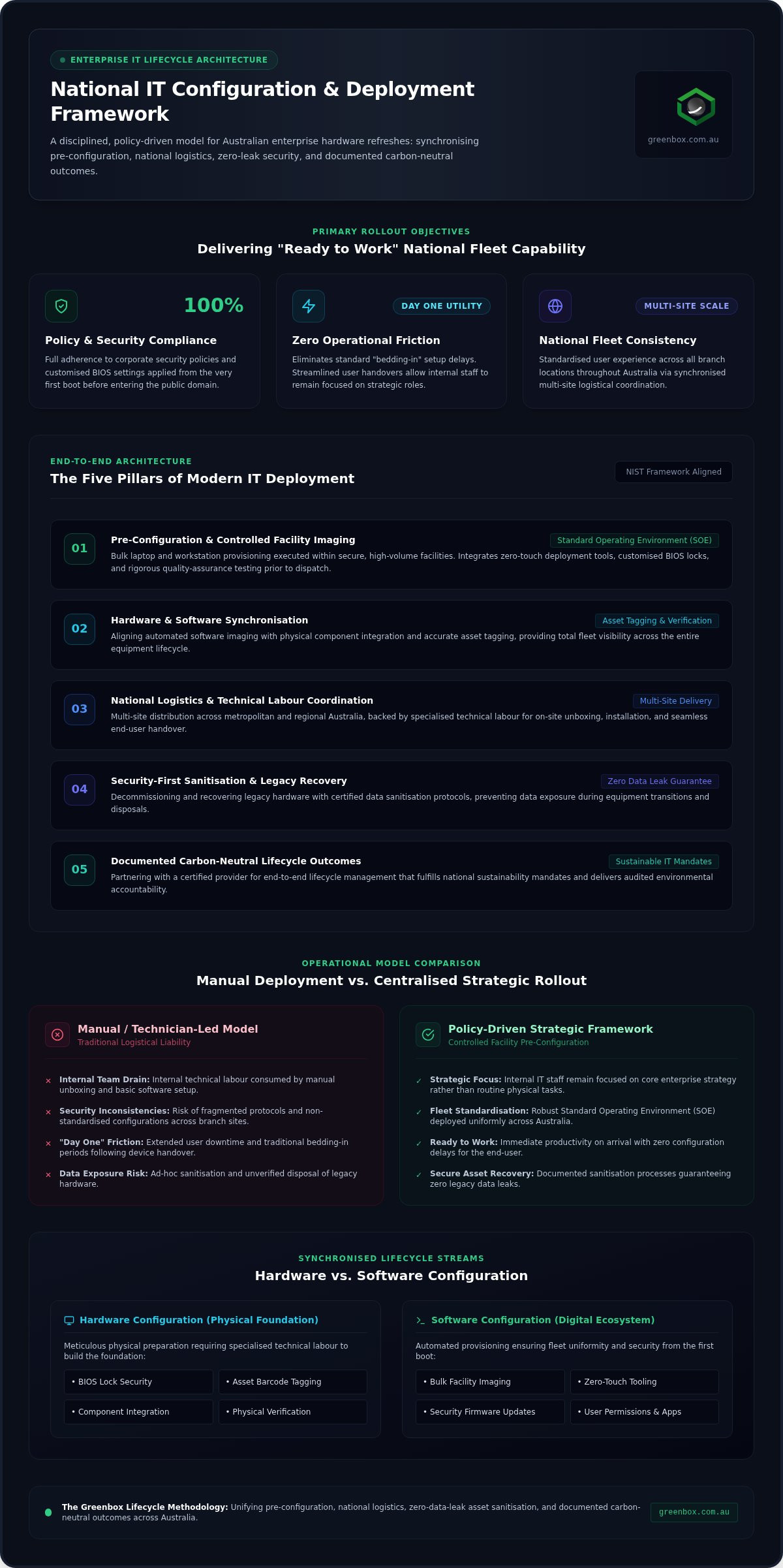
In the Australian enterprise sector, IT configuration and deployment represents the critical bridge between procurement and operational utility. It’s no longer sufficient to treat hardware as a standalone commodity. Instead, modern frameworks treat each device as a pre-configured node within a broader digital ecosystem. This shift from manual, technician-led setups to automated, policy-driven models ensures that every laptop, tablet, or workstation adheres to a strict Standard Operating Environment (SOE) before it even reaches the end user.
A disciplined framework is the only way to maintain this consistency across a complex IT infrastructure. Without a strategic approach, organisations risk fragmented security protocols and mounting technical debt. When deployment is handled with precision, it directly correlates with higher organisational productivity. It removes the friction of “Day One” setup issues, allowing staff to focus on their core roles while the internal IT team remains free to manage high-level strategy rather than unboxing boxes.
Hardware vs. Software Configuration: The Crucial Distinction
While software configuration focuses on applications and permissions, hardware configuration involves the physical preparation that secures the device’s foundation. This includes BIOS locks, asset tagging, and the physical integration of components. Automated imaging handles the data; physical asset management requires a different calibre of technical labour. Large-scale technology rollouts succeed when these two streams are synchronised. It’s a meticulous process that requires a steady hand to ensure that the digital security layer is supported by a physically verified asset.
Core Objectives of a Modern Deployment Strategy
The primary goal of any sophisticated rollout is the delivery of a “Ready to Work” device. This objective minimises user downtime and eliminates the traditional “bedding-in” period associated with new hardware. A secondary, yet equally vital objective, is ensuring 100% compliance with corporate security policies from the moment of power-on. By building scalability into national hardware refresh cycles, enterprises can achieve several key outcomes:
- Reduced operational friction: Streamlined handovers that don’t drain internal resources.
- Enhanced security posture: Uniform imaging and configuration protocols that leave no room for error.
- National consistency: A standardised experience for employees, regardless of their location across Australia.
This structured methodology transforms a logistical hurdle into a competitive advantage, ensuring the refresh cycle is both secure and sustainable. It provides the peace of mind that comes from knowing every asset is accounted for and every security protocol has been rigorously applied.
Pre-Configuration Protocols: Securing the Digital Foundation
The pre-deployment phase is where the strategic framework meets physical reality. For an Australian enterprise, establishing a robust Standard Operating Environment (SOE) is the first step in ensuring fleet-wide consistency. This process involves more than just loading software. It requires a secure environment where customised BIOS settings and the latest security firmware updates can be applied before the device enters the public domain. Aligning these protocols with the NIST Cybersecurity Framework ensures that your hardware is resilient against modern threats from the very first boot.
Device Imaging and Software Provisioning
Bulk laptop deployment relies on the efficiency of the imaging process. High-volume technical facilities allow for the simultaneous provisioning of hundreds of assets, which is far more reliable than on-site manual setups. By integrating zero-touch deployment tools with physical logistics, organisations can ensure that every device is identical in its configuration. Quality assurance is non-negotiable here. Every asset must undergo rigorous testing to verify that the IT configuration and deployment protocols have been executed perfectly before the hardware leaves the facility. This level of precision is exactly what a specialist pre-configuration partner provides to remove the operational burden from your internal teams.
Physical Asset Customisation and Tagging
Visibility is a core requirement for any large-scale hardware refresh. Accurate asset tagging provides the foundation for long-term lifecycle management, allowing IT managers to track a device from the moment it’s unboxed until its eventual retirement. This isn’t just about a sticker; it’s about a secure data link between the physical asset and your internal database.
Customised kitting further enhances the user experience. By delivering peripherals, such as mice and cables, pre-packaged with the primary device, you eliminate the logistical chaos of multiple deliveries. For sensitive government or financial sectors, security labelling and tamper-evident measures add an extra layer of protection. These physical safeguards ensure that the integrity of the device remains uncompromised during transit, providing the peace of mind that a purely software-based approach simply cannot offer.
Executing National Deployment: Logistics and Technical Labour
Execution is the physical manifestation of a successful IT configuration and deployment strategy. Moving thousands of assets across Australia’s vast geography requires more than just a shipping label. It demands a secure, end-to-end chain of custody that ensures the integrity of each pre-configured device. Following cybersecurity best practices for enterprise IT deployment means maintaining strict oversight from the technical facility to the user’s desk. This disciplined approach prevents the security gaps that often emerge when hardware is left in unmonitored loading docks or handled by unvetted personnel.
Centralised vs. Decentralised Deployment Models
A hub-and-spoke logistics model offers the most reliable control for national rollouts. By centralising imaging and kitting in a secure, R2-certified facility, you eliminate the variability of on-site setups. This approach avoids the prohibitive costs and logistical friction of sending internal IT staff to regional sites. Security standards remain uniform because the physical environment is controlled. Transit is managed by specialists who understand that they aren’t just moving boxes; they’re transporting sensitive corporate infrastructure that must remain uncompromised.
The Role of Skilled Technical Labour
Standard couriers are insufficient for enterprise technology rollouts. They lack the training to handle complex installation hurdles or verify that a device is truly “Ready to Work.” Scaling a refresh project requires technical labour capable of on-site installation, docking station integration, and professional user handover. These technicians act as the “boots on the ground,” identifying potential issues before they impact productivity. They must be proficient in both technical setup and data security protocols to ensure that the final stage of the rollout is as secure as the first.
For executive teams and remote staff, a “White Glove” experience is often the standard. This involves a higher level of personalised service where the technician ensures every peripheral is functional and the user is fully onboarded. Post-deployment support serves as the final pillar of this framework. A transition is only successful when the user is productive from the moment they log in. This methodical execution provides the peace of mind that a complex national refresh is being managed by a steady, experienced partner, allowing your internal team to focus on high-level digital transformation.
Security-First Integration: Deployment and Asset Sanitisation
A successful IT configuration and deployment project doesn’t conclude when the new hardware hits the desk. In a mature enterprise framework, every rollout is part of a “Circular Deployment” model. This approach dictates that as a new, pre-configured asset arrives, the legacy device must be securely decommissioned and removed in a single, synchronised motion. Failing to integrate these two phases creates a fragmented lifecycle that leaves your organisation vulnerable to data exposure and logistical bottlenecks.
Managing end-of-life hardware during a refresh cycle is a high-stakes operation. It’s not enough to simply collect old laptops and store them in a secure room. You need a disciplined plan for the immediate recovery and processing of these assets to maintain a clear chain of custody. By treating the arrival of new tech and the departure of old gear as a unified event, you ensure that no device is left unmonitored or unaccounted for during the transition.
Mitigating Risks During Technology Refresh
The most significant threat during a hardware refresh is the “Data Breach Gap.” This is the period between a device being taken out of service and its final data destruction. To eliminate this risk, certified data sanitisation Australia must be a core component of your deployment plan. Applying NIST 800-88 standards to the outgoing fleet ensures that every drive is wiped to a forensic level before it leaves your sight. This level of precision provides the peace of mind that your corporate intelligence remains protected, even as your physical infrastructure evolves.
Sustainability and Carbon-Neutral Outcomes
Modern enterprise leaders are now tasked with proving the environmental responsibility of their technical operations. Measuring the impact of a national hardware refresh is no longer optional; it’s a requirement for ESG reporting. Integrating sustainable IT asset recovery into your rollout allows you to document carbon-neutral outcomes for the entire refresh cycle. This process ensures that retired assets are either remarketed to extend their life or recycled through R2-certified facilities to achieve zero-waste-to-landfill targets.
This methodology transforms a technical necessity into a powerful statement of corporate values. It shows that your organisation doesn’t just value digital security, but also ecological stewardship. To ensure your next rollout meets these rigorous security and environmental standards, you should partner with a specialist that provides integrated ITAD and deployment services across Australia.
The Greenbox Methodology: Partnering for Secure Rollouts
The Greenbox Methodology serves as a disciplined response to the logistical and security challenges of a modern hardware refresh. By managing the entire lifecycle from a single, authoritative vantage point, we remove the operational burdens that typically stall enterprise progress. This end-to-end approach integrates IT configuration and deployment with rigorous technical labour and asset recovery. It ensures that every stage of the rollout, from initial imaging to final remarketing, is handled with the precision required by the government and financial sectors.
Security is the foundation of our service delivery. Our R2-certified facilities provide a controlled environment for pre-configuration, ensuring that every asset meets your specific security standards before it enters the field. This commitment to high-standard protocols extends to our data sanitisation processes, where we apply government-grade destruction methods to your retired fleet. This level of credentialed expertise provides the peace of mind that your data remains protected throughout the entire transition period.
Why National Coverage Matters for Enterprise
Managing a large-scale technology rollout across multiple Australian sites often leads to fragmented service and inconsistent reporting. The Greenbox framework eliminates this complexity by providing a unified national reach. This centralised model ensures that whether a device is being installed in a regional office or a metropolitan headquarters, the user experience and security posture remain identical. By reducing the need to manage multiple regional vendors, your internal IT team gains total visibility over the project, allowing for more accurate forecasting and streamlined communication.
Maximising Value and Sustainability
A strategic hardware refresh should be as financially efficient as it is technically sound. Our methodology focuses on maximising the return on your existing infrastructure through strategic asset remarketing. By recovering the residual value of your outgoing assets, you can significantly offset the capital expenditure of your new IT configuration and deployment project. This financial health is balanced with a deep commitment to environmental stewardship.
As a carbon-neutral organisation, we ensure that your technology needs are met without compromising your ESG goals. We provide documented evidence of sustainable outcomes, from zero-waste-to-landfill recycling to carbon-offset reporting. This holistic approach ensures that your technical success and ethical responsibilities are inseparable. It’s a partnership designed for the future of Australian enterprise, defined by competence, integrity, and a quiet, steady ambition.
Ready to streamline your next refresh? Contact Greenbox for a tailored deployment plan.
Securing the Future of Your Enterprise Infrastructure
Mastering your next technology refresh requires a shift from fragmented logistics to a unified, lifecycle-aware framework. By prioritising secure pre-configuration and integrating asset sanitisation into the rollout, you eliminate the data security gaps that often plague large-scale transitions. This disciplined approach ensures your IT configuration and deployment strategy is not just efficient, but also inherently sustainable and compliant with modern ethical standards.
A successful rollout relies on a steady hand and a national technical labour network capable of handling complex multi-site requirements across the country. With R2-certified facilities and carbon-neutral operations, Greenbox provides the expertise needed to remove the operational burden from your internal teams. You can achieve a seamless transition that protects your sensitive data, recovers maximum value from your legacy assets, and supports your long-term environmental goals.
Optimise your next hardware rollout with Greenbox. We’re ready to help you build a more secure and resilient digital foundation for 2026 and beyond.
Frequently Asked Questions
What is the difference between IT configuration and deployment?
IT configuration involves the technical preparation of a device, such as installing a Standard Operating Environment (SOE) and updating firmware. Deployment is the physical act of transporting and installing that hardware at a user’s workspace. While configuration ensures the device is secure and compliant, deployment ensures it reaches the correct location and is fully operational. Mastering both stages of IT configuration and deployment is essential for a seamless enterprise technology transition.
How long does a typical national hardware refresh take to execute?
The duration of a national hardware refresh varies based on the fleet size and geographical spread of your sites. A typical enterprise rollout for several thousand assets often spans between eight to twelve weeks. This timeline accounts for pre-configuration, secure transit, and on-site installation. Using a centralised hub-and-spoke model can significantly compress this schedule by allowing for parallel processing of assets before they are dispatched for final delivery.
What security standards should I look for in a deployment partner?
You should prioritise partners who maintain R2v3 certification, as this ensures rigorous standards for data security and environmental responsibility. Look for providers who adhere to NIST 800-88 guidelines for data sanitisation to ensure all legacy information is forensically destroyed. Additionally, a partner with government-grade security clearances provides the necessary assurance for handling sensitive corporate infrastructure. These credentials verify that your assets are managed within a controlled and highly auditable chain of custody.
Can IT configuration and deployment be done for remote workers?
Yes, modern frameworks support remote and hybrid workforces through specialised delivery models. Devices are pre-configured in a secure facility and then shipped directly to a user’s home or a satellite office. This process often includes customised kitting with peripherals and clear setup instructions. This approach maintains high security standards while ensuring remote employees receive the same level of technical support as their office-based counterparts without needing to visit a central headquarters.
How does ITAD integrate with a hardware deployment project?
IT Asset Recovery integrates through a circular model where the collection of legacy hardware is synchronised with the rollout of new assets. As technicians install new workstations, they simultaneously secure the old devices for data sanitisation. This integration prevents the accumulation of unsecured hardware in storage rooms. It also allows for immediate asset remarketing, which can help offset the costs of the new deployment project by recovering the residual value of retired gear.
What are the benefits of pre-imaging laptops before they arrive on-site?
Pre-imaging laptops in a centralised facility ensures every device is identical and fully compliant with your corporate security policies. This method eliminates the need for time-consuming manual setups by your internal IT staff once the hardware arrives on-site. It significantly reduces user downtime, as employees can log in and start working immediately. Centralised imaging also allows for more rigorous quality assurance testing compared to fragmented on-site installations, providing a more reliable out-of-box experience.
Is it possible to achieve a carbon-neutral IT hardware rollout?
Achieving a carbon-neutral rollout is possible by partnering with an organisation that maintains certified carbon-neutral operations. This involves measuring the environmental impact of the entire lifecycle, from logistics to recycling. By integrating sustainable IT configuration and deployment practices, you can ensure legacy devices are remarketed or recycled through R2-certified facilities. These documented outcomes allow your enterprise to meet zero-waste-to-landfill targets and fulfill rigorous ESG reporting requirements for the entire refresh cycle.
How do I manage the data on old devices during a technology refresh?
Data management requires a strict chain of custody and certified sanitisation protocols. You should ensure all retired assets are moved directly from the user’s desk to a secure processing facility for data destruction. Using software-based sanitisation that meets NIST 800-88 standards ensures data is unrecoverable while preserving the hardware for potential remarketing. This disciplined approach eliminates the security risks associated with decommissioned assets and provides a verifiable audit trail for your compliance records.