

What if the stack of obsolete laptops in your storage room isn’t just a clutter problem, but actually a $50 million liability waiting to happen? For Australian principals, the physical burden of outdated tech often masks a much deeper risk. You’re likely balancing the need for new hardware rollouts against shrinking budgets and the strict, evolving demands of the Australian Privacy Act. It’s a difficult position to be in, especially when your primary focus is on student outcomes rather than logistics.
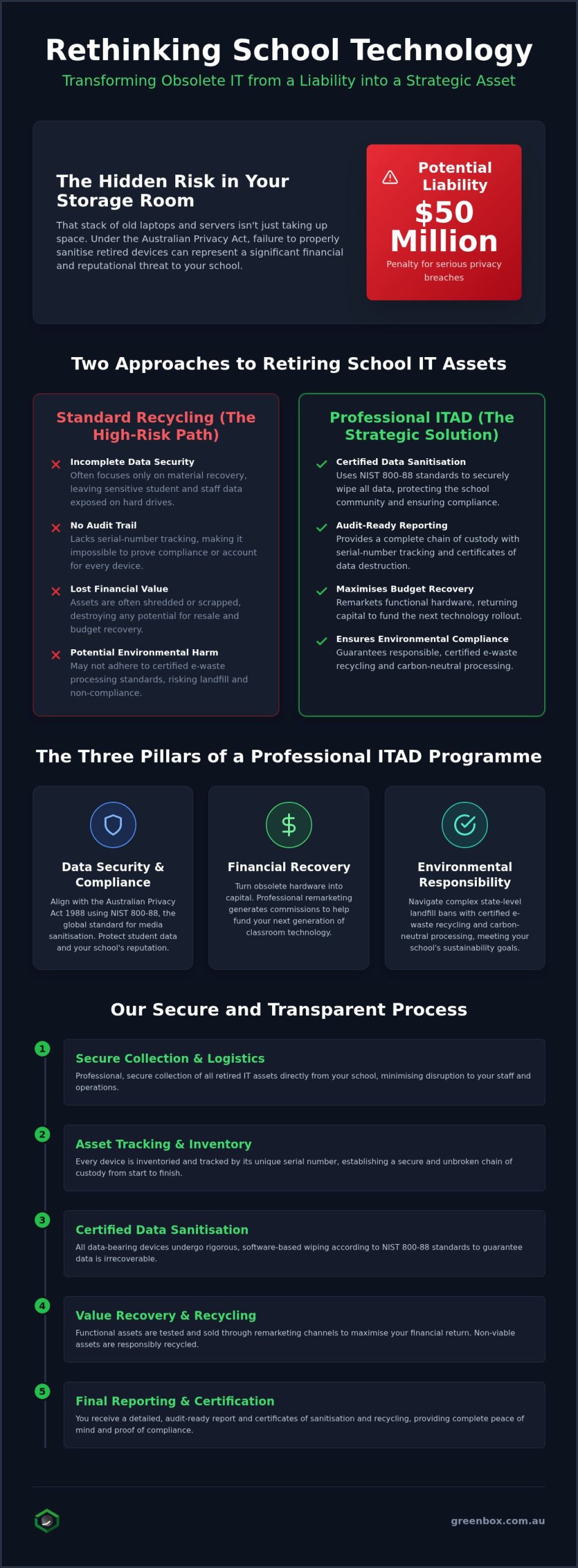
We understand that managing retired hardware feels like a thankless operational task. However, this guide demonstrates how a structured framework for IT asset disposition for schools Australia can turn that storage room into a source of capital. You’ll learn how to secure sensitive student data through rigorous sanitisation, meet your school’s environmental obligations, and recoup significant budget value through professional remarketing commissions.
By implementing a professional ITAD strategy, you can move from reactive disposal to a proactive, audit-ready system. We’ll walk through the essential steps to ensure your organisation remains compliant, sustainable, and financially resilient as we move through 2026.
Key Takeaways
- Protect your school community by aligning with the Australian Privacy Act 1988 through secure data sanitisation that exceeds simple physical destruction.
- Discover how to transform obsolete hardware into liquid capital by utilising remarketing commissions to fund your next technology rollout.
- Navigate complex environmental obligations and state-level landfill bans with carbon-neutral processing and certified e-waste recycling.
- Implement a professional framework for IT asset disposition for schools Australia to ensure every device is tracked, cleared, and accounted for in an audit-ready report.
- Reduce the operational burden on your staff by partnering with a strategist that manages the entire transition from secure collection to final certification.
What is IT Asset Disposition (ITAD) for Australian Schools?
IT asset disposition (ITAD) is often misunderstood as a simple trip to the local tip or a bulk pickup by a generic recycler. For educational leaders, IT asset disposition for schools Australia is the rigorous, end-to-end framework for decommissioning hardware that ensures total data security, financial recovery, and environmental compliance. It represents a shift from merely getting rid of old gear to a disciplined management strategy that protects the school’s reputation and its bottom line.
Schools manage a complex ecosystem of hardware that differs significantly from a standard corporate environment. You are responsible for high volumes of school-issued laptops, administrative servers, and often a diverse array of student-owned devices. This high turnover of technology requires a systematic process for decommissioning, sanitising, and disposing of hardware to prevent sensitive information from ever leaving the campus. Professional ITAD ensures that the transition from the classroom to the secondary market or recycling centre is handled with corporate-level precision.
The Lifecycle of School Technology
The most vulnerable moment for school security occurs when a device is removed from the network but hasn’t yet been professionally wiped. While the deployment phase receives significant attention, the decommission stage is where the risk of a data breach is highest. Every laptop, tablet, and server in your facility is a data-bearing asset. Even interactive whiteboards and network printers can store sensitive credentials or student records that require professional attention.
Many schools struggle with the operational burden of stockpiled tech. Storage rooms filled with obsolete hardware aren’t just a physical nuisance; they represent a growing security threat and a wasted financial resource. Managing this inventory requires a transition from passive storage to active recovery. This ensures that assets don’t sit idle, losing value while increasing the risk of unauthorised access.
Why “Standard Recycling” Isn’t Enough for Schools
Relying on basic collection services often leaves critical gaps in your security protocol. Standard recycling focuses on the material recovery of Electronic waste (e-waste), often overlooking the data residing on the drives. Physical shredding is a common fallback, yet without software-based sanitisation and a verified audit trail, you cannot prove that the data was destroyed before the hardware reached the scrap heap.
Professional ITAD provides a level of accountability that simple recycling cannot match. Every device is tracked by its unique serial number, providing the school board and parents with the certainty that privacy standards are met. This meticulous planning ensures that your organisation moves beyond basic waste management toward a secure, sustainable future.
Data Security and Compliance: Protecting the School Community
Schools hold some of the most sensitive data in the country. Under the Australian Privacy Act 1988, educational institutions must take reasonable steps to protect personal information from misuse, loss, or unauthorised access. The legal climate in 2026 is less forgiving than ever. With the statutory tort for serious invasion of privacy now in effect, individuals have direct legal remedies for privacy breaches. A serious or repeated interference with privacy can result in penalties of up to $50 million, making IT asset disposition for schools Australia a critical risk-mitigation strategy. It isn’t just about the hardware. It’s about the student records, staff details, and financial data residing on those drives. Failing to manage this transition properly risks a reputation-damaging event that could take years to repair.
NIST 800-88 Standards in the Classroom
The NIST 800-88 standard is the global benchmark for media sanitisation. In previous years, schools often relied on physical destruction, like shredding, to ensure data security. However, modern Solid State Drives (SSDs) found in almost all student laptops today are not susceptible to traditional degaussing. Software-based sanitisation according to NIST standards ensures that every block of data is overwritten and verified through a rigorous, documented process. This approach allows the hardware to remain functional. It enables the school to recover value through asset remarketing while ensuring total data privacy. This shift from destruction to sanitisation supports both security and school sustainability goals.
Chain of Custody and Audit Readiness
A professional disposal process requires a documented chain of custody. This means tracking every device from the moment it leaves your school gate until it reaches a secure processing centre. For IT Managers, the “Certificate of Destruction” is the most important document in the asset lifecycle. It provides the legal proof required for internal audits and government oversight.
Guidelines from the NSW Department of Education on waste highlight the importance of managing e-waste as a distinct and sensitive stream. By maintaining serial-number level reporting, schools can confidently face Department of Education audits. This level of transparency ensures that every asset is accounted for. It leaves no room for “lost” devices that could lead to a breach. If you’re looking to streamline this process, engaging an expert in data sanitisation and destruction can remove the administrative burden from your internal IT team.
Maximising School Budgets through IT Asset Remarketing
Many schools view hardware disposal as an unavoidable cost centre. However, professional IT asset disposition for schools Australia transforms these logistics into a strategic revenue-generating opportunity. Remarketing is the process of extracting the remaining value from retired hardware by refurbishing it for the secondary market. Unlike simple recycling, which focuses on material recovery, remarketing returns a portion of the resale value directly to the school. By prioritising refurbishment over immediate destruction, schools contribute to a circular economy while providing the bursar with non-dilutive capital to offset new hardware costs.
The financial impact of a well-managed remarketing programme is significant. Instead of paying for a collection service to haul away “junk,” schools can receive remarketing commissions that help fund the next generation of classroom technology. This shift in perspective allows IT managers to view their fleet as a revolving fund rather than a depreciating liability. It’s a pragmatic solution for schools facing shrinking budgets and rising hardware prices.
Determining the Resale Value of School Fleets
Several variables dictate the financial return on a retired fleet. The age of the device is the most critical factor; hardware that is three to five years old typically retains the highest demand on the secondary market. Specifications such as processor speed, RAM, and the physical condition of the chassis also play a significant role. Bulk laptop refreshes are ideal for these programmes because they offer consistent, high-volume inventory that is attractive to global buyers. Greenbox provides a transparent value recovery model, ensuring educational clients receive clear reporting on the market value achieved for every asset recovered from their campus.
Remarketing vs. Recycling: A Cost-Benefit Analysis
Deciding between remarketing and recycling requires a pragmatic assessment of the asset’s condition. If a device is broken or significantly outdated, certified e-waste recycling is the necessary path to ensure environmental compliance. For functional equipment, refurbishment is almost always the superior choice. It extends the product’s lifecycle and reduces the demand for new raw materials, which is an environmental bonus for any school’s sustainability report.
This creates a sustainable funding loop. The revenue generated from old tablets and laptops can be directly reinvested into new infrastructure. This strategic approach ensures that the school’s technology budget works harder, allowing for more frequent hardware updates without increasing the financial burden on parents or the school board. It’s about achieving maximum efficiency from every dollar spent on technology.
Environmental Responsibility and E-waste Obligations
The education sector is a significant contributor to Australia’s growing e-waste challenge. Australia generated 588,000 tonnes of e-waste in 2023, a figure projected to climb to 657,000 tonnes by 2030. For school leaders, the environmental impact of retired technology is no longer a peripheral concern. Compliance is a baseline requirement. With state-level landfill bans already active in Victoria and South Australia, managing IT asset disposition for schools Australia requires a certified approach. Professional ITAD ensures that hazardous materials like lead and mercury are diverted from landfill. It provides a transparent, documented path for every component, ensuring your school meets its ethical duty of care to the environment.
Carbon Neutral ITAD: A New Standard for Schools
Modern schools are increasingly evaluated on their Environmental, Social, and Governance (ESG) performance. Partnering with a carbon-neutral organisation allows you to align your technical operations with your school’s broader sustainability targets. This isn’t just a symbolic gesture. It’s a data-driven strategy. You receive specific reports detailing the volume of waste diverted from landfill and the measurable reduction in your carbon footprint. This information is invaluable for annual reports and school board presentations. It proves that your technology lifecycle is managed with the health of the planet in mind, turning a logistics task into a core sustainability metric.
R2 Certification: Why it’s Non-Negotiable
R2 (Responsible Recycling) certification is the global standard for the electronics recycling industry. It protects your school from the severe reputational risks associated with “exported” e-waste. Uncertified recyclers often ship hazardous materials to developing nations, where they are processed in ways that damage local ecosystems and communities. An R2-certified facility guarantees that every non-remarketable asset is handled ethically. This includes the safe disposal of lithium-ion batteries and mercury-containing screens. It ensures that the entire downstream path is fully audited. This level of transparency prevents illegal dumping and protects your organisation from potential environmental fines.
If you’re ready to align your hardware retirement with your sustainability goals, explore our carbon neutral ITAD services to ensure a zero-waste outcome for your retired fleet.
Implementing a Seamless ITAD Programme with Greenbox
Implementing a robust ITAD strategy shouldn’t add to the workload of your already stretched IT department. Greenbox provides a comprehensive, end-to-end service that manages every phase of the hardware transition. From secure collection to final data destruction, we handle the complex logistics. This allows your technical staff to focus on their primary mission: enhancing teaching and learning outcomes. By partnering with an expert in IT asset disposition for schools Australia, you gain national coverage and the peace of mind that comes with a secure, disciplined chain of custody.
We remove the operational burden by providing a single point of accountability. Whether your school operates from a single campus or across a distributed network, our national reach ensures consistent service standards. We provide the heavy lifting, the secure transport, and the technical expertise required to clear your storage rooms and secure your data. This pragmatic approach ensures that your school remains compliant without diverting resources from the classroom.
Planning Your Next Hardware Refresh
Integrating disposal into your technology rollout schedule is the most efficient way to manage a fleet update. We offer pre-configuration and imaging services that allow you to deploy new gear while simultaneously recovering the old. This dual-track approach ensures that as soon as new laptops are in student hands, the old ones are securely removed for processing. Our logistics teams are experienced in working within the school calendar. We coordinate bulk collections during term breaks or low-impact periods to ensure a seamless transition that avoids classroom disruption.
The Greenbox Commitment to Education
We have a long history of managing high-security transitions for the government and education sectors. Our R2-certified facilities ensure that every device is handled according to the highest global standards for data security and environmental responsibility. We provide serial-number level reporting and verified certificates of sanitisation. This gives you the documentation needed for any internal or department-level audit. We don’t just act as a service provider. We act as a transparent partner committed to your school’s financial health and environmental targets.
If you’re ready to secure your student data and maximise the value of your retired assets, we invite you to Request a consultation for your school’s ITAD requirements. Our specialists will provide a customised assessment tailored to your specific fleet and budget goals.
Securing the Future of Your School’s Technology Lifecycle
Managing a technology fleet in 2026 requires more than just logistical planning. It demands a strategic approach that balances rigorous data security with fiscal and environmental responsibility. By transitioning to a professional framework for IT asset disposition for schools Australia, your organisation can effectively mitigate the risks of the Australian Privacy Act 1988 while transforming obsolete hardware into a viable funding source for future rollouts. It’s a pragmatic shift that ensures your student data is protected and your budget is utilised to its maximum potential.
Greenbox provides the steady, experienced hand needed to navigate these complex transitions. With R2v3 certified facilities and national Australian coverage, we ensure every device is handled with the highest level of precision and ethical care. As a carbon-neutral organisation, we help you achieve your school’s sustainability targets without adding an operational burden to your IT team. You can move forward with the confidence that your technical success and responsible practice are perfectly aligned.
Secure your school’s data and recover asset value with Greenbox today. We are ready to help you turn your tech disposal into a strategic advantage for your school community.
Frequently Asked Questions
Does our school receive a certificate after the data is destroyed?
Yes, every school receives a formal Certificate of Destruction for every asset processed. This document serves as your legal record of compliance under the Australian Privacy Act 1988. It includes serial-number level reporting to ensure every device is accounted for during departmental audits. Having this verified proof of data sanitisation protects your school’s reputation and provides the necessary audit trail for the school board and education departments.
Is it better to shred hard drives or use software sanitisation for school laptops?
Software-based sanitisation following NIST 800-88 standards is the superior choice for modern SSDs found in school laptops. Unlike physical shredding, software sanitisation securely wipes all data while keeping the hardware functional. This allows your school to recover value through asset remarketing rather than just paying for scrap. Shredding is reserved for devices that are physically damaged or so obsolete that they have no remaining functional life.
Can our school actually make money back from old IT assets?
Yes, schools can recoup significant funds through asset remarketing commissions. When your retired hardware is refurbished and resold on the secondary market, a portion of that value is returned to your school’s budget. This revenue stream is a practical way to offset the costs of new technology rollouts. By treating IT asset disposition for schools Australia as a value-recovery exercise, you can stretch your hardware budget further each year.
What happens to devices that are too old to be resold?
Devices that have no secondary market value are processed through certified e-waste recycling. We ensure that every component is broken down and diverted from landfill in accordance with state and federal regulations. Our R2-certified facilities manage the ethical recovery of raw materials, including the safe handling of hazardous elements like lead and mercury. This ensures your school meets its environmental obligations even when hardware has reached its absolute end of life.
Does Greenbox provide the logistics and transport for the equipment?
Greenbox manages the entire logistics process, providing secure transport from your school gate to our processing centres. We offer national coverage across Australia, ensuring consistent service regardless of your school’s location. Our teams handle the heavy lifting and secure packing, which removes the operational burden from your internal IT staff. This managed chain of custody ensures your devices are tracked and protected every step of the way during the transition.
How does ITAD help our school meet its sustainability goals?
Professional ITAD supports your sustainability targets by prioritising the circular economy. By refurbishing and remarketing functional devices, we extend the lifecycle of technology and reduce the demand for new raw materials. As a carbon-neutral organisation, we provide detailed reporting on the volume of waste diverted from landfill and the resulting carbon footprint reduction. This data is essential for your school’s environmental reporting and demonstrates a commitment to modern ethical standards.
What certifications should we look for in an Australian ITAD provider?
You should prioritise providers with R2 (Responsible Recycling) certification and carbon-neutral status. R2 certification ensures the highest global standards for data sanitisation and ethical downstream recycling. It protects your school from the risks of illegal e-waste exporting. Additionally, look for providers that comply with NIST 800-88 for data destruction. These credentials guarantee that your IT asset disposition for schools Australia is handled with the precision and integrity required for the education sector.
Can we use ITAD services for staff-owned or BYOD devices?
Yes, our services can be utilised for any device that has been used within the school environment, including BYOD or staff-owned hardware. This is particularly useful during bulk end-of-year refreshes where schools want to ensure that any student data residing on these devices is professionally wiped before the hardware is retired or resold. We apply the same rigorous data sanitisation and destruction protocols to these assets to maintain your school’s privacy standards.