

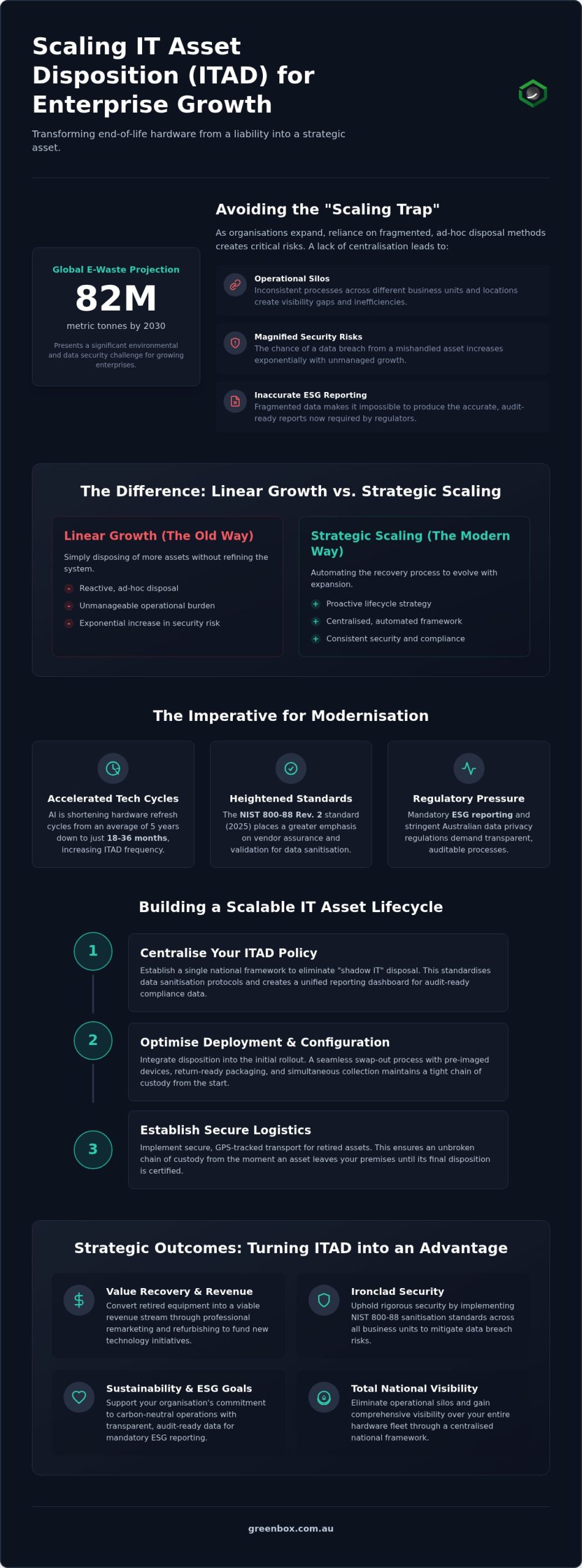
What if your retired hardware wasn’t a logistical liability, but the primary capital source for your next digital transformation? As you look toward scaling ITAD for enterprise growth in 2026, you likely feel the pressure of managing fragmented disposal processes across multiple business units. Meeting increasingly rigid ESG and carbon-neutral reporting targets is no longer optional. The fear of a data breach from mishandled end-of-life hardware is a constant weight on any IT leader’s shoulders, particularly with global e-waste generation projected to reach 82 million metric tonnes by 2030.
We understand that as your organisation expands, your legacy systems shouldn’t hold you back. This article will show you how to transform your asset disposition from a burden into a scalable, secure, and revenue-generating engine. You’ll discover how a centralised national framework and automated, audit-ready reporting can provide total visibility. We’ll also detail how to maximise value recovery from retired assets to fund new initiatives, turning a technical necessity into a strategic advantage for your firm’s future.
Key Takeaways
- Centralise fragmented disposal processes to eliminate operational silos and gain comprehensive national visibility over your entire hardware fleet.
- Adopt an end-to-end lifecycle approach that seamlessly connects pre-configuration and imaging with secure, final-stage asset recovery.
- Uphold rigorous security by implementing NIST 800-88 sanitisation standards across all business units to mitigate the risk of data breaches during expansion.
- Convert retired equipment into a viable revenue stream through professional asset remarketing and refurbishing strategies that fund future projects.
- Discover how scaling ITAD for enterprise growth supports your organisation’s commitment to carbon-neutral operations and mandatory ESG reporting.
Beyond Ad-hoc Disposal: Why Scalable ITAD is a Growth Requirement
Scalable ITAD represents the systematic recovery and sanitisation of technology assets that evolves in lockstep with organisational expansion. It is no longer a back-office logistics task. Instead, scaling ITAD for enterprise growth requires a transition from reactive, ad-hoc disposal to a proactive lifecycle strategy. This approach ensures that as your footprint increases, your security and compliance protocols remain robust and uniform across every business unit.
Many organisations fall into the “Scaling Trap” when expanding nationally. They rely on fragmented, local disposal methods that vary from branch to branch. This lack of centralisation creates visibility gaps. It makes it nearly impossible to produce accurate, audit-ready ESG reports or guarantee consistent data destruction. When disposal is unmanaged, it threatens corporate reputation and complicates the speed of new technology deployment. A foundational step in this process involves understanding electronic waste and its environmental implications, as these factors now directly influence corporate governance and shareholder expectations.
The Difference Between Growth and Scalable ITAD
Growth is simply disposing of more computers; scaling is automating the recovery process. If an organisation doubles its hardware volume without refining its systems, the operational burden becomes unmanageable. Linear growth in ITAD volume leads to exponential increases in security risks. Without a centralised framework, the likelihood of a single drive slipping through the cracks rises significantly. This shift requires moving from “disposal as an afterthought” to “disposition as a strategy”, where every asset’s end-of-life is planned at the point of procurement.
Why 2026 is the Year for Lifecycle Modernisation
The landscape has shifted. With the National Institute of Standards and Technology releasing NIST 800-88 Revision 2 in 2025, there is a heightened emphasis on vendor assurance and validation. Australian data privacy regulations and mandatory ESG reporting now demand a level of transparency that manual spreadsheets cannot provide. Simultaneously, the rise of AI is shortening hardware refresh cycles from five years down to 18-36 months for specific servers. This increased frequency makes traditional e-waste methods obsolete. Scalable ITAD is a core pillar of modern enterprise governance.
Building a Scalable IT Asset Lifecycle: From Deployment to Disposition
To achieve scaling ITAD for enterprise growth, a business must view the asset lifecycle as a continuous loop rather than a linear path. This model integrates configuration, deployment, and disposition into a single, cohesive workflow. By centralising these functions, enterprises gain the national visibility required to manage thousands of assets across diverse locations without losing control. Integrating disposition requirements into the initial hardware rollout phase simplifies future recovery and ensures that no asset is left unaccounted for at the end of its primary use.
Step 1: Centralise Your ITAD Policy
Localised “shadow IT” disposal habits often emerge when regional offices lack a clear directive. Establishing a single national framework eliminates these inconsistencies and ensures every branch follows the same rigorous standards. Standardising data sanitisation protocols across all business units protects the organisation from regional compliance gaps. This centralisation facilitates a unified reporting dashboard, providing audit-ready compliance data that is essential for modern corporate governance.
Step 2: Optimise Deployment and Configuration
Efficiency begins long before an asset is retired. Utilising specialised pre-configuration and imaging services during the initial rollout reduces the technical burden on internal IT teams. When bulk deployment logistics are designed to mirror recovery processes, the future transition becomes predictable and manageable.
To transition staff to new hardware seamlessly, follow these steps:
- Distribute pre-imaged devices to end-users via standardised, secure courier routes.
- Provide clear instructions and return-ready packaging for the legacy hardware being replaced.
- Schedule a simultaneous collection of the old asset to maintain an immediate chain of custody.
- Verify serial numbers against the central registry to close the lifecycle loop and trigger automated reporting.
Step 3: Establish Secure Logistics and Chain of Custody
Secure transport is the backbone of any national strategy. It is vital to ensure every device is tracked from the moment it leaves a desk until it arrives at a certified processing facility. While following EPA guidelines for electronics recycling helps maintain environmental standards, data security requires a more rigorous, documented chain of custody. National coverage is essential; it guarantees that service levels and security protocols remain consistent whether an asset is in a major CBD or a remote regional office. For organisations managing complex transitions, partnering with a specialist in IT Asset Recovery ensures that logistics never become a bottleneck during periods of rapid expansion.
Maintaining Governance and Security Standards at Scale
A common concern for executive leadership is that scaling ITAD for enterprise growth inevitably increases the risk of data breaches. In reality, the greatest security threats often stem from fragmented, ad-hoc processes where hardware is left in unsecured storage or handled by uncertified local vendors. Transitioning to a centralised, national framework replaces these vulnerabilities with a steady, disciplined strategy. By utilising R2-certified facilities, organisations ensure that every asset is processed under the most rigorous global standards for data security and environmental responsibility.
Central to this security framework is the National Institute of Standards and Technology (NIST) 800-88 Revision 2 standard. This protocol provides a structured approach to media sanitisation, moving beyond simple deletion to ensure data is unrecoverable. Adhering to these standards is essential for maintaining compliance with the Australian Privacy Act and other industry-specific regulations. It’s impossible to achieve this level of vendor assurance through uncoordinated regional disposal efforts that lack uniform validation.
Certified Data Sanitisation vs. Physical Destruction
Software-based data sanitisation offers a superior outcome for both security and sustainability. While physical shredding is often perceived as the ultimate security measure, it is frequently less secure for high-density modern drives and certainly less sustainable. Software-based wiping allows for asset remarketing, converting retired hardware into a revenue stream that offsets the cost of new rollouts. By preserving the functional integrity of devices, enterprises can significantly improve their ROI while avoiding the environmental impact of unnecessary destruction. This reuse-first hierarchy is a core metric for any organisation pursuing carbon-neutral targets.
Automating Compliance and Reporting
Scaling requires moving away from manual spreadsheets toward automated, audit-ready reporting. Modern ITAD partnerships provide comprehensive “Certificates of Destruction” and sanitisation reports that are generated automatically for every serial number. This transparency is critical for government and financial sector audits, where a clear chain of custody must be demonstrated. A centralised reporting portal provides real-time visibility into the asset journey, ensuring that every piece of hardware is tracked from the moment it leaves the desk until its final disposition is confirmed. This methodical approach provides the peace of mind required for complex, large-scale transitions.
Value Recovery: Turning ITAD into a Revenue Stream
When scaling ITAD for enterprise growth, the financial objective shifts from minimising costs to maximising returns. Retired hardware should not be viewed as a logistical burden. Instead, it represents a significant capital asset that can fund future technology rollouts. By integrating professional asset remarketing into the disposition process, organisations can transform their ITAD programme from a cost centre into a self-sustaining revenue engine. This pragmatic approach ensures that the value remaining in functional hardware is captured and reinvested back into the business.
Remarketing vs. Recycling: The Financial Impact
Choosing between remarketing and recycling depends largely on the age and condition of the equipment. While recycling focuses on material recovery, remarketing focuses on extending the lifecycle of functional devices. For assets less than four years old, the resale value often exceeds the total cost of the disposition process. This supports a circular economy and aligns with corporate ESG goals by reducing the demand for new raw materials. The raw materials in global e-waste were estimated to be worth approximately $57 billion in 2019, yet the value of functional, refurbished units is significantly higher.
| Metric | Asset Remarketing | E-waste Recycling |
|---|---|---|
| Financial Outcome | Revenue generation / Positive ROI | Operational cost / Disposal fee |
| Environmental Impact | Circular economy / Lifecycle extension | Material recovery / Landfill diversion |
| Strategic Value | Offsets cost of new hardware | Meets baseline compliance |
High-value assets for resale are typically identified by their technical specifications and physical grade. Meticulous asset management, including professional cleaning and minor refurbishments, can significantly increase the final resale price. This level of precision ensures that the enterprise receives the highest possible return on its original investment.
Funding Future Innovation with Retired Assets
Strategic disposition allows organisations to reduce their Total Cost of Ownership (TCO) across the entire fleet. For example, an enterprise refreshing 5,000 laptops can often fund up to 20 per cent of the new fleet’s cost simply through the remarketing of the retired units. This provides a steady stream of capital that can be diverted toward innovation and digital transformation projects. Greenbox retains a commission only upon successful resale, aligning interests and ensuring a shared focus on achieving the best market price. To begin optimising your hardware returns, consider a professional consultation for Asset Remarketing to identify the hidden value in your current inventory.
Partnering for National Scale: The Greenbox Advantage
Managing a patchwork of regional providers introduces unnecessary complexity and risk; a single national partner provides the consistency required for true scalability. Choosing the right partner is the final, most critical step in scaling ITAD for enterprise growth. A national framework ensures that every site across Australia and New Zealand adheres to the same rigorous sanitisation and reporting standards. This unified approach eliminates administrative bloat and provides a single source of truth for your entire hardware fleet.
Greenbox stands as a carbon-neutral organisation, directly aligning with the mandatory ESG and carbon-neutral reporting targets that modern enterprises face in 2026. Our R2-certified facilities, including current R2v3 standards, provide a secure foundation for every stage of the asset journey. By maintaining these high-level certifications across our entire national network, we guarantee that your data security and environmental responsibilities are never compromised by regional service gaps. This level of precision is essential for organisations in the government, education, and financial sectors where the stakes for data protection are highest.
A Steady Hand for Complex Transitions
We act as a steady, experienced hand for complex, large-scale transitions, particularly as organisations navigate the rapid hardware refresh cycles driven by AI and cloud migration. Our end-to-end model removes the operational burden from internal IT teams by seamlessly integrating pre-configuration and imaging with secure disposition. This allows your technical staff to focus on high-value innovation rather than the logistics of asset recovery. We understand the high-stakes nature of enterprise data and provide the disciplined strategy needed to protect it at every transition point.
Ready to Scale Your ITAD Strategy?
Transitioning to a scalable model begins with a clear understanding of your current state. We recommend conducting an initial asset audit to identify fragmented processes and hidden value in your retired inventory. This baseline allows for the development of a tailored lifecycle management proposal that meets your specific security and sustainability goals. Our team provides the visibility and transparency required to move from reactive disposal to a strategic, revenue-generating engine. If you are ready to modernise your approach, enquire about Greenbox’s national ITAD services today to secure your organisation’s growth and environmental legacy.
Strategic Resilience through Scalable Lifecycle Management
Transitioning from fragmented disposal to a centralised framework is the definitive move for modern IT leaders. By aligning your hardware lifecycle with rigorous sanitisation standards and professional remarketing, you transform a legacy burden into a strategic asset. Scaling ITAD for enterprise growth in 2026 requires this level of precision to meet mandatory ESG targets and protect against the rising complexity of data breaches. It’s about more than just clearing desk space; it’s about funding future innovation through the value hidden in your current fleet.
As a carbon-neutral organisation with R2-certified facilities, Greenbox provides the high-level security required by the government and financial sectors. We offer a steady hand for your most complex transitions, ensuring every asset is tracked and every risk is mitigated. Secure your enterprise growth with Greenbox’s national ITAD framework and gain the peace of mind that comes with a disciplined, end-to-end strategy. Your organisation is ready for its next phase of expansion, and your technology lifecycle should be the engine that drives it forward.
Frequently Asked Questions
What is the difference between ITAD and e-waste recycling?
ITAD encompasses the entire end-of-life process, including secure data sanitisation and asset recovery, whereas e-waste recycling focuses primarily on material recovery and landfill diversion. ITAD is a strategic business function that prioritises data security and financial return. While recycling breaks devices down into raw components, ITAD seeks to extend the lifecycle of functional hardware through refurbishment. This distinction is vital when scaling ITAD for enterprise growth to maximise value.
How does scalable ITAD support my company’s ESG and carbon-neutral goals?
Scalable ITAD ensures that as your organisation grows, your environmental footprint remains controlled through circular economy principles. Greenbox operates as a carbon-neutral organisation, providing the documented evidence required for mandatory ESG reporting. By prioritising the reuse of functional assets over immediate recycling, you significantly reduce the carbon intensity of your technology fleet. This methodical approach provides transparent, audit-ready data that aligns with modern corporate sustainability benchmarks.
Is software-based data sanitisation really as secure as physical shredding?
Software-based data sanitisation adhering to NIST 800-88 standards is just as secure as physical destruction while being far more sustainable. Unlike shredding, which renders hardware useless, certified wiping ensures data is unrecoverable but keeps the device functional for remarketing. This allows enterprises to recover value from retired assets. It also prevents the environmental waste associated with shredding high-density modern drives that could otherwise be refurbished and reused.
Can ITAD services help fund our next technology refresh cycle?
Asset remarketing can significantly offset the capital expenditure required for new hardware rollouts. By refurbishing and reselling functional laptops, servers, and desktops, organisations can often recover a percentage of their original investment. This revenue stream can be directly reinvested into your next technology refresh cycle. It effectively lowers the Total Cost of Ownership (TCO) for your entire fleet while turning a logistical necessity into a financial advantage.
What certifications should I look for in a national ITAD partner?
A national ITAD partner should hold R2 certification, such as the current R2v3 standard, which governs the responsible recycling and reuse of electronics. You should also verify ISO certifications for quality management and environmental safety. Partnering with a carbon-neutral organisation is increasingly important for meeting corporate ESG mandates. These credentials ensure that your disposition partner operates with a disciplined strategy that protects both your data and your reputation.
How does Greenbox ensure data security during the transport of retired assets?
Greenbox maintains a rigorous chain of custody through secure logistics and tracked transportation protocols. Every asset is scanned and recorded the moment it leaves your facility, ensuring total visibility throughout the journey. We use vetted personnel and secure vehicles to mitigate risks during transit to our R2-certified facilities. This methodical approach provides the peace of mind required for high-stakes transitions in the government and financial sectors.
What types of IT assets are eligible for remarketing and value recovery?
A wide range of corporate hardware is eligible for remarketing, including laptops, desktops, servers, and networking equipment. Generally, functional devices less than four years old hold the highest resale value. Mobile devices and high-end tablets are also frequently refurbished. By conducting a professional asset audit, we can identify which items in your inventory are suitable for recovery and which should proceed to certified e-waste recycling.
Does Greenbox provide ITAD services for the government and education sectors?
Greenbox is a specialist provider for the government and education sectors, understanding the unique compliance and security requirements of these fields. We provide the transparent reporting and certified data destruction necessary to meet strict public sector standards. Our national framework allows us to manage large-scale transitions for universities and government departments across Australia and New Zealand. This expertise ensures a steady, reliable hand for even the most complex institutional rollouts.