

A factory reset can make a business phone look empty, but it doesn’t automatically make it safe to leave your organisation. For mobile device disposal Australia, the priority is clear: protect company and employee data first, then identify devices that can be reused, remarketed or recycled. With phones and tablets spread across teams and locations, the process needs to be controlled and documented, not left to ad hoc handovers.
A straightforward process can protect sensitive information without sending usable equipment straight to e-waste. This guide explains how to plan a documented retirement pathway, prepare devices for appropriate data sanitisation, coordinate collection across a dispersed fleet and direct each asset towards its best next use.
Greenbox brings data sanitisation and destruction, IT asset recovery, asset remarketing and e-waste recycling into a coordinated lifecycle process. Founded in 2000, Greenbox operates R2-certified facilities and is a carbon-neutral organisation. Its services help Australian organisations manage mobile assets with security, visibility and responsible recovery in view.
Key Takeaways
- Build a documented mobile device disposal Australia process that tracks devices from inventory and approval through collection and reporting.
- Give employees clear preparation steps, while keeping organisational responsibility for data-bearing devices with the relevant business teams.
- Match each device to redeployment, remarketing or recycling based on its condition and intended next use.
- Set clear responsibilities for IT, procurement, information security and device users to coordinate fleet retirement.
- Connect sanitisation, asset recovery, remarketing and responsible e-waste processing through a managed recovery pathway.
Mobile device disposal in Australia: why businesses need a defined process
For an organisation, mobile device disposal is the controlled retirement of phones, tablets and related equipment. It covers each step, from identifying an asset to deciding whether it can be reused, remarketed or recycled. The process needs to do more than account for the physical device: it should protect data, maintain an accurate asset record and direct equipment towards an appropriate next use.
Household recycling guidance can help individuals find ways to recycle a phone, but it doesn’t address a company fleet’s data, ownership or chain of accountability. A business may have devices assigned to employees, shared across teams or held in different locations. A defined programme brings those assets together for consistent assessment and processing, rather than relying on informal returns or household disposal routes.
Which devices belong in a business disposal programme?
Include company phones and tablets, as well as connected accessories and batteries accepted by the selected processing pathway. Before collection, record each item’s ownership, identifying details and condition. This helps distinguish serviceable devices that may be suitable for reuse from damaged or end-of-life equipment that needs a different outcome.
A basic inventory also supports accountability. Teams can reconcile what was issued with what has been returned, flag missing assets and document the intended pathway. Condition matters, but it shouldn’t determine the outcome by itself. A working device still needs appropriate data controls before it can move on.
Why is mobile device disposal a data governance issue?
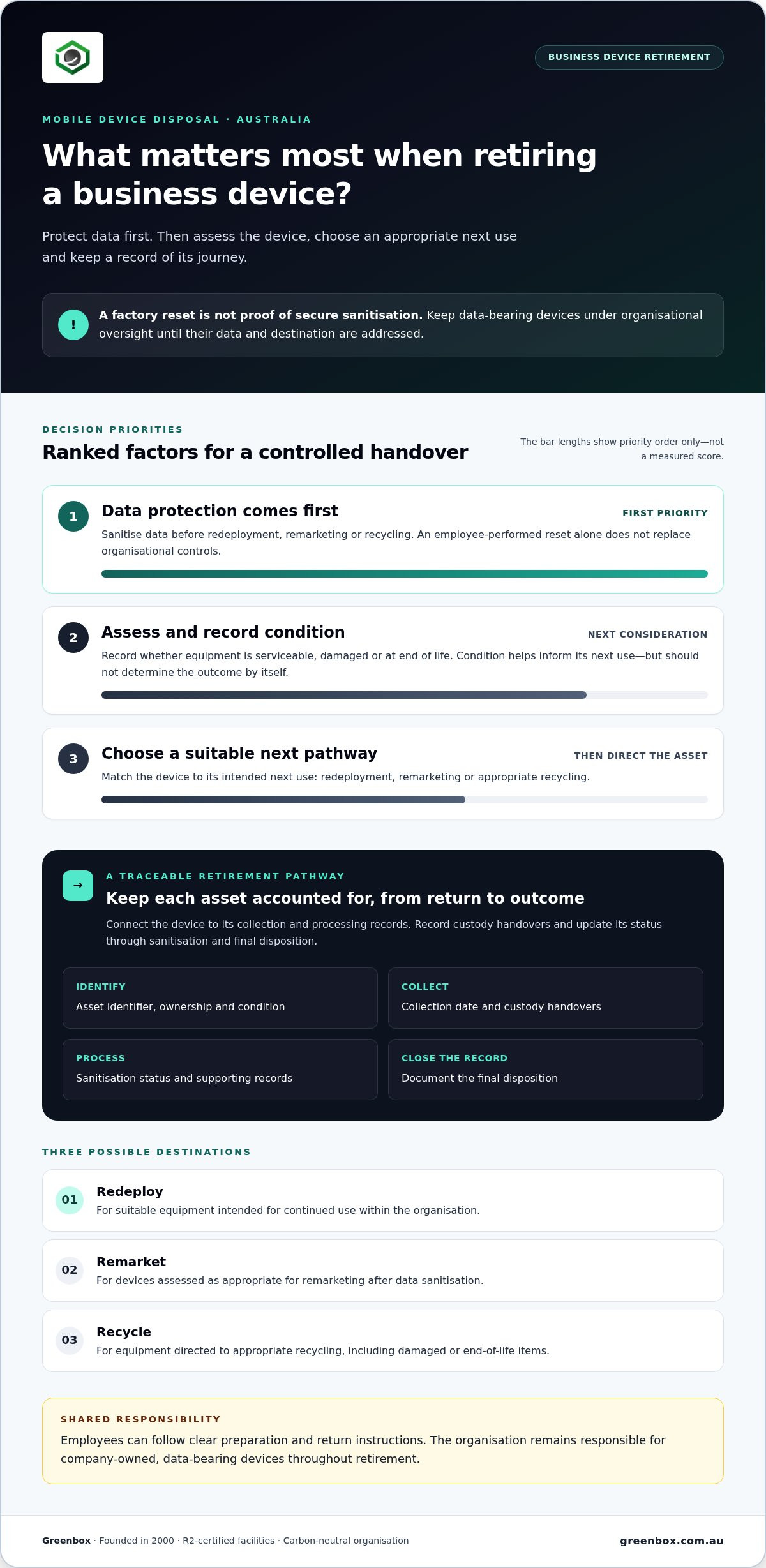
Business devices may hold work files, messages, saved credentials and personal information. A factory reset can remove visible content, but it shouldn’t be treated as proof that data has been securely sanitised. Account for data-bearing devices before they leave organisational oversight, including equipment returned by employees.
Secure mobile device disposal is the controlled retirement of a device, with its data addressed and its next destination recorded before it leaves organisational control. Employees can follow clear preparation instructions, but the organisation remains responsible for managing company assets and confirming their disposal pathway.
Responsible recovery connects data controls with environmental care. Devices suitable for continued use can retain value, while equipment that has reached end of life can be directed to appropriate recycling. The overview of mobile phone recycling explains how recycling can recover materials from phones and reduce the need to treat them as general waste. This guide focuses on organisational processes for business devices in Australia, not household drop-off instructions.
Secure mobile device disposal: sanitise data before devices leave your control
Data sanitisation should happen before a device is redeployed, remarketed or recycled. A phone may appear blank after a factory reset, but that alone doesn’t provide evidence that its data has been sanitised appropriately. Treat sanitisation as a defined processing control, not a task that ends when an employee taps “reset”.
For organisations planning mobile device disposal Australia wide, connect each device to its collection and processing records. Capture an asset identifier, record who has custody at each handover, and update the device’s status as it moves through sanitisation and towards its next pathway. This creates a traceable record and helps teams follow up on assets without a recorded outcome.
What should staff do before returning a work phone?
Give employees clear, consistent return instructions. Staff can back up approved work information through organisational systems, remove personal accounts where directed and return the device through the designated collection process. They shouldn’t discard company-owned equipment or pass it on informally.
An employee-performed factory reset shouldn’t replace the organisation’s sanitisation controls. Staff preparation supports a smooth handover, while the organisation remains responsible for managing the data-bearing asset throughout its retirement process.
What should the organisation record during sanitisation?
Maintain records that link each asset to its custody and processing journey. Depending on the workflow, these may include the device identifier, collection date, custody handovers, condition, sanitisation status and final disposition. Retain sanitisation and processing records as supporting evidence, and label each record accurately.
Choose sanitisation procedures that suit the device and your organisation’s requirements, and document the outcome. Avoid claiming a particular standard or method unless it has been verified for the process being described. For practical information about phone recycling, including collection processes, see the official mobile phone recycling program.
A consistent approach helps information security teams oversee data controls, IT reconcile device records, and procurement track assets through retirement. Greenbox’s certified data sanitisation guide provides further detail on building a considered sanitisation process. For a managed pathway that connects sanitisation with recovery and responsible processing, explore Greenbox’s business IT asset recovery.
Reuse, remarketing or recycling: compare mobile device disposal pathways
Once a device has been sanitised, its condition and suitability for business use can guide its next step. A working phone may be suitable for redeployment or remarketing, while a damaged or obsolete device may be better directed to e-waste recycling. In a mobile device disposal Australia programme, separating these pathways helps organisations retain usable assets and manage end-of-life equipment responsibly.
| Pathway | Suitable condition | Data control | Intended outcome |
|---|---|---|---|
| Reuse or redeployment | Fit for purpose and suitable for continued organisational use | Sanitise before preparing the device for its next user | Extend useful life within the organisation |
| Remarketing | Functional and assessed as suitable for a new owner | Sanitise before transfer or sale | Recover potential asset value through resale |
| Recycling | Damaged, obsolete or unsuitable for reuse or remarketing | Sanitise before recycling where data-bearing components are present | Direct equipment and recoverable materials to responsible processing |
When should a business consider reuse or remarketing?
Consider reuse when a device remains fit for its intended role and can be securely sanitised. For example, an organisation may redeploy a suitable phone for another team member rather than replace it with a new unit. Remarketing may suit devices that have been assessed and are no longer needed internally. Any financial return depends on factors such as condition and assessment, so it shouldn’t be assumed or guaranteed.
Record the assessment, sanitisation status and chosen destination. These asset records help teams explain decisions, reconcile equipment and support internal reporting.
When is recycling the appropriate outcome?
Direct damaged, obsolete or otherwise unsuitable equipment to responsible e-waste processing. Batteries need appropriate handling and shouldn’t be placed in general waste. Keep them with the device or separate them only in line with the collection and processing instructions for the selected pathway.
Reuse extends a device’s service, remarketing transfers it to a new owner, and recycling recovers materials when further use isn’t suitable. Sanitisation comes first in every pathway, before redeployment, remarketing or recycling.
For a broader framework on responsible end-of-life technology decisions, read Greenbox’s secure, sustainable IT disposal guide. A consistent assessment and recordkeeping process helps your organisation direct each device to an appropriate outcome without assuming every asset will retain resale value.
How to organise mobile device disposal across an Australian organisation
A repeatable workflow gives teams a consistent way to retire devices, even when employees and equipment are spread across the country. For mobile device disposal Australia wide, centralise the process and records while giving staff clear instructions for returns and handovers.
- Set scope and approvals. Procurement and IT identify devices due for retirement, confirm ownership and obtain the required internal approvals. Information security sets data-handling controls before an asset moves to its next pathway.
- Reconcile the inventory. IT checks device identifiers against the asset register and records condition, assigned user and associated accessories. Flag missing, damaged or unaccounted-for items for follow-up.
- Prepare the collection. Tell employees how to return devices and where approved handovers will occur. Plan for accessories and batteries, and identify damaged equipment so it can be handled appropriately during logistics.
- Collect and track custody. Record which assets have been received and each custody handover. Use the same process across teams and locations so devices don’t disappear into informal storage or untracked transfers.
- Process and report. Apply the organisation’s sanitisation controls, assess the devices, then record whether each is redeployed, remarketed or recycled. Reconcile final outcomes against the original register and document exceptions.
How should teams prepare a mobile device collection?
Before collection, IT and procurement should reconcile ownership, condition and accessories, then identify discrepancies. Device users need straightforward return instructions and approved handover points, not informal arrangements. Information security should define how data-bearing assets are controlled through collection and processing. Identify damaged devices and batteries in advance so their handling can be planned appropriately.
Clear roles prevent gaps: users return equipment and report issues; IT maintains device records and coordinates technical preparation; procurement manages approvals and asset accountability; information security oversees data controls and reviews relevant processing evidence.
What records help close the disposal process?
Compare collected assets with the original register. Record missing items, identifier mismatches, damage and other exceptions, then retain available sanitisation, recovery and recycling records in line with organisational policy. Reporting should show the status and outcome of each asset, not just the number of devices sent for processing.
Inventory and approve, prepare and collect, sanitise and assess, then reconcile outcomes and report. This sequence gives teams a practical framework for maintaining oversight from the first register check to final disposition.
For further guidance on business e-waste processes, read Greenbox’s Australian e-waste business guide. Greenbox’s IT asset recovery services connect recovery, sanitisation and responsible processing for organisations.
Greenbox mobile device disposal: a managed route from recovery to responsible processing
For organisations managing phones and tablets across teams, a business-focused recovery partner can bring data controls, asset assessment and end-of-life processing into one coordinated programme. Greenbox supports mobile device disposal Australia wide through services that connect data sanitisation and destruction with IT asset recovery, asset remarketing and e-waste recycling.
These steps work together. Sanitisation addresses data before a device is assessed for reuse or remarketing. Asset recovery helps establish an appropriate next pathway, while recycling directs equipment that isn’t suitable for further use towards responsible processing. Greenbox was founded in 2000, operates R2-certified facilities and is a carbon-neutral organisation. These credentials describe the organisation and its facilities, rather than guaranteeing a particular outcome for every device.
How does a managed service reduce internal workload?
A coordinated service can reduce the need for internal teams to manage separate handovers for collection, data processing, recovery and recycling. The organisation can work to a defined process, with internal teams providing asset information, approvals and employee instructions while processing is managed as part of the device lifecycle.
A managed service doesn’t remove the need for organisational oversight. IT, procurement and information security still set requirements and maintain appropriate records. It can, however, help reduce fragmented handling and give teams a clearer view of where assets are in the recovery process.
How can organisations align security with sustainability?
Security and environmental objectives can reinforce one another. Once a device has been appropriately sanitised, its condition can be assessed for possible recovery or remarketing. Equipment that isn’t suitable for continued use can instead be directed to e-waste recycling. This avoids treating every retired device as waste while giving end-of-life assets a responsible processing pathway.
Greenbox’s recovery and processing services are designed for business IT hardware, supporting organisations that need a managed approach to retiring mobile assets. A well-planned process can align with the organisation’s fleet, internal controls and reporting needs, without assuming that every device is reusable or will return financial value.
To explore a business process that brings sanitisation, recovery and responsible processing together, discuss a secure device recovery programme with Greenbox.
Make your mobile device retirement process work harder
A disciplined approach to mobile device disposal Australia wide starts with clear ownership and a documented workflow. Sanitise data before devices move to reuse, remarketing or recycling, then record each asset’s pathway. This sequence helps protect information, maintain accountability and make better use of equipment that may still have useful life.
Greenbox brings data sanitisation, IT asset recovery, asset remarketing and e-waste recycling together for business technology recovery. Its Australian operations include R2-certified facilities, and Greenbox is a carbon-neutral organisation. This gives organisations a managed pathway that connects secure handling with responsible processing.
Ready to put a controlled recovery process in place? Discuss a secure device recovery programme with Greenbox to plan how your teams can retire mobile assets while keeping security and sustainability in view.
Frequently Asked Questions
Can Australian businesses recycle mobile phones and tablets?
Yes. Businesses can arrange responsible recycling for phones, tablets and related equipment that’s no longer suitable for use or remarketing. A mobile device disposal Australia programme should first account for each asset and address data security, then direct it to an appropriate recovery pathway. Keep collection and processing records so your organisation can reconcile retired devices and document how they were handled.
How should a business prepare mobile devices for disposal?
Start with an asset register and clear return instructions for employees. Record each device’s identifier and condition, then manage sanitisation through the organisation’s approved process before reuse, remarketing or recycling. Keep devices in controlled custody until processing is complete. Identify damaged equipment and batteries for appropriate handling, then reconcile processing records against the original inventory to close the process.
Is a factory reset enough before disposing of a company phone?
Not necessarily. A factory reset can be a useful preparation step, but it shouldn’t automatically count as proof that business data has been securely sanitised. Use a risk-appropriate sanitisation process, maintain asset and custody records, and retain available processing evidence. The suitable method depends on the device, its storage technology and your organisation’s data security requirements. Employees shouldn’t substitute a reset for organisational controls.
What happens to mobile devices after business disposal?
The outcome depends on each device’s condition and suitability. After appropriate sanitisation, a functional device may be assessed for internal reuse or remarketing. Damaged or unsuitable equipment can be directed to responsible e-waste processing. Batteries and accessories also need appropriate handling. A managed process records each asset’s route and retains available evidence of its final processing, helping the organisation account for equipment after collection.
Can an organisation recover value from retired mobile devices?
Potentially. Functional devices that remain suitable for use may be assessed for remarketing after data sanitisation and condition checks. Any resale outcome depends on factors such as device age, condition and market demand, so organisations shouldn’t assume a return in advance. Asset recovery provides a structured way to assess retired equipment and identify devices with further use, rather than sending every asset directly to recycling.
Should mobile phone batteries go in general waste?
No. Batteries shouldn’t go in general waste because they can create safety and environmental risks during handling and processing. Keep them with the appropriate device or manage them through a suitable battery recovery pathway, following your organisation’s handling procedures. For business fleets, include damaged devices and loose batteries in collection planning. Clear instructions help prevent disposal decisions being left to individual employees.
What records should a business keep when disposing of mobile devices?
Keep an asset register that records device identifiers, ownership, condition and retirement status. Add collection or handover custody details, available sanitisation outcomes and the final reuse, remarketing or recycling pathway. Reconcile processed assets against the original inventory and document exceptions, such as missing devices or mismatched identifiers. Set retention periods and evidence requirements according to your organisation’s governance and applicable obligations.