

Keeping IT asset retirement in-house may feel like the more controllable option. But when collection, data sanitisation, asset tracking and end-of-life processing are spread across busy teams, control can be difficult to demonstrate. A sound business case for outsourced ITAD compares the full effort and outcomes of each approach, not just the service fee.
It’s reasonable to expect secure handling, clear accountability and responsible processing, while also asking whether retired equipment can recover value. Outsourcing isn’t automatically the right choice for every organisation. The decision depends on asset volumes, internal capability, governance requirements and the visibility you need across the asset lifecycle.
This guide provides a practical way to weigh in-house and outsourced ITAD against your organisation’s priorities. You’ll assess internal workload, data security controls, asset recovery and environmental outcomes, then identify the evidence IT, security, finance, procurement and sustainability teams need to support a decision. The goal is a repeatable comparison that turns retirement work into a controlled, measurable lifecycle outcome.
Key Takeaways
- Build the business case for outsourced ITAD around total effort and lifecycle outcomes, not the visible service fee alone.
- Use your organisation’s own figures to compare staff time, coordination, storage, transport and processing on a like-for-like basis.
- Assess how each approach supports custody visibility, data sanitisation evidence, asset tracking and reporting, while keeping governance responsibilities clear.
- Scope a programme by documenting asset types, volumes, locations, timing, data requirements and stakeholder reporting needs.
- Consider how recovery, remarketing and responsible recycling can contribute to measurable financial and environmental outcomes.
Why build a business case for outsourced ITAD now?
Compare lifecycle outcomes, not simply the visible service fee. The business case for outsourced ITAD should account for the internal work required to retire equipment, the controls used to protect data, the value that may be recovered from usable assets and the evidence available for environmental reporting.
In-house retirement involves more than arranging a collection. Teams may need to identify and reconcile assets, prepare equipment, coordinate transport, maintain custody records, oversee sanitisation, decide whether each item can be reused or recycled, and gather evidence for internal reporting. When these tasks sit across separate teams or systems, the effort and gaps in visibility can be easy to miss.
Build the comparison around evidence your organisation can assess: staff time for each activity, controls at each hand-off, the final status of each asset and the processing records retained. The right balance depends on device volumes, refresh cycles, locations and internal capability. A planned, centralised refresh may present a different challenge from equipment retired in smaller batches across multiple sites.
Which business problems can outsourced ITAD address?
Fragmented hand-offs can leave IT, security, procurement, facilities and finance working from different records or timelines. Retired equipment may sit in storage while teams establish who owns it, whether its data has been sanitised or how its final processing will be documented. A coordinated recovery and processing workflow can make the sequence clearer, from collection through sanitisation and recovery assessment to end-of-life processing. That gives decision-makers a firmer basis for assessing operational effort and the evidence produced.
Who needs to support the decision?
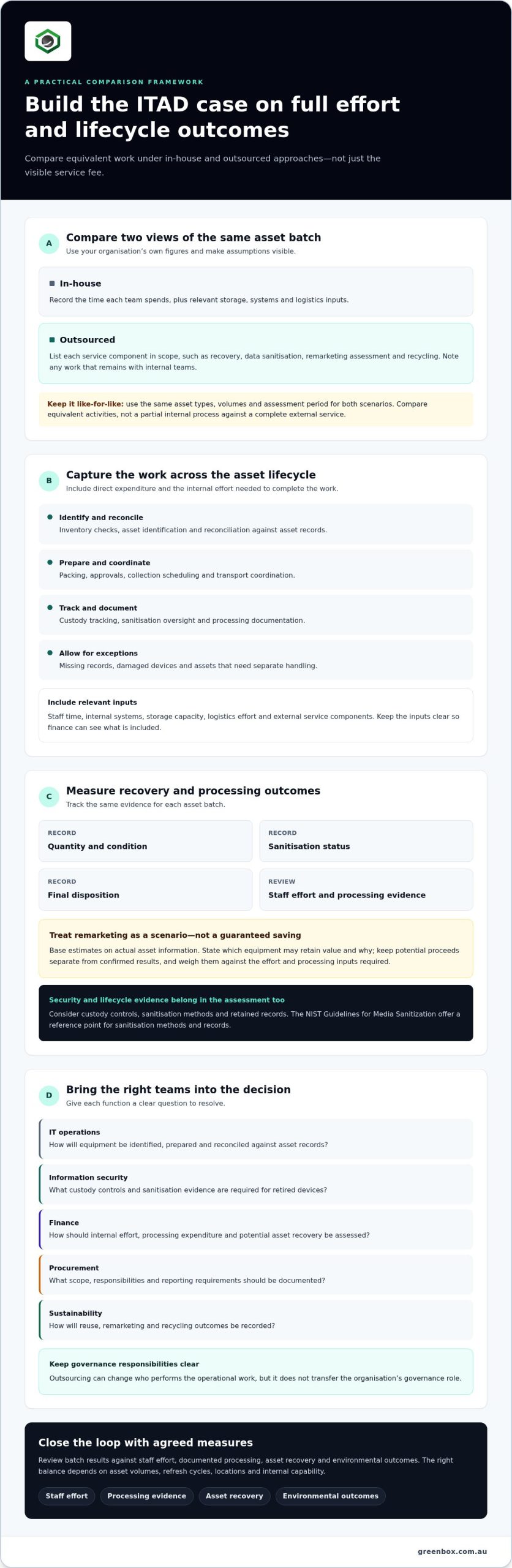
Shared approval works best when each function has a clear question to resolve:
- IT operations: How will equipment be identified, prepared and reconciled against asset records?
- Information security: What custody controls and sanitisation evidence are required for retired devices?
- Finance: How should internal effort, processing expenditure and potential asset recovery be assessed?
- Procurement: What scope, responsibilities and reporting requirements should be documented?
- Sustainability: How will reuse, remarketing and recycling outcomes be recorded?
Outsourcing can change who performs the operational work, but it doesn’t transfer the organisation’s governance role. Agreeing on these questions creates a decision based on shared outcomes: controlled handling, traceable processing, a realistic view of effort and environmental information that supports internal reporting.
How to calculate the full business case for outsourced ITAD
Start with one defined asset batch or refresh cycle, then measure the same work and outcomes under both approaches. The business case for outsourced ITAD shouldn’t rely on a service quote alone or broad market estimates. Use your own staffing, logistics and processing figures, and make assumptions visible so finance can test them.
Separate the model into two views: direct expenditure and internal effort. For the in-house scenario, record the time each team spends and any relevant storage, systems and logistics inputs. For the outsourced scenario, list each service component included in the scope, such as recovery, data sanitisation, remarketing assessment and recycling. Compare equivalent activities, not a partial internal process against a complete external service.
Which costs and inputs belong in the comparison?
Capture the work across the asset lifecycle, including staff time for:
- Inventory checks, asset identification and reconciliation.
- Packing, approvals, collection scheduling and transport coordination.
- Custody tracking, sanitisation oversight and processing documentation.
- Exceptions, such as missing records, damaged devices or assets that need separate handling.
Add relevant internal systems, storage capacity and logistics effort. Record external service components separately so finance can see what is included and identify any activities that remain with internal teams. Keep assumptions consistent across both scenarios, including asset types, volumes and the period being assessed.
How should value recovery and outcomes be measured?
Track each asset batch by quantity, condition, sanitisation status and final disposition. Treat remarketing as a scenario, not a guaranteed saving. Base estimates on actual asset information and state which equipment may retain value and why. Keep potential proceeds separate from confirmed results, and compare them with the effort and processing inputs required to achieve the outcome.
Include security evidence alongside financial inputs. The NIST Guidelines for Media Sanitization offer a reference point for considering sanitisation methods and records. For lifecycle context, Greenbox’s sustainable IT asset recovery approach connects secure handling with recovery and downstream outcomes.
Close the assessment by reviewing batch results against the measures agreed at the outset: staff effort, documented processing, asset recovery and environmental outcomes. Organisations planning a national programme can explore Greenbox’s ITAD services as part of their scope assessment.
Outsourced or in-house ITAD: how to balance control and accountability
| Area | In-house ITAD | Outsourced ITAD |
|---|---|---|
| Internal effort | Teams coordinate preparation, handling, processing and records. | Execution can be managed through an agreed service scope, with internal oversight retained. |
| Custody visibility | Visibility depends on internal tracking and hand-off records. | Agree which custody events are recorded and how they’re reported. |
| Sanitisation evidence | Internal teams oversee methods and retain evidence. | Define the sanitisation evidence and processing records required for assurance. |
| Logistics | Staff arrange movement, storage and coordination. | Logistics can sit within a coordinated recovery and processing scope. |
| Reporting | Teams compile asset and disposition information. | Set reporting requirements for asset status and final outcomes. |
What control can remain with the organisation?
Define approval points before an asset batch moves. Confirm the inventory, record custody events, identify who can approve exceptions and agree how issues will be escalated. Processing records and sanitisation evidence give internal teams information to review against those requirements. For technical context, see the enterprise guide to certified data sanitisation.
How do security and environmental responsibilities fit together?
Security and environmental outcomes are connected. Consider secure handling and data sanitisation alongside assessment for recovery or remarketing, followed by documented recycling or another disposition. Reporting can then show what happened to the assets instead of relying on broad environmental claims. Greenbox operates R2-certified facilities and describes its organisation as carbon-neutral. These points provide context, while batch-level processing and disposition records support a clear account of outcomes.
Use the business case for outsourced ITAD to decide which controls your organisation will retain, which execution tasks can be coordinated externally and what evidence will demonstrate that the agreed process was followed. This keeps accountability visible while allowing the operating model to reflect internal capability and asset requirements.
How to scope an outsourced ITAD programme across Australia
A clear scope turns an ITAD decision into a controlled workflow. Start with an asset inventory, define the required outcomes, then agree how equipment will move from organisational custody through processing and final review. For a national programme, document differences in locations, collection windows and internal processes rather than assuming every site follows the same pattern.
Before equipment leaves your organisation’s custody, document who approves the inventory, who releases each batch and how exceptions are handled. Set escalation steps for missing assets, mismatched records, damaged equipment or devices whose data-bearing status is unclear. A defined first batch or pilot can test hand-offs and reporting before the programme expands.
What should an ITAD scope document capture?
Record asset types, approximate quantities, condition, ownership and whether each device stores data. Specify the required processing evidence and reporting fields, logistics arrangements and expected environmental outcomes. Make accountability explicit: name project roles, approval points and exception contacts, and define what counts as completion. This gives IT, security, procurement and sustainability teams a shared reference from planning through close-out.
Keep the scope practical. Distinguish data-bearing equipment from peripherals, for example, and note where inventory records need reconciliation before collection. Clarify what information must be returned for each asset and how unresolved exceptions will be reported. These details align the work with organisational controls and provide a basis for reviewing results.
How can teams measure programme performance?
Agree measures before the first batch moves. Track whether processing is completed, whether asset records are complete, how custody exceptions are resolved and whether the work aligns with the agreed schedule. Review recovery outcomes and final disposition by asset category, so the programme shows what was reused, remarketed or recycled rather than reporting only a total device count.
Use the review to refine inventory preparation, approvals and reporting before scaling. Retirement planning can also inform incoming equipment requirements and refresh timing. Greenbox’s guidance on IT configuration and deployment planning provides lifecycle context for connecting outgoing assets with future rollouts.
A repeatable scope makes the business case for outsourced ITAD measurable across refresh cycles, not just for a one-off collection. To plan a managed ITAD programme around your asset and reporting requirements, discuss your ITAD programme with Greenbox.
Greenbox outsourced ITAD: turn the business case into a managed outcome
A strong business case for outsourced ITAD should lead to a defined operating model, not simply a decision to move tasks outside the organisation. Bring the assessment together around five measures: total internal effort, governance controls, security evidence, asset recovery and environmental outcomes. These give stakeholders a practical basis for agreeing what success looks like and how it will be reviewed.
Greenbox connects secure asset recovery, data sanitisation, remarketing and e-waste recycling within an IT asset lifecycle service. Data-bearing equipment can be managed with sanitisation and destruction requirements in view, while asset condition and suitability inform whether recovery, remarketing or recycling is the appropriate disposition pathway. Include remarketing in the value assessment without assuming every asset will generate proceeds.
What does Greenbox bring to an outsourced ITAD programme?
Greenbox serves organisations nationally across Australia. Its R2-certified facilities and certified data sanitisation support secure, environmentally responsible IT asset disposition. Greenbox also describes its organisation as carbon-neutral. These credentials provide context for an assessment, while programme reporting should still align with the organisation’s agreed asset-level requirements and outcomes.
The value lies in connecting these service components into a coordinated lifecycle approach. Security evidence, recovery assessments and final disposition information can be considered together, helping internal teams review how assets were handled and what happened to them. The scope can be tailored to the organisation’s asset profile, operating requirements and reporting needs.
What are the next steps for decision-makers?
Before scoping the programme, bring together an asset profile, the current retirement workflow and the requirements of IT operations, information security, finance, procurement and sustainability. Include device categories, approximate volumes, data requirements and known process gaps. This preparation turns broad objectives into clear delivery expectations.
Agree on success measures before work begins. These might cover the completeness of sanitisation evidence, staff effort across the process, recovery outcomes and the information needed for environmental reporting. Set responsibilities, approval points and exception escalation steps so oversight remains clear throughout the programme.
With these foundations in place, Greenbox can shape an outsourced ITAD programme around your organisation’s requirements. Discuss an outsourced ITAD programme with Greenbox.
Make your ITAD decision measurable
A strong business case for outsourced ITAD compares the full work involved, not just the visible service fee. Use your organisation’s own figures to weigh internal effort against an equivalent service scope, then assess custody controls, sanitisation evidence, potential asset recovery and documented environmental outcomes.
The right model depends on your assets, refresh cycles and internal capability. Whether you retain execution in-house or outsource it, clear responsibilities and reporting keep governance with your organisation. A defined first asset batch can help test the workflow and measures before scaling.
Greenbox’s services span secure data sanitisation, asset recovery, remarketing and e-waste recycling. Greenbox operates R2-certified facilities and describes itself as a carbon-neutral organisation, bringing security and environmental considerations into the lifecycle discussion.
Ready to shape a programme around your organisation’s requirements? Discuss an outsourced ITAD programme with Greenbox. A clear scope and shared measures can help turn asset retirement into a more controlled, accountable outcome.
Frequently Asked Questions
What is the business case for outsourced ITAD?
The business case for outsourced ITAD is an evidence-based comparison of whether an external service can meet your asset retirement requirements more effectively than your current model. Assess internal effort, security controls, logistics, asset recovery, reporting and environmental outcomes together. Compare equivalent scopes using your own operational data. Outsourcing isn’t automatically cheaper, and remarketing shouldn’t be treated as guaranteed income. The case should show expected outcomes and the assumptions behind them.
How do you calculate the ROI of outsourced ITAD?
Start with a defined asset batch or refresh cycle and record the internal work involved, including labour, storage, coordination, logistics and processing. Compare these inputs with the proposed service scope and expected outcomes. Model remarketing separately, using actual asset condition and clearly stated assumptions rather than counting potential proceeds as certain. Include security evidence and reporting so the decision reflects governance and operational outcomes as well as financial measures.
Is outsourced ITAD more cost-effective than managing it in-house?
It depends on your asset volumes, internal capability, handling effort, logistics and required controls. An outsourced service may consolidate tasks that otherwise involve several teams, but a headline fee alone won’t show the full comparison. Include staff time, storage, transport, documentation and final disposition in both models. Use internal figures and compare equivalent activities, asset types and reporting requirements. This gives finance a more credible basis for judging cost-effectiveness.
What should an outsourced ITAD business case include?
Include the current workflow, asset profile, internal effort, security requirements, logistics, remarketing assumptions and environmental reporting needs. Specify the sanitisation evidence and processing records required, then set measurable success criteria for the programme. Define how exceptions will be managed and who approves key decisions. The case should bring IT, information security, finance, procurement and sustainability requirements together, while making clear which governance responsibilities remain with your organisation after outsourcing.
How can an organisation retain control when outsourcing ITAD?
Retain control by defining oversight before the programme begins. Agree which asset records and custody events will be captured, where approvals are needed, what sanitisation evidence is required and how exceptions will be escalated. Review completion and processing records against the agreed scope. Outsourcing can shift operational tasks to a specialist service, but your organisation still sets requirements, maintains governance and assesses whether documented outcomes meet its policies.
Can outsourced ITAD help recover value from retired equipment?
Yes, remarketing can be a disposition pathway for assets suitable for resale. Potential recovery depends on factors such as device type, age, condition, demand and processing requirements, so don’t treat it as guaranteed income. Base estimates on actual asset information, state assumptions clearly and distinguish projected value from confirmed outcomes. Reporting on final disposition helps show which assets were remarketed and which followed another processing pathway.
How do you assess the sustainability outcomes of outsourced ITAD?
Define the outcomes you want to measure, such as reuse, remarketing, recycling and documented final disposition. Request reporting that connects asset records with processing outcomes, then use verified information in internal sustainability reporting. Assess certification and carbon-related claims within their stated scope rather than treating one credential or a recycling label as proof of every environmental outcome. Greenbox operates R2-certified facilities and describes itself as a carbon-neutral organisation.