

Sending retired business technology for recycling can recover materials, but it doesn’t automatically explain how data will be protected or whether usable assets could be recovered. That’s the key distinction in ITAD vs e-waste recycling: IT asset disposition (ITAD) can coordinate secure data handling, value recovery and responsible recycling, while recycling focuses on recovering components or materials from equipment.
If you’re unsure what a provider’s recycling service includes, you’re not alone. Service scopes vary, which can make providers difficult to compare and leave gaps in the records of what happened to each asset. The right pathway depends on the equipment’s condition, data risk and your organisation’s requirements.
This guide explains where ITAD and e-waste recycling differ, where they overlap and how to match each asset to an appropriate outcome. You’ll learn what process controls and evidence to ask providers about, how suitable equipment may be prepared for reuse or remarketing, and how residual e-waste can be managed responsibly. The goal is a clear, documented approach that supports information security and environmental responsibility.
Key Takeaways
- Understand how ITAD vs e-waste recycling differ, and why recycling can form part of a broader asset disposition programme.
- Agree on a sanitisation or destruction pathway for data-bearing devices before they move to reuse, remarketing or recycling.
- Match each asset to its condition, data risk and potential for reuse instead of applying one disposal route to every device.
- Assess providers by checking their service scope, certifications, facility details, downstream handling and available records.
- Consider how data sanitisation and destruction, asset recovery, remarketing and e-waste recycling can work together in a coordinated programme.
ITAD vs e-waste recycling: What is the difference for a business?
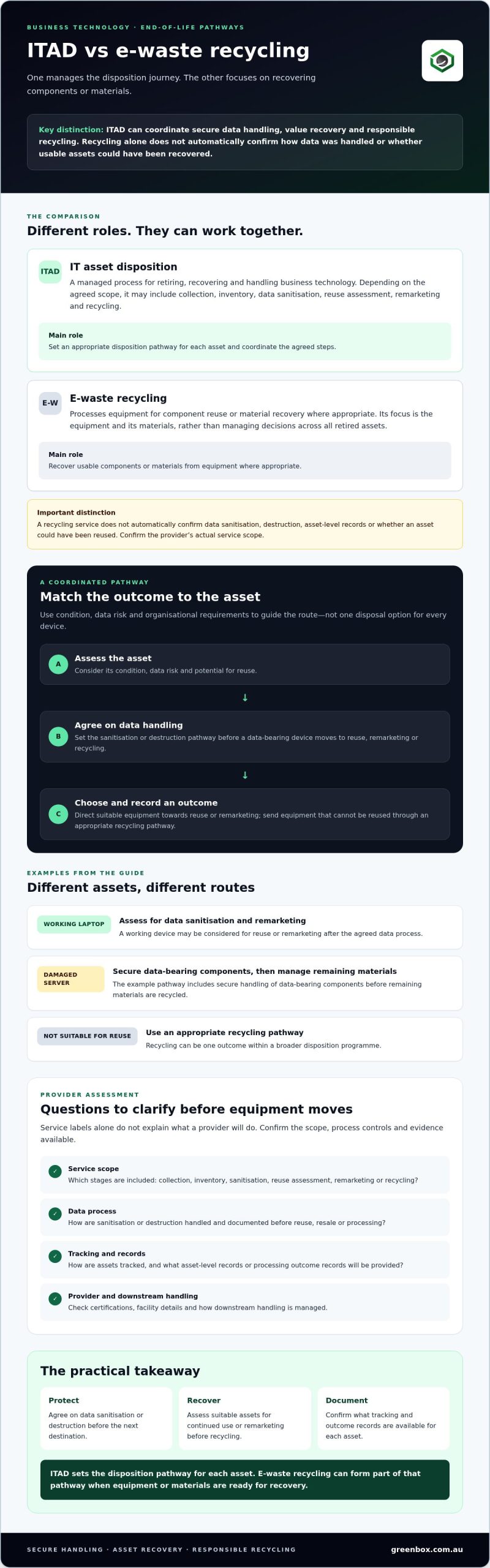
IT asset disposition (ITAD) manages the retirement and disposition of business technology, while e-waste recycling processes equipment or materials for reuse or recovery. The two aren’t mutually exclusive. A business can use ITAD to set an outcome for each asset, then send equipment that can’t be reused through an appropriate recycling pathway.
That distinction matters because different devices can require different outcomes. A working laptop may be assessed for data sanitisation and remarketing, while a damaged server may need secure handling of its data-bearing components before the remaining materials are recycled. Recycling addresses end-of-life materials, but doesn’t on its own confirm what happened to data or whether an asset could have been reused.
Electronic waste includes discarded electrical and electronic equipment, and its growth contributes to the global e-waste problem. For businesses, the practical challenge is coordinating secure handling, potential value recovery and responsible processing for every asset.
What does IT asset disposition include?
ITAD is a managed process for retiring, recovering and handling business technology. Depending on the provider and agreed scope, it may include collection, inventory, data sanitisation, reuse assessment, remarketing and recycling. Before engaging a provider, confirm which stages are included, how assets will be tracked and what records you’ll receive. The label “ITAD” alone doesn’t tell you exactly what the provider will do.
What does e-waste recycling cover?
E-waste recycling processes equipment for component reuse or material recovery where appropriate. Its focus is the equipment and its materials, rather than managing decisions across all of an organisation’s retired assets. For data-bearing devices, ask how sanitisation or destruction is handled and documented before equipment is reused, resold or processed.
| Area | ITAD | E-waste recycling |
|---|---|---|
| Scope | Manages disposition decisions across assets | Processes equipment or materials for recovery |
| Data handling | May include sanitisation or destruction; confirm the agreed process | Doesn’t automatically confirm data sanitisation |
| Value recovery | Can assess suitable assets for reuse or remarketing | Focuses on components and material recovery |
| Reporting | May provide asset-level records; confirm what’s included | Ask what processing and outcome records are available |
| End destination | Reuse, remarketing or recycling, depending on condition and scope | Recovered components or materials, where appropriate |
In short, ITAD sets the disposition pathway for each asset, while recycling is one possible outcome. Comparing ITAD vs e-waste recycling starts with identifying the security, recovery and reporting requirements your business needs to cover.
How ITAD and e-waste recycling handle data, assets and environmental outcomes
The practical difference in ITAD vs e-waste recycling is how each service manages decisions before equipment reaches its next destination. ITAD can coordinate data controls, reuse assessment and recycling across an asset’s journey. Recycling focuses on processing equipment or materials. Gartner’s definition of ITAD provides further context on disposition as a business process, rather than simply a final processing step.
| Consideration | ITAD approach | Recycling-focused approach |
|---|---|---|
| Data security | Can specify sanitisation or destruction before an asset’s next destination. | Ask whether data handling is included, and how it is performed and recorded. |
| Reuse potential | Can assess assets for continued use or remarketing before recycling is considered. | Centres on recovering components or materials, although reuse may be possible where appropriate. |
| Material recovery | Can direct unsuitable assets to a recycling pathway. | Processes equipment to recover usable components or materials. |
| Logistics and reporting | May coordinate asset tracking and records across multiple outcomes. | Confirm what collection, processing and outcome records are provided. |
Where data sanitisation fits into the comparison
Recycling records and sanitisation evidence serve different purposes. For data-bearing equipment, agree on a sanitisation or destruction pathway before reuse, remarketing or recycling. An asset register can connect identifiers to intended outcomes, while chain-of-custody records can help show who handled equipment and when. Request supporting records that match the agreed process, rather than relying on a certificate alone to explain every handling step. For more detail, see this guide to certified data sanitisation.
Reuse, remarketing and recycling are different outcomes
An asset’s condition is only one consideration. Age, market demand and organisational policy can also affect whether equipment is suitable for continued use, remarketing or recycling. A structured assessment helps identify potential value before unsuitable equipment proceeds to material recovery. Record the outcome at asset level so internal teams can understand how decisions were made. Explore the guide to refurbished IT asset resale for more on hardware value recovery.
To compare these steps with available business services, review Greenbox’s IT asset disposition services alongside your organisation’s data, recovery and reporting requirements.
When should a business choose ITAD, e-waste recycling or both?
The choice depends on what each asset contains, its condition and the evidence your organisation needs. In the ITAD vs e-waste recycling decision, consider a broader ITAD process when assets need coordinated data handling, recovery assessment or reporting. A recycling-focused service may suit equipment with no data-bearing components and straightforward handling needs.
| Asset type | Possible pathway | What to consider |
|---|---|---|
| Data-bearing equipment | ITAD, with sanitisation or destruction defined before the next destination | Confirm the data process, asset tracking and supporting records. |
| Functional equipment with reuse potential | ITAD assessment, with remarketing or reuse considered before recycling | Check condition, age, demand and organisational policy. |
| Damaged equipment | ITAD if data handling, tracking or coordinated outcomes are needed; recycling for remaining materials | Specify how data-bearing parts and other components should be handled. |
| Low-value, non-data-bearing equipment | A recycling-focused service may be suitable | Confirm the equipment is in scope and clarify what processing records are available. |
Match the service to the asset and its risk profile
Start with three questions: does the equipment store data, is it functional, and could it have reuse value? Then consider the wider job, including fleet size, collection complexity, internal approvals and reporting expectations. Document exceptions, such as assets that require a specific handling or destruction pathway. Clear instructions help your provider follow the intended route and let your team check that each outcome aligns with requirements.
Compare the benefits and limitations of each pathway
ITAD can bring asset decisions, recovery options and process visibility together, but its value depends on the services agreed and records provided. Recycling offers a focused route for equipment unsuitable for further use, though it may not cover broader asset oversight or data requirements. Neither pathway alone guarantees compliance or a particular financial or environmental result. Confirm the provider’s scope and assess outcomes against your organisation’s objectives.
ITAD doesn’t mean every asset must be remarketed. Some equipment may be suitable for recovery or reuse; other assets may need secure destruction or recycling. A managed ITAD programme can direct different assets to different outcomes, with recycling included where appropriate. Choose a mix that fits your assets, risks and internal requirements instead of applying the same route to the whole fleet.
How to assess an ITAD or e-waste recycling provider
A provider’s service label won’t tell you exactly what happens to each device. Assess the proposed process against your asset scope, data risks and desired outcomes, then check the controls and evidence behind the provider’s claims. This makes ITAD vs e-waste recycling a practical procurement decision, not simply a choice between two service names.
Questions to ask before approving a provider
Start with the assets you’re retiring and the outcomes you need. Ask the provider to explain how equipment is tracked from collection to its final destination. Check how data-bearing devices are sanitised or destroyed, what evidence your organisation will receive, and which activities are completed by the provider or handled by downstream partners.
For example, if some equipment may be reused while other devices need destruction, confirm how the provider separates and records those pathways. Ask which asset types and services are covered by any stated certification, and whether the relevant facilities and downstream handling fall within that scope. Broad claims are a starting point for questions, not a substitute for checking the details.
What documentation supports a defensible process?
Request records that let your team follow assets through the agreed process. Depending on the service scope, these may include:
- An inventory connecting asset identifiers to the equipment received.
- Collection or chain-of-custody records showing key handling stages.
- Sanitisation or destruction documentation that identifies the method and assets covered.
- Outcome records showing whether assets were reused, remarketed or recycled.
A certificate can support your records, but may not explain every movement or outcome on its own. Check that sanitisation evidence matches the agreed method and asset list. Also verify that environmental claims and certifications are current, relevant to the service being purchased and applicable to the facilities or downstream partners involved.
Look for a process that connects security, recovery and recycling decisions rather than treating them as separate claims. The sustainable IT asset recovery case study offers an example of integrated lifecycle thinking.
When comparing Greenbox’s IT asset recovery services with other options, review the proposed scope, controls and records against your organisation’s needs.
How Greenbox can support a secure, sustainable ITAD programme
The right pathway depends on the assets being retired and your organisation’s priorities. Greenbox supports Australian businesses with data sanitisation and destruction, IT asset recovery, asset remarketing and e-waste recycling. These services can be considered as part of a coordinated programme, without assuming every asset needs every service.
An integrated approach to retired business technology
Agree on the intended outcome for each asset group, then define the required data handling and records. Equipment that may be suitable for continued use can be assessed for recovery or remarketing after its data requirements are addressed. Assets that aren’t suitable for reuse can proceed to e-waste recycling, subject to the agreed process. This connects security and recovery decisions with responsible end-of-life handling.
Greenbox states that its facilities are R2 certified and describes its organisation as carbon neutral. Confirm certification scope and facility details, as well as the scope of any carbon-neutral claim, against the services being considered. Ask what evidence is available and how it relates to your programme before relying on a claim for internal reporting.
Plan the next step with clear requirements
Prepare for provider discussions by gathering an approximate breakdown of asset categories, noting which devices may store data and outlining any timing considerations. Specify the sanitisation or destruction methods your organisation requires, the documentation it expects and any downstream reporting needs. Clear requirements make it easier to assess whether the proposed scope fits, while allowing different assets to follow different pathways.
If you’re weighing ITAD vs e-waste recycling, compare the services that match your requirements, from data sanitisation and destruction to asset recovery, remarketing or e-waste recycling.
Build a clear pathway for every retired asset
The right approach isn’t a choice between security and sustainability. ITAD vs e-waste recycling comes down to matching each asset with an appropriate next step: define sanitisation or destruction for data-bearing devices, assess suitable equipment for recovery or remarketing, and direct end-of-life items to responsible recycling.
Before approving a provider, confirm the service scope, downstream handling and records you’ll receive. These details help your team understand what happened to each asset and assess whether the process meets its requirements.
Greenbox supports Australian businesses with services spanning data sanitisation and destruction, IT asset recovery, remarketing and e-waste recycling. Greenbox states that its facilities are R2 certified; confirm current certification scope and facility details when assessing a proposed programme.
Frequently Asked Questions
Is ITAD the same as e-waste recycling?
No. ITAD is a managed process for deciding how retired business technology will be handled, while e-waste recycling focuses on processing equipment or materials for recovery. Depending on the agreed scope, ITAD may include data sanitisation, asset recovery, remarketing and recycling. Recycling can therefore be one outcome within an ITAD programme, rather than a complete substitute for managing data, reuse and asset records.
Can e-waste recycling include secure data destruction?
It can, if the provider includes data sanitisation or destruction in the agreed service. Don’t assume recycling automatically covers data-bearing equipment. Before sending devices such as laptops, servers or storage media, confirm the method, which assets it covers and what evidence you’ll receive. Keep data-handling documentation distinct from records showing that equipment or materials were recycled.
What is the main difference between ITAD and recycling for businesses?
The main difference is scope. ITAD coordinates decisions across retired assets, which may include data handling, reuse assessment, remarketing and recycling. Recycling focuses on material or component recovery. In the ITAD vs e-waste recycling comparison, consider whether your business needs asset-level oversight and documented outcomes or a focused recycling pathway for equipment with straightforward handling needs.
When should a business use an ITAD provider instead of a recycling service?
Consider ITAD when equipment contains data, a fleet has mixed asset types, some devices may have reuse value, or your organisation needs coordinated handling and records. For example, a business retiring laptops, servers and peripherals may need different pathways for each group. A recycling-focused service may be sufficient for non-data-bearing equipment when material recovery is the main requirement and handling is straightforward.
Does ITAD always involve remarketing used equipment?
No. Remarketing is one possible outcome, not a requirement for every asset. Condition, age, demand, data requirements and organisational policy all affect whether equipment is suitable for reuse or resale. Some devices may be recovered for another use, while damaged, unsuitable or restricted assets may require destruction or recycling. Ask how the provider assesses assets and records the final outcome for each group.
What records should a business request after ITAD or e-waste recycling?
Request records that match the agreed services. These may include an inventory linking asset identifiers to received equipment, collection or chain-of-custody details, sanitisation or destruction evidence, and records of reuse, remarketing or recycling outcomes. Check that sanitisation documents identify the method and assets covered. A certificate can support your files, but may not describe every handling stage or downstream outcome.
Can retired IT equipment be resold instead of recycled?
Yes. Equipment may be suitable for remarketing if its condition, age, demand and your organisation’s requirements support reuse. Data-bearing devices need an agreed sanitisation or destruction pathway before resale or another destination. Ask for an asset assessment and clear records showing which items were considered suitable, what outcome they received, and how equipment not selected for remarketing was handled.
Discuss your IT asset disposition requirements with Greenbox, and outline your asset scope, security needs and reporting expectations.