

Treating retired enterprise IT assets as mere electronic waste is one of the most dangerous governance missteps an organisation can make. Defensible end of life hardware management is no longer a downstream logistics task; it is a critical data security gateway. When coordinating major technology refresh cycles, IT leaders face immense pressure managing strict Australian Privacy Principles, eliminating chain of custody gaps during bulk transit, and satisfying aggressive corporate zero-waste mandates. Balancing certified, permanent data sanitisation against commercial value recovery often feels like an impossible operational compromise.
You don’t have to choose between ironclad data security and environmental accountability. You will learn how to master corporate technology decommissioning through a secure, defensible framework that withstands compliance audits, curbs carbon emissions, and unlocks residual hardware value through certified remarketing. Here is your enterprise checklist for executing seamless, fully documented asset retirement across all national facilities in 2026.
Key Takeaways
- Prioritise certified software data sanitisation over default physical destruction to protect storage integrity, maintain compliance, and preserve residual equipment value.
- Deploy a structured end of life hardware management framework that systematically categorises retired technology for redeployment, commercial remarketing, or certified recycling.
- Eliminate chain of custody vulnerabilities across national facilities through serialised asset tracking and unified compliance reporting that satisfies both corporate auditors and ESG standards.
- Unite reverse logistics with ongoing IT rollout workflows to prevent obsolete hardware stockpiling and reduce lifecycle carbon emissions across your enterprise.
End-of-Life Hardware Management: Why Is It Critical?
Enterprise technology does not vanish once written off the corporate balance sheet. Defensible end of life hardware management functions as an active governance protocol rather than an administrative cleanout. When systems reach corporate obsolescence, assets shift immediately from productivity tools into high-risk data repositories. Treating this transition like routine waste disposal invites severe operational failure. Standard commercial refuse collection lacks chain of custody verification, secure physical transit, and auditable proof of sanitisation. Hardware retirement must instead integrate directly into broader corporate refresh programmes, ensuring outgoing assets are governed as strictly as newly procured technology.
Defining the End-of-Life Threshold for Corporate Technology
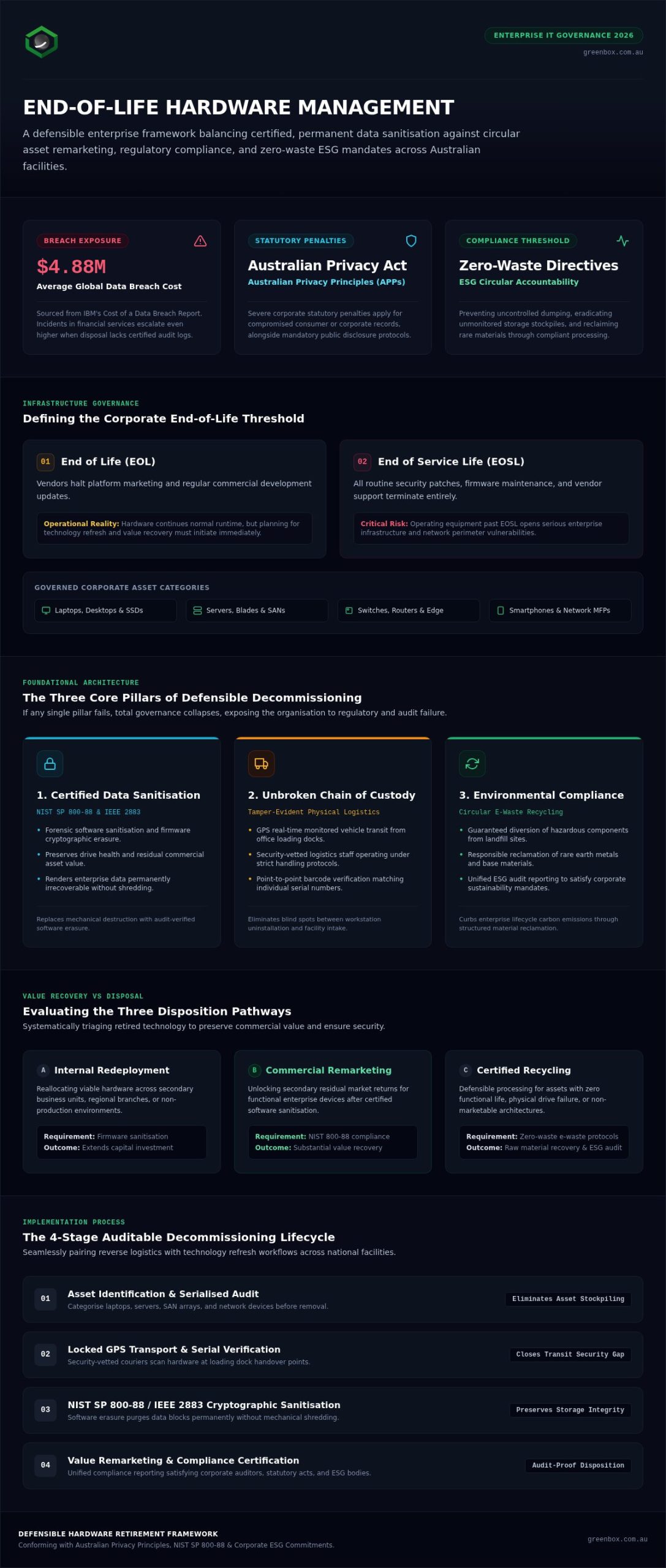
Hardware retirement stems from multiple triggers: mounting maintenance costs, performance degradation, commercial lease expiries, or manufacturer support withdrawal. IT leaders must distinguish between End of Life (EOL), where vendors stop marketing or updating a platform, and End of Service Life (EOSL), where all security patches and firmware support terminate. Operating equipment past EOSL creates severe infrastructure vulnerabilities. Assets requiring structured end of life hardware management include:
- Corporate laptops, workstations, and local solid-state drives (SSDs)
- Enterprise servers, blade chassis, and storage area network (SAN) arrays
- Network switches, routers, firewalls, and edge computing appliances
- Smartphones, tablets, and networked multifunction printing devices
The Legal, Financial, and Security Risks of Neglect
Failing to establish verified asset disposition protocols carries direct financial exposure. According to IBM’s Cost of a Data Breach Report, the global average breach cost reached $4.88 million, with financial services incidents climbing even higher. Under the Australian Privacy Act, organisations face severe statutory penalties for compromised consumer or corporate records, alongside mandatory public disclosure mandates.
Beyond fiscal penalties, unmonitored disposal creates significant brand and environmental liabilities. Abandoning retired IT hardware in unmonitored storage rooms or releasing it to unvetted hauliers often ends in uncontrolled dumping. Secure corporate operations pair certified data destruction with compliant electronic waste recycling, ensuring rare materials are reclaimed responsibly while corporate data remains permanently irrecoverable.
The Core Governance Pillars of Secure Hardware Decommissioning
Defensible end of life hardware management rests on three operational pillars: permanent data sanitisation, unbroken physical chain of custody, and certified environmental compliance. If any single pillar fails, the entire governance structure collapses. Treating retired enterprise assets simply as digital records inside an IT portal overlooks the physical vulnerabilities that occur between workstation uninstallation and final material processing.
Certified Data Sanitisation vs Physical Destruction
Mechanical shredding was once the enterprise default, but it permanently destroys residual commercial asset value. Modern flash media and complex solid-state drives require forensic software sanitisation and firmware-level cryptographic erasure. Adhering to standards outlined in the NIST SP 800-88 Guidelines for Media Sanitization and IEEE 2883 allows organisations to safely clear or purge data blocks while leaving physical storage drives completely functional. Engaging rigorous certified data sanitisation Australia standards ensures corporate records are rendered totally irrecoverable without reducing viable hardware to scrap, unlocking secondary remarketing returns.
Tamper-Evident Chain of Custody Logistics
Most data breaches during asset retirement occur in transit, not on factory floors. Digital asset management portals often fail because they lose line of sight the moment hardware leaves an office loading dock. Secure hardware decommissioning demands physical chain of custody controls across every handover point:
- Dedicated, locked transport using secure vehicles monitored by real-time GPS tracking
- Security-vetted logistics personnel operating under strict security protocols
- Point-to-point barcode verification matching individual serial numbers against collection manifests
- Tamper-evident security seals applied to bulk transport containers prior to departure
Every retired unit must culminate in an auditable, serialised certificate of sanitisation or destruction that matches corporate asset registers perfectly.
Environmental Stewardship and National E-waste Mandates
Enterprise sustainability is no longer satisfied by vague recycling claims. Hardware disposition directly influences Scope 3 emissions under corporate reporting criteria. Facilities processing retired equipment must carry formal R2 certification, with specific credentialing under Appendix B for data sanitisation. Partnering with providers of verified carbon-neutral ITAD services allows enterprises to uphold zero-landfill mandates, recover rare materials through circular reuse, and present auditable sustainability records to corporate stakeholders.
Evaluating Disposition Pathways: Remarketing, Redeployment, or Recycling
Determining the final destination for retired IT assets requires a structured evaluation matrix rather than ad-hoc decision-making. Enterprise technology generally flows into one of three distinct channels: commercial remarketing, internal redeployment, or certified materials recovery. A disciplined end of life hardware management framework evaluates every batch of decommissioned endpoints and datacentre hardware against performance thresholds, data security constraints, and economic return.
Maximising Value Recovery via Secondary Market Remarketing
Retired tier-one enterprise laptops, workstations, and high-density servers frequently retain significant commercial equity. Following software sanitisation, hardware undergoes automated component diagnostics, physical grading, and firmware testing to establish secondary market value. Units are then channelled into vetted wholesale or commercial resale networks. Reclaiming capital from secondary markets directly offsets the cost of modern replacement fleets while supporting circular economy principles.
Internal Asset Redeployment: Cost Savings vs Operational Friction
Cascading premium devices to secondary user groups or regional branch offices appears fiscally conservative on paper. In practice, it often introduces hidden operating deficits. Assessing internal redeployment viability requires evaluating total operational burden:
- Logistics costs for collecting, sanitising, re-imaging, and redistributing legacy units
- Higher ticket volumes and helpdesk labour associated with aging hardware components
- Thermal inefficiency and excessive power draw compared with modern architecture standards
- Elevated risk of unscheduled downtime when operating equipment beyond vendor maintenance coverage
When the cumulative cost of testing, support tickets, and degraded productivity outpaces residual market value, remarketing or certified retirement becomes the more defensible choice.
Certified Sustainable E-waste Recycling for Non-Marketable Assets
Hardware that fails functional grading, carries unremovable physical defects, or represents legacy architectures with zero secondary demand moves directly into material processing. Devices undergo mechanical de-manufacturing, separation of hazardous materials, and commodity sorting into clean streams of aluminium, copper, precious metals, and high-grade plastics. Processing must adhere to the accredited framework set by EPA-certified electronics recyclers, ensuring total downstream traceability. This guarantees obsolete components never enter landfill or unsanctioned offshore processing operations, fulfilling corporate end of life hardware management obligations with complete regulatory integrity.
The Comprehensive End of Life Hardware Management Checklist
Corporate technology retirements require structured operational control rather than informal handovers. Managing bulk hardware collections across distributed offices creates severe operational blind spots if responsibilities remain undefined. A methodical end of life hardware management framework establishes clear accountability gates between internal infrastructure personnel and specialist logistics partners. This workflow must synchronise directly with modern device imaging and deployment schedules, capturing departing assets the instant new systems enter production.
Phase 1: Pre-Decommissioning Audit and Asset Triage
Preparation determines operational success. Before unmounting data centre equipment or collecting regional user hardware, internal IT teams must secure corporate environments and align systems against configuration records:
- Reconcile physical device serials against corporate Configuration Management Databases (CMDB) to identify ghost assets.
- Classify assets into data-bearing tiers, separating cryptographic purge candidates from damaged devices requiring destruction.
- Execute final off-site user backups and revoke active enterprise cloud licences, device certificates, and MDM profiles.
- De-rack enterprise network and server equipment; stage loose endpoints inside access-controlled holding suites.
Phase 2: Secure Packaging, Chain of Custody, and Transport
Logistical transit carries the greatest exposure to physical loss. Protecting hardware during the transition from enterprise facilities to processing centres requires active physical controls:
- Scan and record unique barcoded asset tags on each piece of equipment before building pallets.
- Pack devices securely into locked, tamper-evident security cages or heavy-gauge transit containers.
- Review and countersign transfer manifests alongside vetted logistics professionals bearing verified security credentials.
- Dispatch consignments via point-to-point transit in satellite-monitored vehicles, eliminating unscheduled transfers.
Phase 3: Sanitisation, Environmental Processing, and Audit Sign-Off
The final phase permanently resolves all corporate exposure, delivering defensible compliance reporting for internal audit and risk committees:
- Perform software sanitisation or physical destruction matched to verified device media profiles.
- Generate immutable, serialised certificates of destruction detailing sanitisation algorithms and hardware serials.
- Route failed or non-marketable equipment through certified R2 recycling streams under zero-landfill mandates.
- Reconcile destruction logs with original manifests, purge CMDB records, and file ESG carbon-offset certifications.
To establish a fully documented asset disposition protocol across your operations, contact Greenbox today for national lifecycle support.
Integrating End-of-Life Management with Continuous Technology Deployments
Treating procurement and decommissioning as isolated functions creates friction across enterprise operations. When infrastructure teams roll out refreshed hardware while treating disposal as an occasional task, storage cupboards fill with vulnerable, unmanaged data. Streamlining these opposite motions into a coordinated cycle turns retirement into an operational asset. Incorporating forward distribution alongside reverse logistics unites IT configuration and deployment practices, ensuring outdated machinery leaves corporate floors the moment replacement systems arrive.
The Operational Power of Unified Forward and Reverse Logistics
Coordinating delivery alongside retrieval delivers immediate operational dividends. When executing complex programmes such as bulk laptop deployment Australia wide, technicians can drop off pre-imaged, secure endpoints and simultaneously package legacy units into locked transit bins. This simultaneous swap eliminates on-site hardware hoarding, clearing backlogs from facilities instantly. Consolidating outward delivery and reverse collections into unified transport runs also cuts unnecessary fleet movements, materially lowering corporate Scope 3 freight emissions.
Selecting an Accredited National IT Lifecycle Partner
Managing disparate vendors across multiple branch sites introduces critical compliance risks. Enterprise risk committees demand complete visibility over hardware retirement from desk to disposition. When vetting a nationwide provider for end of life hardware management, verify essential operational credentials:
- R2-Certified Facilities: Confirm facilities hold active R2 certifications nationwide, verifying individual facility credentialing under Appendix B for data sanitisation.
- Certified Carbon-Neutral ITAD Operations: Ensure downstream recovery workflows provide auditable greenhouse gas reporting to support enterprise ESG statements.
- Integrated Tracking Infrastructure: Demand serialised barcode scanning and GPS-monitored chain of custody protocols across all logistics stages.
- Unified Compliance Reporting: Require consolidated certificates of destruction that satisfy external corporate auditors and executive risk registers simultaneously.
Consolidating these lifecycle steps under a single accredited provider eliminates operational handoffs, protects corporate reputation, and delivers verifiable security across your national hardware footprint.
Mastering Defensible Hardware Lifecycle Governance
Mastering end of life hardware management transforms corporate technology retirement from an administrative risk into a strategic advantage. Prioritising certified software sanitisation over indiscriminate mechanical destruction preserves residual asset value, lowers capital replacement expenses, and insulates your business against regulatory exposure under Australian privacy standards. Uniting forward rollouts with closed-loop reverse logistics eliminates storage room backlogs and curbs freight emissions across every corporate facility.
Achieving this level of defensible governance demands a credentialed, dependable partner. As a carbon-neutral certified IT asset disposition provider operating nationwide, Greenbox maintains R2-certified facilities ensuring zero-landfill electronic waste handling. Our team maintains complete end-to-end chain of custody tracking, providing tamper-proof, serialised certificates of destruction that satisfy corporate risk auditors and ESG stakeholders alike.
Secure your national technology lifecycle with Greenbox to bring measurable precision, transparency, and environmental accountability to your next enterprise refresh cycle.
Frequently Asked Questions
What is the difference between end of life (EOL) and end of service life (EOSL)?
End of Life marks when an original equipment manufacturer stops selling or actively marketing a specific hardware model, though maintenance and basic firmware updates may continue. End of Service Life represents the final operational cutoff. At EOSL, all vendor technical support, firmware updates, and critical security patches terminate completely. Operating equipment beyond EOSL exposes corporate networks to severe vulnerabilities, requiring formal retirement protocols within your broader end of life hardware management framework.
Can solid-state drives (SSDs) be safely sanitised using software erasure tools?
Yes, provided the software implements cryptographic erase and firmware-level purge commands conforming to IEEE 2883 and NIST SP 800-88 standards. Traditional magnetic drive overwriting tools are ineffective on flash media due to internal wear-levelling and overprovisioned storage blocks. Modern enterprise sanitisation utilities communicate directly with controller firmware to purge all storage sectors, including reallocated blocks, rendering data forensically irrecoverable while keeping underlying solid-state drives functional for commercial remarketing.
Why is mechanical shredding not always the best method for IT asset disposition?
Mechanical shredding permanently destroys viable equipment, eliminating secondary commercial value and accelerating electronic waste volumes. While physical destruction remains necessary for inoperable or damaged drives, certified software purging allows functioning enterprise hardware to be safely remarketed or redeployed. Retaining physical equipment integrity supports circular economy principles, prevents substantial embodied carbon emissions linked to manufacturing new replacement machinery, and unlocks capital returns that directly offset corporate technology refresh budgets.
What key details must be documented on a Certificate of Data Sanitisation?
A defensible certificate must record the individual device serial number, drive model, manufacturer, and initial storage capacity. It must detail the specific sanitisation standard executed, software version used, pass-fail status, and timestamp of completion. The certificate also requires the verified credentials and signature of the technician who completed the work. These serialised records create an immutable compliance trail that satisfies privacy regulators, corporate legal teams, and independent IT governance audits.
How does certified hardware decommissioning support corporate ESG and net-zero targets?
Certified decommissioning curtails Scope 3 capital goods emissions by diverting obsolete devices from landfills and extending technology lifecycles through secondary remarketing. Choosing a carbon-neutral disposition partner ensures all transport and processing footprints are rigorously measured and offset. In addition, certified end of life hardware management provides auditable ESG documentation, confirming non-reusable assets were processed at R2-certified facilities with verified commodity recovery rates that satisfy corporate sustainability disclosure requirements.
What happens to decommissioned IT assets that cannot be resold or remarketed?
Assets that fail functional grading or lack secondary market demand route directly into accredited recycling streams. Specialist technicians dismantle the hardware to safely isolate hazardous components like lithium-ion batteries and mercury backlights. Clean commodity streams containing aluminium, copper, steel, and trace precious metals are then sorted and transferred to vetted refiners. This mechanical recovery process guarantees zero landfill diversion while returning essential raw materials back into modern manufacturing supply chains.