

Treating deployment, day-to-day management, and eventual asset disposal as disconnected silos is quietly compromising corporate data and draining critical technical resources. If your internal teams are constantly overwhelmed by repetitive device imaging, fragmented freight logistics, and the friction of juggling multiple disposal vendors, you aren’t alone. Modern IT hardware lifecycle services resolve this operational chaos, replacing an ad-hoc burden with a streamlined, secure framework that protects corporate governance while returning valuable hours back to technical staff.
Balancing stricter ESG reporting pressures with heightened cyber security mandates shouldn’t force enterprise IT leaders to compromise on operational efficiency or risk data exposure. In this guide, discover how comprehensive IT hardware lifecycle services streamline deployment, safeguard corporate data, and maximise asset value across Australia. We evaluate the essential components of modern lifecycle management, examining how unifying front-end pre-configuration with certified data sanitisation and sustainable asset recovery delivers total chain-of-custody assurance and tangible capital return for your organisation.
Key Takeaways
- Consolidating procurement, imaging, and deployment under unified IT hardware lifecycle services eliminates operational bottlenecks and frees internal staff from repetitive manual rollouts.
- Mitigate corporate breach vulnerabilities during asset refresh cycles by enforcing NIST 800-88 compliant data sanitisation with complete, verifiable audit trails.
- Establish rigorous partner evaluation frameworks prioritising R2, ISO 27001, and environmental credentials to guarantee end-to-end chain of custody.
- Recover capital from decommissioned assets through strategic remarketing while advancing enterprise Scope 3 targets via carbon-neutral disposal and zero-landfill e-waste recycling.
Understanding IT Hardware Lifecycle Services: A Strategic Enterprise Overview
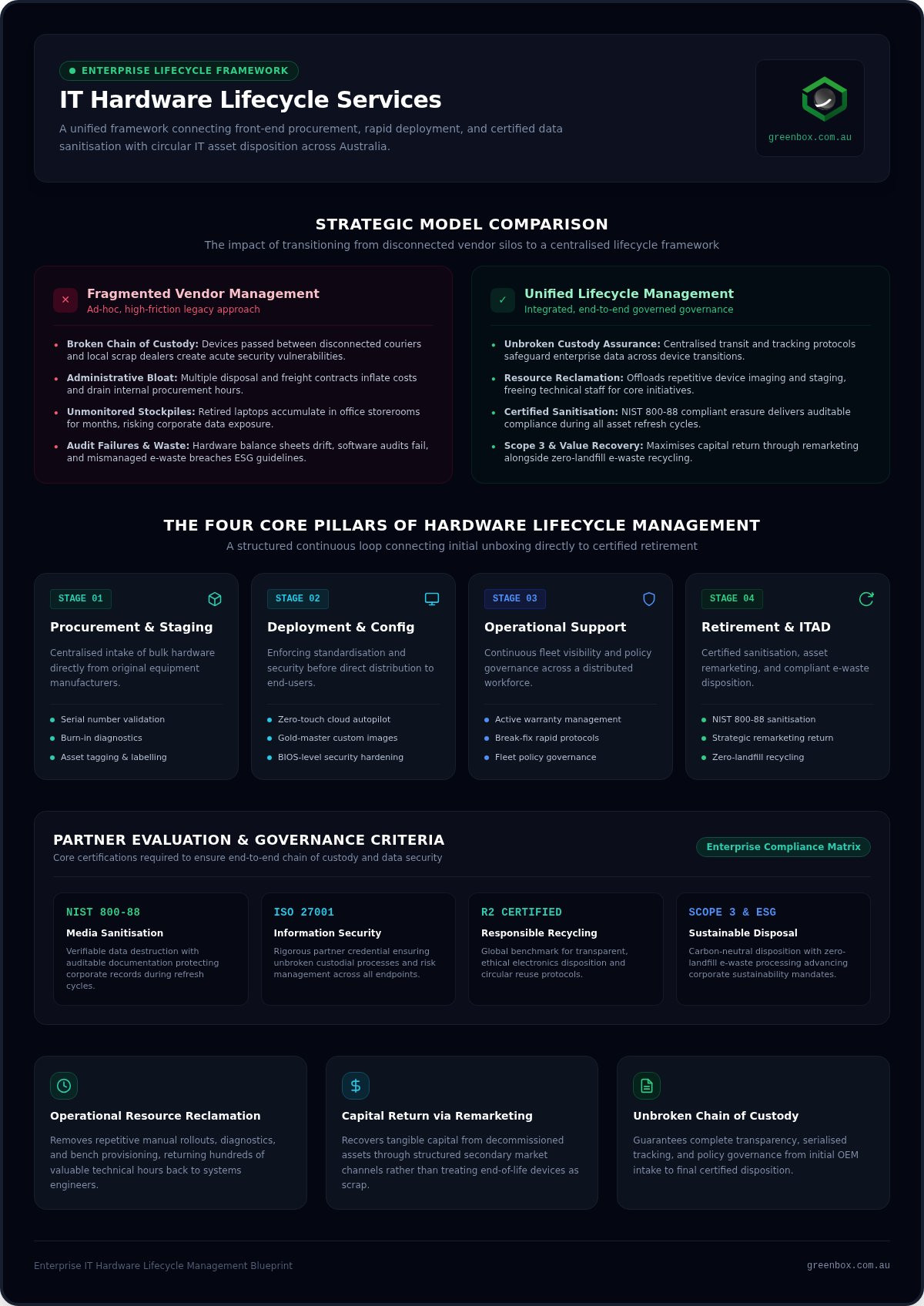
Enterprise technology infrastructure requires constant vigilance across its entire operational journey. Comprehensive IT hardware lifecycle services encompass every physical stage of an asset, spanning initial procurement, staging, configuration, ongoing warranty maintenance, and eventual secure disposition. While traditional approaches treat hardware as isolated capital purchases, an integrated lifecycle framework establishes a continuous, secure loop. This structured approach connects front-end provisioning directly to back-end retirement, providing organisations with absolute transparency, budget predictability, and policy governance across a distributed workforce.
The Four Core Pillars of Hardware Lifecycle Management
A resilient lifecycle framework relies on four interdependent operational stages:
- Procurement and staging: Securing hardware assets centrally, validating serial numbers, and preparing equipment for rapid deployment.
- Deployment and configuration: Applying standardised operating environments, custom imaging, and physical asset tagging before shipping directly to users.
- Operational maintenance and support: Managing active warranties, orchestrating break-fix protocols, and maintaining continuous fleet visibility.
- Asset retirement and disposition: Executing certified data sanitisation, remarketing viable technology, and processing non-recoverable units through ethical e-waste channels.
Why Fragmented Vendor Management Exposes Enterprises to Risk
Relying on disparate suppliers for deployment, freight, and decommissioning introduces severe vulnerabilities. When organisations pass hardware between disconnected transport companies, temporary storage sites, and local scrap dealers, unbroken custody breaks down. Retired laptops often accumulate in unmonitored office store-rooms for months, creating acute data security liabilities long before disposal occurs.
Fragmented vendor models also generate substantial hidden administrative expenses. Managing multiple contracts inflates logistics costs, drains internal procurement hours, and obscures accurate asset accounting. Without a unified system tracking equipment from unboxing to end-of-life, hardware balance sheets drift and software licensing audits fail. Uncontrolled device handoffs also heighten ecological liability, as mismanaged electronic waste undermines corporate environmental governance. Consolidating these functions under dedicated IT hardware lifecycle services eliminates administrative friction, secures data across device transitions, and safeguards regulatory compliance nationwide.
Front-End Lifecycle Management: Configuration, Imaging, and Nationwide Deployment
Manual device unboxing and bench provisioning consume hundreds of internal technical hours, diverting systems engineers from high-impact infrastructure initiatives. Establishing robust IT hardware lifecycle services at the procurement phase removes this administrative logjam. Centralised staging facilities receive bulk hardware directly from original equipment manufacturers, consolidating asset verification, burn-in diagnostics, and custom labelling under one roof. Moving these manual tasks to an off-site integration centre accelerates rollout velocity while enforcing absolute standardisation across your fleet. To explore how enterprise organisations structure these initial rollout phases, review our blueprint for IT configuration and deployment.
Automating Device Imaging and Zero-Touch Provisioning
Modern endpoint management requires combining cloud-based autopilot systems with bespoke gold-master images to support specialised corporate software suites. Before any hardware departs the staging facility, technicians carry out component testing and BIOS-level security hardening, disabling unapproved boot sources and applying custom cryptographic credentials. Adhering to technical standards like the NIST 800-88 Guidelines for Media Sanitization ensures clean firmware architecture across every unit. You can explore modern enterprise configuration workflows in our guide to device imaging and deployment.
Orchestrating Complex Enterprise Rollouts Across Distributed Workforces
Executing nationwide technology refreshes requires precise synchronisation between logistics networks and departmental change management schedules. Rather than dispatching consignments indiscriminately, strategic deployment protocols release hardware in phased tranches, preventing branch downtime and avoiding service desk overload. If your enterprise is preparing for an extensive workforce technology transition, discover how to coordinate friction-free freight through our strategy for bulk laptop deployment Australia wide.
A mature deployment model bridges front-end logistics directly with back-end asset disposition. At the precise moment a user unboxes a freshly configured system, the technician or courier captures the legacy asset inside secure transit packaging, immediately logging the serial number into a central tracking portal. This simultaneous swap prevents displaced machines from lingering in unsecured desk drawers or regional cupboards. For enterprise teams seeking to offload this logistical burden entirely, partnering with specialists like Greenbox ensures every deployment cycle maintains unbroken chain of custody from initial unboxing through to ultimate retirement.
Mitigating Corporate Exposure: Certified Data Sanitisation and Secure Asset Recovery
Decommissioned hardware represents one of the most neglected cyber security vectors in modern organisations. While chief information security officers invest heavily in perimeter firewalls and endpoint protection, retired drives stored in unmonitored facilities frequently leak proprietary data. A secure framework for IT hardware lifecycle services directly mitigates this vulnerability. Effective sanitisation adheres strictly to internationally accepted NIST 800-88 guidelines, applying verified Clear and Purge protocols to overwrite all addressable storage locations on magnetic disks, solid-state drives, and NVMe flash arrays. Where physical defects prevent reliable logical sanitisation, media undergo industrial degaussing or mechanical cross-cut shredding to physically obliterate the storage substrate. For a complete audit framework governing these retirement steps, refer to our operational checklist for end of life hardware management.
Verifiable Chain of Custody from Collection to Destruction
Data exposure risks multiply during domestic transit between corporate sites and processing facilities. Defending against transit diversion requires specialised logistics protocols rather than commercial freight networks:
- GPS-tracked secure transport: Sensitive devices travel in heavy-gauge, lockable steel stillages inside dedicated logistics vehicles.
- Granular barcode reconciliation: Asset serial numbers are scanned, cross-referenced, and signed off at every individual physical handover point.
- Tamper-evident containment: High-security seals prevent unauthorised access to data-bearing media, protecting sensitive corporate IP and employee records throughout transit.
Regulatory Compliance and Defensible Sanitisation Reporting
Australian organisations operate under rigorous regulatory obligations, notably the Australian Privacy Act and the mandatory Notifiable Data Breaches scheme. Disposing of client records or financial data via unverified channels exposes directors to massive civil penalties and brand damage. Enterprise IT hardware lifecycle services neutralize this liability through automated, tamper-proof reporting.
Following sanitisation, certified providers issue serialised Certificates of Data Destruction that document the exact methodology, timestamp, and technician identity for every serial number. These audit records integrate straight into enterprise IT service management databases, providing absolute proof of compliance during statutory security reviews. By closing the loop between asset decommissioning and regulatory reporting, enterprises maintain flawless governance without burdening their internal engineering teams.
Evaluation Criteria: How to Select an Enterprise Lifecycle Services Partner
Selecting an external partner to manage enterprise IT assets requires far more diligence than signing a typical hardware procurement contract. Because these organisations handle devices loaded with proprietary intellectual property and regulated user records, leadership teams must establish objective vetting criteria. A qualified provider of IT hardware lifecycle services should demonstrate verifiable security credentials, audited physical workflows, and the domestic footprint necessary to support branch networks consistently across Australia without subcontracting handling to unvetted third parties.
Assessing Security Credentials and Facility Certifications
Independent, third-party accreditations confirm whether a facility adheres to documented operating standards under external scrutiny. Prioritise partners maintaining these essential benchmarks:
- R2 Certification: Represents the global gold standard for electronics disposition, verifying responsible downstream recycling and stringent data security.
- ISO Management Standards: Demand current certification across ISO 27001 (Information Security), ISO 9001 (Quality Management), and ISO 14001 (Environmental Management).
- Personnel security vetting: Ensure all facility technicians and logistics handlers undergo formal national police checks and security clearances.
- Physical facility controls: Verify that processing centres enforce biometric access controls, monitored perimeter fencing, and 24/7 CCTV recording with prolonged footage retention.
Analysing Technological Integration and Reporting Portals
Operational efficiency stalls when IT departments must manually chase email status updates for incoming or retiring assets. Modern IT hardware lifecycle services must deliver real-time transparency through secure web portals, giving your asset managers instantaneous tracking from initial booking to final disposition. Evaluate whether the provider supports bidirectional API connectivity with enterprise platforms like ServiceNow or internal configuration management databases (CMDBs). Automatic synchronisation prevents discrepancies between physical asset movements and corporate balance sheets.
Finally, examine the provider’s contractual service level agreements (SLAs). Reliable partners commit to strict turnarounds for device imaging, staged dispatch times, and certified destruction timelines. If your organisation requires a proven, fully certified partner with over two decades of secure execution, speak with Greenbox today to establish a secure, auditable lifecycle management framework.
Sustainable Lifecycle Management: Circular ITAD, Remarketing, and ESG Compliance
Decommissioning enterprise technology shouldn’t mean writing off hardware value or sending aged units into waste streams. Modern IT hardware lifecycle services transform retired fleet technology into measurable financial and ecological gains. Embracing a circular economy allows organisations to recover significant capital from secondary markets while diverting complex equipment away from landfills. This approach redefines asset disposition from a reactive overhead expense into an active driver of corporate balance-sheet resilience.
Unlocking Residual Value Through Strategic Hardware Remarketing
Maximising capital return relies on methodical refurbishment protocols rather than generic bulk recycling. Once devices undergo certified sanitisation, trained technicians evaluate each unit through structured engineering workflows:
- Diagnostic grading: Assessing internal motherboards, battery cycle health, and screens to categorise gear for optimal secondary value.
- Cosmetic refurbishment: Cleansing chassis, replacing minor worn components, and de-branding units to prepare assets for enterprise resale.
- Direct revenue return: Leveraging structured revenue-sharing models that funnel proceeds back to corporate procurement funds, directly lowering the net capital needed for incoming hardware refreshes.
- Brand reputation defense: Distributing refurbished assets exclusively through controlled enterprise and wholesale networks to prevent grey-market exposure.
Advancing Corporate ESG Goals with Certified Carbon-Neutral Practices
Sustainability reporting is no longer an optional public relations exercise. Corporate stakeholders, government bodies, and institutional investors now scrutinise supply chain impact, requiring verifiable data on Scope 3 greenhouse gas reductions. Prolonging the operational lifespan of commercial electronics significantly reduces emissions by eliminating the mining, manufacturing, and international transport required to build replacement machines. When hardware reaches end-of-life status and can’t be refurbished, certified materials recovery extracts precious metals, high-grade polymers, and industrial silicon, guaranteeing complete landfill diversion.
Greenbox sets the standard for responsible, circular execution nationally across Australia. Operating as a certified carbon-neutral organisation founded in 2000, Greenbox ensures every stage of collection, processing, and remanufacturing leaves a net-zero footprint. Enterprise clients receive auditable ESG reporting metrics that detail exact carbon emissions avoided through equipment reuse alongside certified e-waste recycling records. Aligning your hardware refresh cycles with dedicated IT hardware lifecycle services delivers proven data security, tangible commercial returns, and environmental integrity from a single trusted partner.
Building a Resilient, Circular IT Lifecycle Strategy
Unifying endpoint deployment, fleet visibility, and end-of-life disposition under a single operational standard eliminates administrative friction and protects your network from data exposure. Modern IT hardware lifecycle services transform what was once an unpredictable operational drain into a structured, value-generating discipline. When you connect automated zero-touch staging directly to circular remarketing, your teams don’t just reclaim critical technical hours; they actively advance statutory ESG targets.
With over two decades of proven experience serving enterprise, education, and government sectors, Greenbox delivers total operational certainty. We maintain R2-certified secure processing facilities nationally, guaranteeing complete chain of custody alongside certified data sanitisation aligned with NIST 800-88 standards. As a certified carbon-neutral organisation, we ensure your technology transitions strengthen balance-sheet efficiency while advancing environmental responsibility. Partner with Greenbox for secure, sustainable IT lifecycle solutions and build a predictable, defensible technology foundation for the future.
Frequently Asked Questions
What is included in comprehensive IT hardware lifecycle services?
Comprehensive IT hardware lifecycle services cover the entire operational trajectory of technology assets. This model begins with secure warehousing, pre-configuration, custom imaging, and nationwide deployment. Once hardware reaches retirement, the service orchestrates GPS-tracked reverse logistics, NIST 800-88 compliant data sanitisation, cosmetic refurbishment, secondary market remarketing, and certified zero-landfill e-waste recycling. Consolidating these phases under a single framework eliminates fragmented supplier management and guarantees end-to-end chain of custody.
How do lifecycle services protect corporate data during equipment decommissioning?
Protection begins the moment equipment leaves your office desk. Decommissioned devices travel in lockable, tamper-evident security stillages inside GPS-monitored vehicles to prevent transit diversion. Inside certified processing facilities, technicians perform verified logical sanitisation or physical degaussing and shredding in accordance with NIST 800-88 guidelines. Every asset generates an individual, serialised Certificate of Data Destruction, delivering complete audit defensibility under the Australian Privacy Act and Notifiable Data Breaches scheme.
What is the difference between IT asset disposition (ITAD) and basic e-waste recycling?
Basic e-waste recycling simply breaks down dead electronics into base commodity materials like scrap metal and shredded plastic. ITAD, conversely, is an enterprise risk management process. It prioritises secure chain of custody, certified data eradication, and asset remarketing to maximise capital recovery. While scrap recycling treats technology as rubbish, ITAD treats hardware as a corporate asset, recovering maximum residual value before processing non-viable parts through zero-landfill recycling channels.
How does hardware remarketing generate a financial return for enterprise fleets?
Remarketing recovers value by preparing superseded technology for second-life usage instead of immediate scrapping. Following certified data erasure, technicians test, repair, and cosmetically clean each unit to achieve optimal resale grades. Devices are then sold through vetted corporate and wholesale channels under transparent revenue-share models. The capital generated flows directly back into IT operating budgets, helping offset the procurement expenditure of incoming hardware refreshes across your enterprise fleet.
Can our organisation retain its existing device images and deployment platforms?
Yes, enterprise lifecycle partners integrate directly with your current endpoint management architecture. Staging teams can execute rollouts using your corporate gold-master images or modern zero-touch cloud platforms such as Microsoft Autopilot and Intune. Custom configurations, local domain joins, BIOS security locks, and asset-tag allocations take place within the staging centre before dispatch, ensuring hardware arrives at end-user desks fully patched, compliant, and ready for immediate operation.
How do sustainable lifecycle practices assist with corporate ESG and Scope 3 reporting?
Refurbishing and remarketing decommissioned hardware avoids the severe carbon emissions tied to manufacturing new devices from scratch. By working with a certified carbon-neutral lifecycle provider, organisations receive auditable ESG reports detailing exact carbon offsets, equipment reuse rates, and certified zero-landfill metrics. These data points provide verifiable documentation for statutory sustainability audits, helping sustainability directors substantiate corporate Scope 3 emissions reductions with concrete evidence rather than vague estimates.
What certifications should enterprise IT leaders look for in a lifecycle partner?
Enterprise leaders should insist on R2 certification, the definitive international standard for data security and responsible electronics handling. Crucially, your partner should also hold current ISO certifications across ISO 27001 for information security, ISO 9001 for quality management, and ISO 14001 for environmental systems. In addition, confirm that handling personnel hold national police clearances and that the organisation operates under certified carbon-neutral standards with complete chain-of-custody tracking.