

What if the decommissioned servers and end-user laptops occupying your enterprise storerooms aren’t obsolete liabilities, but untapped working capital? For organisations managing distributed workforces across Australia, retiring corporate hardware often sparks acute concern over data exposure, strict privacy compliance, and complex freight tracking. Settling for nominal scrap recycling rebates frequently feels like the only risk-free option, yet certified refurbished IT asset resale delivers a proven framework to recover hardware value without compromising device chain of custody.
Balancing high-level security protocols with commercial recovery shouldn’t be an operational compromise. In this guide, you’ll discover how certified refurbished IT asset resale recovers enterprise capital, guarantees complete data sanitisation, and actively advances corporate sustainability targets. We’ll examine the operational steps required to establish a secure, repeatable remarketing workflow, satisfy national data privacy standards, and turn decommissioned technology into measurable Scope 3 emissions reductions for your ESG reporting.
Key Takeaways
- A disciplined refurbished IT asset resale framework transforms end-of-life laptops and servers into an active funding stream for modern enterprise rollouts.
- Certified, software-driven data eradication sanitises sensitive storage media to international compliance standards while preserving hardware integrity for the secondary market.
- Maintaining an unbroken, auditable chain of custody from initial de-installation to commercial sale neutralises corporate regulatory exposure and data breach risks.
- Prioritising functional hardware reuse directly curbs premature e-waste generation and produces defensible Scope 3 emissions reductions for executive ESG reporting.
- Partnering with an accredited national ITAD specialist ensures uniform governance, secure multi-site logistics, and transparent remarketing yields across your Australian operations.
What Is Enterprise Refurbished IT Asset Resale?
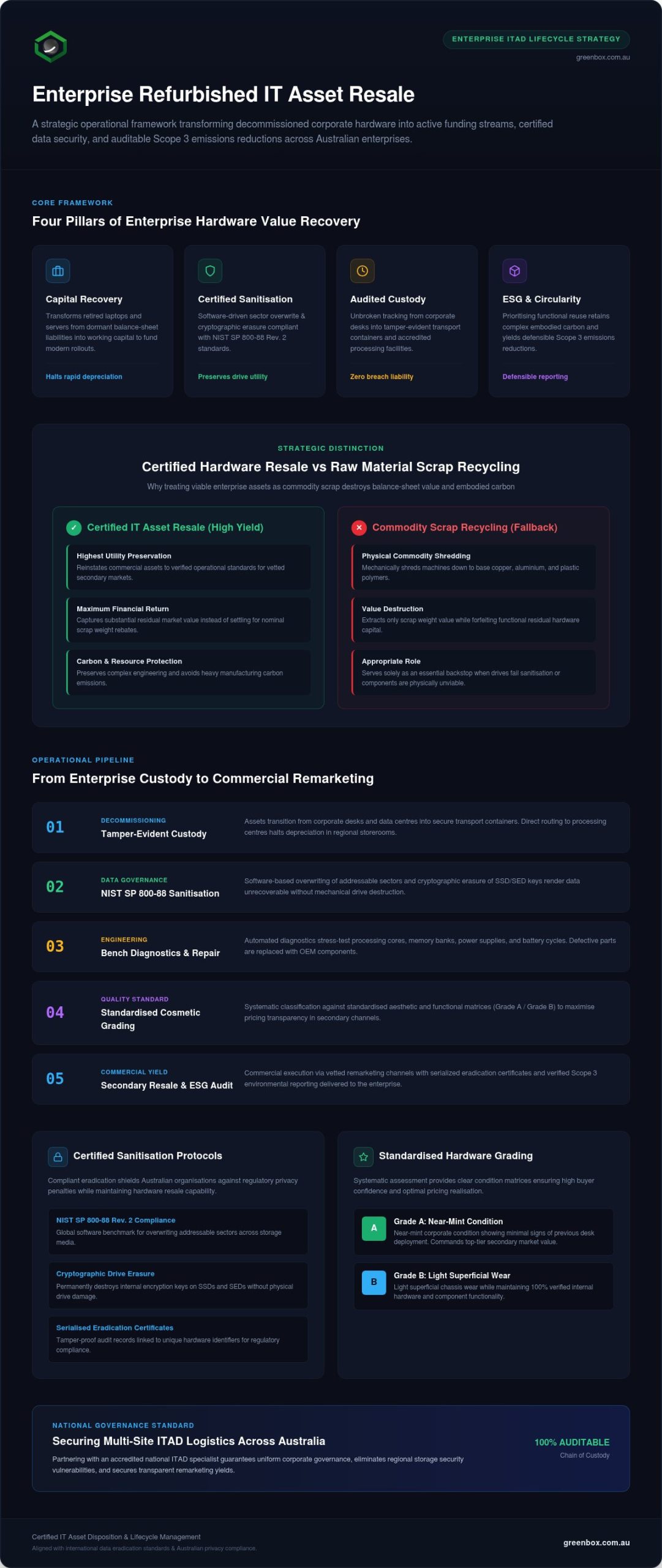
Enterprise refurbished IT asset resale is a structured lifecycle management discipline that transforms retired technology into recovered capital while maintaining complete data governance. Rather than treating refreshed infrastructure as scrap, this framework subjects enterprise laptops, workstations, and data centre racks to rigorous diagnostic testing, certified software-based sanitisation, and component grading. As highlighted in discussions surrounding electronics refurbishment, systematic restoration differs fundamentally from trading unverified used hardware; it reinstates commercial assets to verified operational standards for vetted secondary markets.
Modern commercial remarketing programs are powered by clear enterprise imperatives: reclaiming residual balance-sheet value to subsidise next-generation procurement, eliminating physical data breach liabilities, and delivering verifiable circular economy metrics. By systematically refurbishing viable devices, enterprises extract maximum return across an asset’s usable lifespan.
The Mechanics of Corporate Hardware Decommissioning
Disciplined decommissioning begins the moment hardware leaves active enterprise service. Controlled protocols track assets as they transition from corporate desks and data centres into secure, tamper-evident transport containers. In distributed national workforces, unmanaged devices frequently accumulate in regional storerooms; these dormant stockpiles steadily lose secondary market value while exposing the organisation to security vulnerabilities. Routing retired infrastructure directly into accredited processing facilities halts this rapid depreciation, transforming dormant equipment into liquid corporate capital through audited remarketing channels.
Remarketing Versus Raw Material E-Waste Recycling
A frequent operational mistake is conflating high-grade hardware remarketing with raw material recycling. Commodity scrap processing mechanically shreds assets down to base commodities like copper, aluminium, and plastic polymers. While recycling serves as an essential backstop for physically defective components, it permanently destroys the complex engineering and embodied carbon within functional machines.
Prioritising refurbished IT asset resale preserves hardware at its highest utility. Extending the service lifespan of enterprise laptops and servers avoids the heavy carbon emissions tied to new manufacturing. While physical destruction remains mandatory when storage media fails cryptographic erasure, viable enterprise hardware delivers vastly superior financial and environmental returns when restored for secondary commercial deployment.
The Technical Refurbishment Process: From Custody to Resale
High-yield refurbishment relies on an auditable, multi-phase engineering pipeline. Rather than simple visual inspections, institutional hardware undergoes meticulous bench testing and data eradication before entering secondary commercial channels. This methodical workflow protects both the consigning enterprise and downstream buyers, transforming depreciated assets into high-performance inventory suitable for competitive refurbished IT asset resale.
Certified Data Sanitisation and Cryptographic Eradication
Data security forms the uncompromising foundation of asset recovery. Software-based sanitisation overwrites all addressable storage sectors using protocols aligned with modern international benchmarks, such as NIST SP 800-88 Rev. 2. For solid-state drives and self-encrypting media, cryptographic erasure permanently destroys internal encryption keys, rendering residual data unrecoverable without causing mechanical damage. Reviewing our guide on certified data sanitisation Australia illustrates how tamper-proof, serialised eradication certificates shield organisations from data breach liability while preserving storage drives for profitable resale.
Hardware Diagnostics, Component Repair, and Cosmetic Grading
Once wiped, machines face intensive automated diagnostics across processing cores, memory banks, power supplies, and battery health cycles. Technicians replace defective components using original-equipment parts, restoring full operational integrity. Devices are then classified using standardised cosmetic matrices:
- Grade A: Near-mint corporate condition showing minimal signs of previous desk deployment.
- Grade B: Light superficial chassis wear with zero screen defects or structural compromises.
- Grade C: Visible cosmetic blemishes, re-routed for wholesale deployment or internal component harvesting.
Chain of Custody and Audit Reporting
Precision logistics protect sensitive corporate fleets during national transit. Secure collections utilise barcoded, tamper-evident security bins tracked continuously across national transport routes. Upon delivery to R2-certified facilities, every serial number is scanned into an inventory tracking portal, giving asset managers real-time visibility over processing milestones.
The pipeline concludes with exhaustive reconciliation reporting. Enterprises receive itemised audit manifests matching asset tags, serial numbers, wiping certificates, and assigned cosmetic grades. Incorporating these verified workflows into your broader operational framework is straightforward; explore how Greenbox coordinates secure national logistics and certified refurbishment to de-risk corporate asset retirements.
Financial Value Recovery: Assessing the True Business Case
Decommissioning enterprise hardware should function as a commercial opportunity rather than a balance-sheet loss. When organisations synchronise technology refreshes with structured remarketing channels, residual hardware yields directly offset the capital expenditure required for replacement fleets. Evaluating the true commercial return of refurbished IT asset resale requires examining hardware depreciation dynamics, market timing, and engagement models. As detailed in our analysis of sustainable IT asset recovery, strategic remarketing transforms traditional IT write-offs into predictable, self-funding revenue streams.
Timing the Enterprise Fleet Refresh Cycle
Enterprise hardware depreciation accelerates sharply over time. For commercial laptops and servers, the three-to-four-year operational window represents the optimal recovery threshold. During this window, tier-one enterprise units retain strong secondary commercial demand across educational institutions and mid-market organisations. Delaying retirement beyond five years leads to a steep depreciation cliff; obsolete processor architectures and degraded battery health reduce high-performance assets to low-margin scrap value. Synchronising national fleet rollouts ensures consistent hardware volumes, allowing consignors to command wholesale premiums in secondary markets.
Direct Buyback Models Versus Consignment Remarketing
Organisations generally select between two financial recovery mechanisms when preparing corporate hardware portfolios for resale:
- Direct Upfront Buyback: The provider inspects the fleet, calculates residual market worth, and purchases the assets outright. This route delivers immediate capital realisation and transfers downstream market volatility away from the enterprise.
- Consignment Remarketing: Assets undergo full testing and cosmetic grading before being listed across commercial buyer networks. Consignors receive a contracted percentage of the gross secondary sale price, which frequently yields higher net financial returns for premium, uniform fleets.
In structured consignment partnerships, data eradication fees, transport logistics, and testing costs are consolidated and offset against gross hardware sales. This self-funding mechanism ensures corporate treasury teams recover net capital without managing separate vendor invoices for technical disposition work.
Environmental Governance and Circular Economy Compliance
Environmental stewardship within corporate technology requires moving beyond simple downcycling. Under established circular economy principles, maintaining equipment at its highest utility delivers far superior ecological returns compared to melting casings down for raw commodities. Prioritising refurbished IT asset resale diverts complex electronics from early disposal, preserving the finite resources invested during component fabrication. For Australian enterprises facing rigorous regulatory scrutiny, circular asset management bridges the gap between commercial efficiency and tangible sustainability outcomes.
Scope 3 Emission Reductions Through Device Lifespan Extension
Manufacturing commercial laptops, microprocessors, and storage arrays consumes vast amounts of water and energy, generating significant embodied carbon before hardware ever powers on. When organisations extend the operational life of functional devices by remarketing them to secondary users, they displace the demand for newly manufactured equipment. IT leaders convert these preserved lifespans directly into defensible greenhouse gas reductions. These metrics provide auditable Scope 3 emissions data suitable for modern corporate ESG filings and executive sustainability scorecards.
Adhering to R2 and Environmental Quality Standards
Sound corporate governance demands absolute confidence that retired technology will never end up in informal waste streams or overseas dumps. Partnering with an R2-certified processor guarantees that every downstream outlet adheres to strict ethical handling frameworks:
- Downstream Due Diligence: Rigorous auditing tracks non-working components through verified processing tiers to final material recovery.
- Zero-Landfill Mandates: Transparent processing channels prevent hazardous electronic waste from contaminating domestic landfill ecosystems.
- Ethical Non-Export Compliance: Decommissioned infrastructure is processed within certified facilities rather than exported to unregulated markets.
Executing an ethical asset lifecycle strategy protects brand reputation while delivering documented carbon offsets. Partner with Greenbox for certified carbon-neutral IT asset disposition to align your national technology lifecycle management with accredited circular economy standards.
Selecting an Accredited National Remarketing Partner
Selecting a lifecycle partner requires looking far beyond simple brokerage promises. Unaccredited scrap dealers and spot-market traders frequently operate without verified custodial tracking, exposing enterprise consignors to severe regulatory breaches and unrecorded data loss. Maximising the commercial yield of refurbished IT asset resale demands an experienced provider with industrial-grade physical infrastructure, nationwide reach, and verified compliance credentials.
Essential Accreditations and Facility Security Controls
Enterprise risk committees must mandate third-party audited certifications before releasing hardware assets. Non-negotiable accreditations include R2 certification for ethical electronics processing, alongside ISO 27001 for information security management, ISO 9001 for quality assurance, and ISO 14001 for environmental systems.
Physical site security must match these administrative credentials. Secure processing centres require multi-factor biometric access controls, isolated sanitisation laboratory areas, and continuous high-definition CCTV coverage monitoring all storage bays. Logistics personnel handling enterprise collections must undergo rigorous background vetting, ensuring hardware remains secure across every touchpoint.
End-to-End Enterprise Integration Across National Footprints
Managing disparate, piecemeal regional vendors creates dangerous compliance blind spots. Fragmented logistics increase freight overheads and introduce tracking errors between corporate branch offices. A single national partner provides consistent security protocols, unified serialised auditing, and identical processing standards across the entire country.
True operational efficiency emerges when enterprises integrate forward deployment and reverse logistics under one roof. Aligning new asset provisioning alongside legacy equipment recovery eliminates redundant transport routes and sharply lowers operational costs. Reviewing our framework for IT configuration and deployment demonstrates how combining imaging, warehousing, and deployment with downstream remarketing creates a continuous, secure lifecycle that protects corporate balance sheets.
Unlocking Measurable Capital From Your Technology Refreshes
Treating decommissioned technology as an operational write-off overlooks its immense commercial and ecological potential. Implementing a disciplined framework for refurbished IT asset resale transforms idle hardware into recovered working capital, significantly offsets replacement procurement expenses, and generates verified Scope 3 metrics for executive ESG reporting. By coupling certified, software-based data sanitisation with rigorous diagnostic testing, organisations eliminate breach liabilities without sacrificing hardware integrity.
Executing this transition doesn’t need to complicate logistics or compromise security. With over two decades of national lifecycle management experience since 2000, Greenbox operates certified carbon-neutral, R2-certified facilities backed by an unbroken chain of custody that safeguards sensitive corporate and government data at every stage. Ready to convert your dormant technology portfolios into strategic balance-sheet value? Maximise your enterprise hardware return with Greenbox and turn your next corporate hardware refresh into a measurable commercial success.
Frequently Asked Questions
What is the difference between IT asset remarketing and electronics recycling?
IT asset remarketing restores and resells functional equipment at the whole-device level, whereas electronics recycling dismantles hardware to recover raw commodities. Remarketing preserves the embodied manufacturing carbon and engineering integrity of enterprise laptops and servers, maximising financial recovery. Conversely, e-waste recycling serves as a downstream backstop for obsolete or non-repairable units, mechanically processing components into base materials like plastics, copper, and precious metals.
How do enterprises ensure confidential data is eradicated before hardware resale?
Organisations ensure complete data security by mandating certified, software-based sanitisation aligned with international standards such as NIST SP 800-88 Rev. 2. Unlike crude physical destruction that destroys asset value, software eradication and cryptographic wiping overwrite all sectors while preserving physical drives. Each sanitised asset receives an automated, tamper-proof erasure certificate matched to its chassis and drive serial numbers before entering refurbished IT asset resale channels.
Which corporate IT assets hold the strongest residual value on secondary markets?
Uniform fleets of tier-one commercial laptops, enterprise workstations, and mid-tier rack servers consistently retain the strongest residual value. Equipment retired within a three-to-four-year lifecycle window remains highly attractive to education, healthcare, and commercial sectors. High-specification components, particularly modern multi-core processors and high-capacity memory modules, preserve strong market interest, especially when cosmetic condition rates Grade A or B with intact original enclosures.
Can leased IT hardware be processed through refurbished resale programs?
Leased equipment cannot be resold without explicit authorisation from the financing company holding asset ownership. However, enterprises can engage an accredited ITAD specialist to manage end-of-lease processing. This workflow includes secure collection logistics, certified data eradication, diagnostic testing, and return packaging to lessor specifications. This disciplined approach avoids expensive return penalties, missing equipment charges, and lease-end compliance disputes.
How does refurbished IT asset resale contribute to corporate ESG targets?
Refurbished IT asset resale advances corporate ESG metrics by prioritising functional reuse over raw downcycling within the circular economy framework. Extending device working lifespans directly displaces the emissions and mineral extraction required to produce replacement equipment. Enterprise consignors receive verifiable documentation detailing diverted e-waste weights and avoided carbon outputs, providing defensible Scope 3 greenhouse gas reduction figures for statutory sustainability disclosures.
What industry certifications should a corporate ITAD remarketing partner hold?
A qualified enterprise remarketing partner should hold audited accreditations, including R2 (Responsible Recycling) for ethical electronics processing and ISO 27001 for information security management. Additionally, look for ISO 9001 quality management and ISO 14001 environmental certifications. In Australia, partnering with an organisation featuring independently verified, certified carbon-neutral operations guarantees that your reverse logistics and remarketing footprint actively support corporate net-zero commitments.
What factors determine whether an enterprise device is refurbished or recycled?
Technicians evaluate three primary criteria: functional viability, cosmetic grading, and secondary commercial demand. Devices that pass hardware diagnostic testing, achieve successful software-based data eradication, and retain commercial resale value proceed through the refurbishment pipeline. If equipment suffers irreparable motherboard damage, contains non-erasable storage media, or represents an obsolete architecture with negligible secondary demand, it is routed to accredited recycling for zero-landfill material recovery.